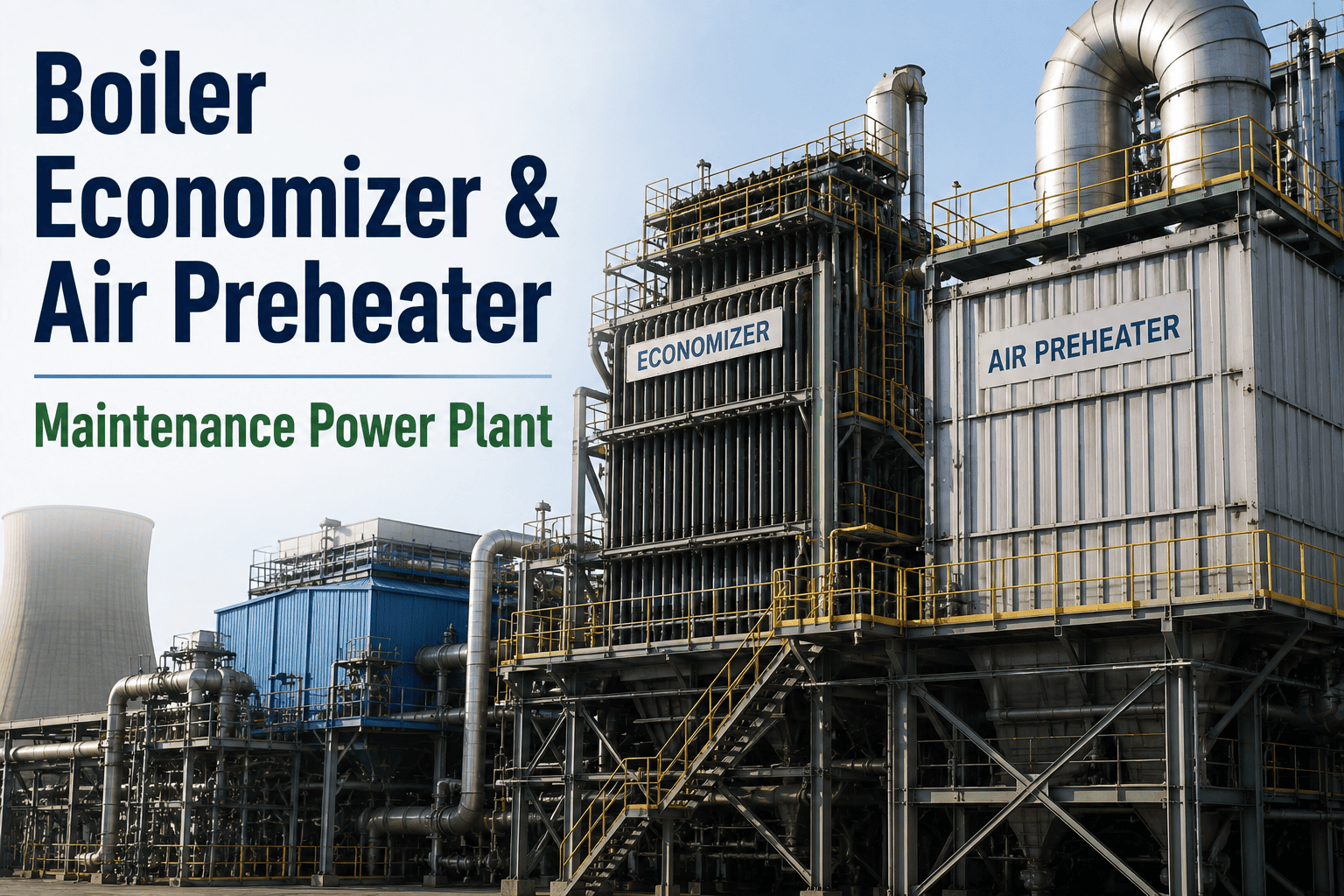
Boiler economizer maintenance and air preheater maintenance are the two highest-leverage PM activities in any fossil-fueled power plant — together they influence 8–12% of unit heat rate and account for nearly 30% of forced boiler outages when neglected. A structured economizer inspection and air preheater inspection program catches tube fouling, seal-air leakage, and cold-end corrosion before they escalate into efficiency losses exceeding $200K per year on a mid-size 500MW unit. This guide walks plant reliability teams through a defensible PM checklist, leakage-testing protocols, basket-replacement timing, and corrosion-monitoring thresholds — then shows how deploying a CMMS like OxMaint digitizes the entire workflow so nothing falls through the cracks. If you want to skip straight to digitizing your preheater PM program, you can Start Free Trial or read on for the full playbook.
Economizer & Air Preheater PM Playbook
Is a single leaking seal or fouled economizer tube bundle silently draining 1–3% of your unit heat rate?
Boiler economizer and air preheater failures cause over a quarter of all forced boiler outages in thermal power plants. With a disciplined, CMMS-driven PM program, reliability teams cut unplanned downtime by 30–50% and recover hundreds of thousands in lost efficiency — every single year.
Preventive Maintenance Checklist
Boiler Economizer & Air Preheater Maintenance Checklist
A tiered PM checklist organized by criticality and frequency ensures the highest-risk failure modes are addressed first. Reliability teams running CMMS-scheduled PMs report 25–40% fewer unplanned economizer and preheater events compared to spreadsheet-driven plants.
Economizer Online Monitoring
- Track flue-gas outlet temperature trend vs. design (alarm if +15°F above baseline)
- Monitor feedwater inlet temperature delta across economizer bank
- Log continuous opacity / particulate readings for soot-blower effectiveness
- Verify soot-blowing steam pressure and cycle completion signals
Air Preheater Inspection & Testing
- Perform air preheater leakage test (target < 8% on regenerative APH)
- Inspect radial, axial and circumferential seal clearances with feeler gauges
- Measure cold-end average metal temperature vs. acid dew point margin
- Check rotor bearing vibration, temperature and oil condition
Deep Inspection & Renewal
- Non-destructive testing (UT/ECT) on economizer tube bends and welds
- Replace cold-end baskets if ash plugging exceeds 40% of free area
- Wall-thickness mapping on economizer fins and harp headers
- Calibrate APH outlet gas-temperature thermocouples and draft transmitters
Cost of Inaction
What Neglected Economizer & Air Preheater Maintenance Actually Costs
Every 1% increase in APH air leakage raises induced-draft fan power demand by roughly 2% and lifts the unit heat rate by 0.3–0.5%. When fouling and corrosion go unchecked, the financial impact compounds fast across the operating year.
Annual Efficiency Loss Formula
Fuel Cost Increase = Heat Rate Deviation (%) × Annual Fuel Spend ($)
A 500MW unit burning $120M/yr of fuel with a 1.2% heat-rate penalty from combined economizer fouling and APH leakage loses $1,440,000 per year in excess fuel alone.
Forced-Outage Risk Formula
Outage Cost = MW Lost × Duration (h) × Wholesale Price ($/MWh)
A 4-day forced outage to replace a failed economizer tube bank at $65/MWh costs $3,120,000 in lost generation — before repair labor and replacement power.
| Failure Mode | Typical Detection Gap (Reactive) | Efficiency / Availability Impact | Annualized Cost (500MW unit) |
|---|---|---|---|
| Economizer tube fouling | 4–8 weeks | +0.8% heat rate, reduced steam temp | $960K |
| APH seal-air leakage | 3–6 months | +0.5% heat rate, fan capacity limit | $600K |
| Cold-end corrosion (acid dew point) | 1 outage cycle | Basket replacement, 2–4 day outage | $1.5M–$3.1M |
| Soot-blower failure (economizer) | 2–4 weeks | Accelerated fouling, gas-side restriction | $420K |
| APH rotor bearing degradation | Vibration trend missed | Forced outage, rotor jam risk | $2.4M |
CMMS Workflow
How OxMaint Structures Your Preheater PM Power Plant Program
Spreadsheets and paper logs are why 6-month APH leakage tests slip and economizer UT inspections get deferred until failure. OxMaint digitizes the full PM lifecycle — from trigger to completed work order with photo evidence — so every inspection happens on schedule, every time.
Automated PM Triggers & Compliance
Schedule economizer inspections on runtime hours, fuel consumed, or calendar intervals. OxMaint auto-generates work orders with checklists, safety permits, and spare-part reservations — eliminating missed PMs and audit gaps.
Outcome: 100% PM schedule compliance, zero audit findings.
Predictive Condition Monitoring
Ingest vibration, bearing-temperature, draft-pressure and gas-temperature trends. OxMaint's AI engine flags APH rotor bearing degradation and economizer fouling progression weeks before failure, converting reactive fixes into planned work.
Outcome: Cut unplanned downtime 30–50% by catching failures early.
Spare-Parts Inventory for Baskets & Tubes
Track economizer tube stubs, APH cold-end baskets, seal strips, and bearing assemblies by serial number and storage location. OxMaint links parts to assets and auto-reorders at min-stock thresholds so outages never wait on procurement.
Outcome: Cut parts-related outage delays by 60–80%.
Maintenance Analytics & Heat-Rate Tracking
Tie PM completion and inspection findings directly to unit heat-rate deviation and APH leakage trends. OxMaint dashboards show reliability KPIs (MTBF, MTTR, OEE) alongside thermal-performance metrics so you can prove maintenance ROI.
Outcome: Justify maintenance spend with quantified efficiency gains.
Inspection Timeline
Annual Maintenance Timeline for Economizer & Air Preheater
A well-structured 12-month PM calendar balances online monitoring with scheduled outages. Here is what a CMMS-driven schedule looks like for a typical 500MW fossil unit, mapped to seasonal load patterns.
High-Load Winter Season
Daily economizer flue-gas temperature trend review. Weekly soot-blower performance audit. Bi-weekly APH leakage estimation via input/output oxygen differential. CMMS auto-escalates anomalies to work orders.
Planned Outage — Deep Inspection
Full economizer tube UT/ECT inspection, APH seal replacement, cold-end basket cleaning or replacement, rotor bearing inspection. OxMaint generates one master outage work order with 40+ sub-tasks, permits, and parts kits pre-staged.
Low-Load Summer Season
Conduct full air preheater leakage test during a planned ramp-down. Inspect and calibrate all draft and temperature transmitters. Review predictive analytics trends for bearing and corrosion early warnings.
Pre-Winter Readiness
Confirm soot-blowing system reliability for high-load season. Verify cold-end temperature control (steam coil / bypass) operation. OxMaint issues winter-readiness checklist with sign-off traceability for every asset.
Real-World Scenario
A 500MW Plant That Stopped Losing $1.4M/Year to APH Leakage
A coal-fired plant in the Midwest was running 11.3% APH leakage on two units — well above the 8% design threshold — because quarterly leakage tests were inconsistently scheduled and seal replacements were deferred during tight generation periods.
APH air leakage, climbing 1.5% per year. PM compliance at 61%. Three spreadsheet trackers, no central visibility. Annual excess fuel cost: $1.36M across both units.
APH leakage brought below design threshold. PM compliance at 98%. Seal replacements scheduled during planned outages with parts pre-staged. Net annual savings: $920K in fuel plus $1.2M avoided forced-outage cost.
"We went from missing APH leakage tests for entire quarters to having every inspection auto-scheduled, photo-documented, and tied to heat-rate trends. OxMaint paid for itself in the first sealed-leakage event we prevented."
See OxMaint on Your Economizer & Air Preheater Assets — Book a 30-Min Demo
We will map your boiler's PM checklist, inspection triggers, and spare-parts kits inside OxMaint — live, on your asset hierarchy, before you commit to anything.
Frequently Asked Questions
Boiler Economizer & Air Preheater Maintenance FAQs
How often should air preheater inspection and leakage testing be performed?
Air preheater leakage testing should be conducted quarterly on regenerative APH units, with a full seal inspection during every planned outage (typically annually or semi-annually depending on load profile). Plants that schedule these tests through a CMMS like OxMaint consistently maintain leakage below 8%, while spreadsheet-driven plants often exceed 12% before anyone notices the efficiency drift.
What are the main signs that economizer tube maintenance is overdue?
The primary indicators are a rising flue-gas outlet temperature (more than 15°F above design baseline), declining feedwater temperature rise across the economizer bank, increased soot-blower frequency with diminishing effect, and visible gas-side restriction. If you are tracking these parameters manually in spreadsheets, consider switching to Start Free Trial on OxMaint to automate trend alerts before they become forced outages.
When should air preheater baskets be replaced vs. cleaned?
Cold-end baskets should be cleaned when ash plugging reduces free flow area by 20–30%, and replaced when corrosion has consumed more than 40% of the original material thickness or when repeated cleaning no longer restores adequate flow. Monitoring cold-end average metal temperature relative to the sulfuric acid dew point is critical — sustained operation below the dew point accelerates corrosion dramatically.
How does a CMMS improve boiler economizer maintenance in power plants?
A CMMS like OxMaint eliminates the two biggest failure points in economizer maintenance: missed PM intervals and lost inspection data. It auto-generates work orders on runtime or calendar triggers, enforces checklist completion with photo evidence, tracks UT wall-thickness trends over time, and links spare tubes and welding materials to the asset record. Plants typically see 25–40% fewer economizer-related forced outages within the first year.
What is the typical payback period for deploying CMMS software for preheater PM in a power plant?
Most 500MW-class plants recover the annual cost of OxMaint within the first 3–4 months by preventing a single APH leakage escalation or catching one economizer tube failure before it forces an outage. A single avoided forced outage on a 500MW unit saves $2–3M in lost generation — orders of magnitude beyond the software cost. You can see a live demo on your assets by booking a 30-minute session at Book a Demo.
Stop Losing Efficiency to Missed Inspections and Deferred PMs
Deploy OxMaint across your economizer and air preheater assets in days, not months. Your team gets automated PM schedules, predictive alerts, and full audit traceability — without migrating a single spreadsheet manually.
Free 14-day trial · No credit card