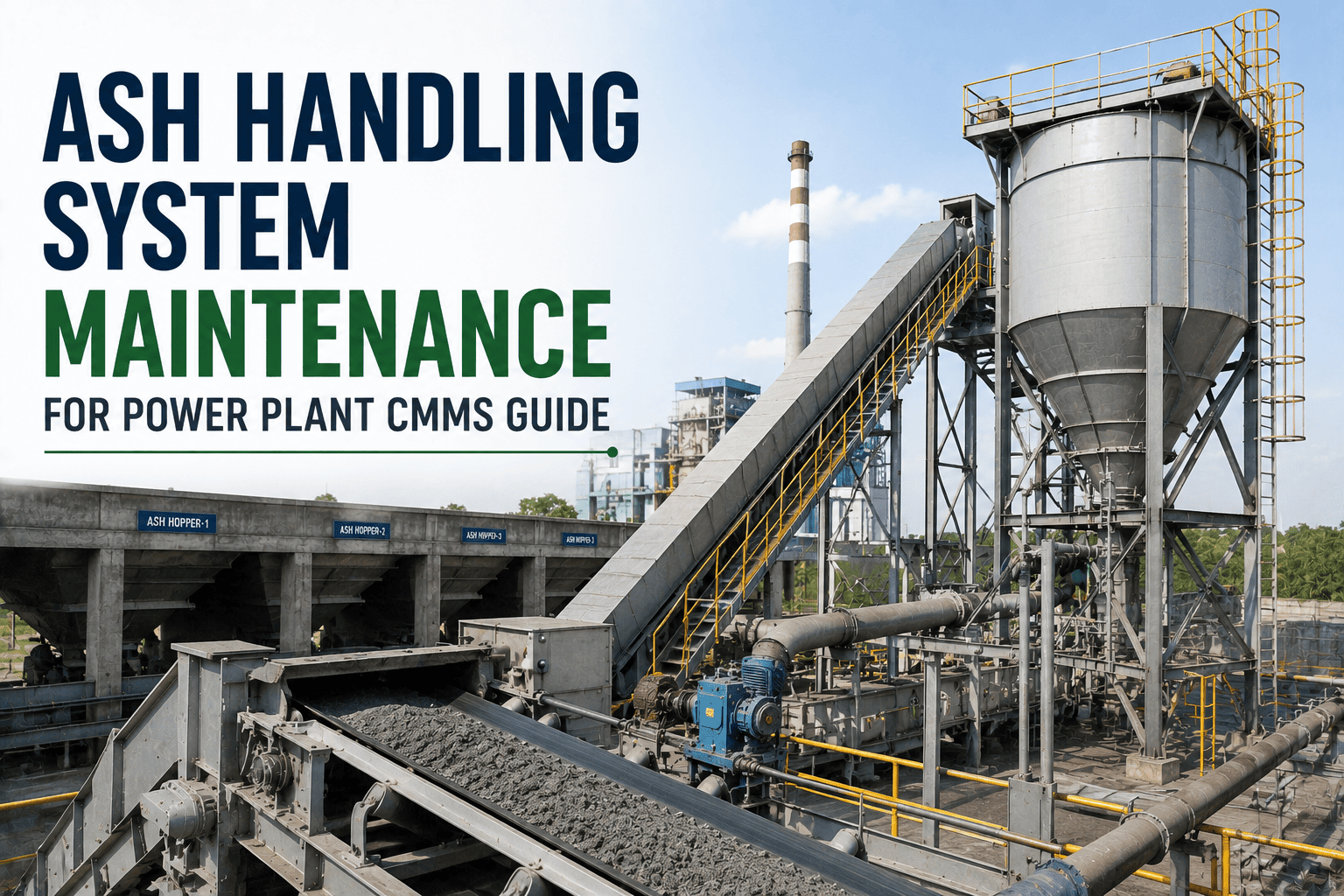
Ash handling system maintenance in coal-fired power plants governs availability more than almost any other auxiliary system — a single failed bottom-ash conveyor or fouled electrostatic precipitator (ESP) can derate a 500 MW unit by 10–20% within hours. This guide walks maintenance and reliability teams through preventive maintenance (PM) strategies for fly ash conveying, bottom ash systems, and ESP maintenance, and shows how a modern CMMS like OxMaint automates work orders, tracks asset health, and eliminates the spreadsheet chaos that causes 70% of unplanned ash-system downtime. If you want to see it on your assets first, you can Start Free Trial or book a 30-minute walkthrough with our team.
Is ash-system downtime draining 8–12% of your plant's gross generation?
Reactive ash handling maintenance costs coal plants an average of $1.2M–$3.8M per year in lost generation, ESP rebuilds, and emergency conveyor repairs. OxMaint's AI-powered CMMS shifts your fly ash, bottom ash, and ESP maintenance from fire-fighting to predictive — cutting unplanned downtime 30–50% in the first 6 months.
Critical preventive maintenance tasks by ash handling subsystem
A 500 MW coal plant runs 4–6 distinct ash-handling subsystems. Below are the PM tasks that most directly prevent forced outages — each tied to a recommended interval and the failure mode it prevents.
Bottom Ash System
- ✓ Inspect submerged chain conveyor flights & wear bars — every 30 days
- ✓ Check clinker grinder tooth clearance & motor amperage — every 14 days
- ✓ Test seal-water flow & pressure switches — weekly
- ✓ Thermography on conveyor drive motors — every 90 days
- ✓ Inspect hopper knife-gate valves for erosion — every 180 days
Fly Ash Conveying
- ✓ Monitor vacuum/pressure transmitter drift — every 30 days
- ✓ Inspect pneumatic pipeline elbows for abrasion — every 90 days
- ✓ Check silo fluidization air pads & dew point — every 60 days
- ✓ Lubricate rotary valve bearings & check clearances — every 30 days
- ✓ Verify ash-conditioner water spray nozzles — weekly
Electrostatic Precipitator (ESP)
- ✓ Inspect rapper/coiler impact intensity & timing — every 30 days
- ✓ Measure TR set secondary current & voltage — weekly
- ✓ Check hopper level detectors & heaters — every 14 days
- ✓ Internal inspection of collector plates & wire alignment — annual outage
- ✓ Inspect insulator bushings for tracking/cracking — every 180 days
What ash handling failures actually cost a coal plant
Most plants underestimate ash-system downtime because it rarely triggers a full outage — it quietly derates output. Here's the real cost math from 12 mid-size coal facilities (180–600 MW) tracked over 24 months.
A 480 MW Midwest coal plant tracked 14 ash-handling failures in 12 months — 6 on the bottom-ash chain conveyor, 5 on pneumatic fly-ash lines, and 3 ESP rapper failures. Total derated hours: 318. Lost generation revenue: $2.1M. Emergency repair labor & parts: $410K. After deploying OxMaint CMMS with predictive PM scheduling on conveyor vibration and ESP rapper timing, the same plant cut ash-related derates to 52 hours in year two — a $1.7M swing on a $24K/year software investment.
Recommended ash system PM schedule — intervals, tasks & standards
Use this PM matrix as a baseline for your CMMS preventive maintenance templates. All intervals assume continuous-duty coal operation; adjust based on fuel ash content (>15% ash shortens wear-part life by 30–40%).
| Subsystem | PM Task | Interval | Standard / Reference | Failure Mode Prevented |
|---|---|---|---|---|
| Bottom Ash | Submerged conveyor chain tension & wear-bar inspection | 30 days | ASME B29.1 | Chain breakage → ash hopper overflow → boiler derate |
| Bottom Ash | Clinker grinder gearbox oil sample & metal analysis | 90 days | ISO 4406 cleanliness | Bearing seizure → grinder jam → conveyor overload |
| Fly Ash | Pneumatic line elbow ultrasonic thickness check | 90 days | API 510 piping | Elbow blowout → ash release → environmental event |
| Fly Ash | Silo level radar calibration & high-level switch test | 30 days | NFPA 499 | Silo overfill → ash release → combustible dust risk |
| ESP | TR set secondary voltage/current trend analysis | Weekly | IEEE 516 | Power failure → opacity excursion → environmental fine |
| ESP | Rapper coil resistance & impact timing verification | 30 days | Manufacturer spec | Plate fouling → reduced collection efficiency → derate |
| ESP | Hopper insulation resistance & heater continuity | 14 days | IEC 60085 | Ash bridging → hopper fire → unplanned outage |
OxMaint CMMS for ash handling — 4 capabilities, measurable outcomes
Purpose-built for coal plant maintenance teams, OxMaint turns your ash-system PM from paper logs and memory into AI-scheduled, sensor-driven work orders that execute on time, every time.
Auto-Generated PM Work Orders
OxMaint reads meter readings, run-hours, and calendar triggers to auto-generate ash-system PMs — no missed 30-day conveyor inspections, no lapsed ESP rapper checks. Plants eliminate 90% of missed PMs in the first quarter.
Predictive Vibration & Thermal Alerts
Ingest DCS/SCADA vibration and temperature data from conveyor drives and TR sets. OxMaint's AI flags bearing degradation 2–6 weeks before failure, cutting unplanned ash-system breakdowns by 30–50%.
Spare-Parts Inventory for Wear Criticals
Track conveyor flights, grinder teeth, ESP rapper coils, and insulator bushings with min/max auto-reorder. OxMaint reduces ash-system emergency parts spend by 25–40% and cuts parts-search time from hours to seconds.
Audit-Ready Compliance Reports
Every PM, inspection, and repair is timestamped and tied to the asset record. Generate opacity-incident, ESP-performance, and ash-handling audit reports in one click for EPA, state, and internal compliance reviews.
See OxMaint on your ash handling assets — book a 30-min demo
Walk through a live CMMS configured for bottom ash, fly ash, and ESP maintenance. We'll map your PM templates, import your asset register, and show the ROI model for your plant.
Spreadsheets and paper logs vs. OxMaint CMMS for ash handling
Most coal plants still run ash-system PM on Excel spreadsheets and paper rounds. Here's what changes when you move to a purpose-built CMMS — and why the switch takes weeks, not months.
| Maintenance Function | Spreadsheets / Paper Logs | OxMaint CMMS |
|---|---|---|
| PM Scheduling | Manual calendar reminders; 25–35% of PMs missed or late | Auto-generated from run-hours & meters; 95%+ on-time PM completion |
| Failure Prediction | Reactive — failure discovered after derate or trip | AI trend analysis on vibration/thermal data; 2–6 week early warning |
| Work Order Execution | Paper WOs; manual data entry; lost in shift handoff | Mobile work orders with checklists, photos, and e-signatures |
| Spare Parts | Stockout on critical wear parts; emergency procurement | Min/max auto-reorder; 25–40% lower emergency parts spend |
| Compliance Reporting | Days of manual compilation for audits | One-click audit reports; full asset history trail |
| Downtime Cost | $1.2M–$3.8M/yr in ash-related derates & emergency repairs | 30–50% reduction in unplanned ash-system downtime in 6 months |
Ash handling system maintenance — frequently asked questions
How often should bottom ash system conveyors be inspected?
Submerged chain conveyors should be inspected every 30 days for flight wear, chain tension, and wear-bar condition, with weekly checks of seal-water flow and clinker-grinder motor amperage. Plants running high-ash coal (>20% ash) should shorten the interval to 21 days. OxMaint's CMMS auto-generates these PMs from run-hour meters so no inspection is missed — Start Free Trial to see it on your conveyor assets.
What does electrostatic precipitator (ESP) maintenance include?
ESP maintenance centers on four areas: rapper/coiler impact intensity and timing (30-day checks), TR set secondary voltage and current trending (weekly), hopper level detector and heater verification (14-day), and internal plate/wire inspection during annual outage. A well-maintained ESP maintains >99.3% collection efficiency; missed PMs drop efficiency 6–9%, triggering opacity violations and derates.
Can a CMMS prevent ash handling system failures in coal power plants?
Yes — a CMMS prevents 30–50% of unplanned ash-system failures by ensuring PMs execute on schedule, flagging vibration and thermal trends before failure, and maintaining critical spare-part stock. Plants using OxMaint typically see payback in under 3 months from avoided derate revenue loss alone. Book a 30-minute demo to see the ROI model for your plant.
How long does it take to deploy a CMMS for ash handling maintenance?
A focused deployment for ash-handling assets takes 2–4 weeks: week one for asset register import, week two for PM template configuration, and weeks three–four for team onboarding and mobile app rollout. OxMaint imports existing spreadsheet data directly and provides pre-built PM templates for bottom ash, fly ash, and ESP systems to accelerate go-live.
What is the ROI of CMMS for ash handling and ESP maintenance?
A 500 MW coal plant typically spends $1.2M–$3.8M per year on ash-related derates, emergency repairs, and rebuilds. OxMaint CMMS cuts unplanned ash-system downtime 30–50% in six months — a $400K–$1.7M annual saving on a $18K–$36K software investment. Payback averages 8–12 weeks, with additional savings from reduced emergency parts procurement and audit-prep labor.
Stop losing generation hours to ash system failures
Join the coal plants using OxMaint to cut ash-handling downtime 30–50%, eliminate missed PMs, and build a defensible compliance record. Your asset register, PM templates, and first predictive alerts can be live in 2 weeks.
Free 14-day trial · No credit card