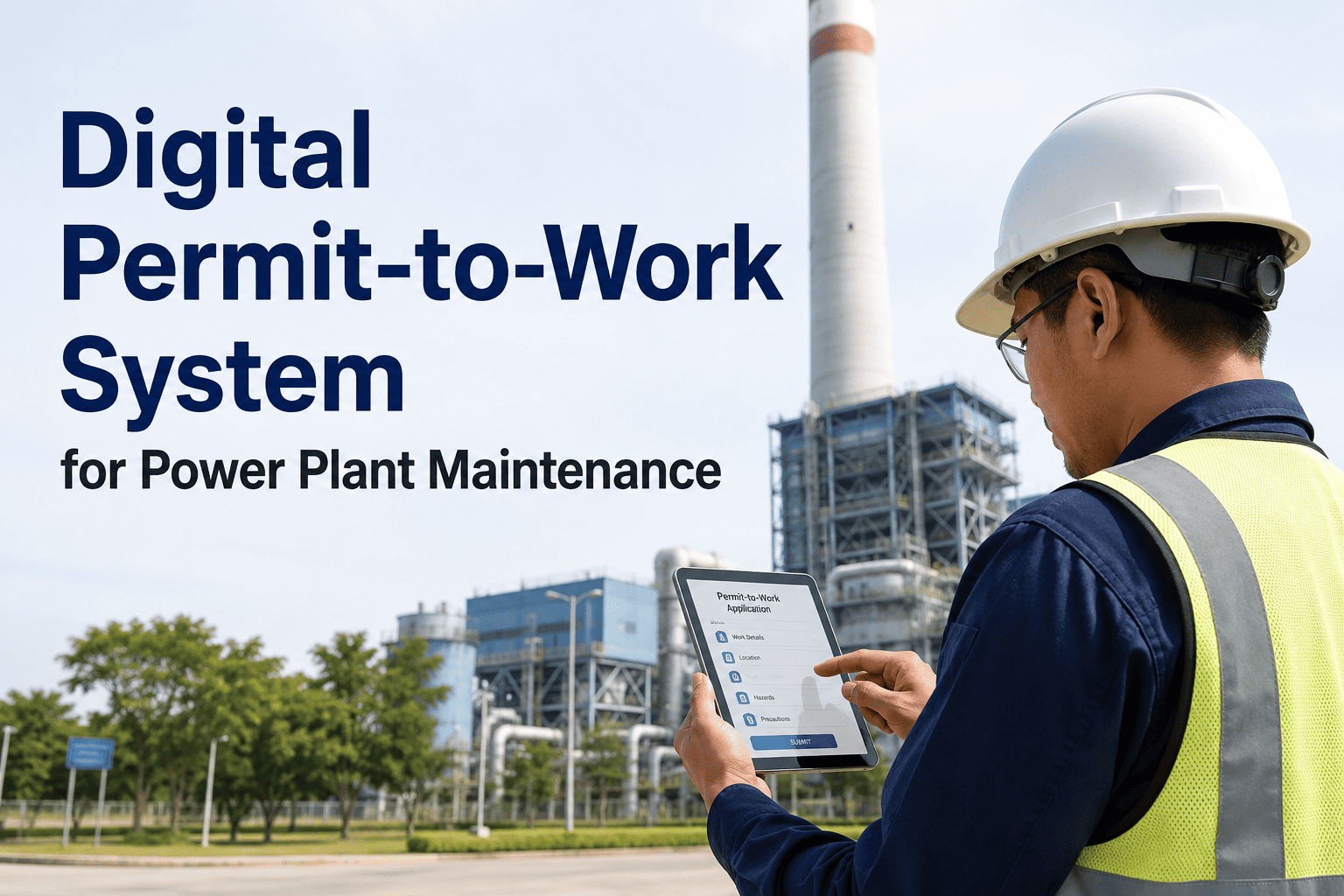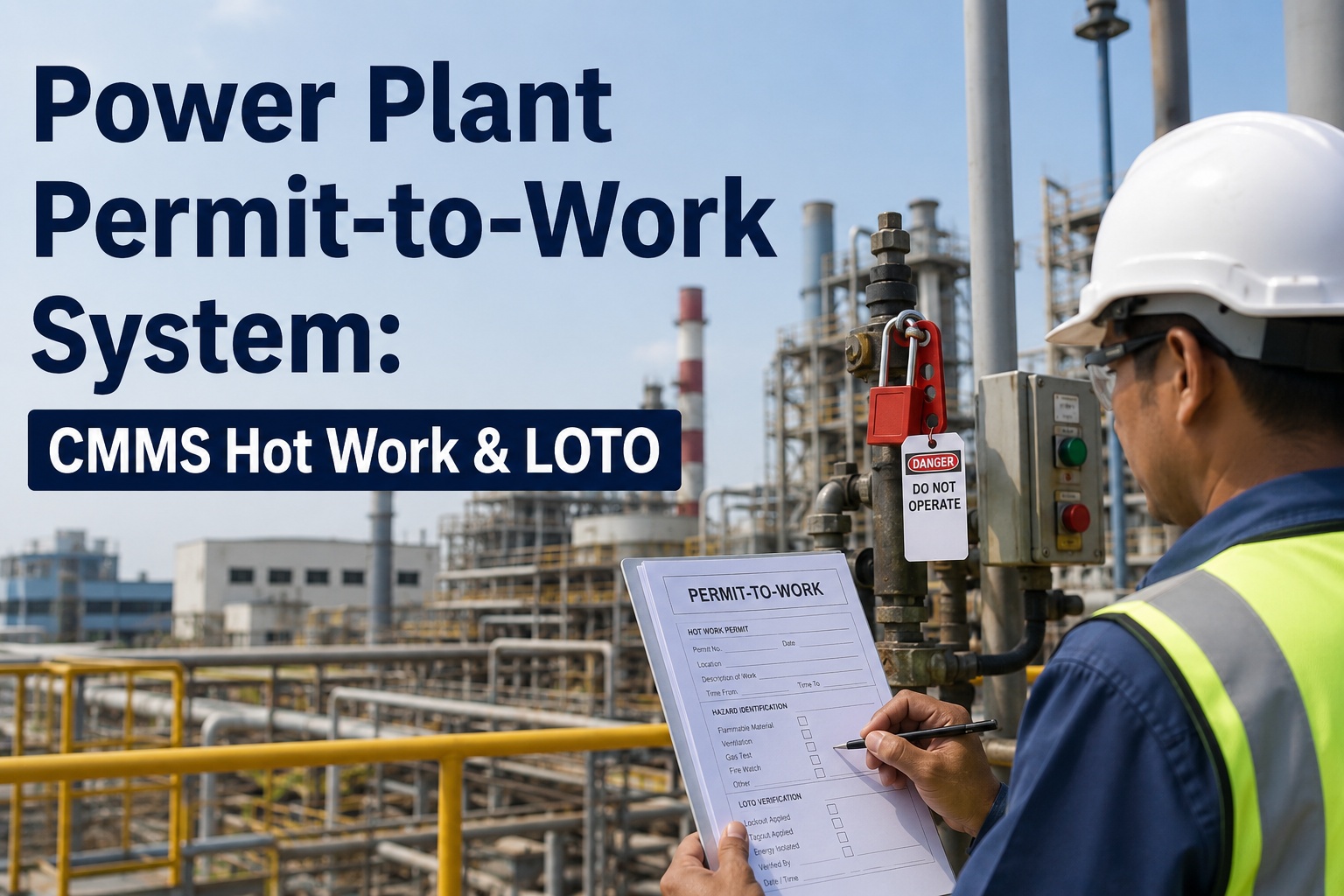
A power plant permit to work system is the formal, documented control process that authorizes high-risk maintenance activities — hot work near boilers, LOTO for turbine overhauls, confined space entry in HRSG ducts — so that energy sources are isolated, atmospheres are verified safe, and only authorized personnel perform the work within defined precautions. In a generating environment where a single bypassed lockout can cost $10K–$50K per hour in lost generation and a boiler hot work spark can trigger a catastrophic event, a CMMS-based PTW system replaces paper permits with real-time digital authorization, isolation verification, and audit-ready records. Power plants that deploy OxMaint's CMMS permit module typically cut permit issuance time by 60–80% while achieving full NERC/OSHA compliance traceability — you can Start Free Trial or book a demo to see it on your assets.
Power Plant PTW · CMMS Permit Control
Is a single missed lockout costing your plant $30K per hour in downtime?
Paper-based permit-to-work systems in power plants fail because permits get lost between shifts, isolations are verified on clipboards, and no one knows in real time who is working inside the HRSG or on the turbine deck. OxMaint digitizes every hot work permit, LOTO sequence and confined space authorization — so your control room sees live permit status and your compliance audit takes minutes, not weeks.
Permit Types · Risk Coverage
What permits does a power plant PTW system need to control?
A compliant power plant permit to work system must cover at minimum four high-energy permit categories — each with its own isolation logic, atmospheric testing requirements, and return-to-service verification.
Hot Work Permit
Welding, grinding, cutting near boiler casings, coal bunkers, fuel-oil lines, and hydrogen-cooled generators. Requires combustible-gas monitoring (LEL below 10%), fire watch for 1 hour after work, and 35-foot radius clearance of flammables.
LOTO (Lockout/Tagout)
Turbine LOTO, boiler feed pump isolation, conveyor pull-cord bypass, and electrical switchgear clearance. Per OSHA 1910.147, each energy-isolating device must be individually locked and verified by try-start before maintenance begins.
Confined Space Entry
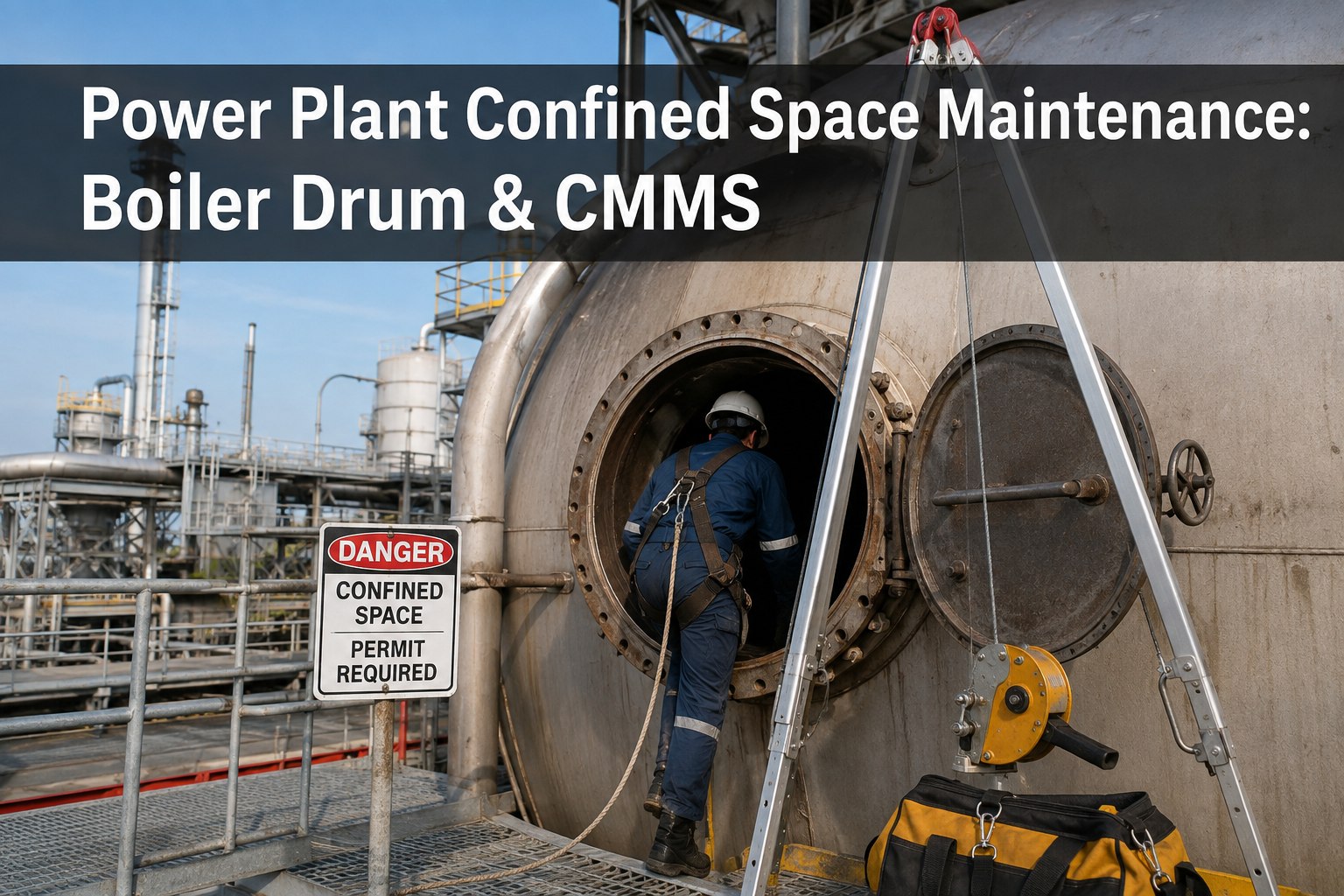
HRSG duct entry, condenser waterbox, scrubber vessel, ash silo, and boiler drum inspection. Requires O2 (19.5–23.5%), LEL below 10%, continuous atmospheric monitoring, dedicated attendant, and rescue plan on standby.
Electrical Work Permit
Live work on energized equipment above 50V (NFPA 70E), switchgear racking, transformer oil sampling, and relay testing. Requires arc-flash boundary calculation, incident-energy analysis, and PPE category selection before authorization.
LOTO Procedure · Sequence
Power plant LOTO guide: the 6-step isolation sequence
A turbine LOTO event at a 500 MW combined-cycle plant can involve 15–30 individual energy-isolating devices across steam, electrical, hydraulic, and pneumatic systems. Here is the OSHA 1910.147-compliant sequence that OxMaint enforces digitically — no permit closes until every step is verified and signed.
Notify Affected Personnel
Inform all operators, contractors, and control-room staff that LOTO is being applied to the turbine, boiler feed pump, or conveyor. OxMaint auto-notifies all parties via the work-order record and logs acknowledgment timestamps.
Identify All Energy Sources
List every energy-isolating device — main steam stop valves, generator breaker, lube-oil pumps, seal steam, extraction lines. OxMaint's asset registry stores each device with its isolation point and required lock type.
Shut Down Equipment Normally
Follow the OEM shutdown procedure — ramp turbine to turning gear, close stop valves, trip breaker. OxMaint links the PTW permit to the preventive maintenance checklist so the shutdown sequence is enforced step-by-step.
Isolate & Apply Locks/Tags
Each worker applies their personal lock to each isolation point. OxMaint generates the group LOTO box assignment, tracks individual lock numbers, and prevents permit closure until all locks are recorded as removed.
Verify Zero Energy (Try-Start)
Attempt to start the equipment after isolation. Bleed down stored energy — residual steam pressure, hydraulic accumulators, capacitor charge. OxMaint requires photo evidence and voltage-test attestation before the permit advances.
Release & Return to Service
After work is complete, each worker removes their personal lock in reverse order. The control room verifies all tools are retrieved, guards replaced, and personnel clear before energizing. OxMaint closes the permit with a full digital audit trail.
Paper vs. CMMS · Compliance
Paper permit to work vs. CMMS permit system: what changes for power plants
A 600 MW coal plant typically issues 8–15 permits per day during an outage. On paper, that means 8–15 carbon copies filed in a binder, 8–15 handoffs between control room and field, and zero real-time visibility. Here is what changes when the same plant runs permits through OxMaint's CMMS PTW module.
| Permit Dimension | Paper-Based PTW | OxMaint CMMS PTW |
|---|---|---|
| Permit Issuance Time | 20–45 minutes per permit (handwritten, multiple signatures) | 5–10 minutes — pre-populated isolation lists, e-signature, auto-approval routing |
| Real-Time Visibility | Control room calls field supervisor; permit status unknown between shifts | Live dashboard — all active permits, isolations, and personnel locations visible to control room |
| Isolation Verification | Clip-board checklist; try-start step often skipped under outage pressure | Forced verification — photo evidence + voltage test attestation required before permit advances |
| Shift Handover | Binder passed verbally; incoming shift may miss open isolations | Digital shift handover — all open permits/isolations roll over with acknowledgment required |
| Audit Retrieval | 3–5 days to locate, copy, and assemble permits for NERC/OSHA audit | 5 minutes — filter by date, asset, permit type; export to PDF for auditor |
| Permit-to-Work Compliance Rate | 60–75% — permits backfilled after work, steps skipped during outages | 98%+ — workflow-enforced; permits cannot close without all steps signed |
| Cost of Non-Compliance | $15K–$150K per OSHA citation; $100K+ per NERC violation; unplanned outage risk | Zero citation risk from permit process gaps — every action timestamped and attributable |
How OxMaint Helps · CMMS PTW Module
How OxMaint digitizes your power plant permit-to-work system
OxMaint's AI-powered CMMS gives maintenance and reliability teams a purpose-built PTW engine that connects permits directly to work orders, asset histories, and isolation registries — so authorization, execution, and audit are one continuous digital thread.
Permit Templates with Pre-Populated Isolation Lists
Each asset in OxMaint carries its own isolation registry — turbine T-7 has its 23 energy-isolating devices pre-mapped. When a permit is created from a work order, the isolation list auto-populates, cutting permit issuance from 30 minutes to under 8.
Real-Time Permit Dashboard for Control Room
The control room sees every active permit — hot work near the boiler, LOTO on the turbine, confined space entry in the HRSG — with live status, personnel inside, and isolation verification state. No more calling the field to confirm if a lock is applied.
Forced Verification & Photo Evidence
OxMaint's mobile app requires field technicians to photograph each isolation point, confirm voltage-test results, and e-sign each LOTO step before the permit advances. No step can be skipped — even during a 72-hour outage sprint.
Audit-Ready Records in 5 Minutes
Every permit action — creation, isolation, verification, sign-off, return-to-service — is timestamped and attributable. For a NERC or OSHA audit, filter by date range and asset, export to PDF, and hand the auditor a complete chain-of-custody in minutes.
Scenario · ROI
The cost of paper permits: a 600 MW combined-cycle plant scenario
Consider a 600 MW combined-cycle plant running 180 critical assets, generating $42K/hr in revenue at full load, and managing permits on paper during a 14-day gas-turbine major inspection with 12 permits issued per day.
Annual Paper PTW Cost
Permit issuance labor (30 min × 12/day × 300 outage days × $45/hr), plus 2 FTE control-room clerks managing binders and shift handover logs.
Annual Compliance Risk Exposure
Average OSHA LOTO citation ($15K–$150K per violation) probability-weighted at 1.2 incidents/year for paper-based plants with 60–75% compliance rate.
Downtime Risk from Permit Errors
One missed isolation during outage per year causing 3 hours of unplanned downtime at $42K/hr — a conservative estimate for paper-permit plants.
Annual Cost with OxMaint CMMS PTW
OxMaint subscription + mobile licenses. Permit issuance drops to 8 min, compliance hits 98%+, audit prep is 1 hour, and isolation errors are virtually eliminated.
See It On Your Assets
Stop managing power plant permits on paper and clipboards
Book a 30-minute demo and we will build your turbine LOTO isolation list live, show you the real-time control-room permit dashboard, and walk through a hot work permit near your boiler — all on your own asset data.
FAQ · Power Plant PTW
Power plant permit to work: frequently asked questions
What is a permit to work system in a power plant?
A power plant permit to work (PTW) system is a formal, documented authorization process that controls high-risk maintenance activities — hot work, LOTO, confined space entry, electrical work — by requiring isolation verification, atmospheric testing, authorized signatures, and defined precautions before work begins. In a CMMS like OxMaint, the PTW system is digital: permits are generated from work orders, isolation lists auto-populate from asset registries, and every step is timestamped for audit compliance.
How does CMMS-based LOTO work for turbine maintenance?
CMMS-based LOTO for turbine maintenance links the work order to the turbine's pre-mapped isolation registry — every steam stop valve, generator breaker, lube-oil pump, and seal-steam isolation point is listed with its required lock type. The technician works through each isolation on a mobile app, photographs the applied lock, and e-signs the try-start verification. The permit cannot close until all locks are recorded as removed, giving you a full OSHA 1910.147-compliant audit trail. You can Book a Demo to see a turbine LOTO sequence built live.
What are the OSHA requirements for hot work permits in power plants?
OSHA 29 CFR 1910.252 requires a hot work permit for welding, cutting, and grinding in areas where combustibles are present — which in a power plant includes boiler casings, coal bunkers, fuel-oil lines, hydrogen-cooled generator areas, and cable trays. The permit must verify LEL below 10%, assign a fire watch for at least 1 hour after work ceases, clear a 35-foot radius of flammables, and document authorized personnel. OxMaint's hot work CMMS module enforces every one of these requirements digitally before the permit can be issued.
How long does it take to implement a CMMS permit system in a power plant?
A typical 100–300 asset power plant can go live with OxMaint's CMMS permit module in 4–6 weeks: week 1–2 for asset registry and isolation-list upload, week 3 for permit template configuration and approval-routing setup, week 4–5 for control-room dashboard and mobile-app pilot on 5–10 assets, and week 6 for full rollout. Existing paper permit templates are replicated digitally so field crews see a familiar workflow — just faster and enforced. Start Free Trial to pilot on your assets today.
Can a CMMS PTW system integrate with our existing control-room SCADA or DCS?
Yes — OxMaint's CMMS PTW module can receive equipment status and tag data from your SCADA or DCS via OPC-UA or REST API, so the permit dashboard shows real-time valve positions, breaker states, and equipment running status alongside active permits. This means the control room sees not just that a LOTO permit is open, but that the turbine is confirmed at zero rpm and the generator breaker is racked out — closing the loop between permit authorization and physical isolation verification.
Get Started Today
Your power plant permits, audit-ready in one platform
Join the maintenance and reliability teams using OxMaint to issue hot work permits in 8 minutes, achieve 98%+ LOTO compliance, and cut audit prep from days to under an hour.
Free 14-day trial · No credit card