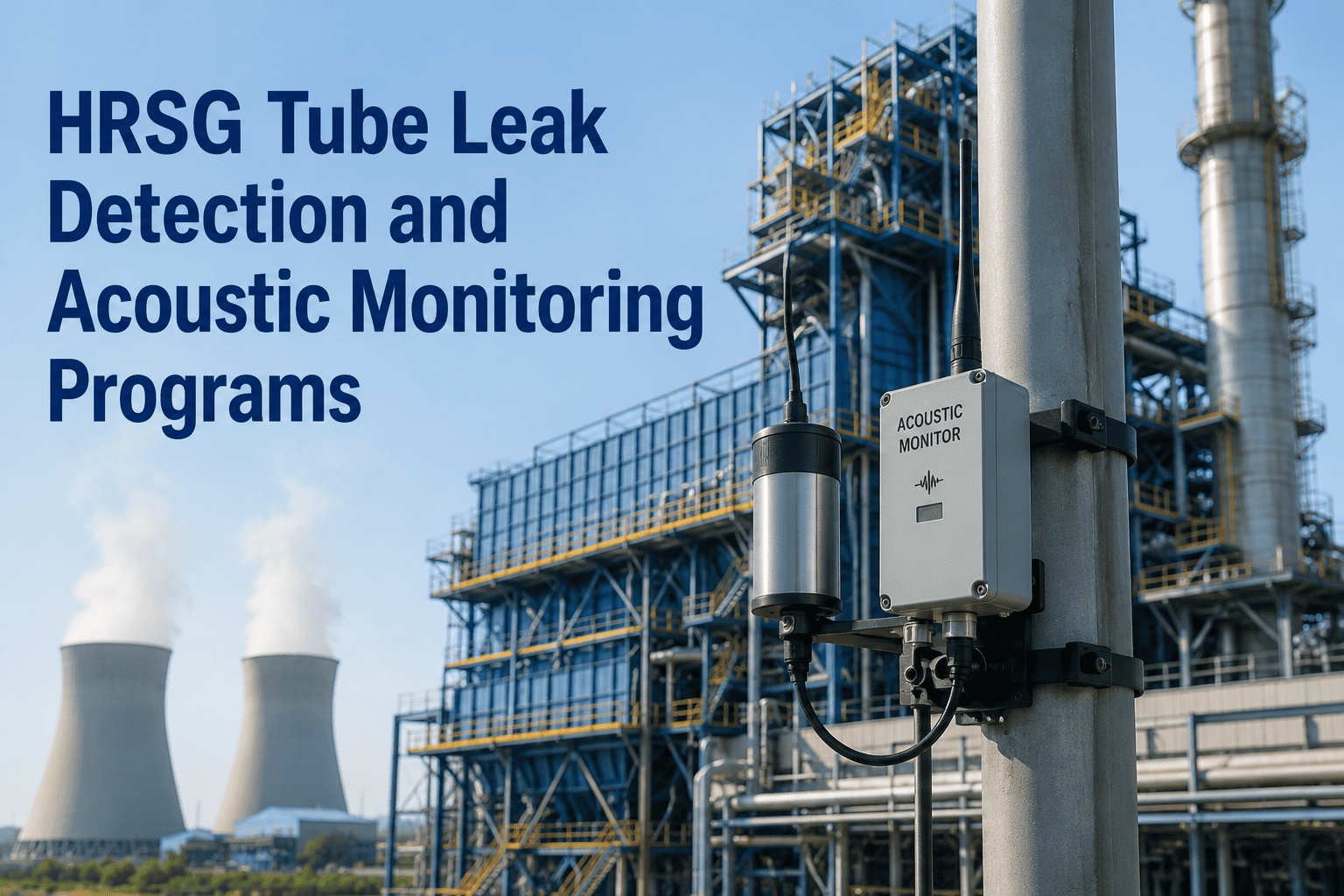
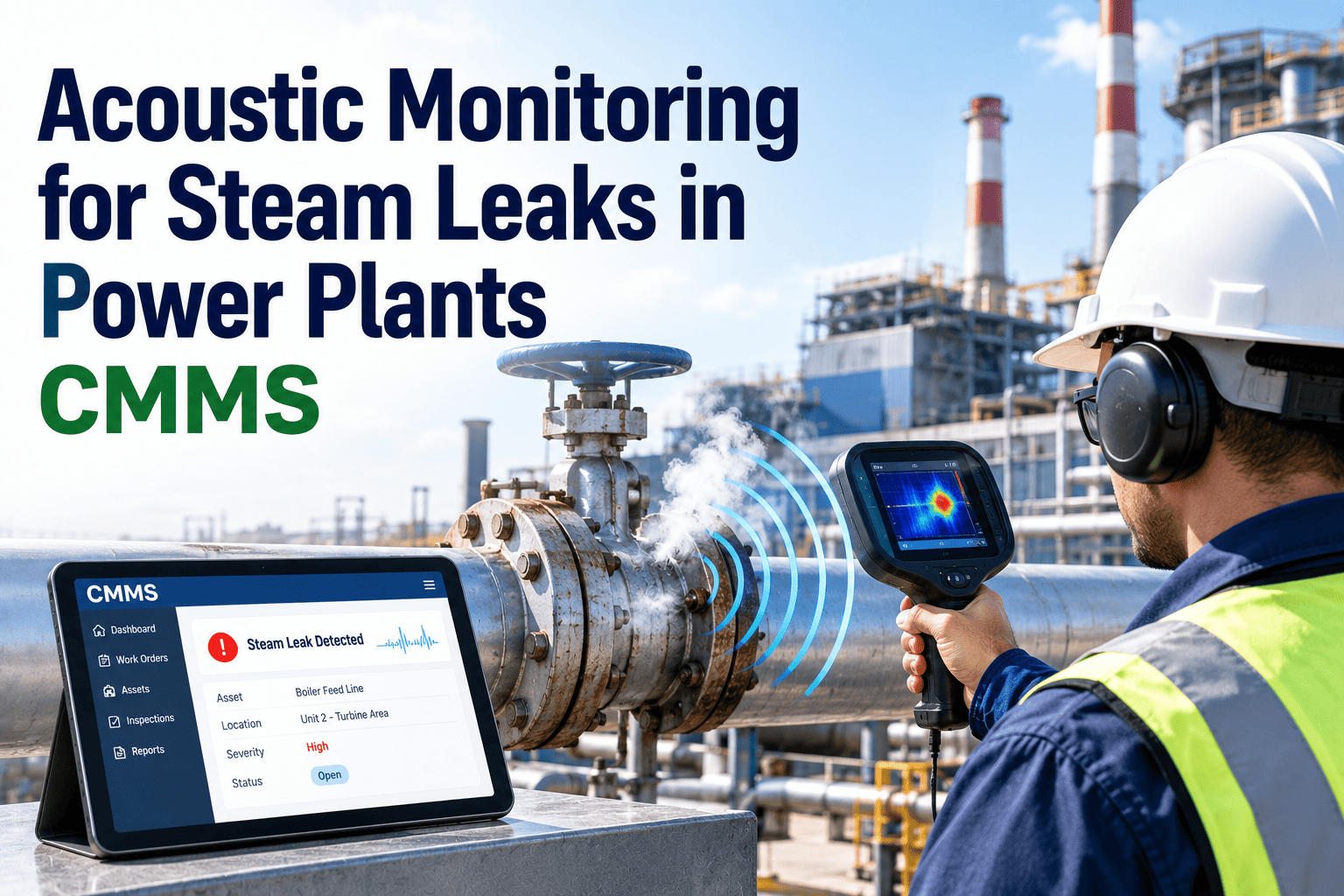
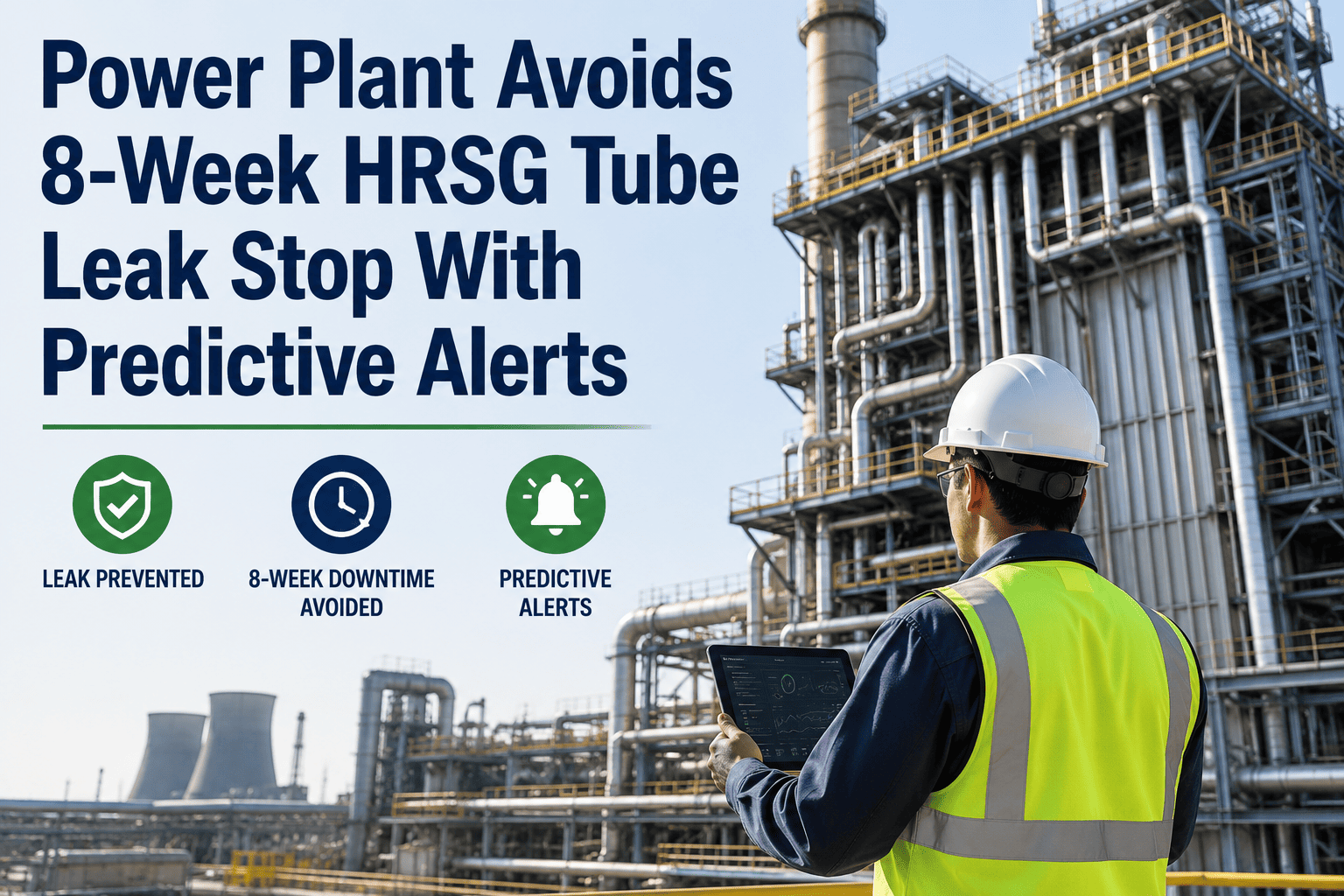
HRSG tube leaks are the leading cause of forced outages in combined cycle power plants — and the most preventable. A pinhole leak in a superheater weld detected two weeks early can be repaired in the next planned window. The same leak discovered during a forced outage costs $100,000 to $1.8 million in replacement power, overtime labor, and accelerated component damage. Acoustic Leak Detection Systems (ALDS), combined with structured makeup water tracking, sodium monitoring, and CMMS-anchored inspection records, give operations teams the early warning and documented evidence trail to convert forced outage events into planned maintenance. OxMaint's CMMS platform connects HRSG monitoring data to PM scheduling, corrective work orders, and outage planning so every leak signal becomes a trackable, closeable action — not a verbal note that gets missed at shift change. Book a free demo to see how combined cycle teams structure HRSG tube leak programs in OxMaint.
Combined Cycle · HRSG · Tube Leak Detection · ALDS · OxMaint
HRSG Tube Leak Detection and Acoustic Monitoring Programs
Boiler tube leaks are the number one loss-of-generation cause in combined cycle plants. The difference between a planned repair and a forced outage is almost always detection timing. Acoustic monitoring, makeup water trending, and sodium tracking give your operations team two to four weeks of advance warning — enough time to schedule the repair, stage the parts, and protect generation revenue.
$1.8M
Typical cost of an unplanned HRSG tube leak outage including replacement power and lost generation
2 Weeks
Earlier detection delivered by acoustic monitoring versus conventional lagging indicators
60%
Of HRSG tube failures are detectable weeks before rupture through chemistry and thickness trending
4–8 Days
Average duration of forced outages from pressure-part failures in combined cycle HRSGs
Detection Gap
Why Conventional Leak Detection Fails HRSG Operations
Before acoustic monitoring, plant operators depended entirely on lagging indicators — visible steam in the stack, wet spots at the base of the HRSG, elevated makeup water consumption, or a unit trip. Every one of these signals appears only after the leak has already grown large enough to cause measurable damage. The HRSG was already losing efficiency, wetting adjacent tube bundles, and accelerating secondary corrosion by the time anyone knew there was a problem.
Without Structured Detection Program
Stack plume visible — leak already significant
Wet floor below HRSG — water volume already high
Makeup water rising — no baseline to compare against
Sodium spike detected — condenser contamination already underway
Unit trip — forced outage, unscheduled crew, replacement power cost
Repair during emergency window — 5–15× planned cost
With ALDS + Chemistry + CMMS Program
Acoustic sensor flags abnormal noise profile — pinhole stage
Makeup water trend deviates from 7-day baseline — 2+ weeks advance
Sodium reading rises above threshold — corrective WO auto-generated
Leak located, severity assessed, outage window selected
Parts staged, contractor assigned, permit drafted — planned repair
Repair completed on schedule — generation protected
Detection Technology
How Acoustic Leak Detection Systems Work on HRSGs
ALDS technology for HRSGs was developed specifically to overcome the challenge of filtering GT exhaust noise — the same signal processing problem that prevented conventional boiler acoustic systems from working in combined cycle applications. Understanding how the system works helps maintenance teams configure CMMS monitoring tasks correctly around its outputs.
01
Sensor Placement at High-Risk Zones
Non-invasive sensors — typically waveguide rods clamped to headers or welded to HRSG casing — are positioned at historically problematic locations: superheater and reheater tube-to-header welds, HP drum connections, and LP economizer bends. These are the zones where fatigue cracking, corrosion pitting, and FAC damage produce the majority of reported tube failures in cycling combined cycle plants.
02
Continuous Sound Measurement and Filtering
Sensors measure the internal acoustic environment continuously — 24 hours, 7 days. Dual-frequency-band amplifiers filter GT exhaust noise from the leak signal. The processed signal is trended against a baseline established during known leak-free operation. A tube leak produces a characteristic high-frequency noise signature that rises progressively as the leak grows — detectable weeks before it reaches a threshold visible to operators.
03
Threshold Alarm and Location Output
When the acoustic signal exceeds the preset threshold for a defined duration, the ALDS generates an alarm. Multi-sensor triangulation identifies the probable leak location within the HRSG — narrowing the inspection scope significantly and reducing the time required to locate and confirm the leak during the subsequent planned outage inspection. This location precision is what allows maintenance teams to stage the right repair materials before shutdown.
04
CMMS Integration for Action Tracking
An acoustic alarm without a connected corrective work order is just a notification. OxMaint integrates with ALDS outputs — or accepts manual ALDS alarm entries — and auto-generates corrective work orders with leak location data, probable failure mode, recommended inspection scope, and outage scheduling flags. Every ALDS alarm becomes a tracked maintenance event with a documented response, not a shift log entry that disappears after handover.
Monitoring Parameters
The Three Chemistry Indicators Every HRSG Program Must Track
Acoustic monitoring detects the mechanical leak event. Chemistry monitoring provides the corroborating evidence, reveals secondary damage pathways, and catches leak types that acoustic sensors may not detect at small flow rates. These three parameters form the chemistry backbone of a complete HRSG tube leak program.
Primary Indicator
Makeup Water Consumption
Unexplained increases in makeup water consumption are one of the earliest and most reliable indirect indicators of a developing tube leak. Even a small leak — below the detection threshold of acoustic sensors at early stage — causes measurable deviation from a 7-day rolling baseline of normal makeup flow. Structured makeup tracking in OxMaint establishes this baseline per unit, per operating mode, and flags deviations with automatic corrective work order generation. One plant detected a developing HP economizer leak through a sustained 3.5 t/hr unexplained makeup water increase — two weeks before any acoustic or visual indicator appeared.
Baseline: Track against 7-day rolling average per operating mode
Condenser Contamination
Sodium Tracking
Sodium is the most reliable indicator of cooling water in-leakage through condenser tubes into the HRSG water-steam circuit. When sodium levels rise above background in HP, IP, or LP drum samples, condenser tube integrity is compromised — and chloride, sulfate, and hardness contaminants are entering pressure parts. Sodium tracking provides early warning of condenser tube failure before stress corrosion cracking and scaling damage high-pressure superheater components. CMMS-recorded sodium readings against defined action levels — with clear corrective work order triggers at each level — are the minimum required for a defensible chemistry programme.
Action level: Typically >10 ppb — refer to plant-specific EPRI chemistry guidelines
Cycle Chemistry Sentinel
Cation Conductivity
Cation conductivity of boiler feedwater and steam measures the total ionic contamination load in the HRSG circuit — catching acid anion ingress (chlorides, sulfates) that sodium tracking alone may miss at low concentrations. EPRI HRSG chemistry guidelines specify cation conductivity as a continuous on-line measurement with defined normal, alert, and action levels. Structured CMMS recording of cation conductivity against these levels — with operator response documented at each action level — creates the audit trail required to demonstrate program compliance and correlate chemistry excursions with observed tube damage at the next outage inspection.
Target: <0.2 µS/cm for feedwater in AVT(O) or OT regimes
Failure Mode Map
Where HRSG Tube Leaks Actually Occur — And What Monitoring Catches Each
Tube failure risk in a triple-pressure HRSG is not uniformly distributed. Different pressure sections, tube materials, and flow conditions produce distinct failure mechanisms — each requiring a specific combination of monitoring methods and CMMS-tracked inspection tasks.
| HRSG Section |
Primary Failure Mode |
Detection Method |
CMMS PM Required |
Forced Outage Risk |
| HP Superheater / Reheater |
Corrosion fatigue at tube-to-header welds from cycling thermal stress |
ALDS (primary) + sodium tracking |
Weld UT inspection, borescope at outage, ALDS alarm response WO |
High |
| HP Economizer |
FAC (flow-accelerated corrosion) wall thinning at bends and headers |
UT thickness trending + makeup water baseline |
UT mapping at every outage, FAC susceptibility ranking, thickness trend records |
High |
| LP Economizer / Evaporator |
FAC in carbon steel at peak dissolution temperature (~150°C) and high-velocity two-phase flow |
UT thickness + cation conductivity |
UT at bends, tees, and downstream of restrictors every outage — non-negotiable |
High |
| Attemperator / Spray Lines |
Sleeve cracking and downstream thermal fatigue from spray impingement |
ALDS (distinguishable from tube leaks with proper filter) + visual inspection |
Sleeve inspection at outage, downstream pipe UT, ALDS baseline calibration |
Medium |
| HP / IP / LP Drums |
Stress corrosion cracking from chloride/caustic contamination; corrosion pitting |
Sodium tracking + cation conductivity + visual at outage |
Drum internal inspection at major outage, chemistry action level response WOs |
Medium |
Tracking HRSG makeup water, sodium, and ALDS alarms in separate spreadsheets and shift logs?
OxMaint brings all three into a single PM and corrective work order structure — so every signal gets a tracked response, every finding is recorded against the right asset, and every outage team inherits the full detection history. Free to start.
CMMS Program Structure
How OxMaint Structures HRSG Tube Leak Detection as a Maintenance Program
A detection system without a connected maintenance workflow is an expensive alarm bell. OxMaint turns HRSG monitoring signals into structured PM work orders, corrective actions, and outage work packages — with full documentation from first alarm to completed repair.
Trigger
Detection Signal
ALDS threshold alarm, makeup water baseline deviation, sodium action level exceeded, or cation conductivity excursion — any signal enters OxMaint as a recorded event against the specific HRSG asset and pressure section.
→
Response
Corrective Work Order
Auto-generated or manually raised corrective work order — with probable location from ALDS triangulation, recommended inspection scope, and required chemistry sampling steps — assigned to the responsible operations or maintenance crew.
→
Tracking
Severity Assessment
Leak rate trending from makeup water and acoustic data is recorded in the work order — enabling the maintenance team to decide whether to continue operation to the next planned window or call a discretionary outage based on documented rate-of-change, not operator judgment alone.
→
Repair
Outage Work Package
The corrective work order is elevated into the outage work package register — with tube location, failure mode, required materials, and contractor type defined before shutdown. No first-day scope ambiguity. Repair is documented with as-found and as-left condition records for multi-cycle trending.
Remaining Useful Life
From Leak Detection to Remaining Life Prediction — The Role of Multi-Cycle Records
A single UT thickness reading tells you where a tube is today. Three or four readings from successive outages — stored against the same tube location in OxMaint — tell you how fast the wall is thinning and when it will reach the minimum acceptable thickness. That is the difference between reactive inspection and a true remaining useful life program.
Without Trending
A UT reading of 6.2 mm at an LP economizer bend looks acceptable against the 5.0 mm minimum. Tube passes inspection. No action taken.
Outcome: Tube fails in service 14 months later. Forced outage. $1.8M+ cost.
With OxMaint Multi-Cycle Trending
Four outage readings stored: 7.8 mm → 7.1 mm → 6.5 mm → 6.2 mm. Thinning rate: ~0.55 mm/year. Calculated remaining life: 2.2 outage cycles. Tube replacement flagged for next outage window.
Outcome: Planned replacement at next outage. Parts pre-staged. Generation protected. Full documentation retained.
Common Questions
What HRSG Operations Teams Ask About Tube Leak Detection Programs
Is acoustic monitoring reliable enough on HRSGs given the high gas turbine exhaust noise environment?
HRSG-specific acoustic systems use dual-frequency-band filtering and waveguide sensor mounting specifically developed to distinguish tube leak signatures from GT exhaust noise — a problem that prevented deployment on HRSGs until purpose-built systems were developed. Documented deployments have successfully early-detected 10 or more tube leaks across multi-year operational periods. The key is using an HRSG-qualified system, not a conventional boiler acoustic monitor deployed without modification.
Book a demo to see how OxMaint structures ALDS alarm response workflows.
What makeup water baseline deviation should trigger a corrective work order?
Industry practice varies, but a sustained unexplained makeup water increase of 10–15% above the 7-day rolling baseline for the same operating mode is a widely used trigger point for investigation. The critical factor is "sustained and unexplained" — a single-shift deviation from plant start-up or load change is normal; a deviation that persists through stable baseload operation over 24–48 hours is not. OxMaint stores rolling baseline data per unit and operating mode, flagging deviations automatically.
Set up your baseline tracking in OxMaint before your next operating cycle.
How does OxMaint retain UT thickness trend data across multiple outage cycles?
Every UT reading captured during an outage inspection is stored in OxMaint against the specific tube section, row, and location identifier — not just the asset header. On the next inspection, the technician opens the same location record and enters the new reading alongside the historical values. OxMaint displays the multi-cycle trend and calculated thinning rate, making remaining life assessment a standard part of outage closeout.
Sign up free to explore the inspection record structure before your next planned outage.
Can OxMaint handle both the operational monitoring PMs and the outage inspection work packages for the same HRSG asset?
Yes. In OxMaint, the same HRSG asset carries both its online monitoring PMs — makeup water checks, sodium sampling, ALDS alarm reviews — and its outage inspection work packages, including UT mapping, weld inspections, and drum internals. When a corrective work order raised from an online detection signal reaches outage scope, it is automatically elevated into the outage work package register with its full detection history attached.
Book a technical call to map your HRSG asset hierarchy into OxMaint's PM structure.
HRSG · Tube Leak Detection · ALDS · Acoustic Monitoring · CMMS
The Next Forced Outage From a Tube Leak Is Almost Always a Detection Problem, Not a Maintenance Problem.
OxMaint gives combined cycle operations and maintenance teams the PM structure, signal-to-work-order workflow, and multi-cycle inspection records to detect HRSG tube leaks weeks before they force a unit trip — and document every step from first alarm to completed repair.