Manufacturing plants handle operations that can result in severe injury, equipment damage, or facility shutdown if not properly controlled. A permit-to-work system is the primary control mechanism for high-risk activities — hot work that could ignite flammable atmospheres, confined space entry where atmospheric hazards or engulfment risks exist, working at height above six feet, and energized electrical work. Every one of these tasks requires documented authorization, hazard assessment, and verification of control measures before work begins. This checklist structures the permit-to-work process across five high-risk categories with pre-work verification, active monitoring, and post-work closure protocols aligned with OSHA 1910 standards and NFPA requirements. Book a demo to see how Oxmaint's digital permit-to-work system automates authorization workflows, tracks active permits in real-time, and maintains compliance documentation across your manufacturing operations.
Manufacturing Safety · Permit Management · Risk Control
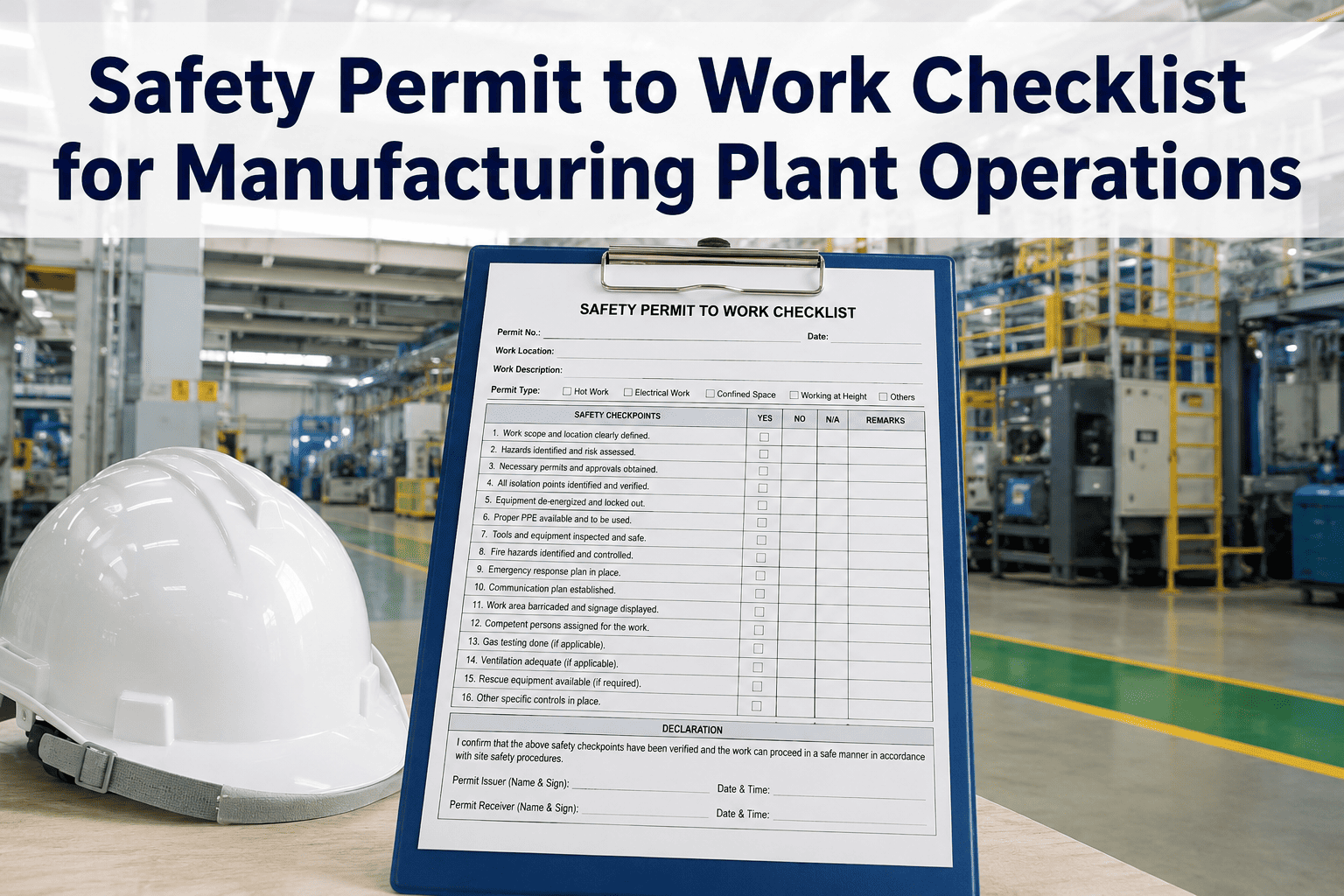
Safety Permit to Work Checklist for Manufacturing Plant Operations
Five high-risk work categories, pre-authorization controls, and closure verification — the complete permit-to-work framework that keeps your manufacturing operations compliant and your workforce protected.
65%
Of workplace fatalities occur during non-routine maintenance and high-risk tasks
18%
Oxygen concentration minimum for safe confined space entry per OSHA 1910.146
6 feet
Height threshold requiring fall protection equipment under OSHA 1910.140
50 volts
Minimum voltage requiring electrical work permit and qualified person authorization
Hot Work Permits
Confined Space Entry
Working at Height
Electrical Work
Isolation & Lockout
Risk Classification by Work Type
Hot Work
Critical — fire/explosion risk, facility damage potential
Confined Space
Critical — atmospheric hazards, fatality risk without controls
Height Work
High — fall hazard, severe injury without proper equipment
Electrical Work
High — electrocution, arc flash, equipment damage
Isolation Work
Medium — unexpected startup, energy release hazard
Category 01
Hot Work Permit — Welding, Cutting, Grinding & Flame Operations
Hot work generates temperatures capable of igniting flammable vapors, combustible dust, or nearby materials. NFPA 51B requires a written permit for all hot work performed outside designated welding areas. The permit process verifies atmospheric testing, fire watch assignment, and combustible material clearance before ignition.
Work area atmosphere tested for flammable gases — LEL reading below 10% of lower explosive limit confirmed before permit issuance
Test Record: Gas detector calibration date · Role: Safety Supervisor
Combustible materials cleared within 35-foot radius or protected with fire-resistant blankets — flammable liquids removed from area
Verification: Work area inspection · Role: Area Supervisor
Fire watch assigned and present — dedicated observer with extinguisher stationed for duration of work plus 60 minutes post-completion
Assignment: Fire watch name and contact · Role: Safety Coordinator
Fire extinguishers positioned within 30 feet of work location — minimum 10-lb ABC rated extinguisher or equivalent suppression equipment
Equipment Check: Extinguisher inspection tag current · Role: Fire Watch
Continuous fire watch maintained — observer monitoring for sparks, smoke, or ignition throughout active hot work operations
Log: Fire watch observation log · Role: Fire Watch
Atmospheric monitoring repeated every 30 minutes if work exceeds one hour — LEL readings documented on permit form
Record: Continuous monitoring log · Role: Safety Technician
Fire watch continues 60 minutes after final hot work activity — area inspected for smoldering materials or concealed fire spread
Closure: Fire watch sign-off time · Role: Fire Watch / Supervisor
Permit closed and filed — permit issuer and work supervisor signatures confirm safe completion and area clearance
Archive: Permit retention minimum 1 year · Role: Safety Administrator
Category 02
Confined Space Entry Permit — Tanks, Vessels, Vaults & Sumps
Confined space entry is one of the deadliest industrial activities. OSHA 1910.146 mandates a permit system for spaces with limited egress, atmospheric hazards, or engulfment risk. The permit process verifies atmospheric testing, rescue readiness, and continuous monitoring before and during entry.
Atmospheric testing completed before entry — oxygen 19.5-23.5%, LEL below 10%, toxic gases within permissible exposure limits
Test Record: Multi-gas detector readings · Role: Entry Supervisor
Ventilation established and operating — continuous forced air ventilation confirmed, air changes per hour adequate for space volume
Verification: Ventilation equipment inspection · Role: Safety Technician
All isolation and energy control verified — upstream/downstream valves locked out, electrical disconnects tagged, piping blanked or disconnected
Lock Check: LOTO verification form · Role: Authorized Electrical Person
Rescue equipment positioned at entry point — tripod, winch, retrieval harness, and trained rescue personnel standing by
Equipment: Rescue gear inspection current · Role: Rescue Team Lead
Communication system tested — radio, voice, or visual contact confirmed between entrant, attendant, and entry supervisor
Test: Communication check documented · Role: Entry Attendant
Continuous atmospheric monitoring active — entrant wearing calibrated multi-gas detector with alarm set at action levels
Log: Continuous gas readings · Role: Entrant / Attendant
Attendant maintains constant visual or communication contact — no distraction from monitoring duties, immediate evacuation authority
Duty Log: Attendant sign-in/out log · Role: Entry Attendant
Final headcount confirms all entrants exited — no tools, equipment, or personnel remain in confined space
Closure: Entrant sign-out verification · Role: Entry Supervisor
Space secured and permit closed — entry point re-secured, permit cancelled, file retained per company records policy
Archive: Permit retention minimum 1 year · Role: Safety Administrator
Stop managing permits on paper clipboards. Oxmaint's digital permit system tracks active authorizations, sends expiration alerts, and archives compliance records automatically.
Category 03
Working at Height Permit — Scaffolds, Ladders, Aerial Platforms
Falls are the leading cause of fatalities in manufacturing. OSHA 1910.140 requires fall protection for work above six feet. The working-at-height permit verifies equipment inspection, anchor point integrity, and rescue plan readiness before elevation.
Fall protection equipment inspected — harness, lanyard, and anchor point examined for wear, damage, or expiration before use
Inspection: Equipment tag verification · Role: Competent Person
Anchor points load-rated and verified — minimum 5,000-lb capacity per attached worker confirmed by engineering documentation
Certification: Anchor certification on file · Role: Safety Engineer
Scaffold inspection completed if applicable — platform fully decked, guardrails in place, base plates level, tie-offs secured
Tag: Green scaffold inspection tag current · Role: Scaffold Competent Person
Rescue plan documented and communicated — rescue equipment positioned, trained personnel identified, evacuation procedure reviewed
Plan: Fall rescue procedure on permit · Role: Safety Supervisor
100% tie-off maintained — worker connected to anchor at all times when above six feet, never detached during repositioning
Observation: Supervisor spot-check log · Role: Area Supervisor
Equipment returned to storage and inspected — harnesses, lanyards, and tools checked for damage before next use authorization
Return: Equipment sign-in log · Role: Tool Crib Attendant
Permit closed and archived — work completed without incident, area secured, permit signed off by competent person
Archive: Permit file retention · Role: Safety Administrator
Category 04
Electrical Work Permit — Energized Work & Arc Flash Hazard
Electrical work on energized equipment above 50 volts requires a qualified person and a written energized electrical work permit under NFPA 70E. The permit confirms arc flash risk assessment, PPE selection, and voltage verification before contact.
Arc flash hazard analysis completed — incident energy level calculated, arc flash boundary identified, PPE category determined
Analysis: Arc flash label on equipment · Role: Qualified Electrical Person
Appropriate PPE donned before approach — arc-rated clothing, voltage-rated gloves, face shield rated for incident energy level
Inspection: PPE rating verification · Role: Electrical Supervisor
Test equipment verified operational — voltage tester tested on known live source before and after use per live-dead-live procedure
Test: Voltage tester function check · Role: Qualified Person
Barriers and warning signs posted — restricted approach boundary marked, unauthorized personnel excluded from work area
Setup: Boundary signage placement · Role: Electrical Crew Lead
Only qualified persons within arc flash boundary — unqualified personnel remain outside limited approach boundary throughout work
Control: Access log for restricted area · Role: Electrical Supervisor
Equipment re-energized and tested — circuit function verified, no faults detected, equipment returned to normal operation
Test: Functional test record · Role: Qualified Electrical Person
Permit closed and filed — all barriers removed, work area cleared, permit signed by qualified person and supervisor
Archive: Electrical permit retention · Role: Safety Administrator
Category 05
Isolation & Lockout-Tagout (LOTO) Permit
Energy isolation prevents unexpected equipment startup that causes amputations, crushing injuries, and fatalities. OSHA 1910.147 requires lockout-tagout procedures and verification for servicing equipment with stored energy — electrical, mechanical, hydraulic, pneumatic, or thermal.
Energy sources identified — all electrical, mechanical, hydraulic, pneumatic, thermal, and chemical energy sources documented on permit
Identification: Equipment-specific LOTO procedure · Role: Authorized Person
Isolation devices locked out — circuit breakers off and locked, valves closed and locked, each worker applies personal lock
Lock Application: Individual lock inventory log · Role: Each Authorized Person
Stored energy released or blocked — capacitors discharged, springs compressed, elevated components lowered and blocked
Verification: Energy release checklist · Role: Authorized Person
Zero energy state verified — voltage tested at point of work, pressure gauges at zero, motion confirmed stopped
Test: Zero-energy verification form · Role: Authorized Person
Locks remain in place for work duration — no removal of locks except by person who applied them, supervisor override only for emergencies
Control: Lock status inspection · Role: Area Supervisor
Work area inspected and cleared — tools removed, guards reinstalled, all personnel accounted for and clear of equipment
Clearance: Pre-startup inspection · Role: Authorized Person
Locks and tags removed in reverse order — each worker removes personal lock, authorized person verifies all locks removed before re-energization
Removal: Lock removal log · Role: Authorized Person
Equipment re-energized and tested — startup procedure followed, equipment function verified, permit closed and filed
Archive: LOTO permit retention · Role: Safety Administrator
Regulatory Reference
Permit Frequency and Regulatory Standards by Work Type
| Work Type |
Permit Required When |
Key Control Measure |
Governing Standard |
| Hot Work |
Any welding, cutting, grinding, or flame work outside designated areas |
Fire watch + atmospheric testing + combustible clearance |
NFPA 51B / OSHA 1910.252 |
| Confined Space Entry |
Entry into tank, vessel, vault, or space with limited egress and atmospheric hazard |
Atmospheric monitoring + ventilation + rescue standby |
OSHA 1910.146 |
| Working at Height |
Work performed more than 6 feet above lower level |
Fall protection equipment + anchor certification + rescue plan |
OSHA 1910.140 / 1926.501 |
| Energized Electrical Work |
Work on energized circuits above 50 volts |
Arc flash analysis + arc-rated PPE + voltage verification |
NFPA 70E / OSHA 1910.333 |
| Lockout-Tagout |
Servicing equipment with stored energy (electrical, mechanical, hydraulic, pneumatic) |
Energy isolation + personal locks + zero-energy verification |
OSHA 1910.147 |
| Excavation Work |
Digging or trenching below 4 feet depth |
Soil classification + shoring/sloping + utility location |
OSHA 1926 Subpart P |
| Crane Operations |
Lifting operations with mobile or overhead cranes |
Load chart verification + ground conditions + swing radius clearance |
OSHA 1926.1400 / ASME B30 |
| Radiation Work |
Exposure to ionizing radiation sources above background levels |
Dosimetry monitoring + shielding + exposure time limits |
10 CFR 20 / OSHA 1910.1096 |
Industry Insights
What Manufacturing Safety Professionals Say About Permit Systems
01
The permit is not bureaucracy — it is the last defense against a fatality. We had a confined space near-miss where the entry supervisor skipped atmospheric testing because the space had been safe the day before. The space had been purged with nitrogen overnight for maintenance. Without the permit checklist forcing that test, we would have had a body recovery instead of a safety stand-down.
EHS Manager, Automotive Parts Manufacturing, 1,200 Employees
02
Hot work permits prevent fires, but only if you actually use them. We mandate a permit for any spark-generating work. Last year a maintenance contractor tried to grind a bracket off a process line without a permit. The fire watch caught him before ignition. The permit system works because it forces the conversation before the work starts, not after the damage is done.
Facilities Director, Chemical Manufacturing Plant
03
Digital permits changed our compliance posture overnight. Before Oxmaint, we had paper permits that disappeared or got filed wrong. Now every permit is timestamped, searchable, and accessible during OSHA inspections. When the inspector asked for our confined space permits from the previous quarter, I had them on screen in 15 seconds. That is the difference between a compliance finding and a clean audit.
Safety Coordinator, Food Processing Facility, Multi-Site Operations
Common Questions
Frequently Asked Questions About Permit-to-Work Systems
Can Oxmaint enforce permit expiration and prevent work from continuing past the authorized time window?
How does the system handle simultaneous permits for the same equipment or area?
Oxmaint tracks active permits by location and equipment ID. If a hot work permit is already active in an area, the system flags the conflict when a second permit is requested, preventing overlapping high-risk work without coordination.
What is the difference between a permit-required confined space and a non-permit space?
A permit-required confined space has atmospheric hazards, engulfment risk, or an internal configuration that could trap an entrant. A non-permit space has none of these hazards. OSHA 1910.146 requires written permits only for permit-required spaces.
Can contractors access and complete permits in Oxmaint, or is it only for internal staff?
Contractors can be granted permit access with role-based permissions. They can request permits, upload certifications (like fire watch qualifications), and sign off on completed work — all tracked under their contractor profile for audit purposes.
Does this checklist apply to both union and non-union manufacturing facilities?
Yes. OSHA 1910 and NFPA standards apply to all manufacturing operations regardless of labor structure. Union contracts may impose additional safety requirements, but the baseline regulatory minimums in this checklist are universal.
Every High-Risk Work Task. Every Authorization. One Digital Permit System.
Oxmaint's Permit-to-Work module replaces paper forms with digital workflows — permit requests route to the right approver, safety checklists enforce compliance before work begins, and completed permits archive automatically for inspections and audits.