Process control accuracy in manufacturing depends entirely on instrument calibration integrity — a temperature transmitter reading 3°C high causes batch rejection in pharmaceutical production, a pressure gauge drifting 5 PSI low triggers compressor shutdown in chemical plants, and uncalibrated flow meters result in product giveaway that costs thousands per shift. Calibration is not a compliance checkbox. It is the foundation of process repeatability, product quality verification, and regulatory compliance across FDA-regulated, ISO-certified, and HACCP-controlled manufacturing operations. This checklist covers the complete calibration lifecycle for temperature, pressure, flow, level, analytical, and control valve instrumentation — from calibration planning and as-found documentation through calibration execution, tolerance verification, and certificate retention. Book a demo to see how Oxmaint's Calibration Management system schedules instrument calibration, tracks due dates, and maintains audit-ready calibration certificates across your plant.
Instrumentation · Calibration Management · Process Control
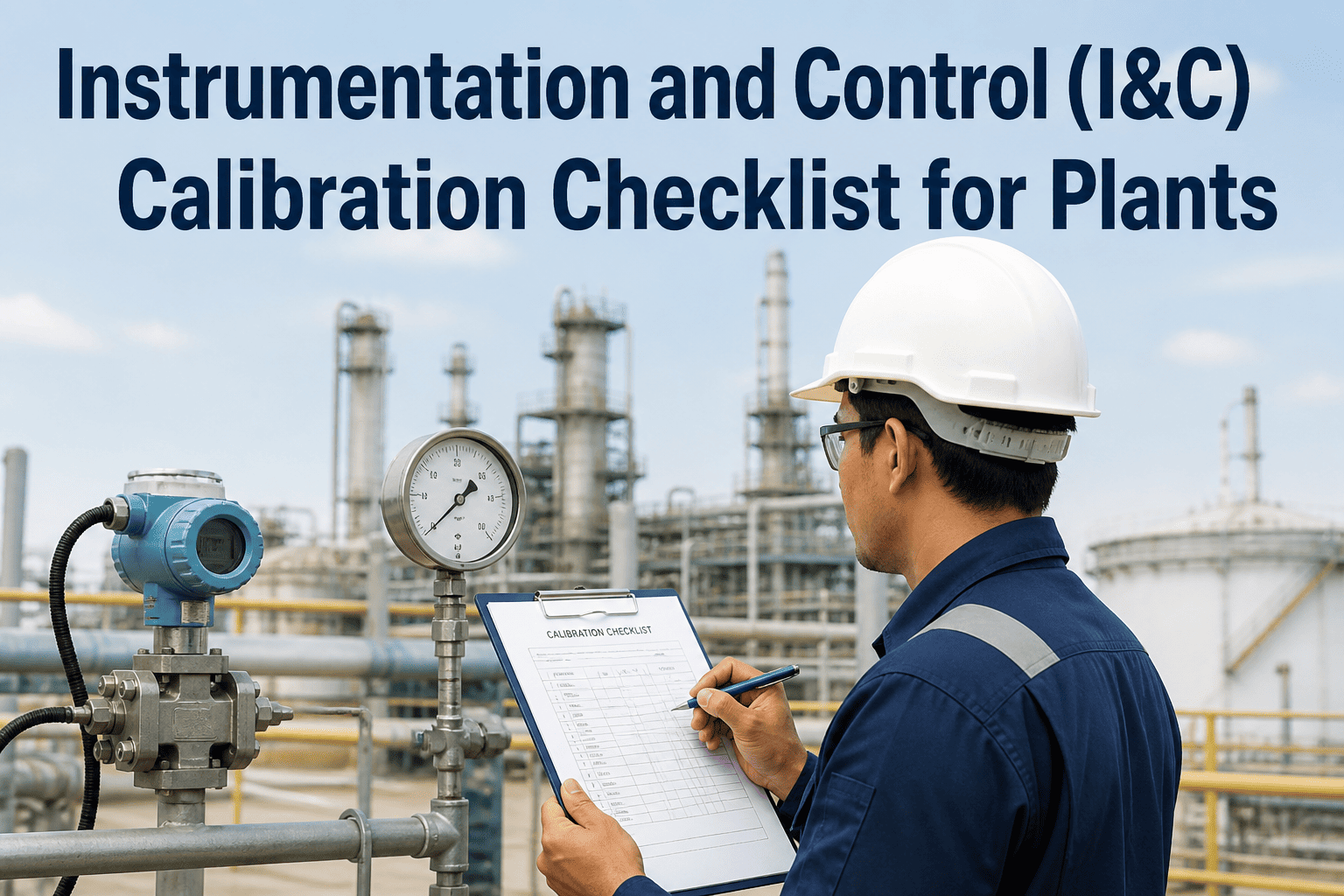
Instrumentation and Control Calibration Checklist for Manufacturing Plants
Complete calibration protocols for transmitters, gauges, analyzers, and control valves — covering as-found verification, adjustment procedures, as-left documentation, and certificate generation for ISO 17025 and regulatory compliance.
±0.5% accuracy
Typical specification for industrial pressure transmitters at calibrated range
ISO 17025
International standard for calibration laboratory competence and traceability
Annual minimum
Standard calibration interval for critical process instrumentation in manufacturing
4:1 ratio
Minimum test equipment accuracy ratio required for valid calibration per ANSI Z540
Temperature Instruments
Pressure Instruments
Flow Meters
Level Instruments
Analytical Instruments
Control Valves
Calibration Priority Classification by Process Criticality
Critical Safety Instruments
Pressure relief setpoints, combustible gas detectors, safety interlocks — calibration failure causes safety system failure
Quality-Critical Instruments
Product specification measurements, batch control instruments — drift causes product nonconformance
Process Control Instruments
Loop controllers, transmitters affecting yield or efficiency — drift reduces process performance
Indication-Only Instruments
Local gauges for operator reference, non-critical monitoring — drift causes inconvenience only
Instrument Category 01
Temperature Instruments — Transmitters, RTDs, Thermocouples, and Temperature Gauges
Temperature measurement is fundamental to batch processing, heat treatment verification, and HVAC control. Calibration verifies sensor accuracy across the process range and documents traceability to NIST or equivalent national standards through accredited reference equipment.
Instrument identification verified — tag number matches calibration database, previous calibration certificate reviewed for history
Verify: Tag number, serial number, manufacturer model · Record: As-found condition
Calibration equipment verified current — reference thermometer, simulator, or temperature source calibration certificate valid and traceable
Verify: Calibrator certificate, traceability chain to NIST · Record: Calibrator ID and due date
Test equipment accuracy ratio confirmed — calibrator accuracy minimum 4:1 better than instrument under test per ANSI Z540
Calculate: TUR (Test Uncertainty Ratio) · Record: Pass/fail on ratio requirement
As-found readings documented at minimum five points across calibrated range — 0%, 25%, 50%, 75%, 100% of span
Test: Apply reference input, record instrument output · Record: As-found error at each point
As-found tolerance compliance assessed — instrument error compared to manufacturer specification or process tolerance before adjustment
Evaluate: Pass/fail against tolerance · Record: Out-of-tolerance notification if failed
Out-of-tolerance investigation initiated if as-found fails — process review, product impact assessment, corrective action per quality system
Action: Notify production, quality, process engineering · Record: Investigation reference number
Instrument adjusted to bring within tolerance — zero and span adjustments performed per manufacturer procedure, software configuration updated if smart transmitter
Adjust: Zero offset, span correction · Record: Adjustment method and settings changed
As-left readings verified and documented — calibration repeated at same test points to confirm adjustment brought instrument within tolerance
Test: Repeat five-point check · Record: As-left error at each point, final pass/fail determination
Instrument tagged and returned to service — calibration sticker applied with next due date, instrument restored to process operation
Tag: Calibration date, due date, technician initials · Record: Return-to-service timestamp
Calibration certificate generated with complete data — as-found, as-left, uncertainty, environmental conditions, traceability statement, technician signature
Certificate: Include all required fields per ISO 17025 · Record: Archive in calibration database
Certificate filed and retrievable for audit — electronic or physical filing system maintains certificates for minimum retention period per regulatory or quality requirements
File: Index by tag number and date · Record: Retention minimum 5 years or per industry regulation
Instrument Category 02
Pressure Instruments — Transmitters, Gauges, Switches, and Transducers
Pressure measurement controls compressor operation, vessel safety, and product quality in filling operations. Calibration uses deadweight testers, pressure calibrators, or master gauges traceable to national standards, with documented uncertainty statements.
Pressure instrument isolated and vented — process isolation valves closed, pressure released, instrument safe to remove or test in place
Safety: Verify zero pressure before connection · Record: Isolation method and safety verification
Test equipment connected — calibrator or master gauge connected to instrument, leak check performed, system stabilized before testing
Setup: Verify no leaks at connections · Record: Calibrator ID and stabilization time
Five-point ascending and descending test performed — hysteresis and repeatability verified by testing both increasing and decreasing pressure
Test: 0%, 25%, 50%, 75%, 100% up and down · Record: Hysteresis magnitude and direction
Tolerance assessment and adjustment if required — compare as-found to tolerance, adjust zero and span if out of specification, verify as-left compliance
Adjust: Zero trim, span adjustment · Record: As-found pass/fail, as-left final error
Pressure switch setpoint verification if applicable — switch actuation point tested and compared to setpoint requirement, adjustment documented
Test: Rising and falling trip points · Record: Actual trip pressure vs setpoint tolerance
Instrument reinstalled and pressure restored — instrument reconnected to process, isolation valves opened, no leaks at connections verified
Safety: Leak check at operating pressure · Record: Return-to-service verification
Calibration certificate issued and filed — certificate includes traceability statement, environmental conditions, and measurement uncertainty
Certificate: Archive with as-found and as-left data · Record: File in calibration management system
Never miss another calibration due date. Oxmaint sends automated alerts 30 days before expiration, assigns work orders to technicians, and archives certificates in a searchable compliance database.
Instrument Category 03
Flow Meters — Magnetic, Vortex, Coriolis, and Turbine Flow Measurement
Flow measurement accuracy directly impacts material balance, batch formulation, and custody transfer. Calibration verifies flow meter accuracy across the operating range using flow rigs, master meters, or gravimetric methods with documented traceability.
Flow meter removed from process if bench calibration required — isolation performed, meter drained or purged, transported to calibration facility
Process: Coordinate downtime with production · Record: Removal date and condition
Calibration method selected based on meter type and accuracy requirement — flow rig, master meter comparison, or gravimetric test
Method: Select appropriate calibration standard · Record: Calibration method and reference equipment
Multi-point flow test conducted across operating range — minimum three flow rates tested (low, mid, high) within meter specification
Test: Typical 10%, 50%, 100% of rated flow · Record: Flow error percentage at each test point
Linearity and repeatability verified — error plotted across range, repeatability assessed through multiple runs at same flow rate
Analyze: Error curve, repeatability standard deviation · Record: Linearity within specification
Meter factor or K-factor updated if programmable — correction applied to electronics or DCS configuration to bring within tolerance
Adjust: Update meter factor in transmitter · Record: Old factor, new factor, configuration date
Calibration certificate generated with flow data — includes test fluid properties, temperature, pressure, flow rates tested, and measurement uncertainty
Certificate: Complete with environmental conditions · Record: Archive in calibration database
Flow meter reinstalled and verified operational — meter returned to service, flow verified in DCS, totalizer function confirmed
Verify: Flow indication matches expected process conditions · Record: Commissioning sign-off
Instrument Category 04
Level Instruments — Radar, Ultrasonic, DP, and Guided Wave Radar
Level measurement prevents overfill incidents, controls batch transfers, and monitors inventory. Calibration verifies instrument zero and span against known level references or simulated inputs with documented accuracy statements.
Wet calibration or simulation determined — full tank fill for critical applications, electronic simulation for transmitter verification only
Method: Coordinate wet calibration with operations · Record: Calibration approach and justification
Zero and span verification performed — empty tank zero confirmed, full tank span verified or simulated based on tank geometry
Test: Zero at empty, span at full or calculated · Record: As-found zero and span error
Intermediate level points tested if possible — confirm linearity at quarter, half, three-quarter levels using known fill heights
Test: Intermediate points if accessible · Record: Error at each verified level
Adjustment applied and as-left verified — transmitter calibrated to match actual levels, configuration updated in DCS or PLC
Adjust: Zero trim, span correction · Record: Final as-left error and tolerance compliance
Instrument Category 05
Analytical Instruments — pH, Conductivity, Dissolved Oxygen, Gas Analyzers
Analytical measurement controls product quality, environmental compliance, and process optimization. Calibration uses certified buffer solutions, gas mixtures, or reference standards with documented concentration and traceability.
Calibration standards verified current and traceable — buffer solutions, calibration gases, or reference materials within expiration date and certified
Verify: Lot number, expiration date, certificate of analysis · Record: Standard ID and traceability
Sensor or probe inspected and cleaned — electrode condition assessed, reference junction clear, membrane intact before calibration
Inspect: Physical condition of sensor · Record: Cleaning or maintenance performed
Multi-point calibration performed with certified standards — minimum two-point calibration for pH, conductivity, DO; three-point for gas analyzers
Test: Apply standards across measurement range · Record: Instrument response at each standard
Slope and offset adjusted to match standards — calibration constants updated in transmitter or analyzer, verification check performed
Adjust: Slope and intercept calibration · Record: As-left error at calibration points
Calibration certificate issued with standard traceability — certificate includes standard lot numbers, concentration, and measurement uncertainty
Certificate: Document all standards used · Record: File with traceability chain
Instrument Category 06
Control Valves — Positioner Calibration and Stroke Testing
Control valve performance directly affects process stability and loop performance. Calibration verifies valve positioner accuracy, stroke linearity, and response time to ensure control system commands translate to actual valve position.
Valve and actuator inspected for mechanical issues — stem binding, packing leaks, actuator air supply verified before calibration
Inspect: Mechanical condition, air supply pressure · Record: Issues found and corrected
Stroke test performed — valve commanded to 0%, 25%, 50%, 75%, 100% positions, actual position verified against command
Test: Position feedback vs command signal · Record: Position error at each test point
Positioner calibration adjusted if position error exceeds tolerance — zero and span trim performed, auto-calibration routine executed if smart positioner
Adjust: Zero, span, characterization · Record: Calibration parameters before and after
Valve signature or response curve documented — stroke time, hysteresis, and dead band measured and compared to baseline or specification
Measure: Stroke time, dead band, hysteresis · Record: Valve performance signature
Valve returned to automatic control — control mode restored, loop tuning verified, valve response to process demand confirmed
Verify: Loop stability after calibration · Record: Return-to-service timestamp and operator notification
Calibration Standards Reference
Instrument Calibration Frequency and Traceability Requirements by Type
| Instrument Type |
Typical Calibration Interval |
Traceability Standard |
Test Equipment Required |
| Temperature Transmitter |
Annual |
NIST-traceable RTD or thermocouple |
Precision temperature simulator or dry-block calibrator |
| Pressure Transmitter |
Annual |
NIST-traceable pressure standard |
Deadweight tester or pressure calibrator with 4:1 TUR |
| Pressure Gauge |
Annual or per use (critical safety) |
NIST-traceable master gauge |
Pneumatic or hydraulic pressure source and master gauge |
| Flow Meter |
Annual to biennial |
Traceable flow standard or master meter |
Flow calibration rig or gravimetric system |
| Level Transmitter |
Annual |
Geometric reference or calibrated simulator |
Tank strapping or electronic simulator |
| pH Analyzer |
Quarterly to monthly (process-dependent) |
NIST-traceable pH buffers |
Certified buffer solutions pH 4, 7, 10 |
| Conductivity Analyzer |
Quarterly |
NIST-traceable conductivity standards |
Certified conductivity reference solutions |
| Gas Analyzer |
Quarterly to semi-annual |
NIST-traceable calibration gas |
Certified gas mixtures with known concentration |
| Control Valve Positioner |
Annual or per valve signature analysis |
Position feedback vs command signal |
Stroke test equipment or smart positioner diagnostic |
Track every instrument calibration from due date alert through certificate archive. Oxmaint schedules calibrations, assigns technicians, and maintains audit-ready records for ISO, FDA, and regulatory inspections.
Practitioner Insights
What Instrumentation Professionals Say About Calibration Management
01
The most expensive calibration failure is the one you discover after the batch fails quality inspection. We had a pH transmitter drift out of tolerance over six months — undetected because the as-found check was never documented. By the time we caught it during routine calibration, we had released 14 batches with suspect pH control. The product recall and investigation cost us more than ten years of calibration program expenses. As-found documentation is not optional. It is the only way to assess product impact when calibration fails.
Instrumentation Manager, Pharmaceutical Manufacturing, FDA-Regulated Facility
02
You cannot calibrate an instrument with test equipment that is less accurate than the instrument itself. The 4:1 test uncertainty ratio is not a suggestion — it is a fundamental measurement principle. If your pressure transmitter is specified at 0.1% and your calibrator is only 0.2%, you are not calibrating anything. You are comparing two uncertain measurements and calling it calibration. Every accredited lab understands this. Every plant should too.
Metrology Engineer, ISO 17025 Accredited Calibration Laboratory
03
We switched to Oxmaint for calibration tracking because our spreadsheet system was failing audits. Instruments were going past due, certificates were lost, and we had no systematic way to prove calibration coverage. Oxmaint sends alerts 30 days before expiration, auto-generates work orders, and archives every certificate with full traceability. When the ISO auditor asked for our pressure transmitter calibration history, I pulled it up in 10 seconds. That is the difference between a finding and a clean audit.
Quality Manager, Chemical Processing Plant, ISO 9001 Certified
Common Questions
Frequently Asked Questions About Instrumentation Calibration
How does Oxmaint calculate and alert on upcoming calibration due dates?
Oxmaint tracks each instrument's calibration interval and sends automated alerts 30, 14, and 7 days before expiration. Work orders are auto-generated and assigned to technicians based on skill and availability.
Book a demo to see calibration scheduling in action.
Can calibration certificates be uploaded and archived directly in Oxmaint?
Yes. Technicians can upload calibration certificates, test data sheets, and traceability documents directly to each instrument record. All files are searchable by tag number, date, or technician for instant retrieval during audits.
What is the difference between as-found and as-left calibration data?
As-found is the instrument error before adjustment, used to assess calibration stability and product impact. As-left is the final error after calibration adjustment, demonstrating the instrument was brought within tolerance before return to service.
Does the 4:1 test uncertainty ratio apply to all calibrations?
ANSI Z540.3 recommends a 4:1 ratio (test equipment four times more accurate than the instrument being calibrated). Some industries allow lower ratios with documented uncertainty analysis, but 4:1 is the recognized best practice for valid calibration.
Can calibration intervals be adjusted based on instrument history and criticality?
Yes. Risk-based calibration programs extend intervals for stable instruments and shorten them for critical or drift-prone devices. Oxmaint tracks as-found history to support interval optimization while maintaining compliance with regulatory minimums.
Every Instrument. Every Calibration. Every Certificate. One Management System.
Oxmaint's Calibration Management platform schedules instruments by interval, assigns calibration work orders, captures as-found and as-left data, archives certificates with full traceability, and generates audit-ready compliance reports for ISO, FDA, and regulatory inspections.