Manufacturing plants across the world are navigating an accelerating workforce crisis. Experienced tradespeople are retiring faster than new technicians are entering the industry, apprenticeship pipelines have contracted, and competitive wage pressure from adjacent sectors is pulling skilled workers away from plant floors. The response from high-performing manufacturers is not to wait for the labour market to recover — it is to deploy technology that multiplies the output of the workforce they have. Sign in to OxMaint to see how digital maintenance tools help lean teams manage more assets with less effort, or book a demo and explore the platform built for understaffed maintenance operations.
Workforce Strategy / Digital Operations
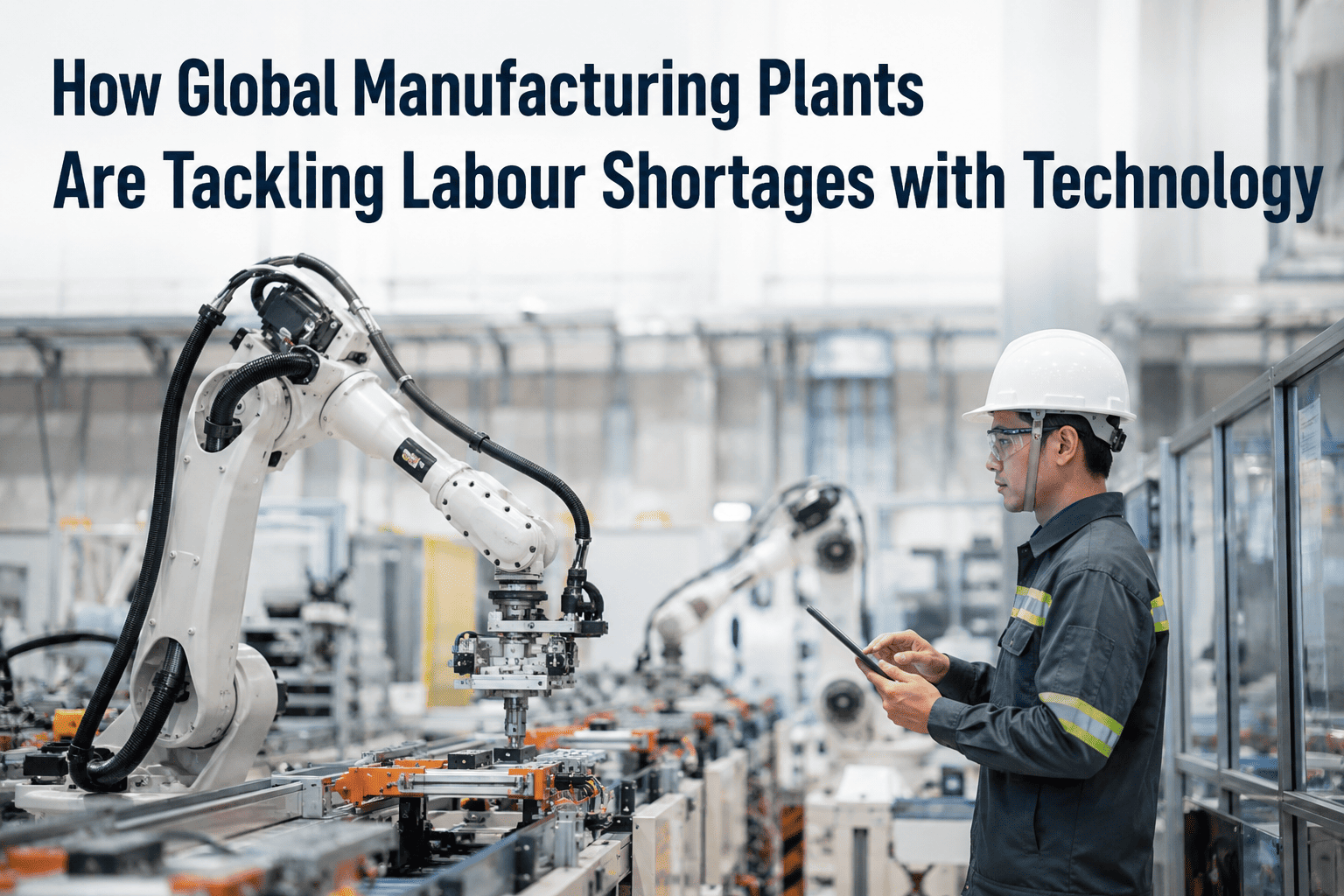
How Global Manufacturing Plants Are Tackling Labour Shortages with Technology
The skilled trades shortage in manufacturing is structural, not cyclical. Discover how technology — from mobile CMMS to AI-assisted scheduling — is enabling plant teams to maintain production targets with reduced headcount and rising asset complexity.
The Scale of the Manufacturing Labour Crisis
This is not a local problem or a temporary dip. The manufacturing workforce gap is structural — a combination of demographic ageing, skills training shortfalls, and competing sector demand that is reshaping how plants must operate for the next decade.
2.1M
manufacturing jobs projected to go unfilled in the US alone by 2030 (Deloitte)
54%
of plant managers report difficulty filling skilled maintenance technician roles in 2024
10,000
baby boomer workers retire from US manufacturing every single day
$1.3T
estimated economic impact of the manufacturing skills gap by 2030 (NAM)
Where the Labour Shortage Hits Hardest in Plant Operations
Critical Impact
Maintenance & Reliability
Preventive maintenance tasks are deferred when technician headcount is insufficient. Backlogs grow. Assets run to failure. Reactive maintenance costs 3–5x more than planned work — and requires even more labour to execute.
Critical Impact
Knowledge Transfer
When experienced technicians retire, decades of undocumented asset knowledge leaves with them. Plants with no digital maintenance records lose tribal knowledge that cannot be recovered — every new hire starts from zero on every asset.
High Impact
Shift Coverage
Understaffed shifts mean supervisors spend time on tasks that do not require supervision, operators run without adequate oversight, and handover quality drops — increasing unplanned downtime risk at shift change.
High Impact
Safety Compliance
Fatigue from mandatory overtime, inexperienced workers on safety-critical tasks, and missed safety inspections due to workload pressure are direct consequences of understaffed operations — all with measurable incident risk.
Technology Built for Lean Maintenance Teams
OxMaint is used by maintenance teams running fewer people than their asset base demands. Mobile-first work orders, AI-assisted scheduling, and digital asset history mean one technician can do what used to take two.
Six Technologies Closing the Manufacturing Workforce Gap
Technology cannot replace a skilled trades workforce. But it can make a smaller team significantly more productive, reduce the time new workers need to become effective, and eliminate the administrative overhead that pulls technicians away from hands-on work.
01
Mobile CMMS — Eliminating Paperwork Overhead
A technician using a mobile CMMS spends 40–60% less time on work order paperwork — no handwritten job cards, no end-of-shift data entry, no hunting for asset history in filing cabinets. That reclaimed time goes back to maintenance execution. For a team of 8 technicians, this can recover the equivalent of a full additional headcount in productive hours per week.
Productivity multiplier
02
AI-Assisted Maintenance Scheduling
AI scheduling tools prioritise work orders by asset criticality, technician skill match, and available parts — automatically generating optimised daily task lists for each technician. Planners in labour-constrained plants use this to ensure the highest-priority work is always assigned first, without manual triage across large backlogs every morning.
Planning efficiency
03
Digital Asset History — Replacing Tribal Knowledge
When every repair, observation, and fault is captured in a digital asset record, new technicians inherit the accumulated knowledge of everyone who worked on that asset before them. The CMMS becomes an institutional memory that does not leave when a senior technician retires — and dramatically reduces the learning curve for new hires.
Knowledge retention
04
IoT Condition Monitoring — Fewer Inspection Rounds
IoT sensors on critical assets continuously monitor vibration, temperature, and pressure — replacing manual inspection rounds that require a technician to physically walk to each asset on a fixed schedule. Labour-constrained teams use condition monitoring to shift from scheduled patrol to exception-driven inspection: only go when the sensor tells you to.
Inspection efficiency
05
Autonomous Mobile Robots for Hazardous Patrol
AMRs patrol gas corridors, electrical substations, and high-temperature zones continuously — tasks that previously required a technician to enter hazardous areas on a regular schedule. In labour-short operations, AMR patrol eliminates one of the most time-consuming and high-risk inspection activities, freeing technicians for work that requires human skill.
Hazard zone coverage
06
Predictive Maintenance Reducing Emergency Calls
Emergency breakdowns require multiple technicians, extended overtime, and immediate parts procurement — all of which are disproportionately expensive for a workforce-constrained team. Predictive maintenance converts emergency responses to planned repairs: fewer technicians needed, at scheduled times, with parts already on hand. This is the highest-ROI technology investment for understaffed maintenance operations.
Breakdown reduction
Technology Adoption by Plant Size and Labour Pressure
| Technology |
Small Plants (<50 staff) |
Mid-Size Plants (50–200) |
Large Plants (200+) |
Labour Saving Potential |
| Mobile CMMS |
High priority — immediate ROI |
Standard adoption |
Already widespread |
20–35% admin time reduction |
| AI Scheduling |
Moderate — requires data volume |
High priority |
High priority |
15–25% planner efficiency gain |
| IoT Condition Monitoring |
Critical asset focus only |
Partial deployment |
Broad deployment |
Replaces 30–50% of manual rounds |
| AMR Inspection |
Cost-prohibitive at scale |
Hazardous zone focus |
Multi-zone deployment |
Full coverage of hazardous zones |
| Predictive Maintenance AI |
Targeted on critical assets |
Growing adoption |
Standard for reliability teams |
60–70% reduction in emergency work |
"
The plants that are managing well with reduced headcount are not cutting corners — they have systematically removed every administrative task that doesn't require a skilled technician's hands. Paper work orders, manual inspection logs, verbal handovers, spreadsheet-based scheduling — all of that overhead was absorbing 30 to 40 percent of maintenance capacity. Digital tools give that time back. The plants that struggle are the ones that bought the technology but didn't change the process around it.
Marcus Elliot
Manufacturing Operations Director · 22 years restructuring maintenance operations in automotive and FMCG sectors · Specialisation in workforce productivity, lean maintenance, and digital transformation programmes
Frequently Asked Questions
Will technology replace maintenance technicians in manufacturing?
Technology reduces administrative overhead, automates patrol tasks, and eliminates low-skill inspection rounds — but skilled maintenance work (diagnosis, repair, calibration, complex fault-finding) requires human expertise and is not at risk of automation. The goal is to remove non-skilled tasks so experienced technicians can focus on the work that requires their training.
OxMaint is built around this principle.
What is the fastest technology to deploy for immediate workforce relief?
Mobile CMMS is typically the fastest to deploy and the most immediate in impact — it can be operational in days and begins reducing administrative overhead immediately. IoT condition monitoring for critical assets is the second priority. Both can be implemented without major infrastructure change and deliver measurable productivity gains within the first month.
Book a demo to see deployment timelines.
How do digital tools help with knowledge transfer when experienced staff retire?
Every maintenance action recorded in a CMMS — fault codes, repair notes, parts used, observations — builds a permanent, searchable asset history. When an experienced technician leaves, their accumulated knowledge of each asset's failure patterns and repair history remains in the system. New technicians inherit that knowledge from day one rather than starting with a blank asset record.
How do plants justify technology investment when budgets are already under pressure from labour costs?
The ROI case is built on avoided overtime, reduced emergency repair costs, and deferred headcount replacement. A plant spending on emergency breakdown labour can typically recover the cost of a CMMS platform in the first quarter through planned maintenance efficiency gains alone.
Book a demo to walk through the cost model.
Is technology adoption in manufacturing increasing or stalling during the labour shortage?
Accelerating. The labour shortage is the primary driver of technology adoption in plant maintenance — not cost efficiency alone. Plants that previously delayed digital transformation because headcount was sufficient are now implementing CMMS, IoT, and automation tools as a direct response to unfilled roles.
OxMaint has seen significant growth in new plant onboardings driven specifically by workforce constraint.
Your Team Is Smaller. Your Asset Base Is Not. OxMaint Bridges the Gap.
Mobile work orders, AI scheduling, condition monitoring integration, and digital asset history — OxMaint gives lean maintenance teams the tools to maintain production targets without adding headcount.