Manufacturing facilities implementing 5S workplace organisation report 30% fewer safety incidents and 25% faster material retrieval times within the first six months of sustained practice. Yet the most critical failure point in 5S programs is inconsistent auditing — facilities that skip monthly scoring see gradual erosion back to baseline conditions within 90 days. This 5S audit checklist provides production supervisors, lean managers, and continuous improvement teams with a quantitative scoring framework to measure workplace organisation across all five pillars: Sort, Set in Order, Shine, Standardise, and Sustain. Each zone receives a numerical score that tracks improvement trends and identifies areas requiring corrective action. Moving from paper-based 5S audits to OxMaint's digital inspection platform eliminates scoring disputes and creates photo-documented evidence of workplace conditions over time.
Lean Manufacturing · Workplace Organisation · Continuous Improvement
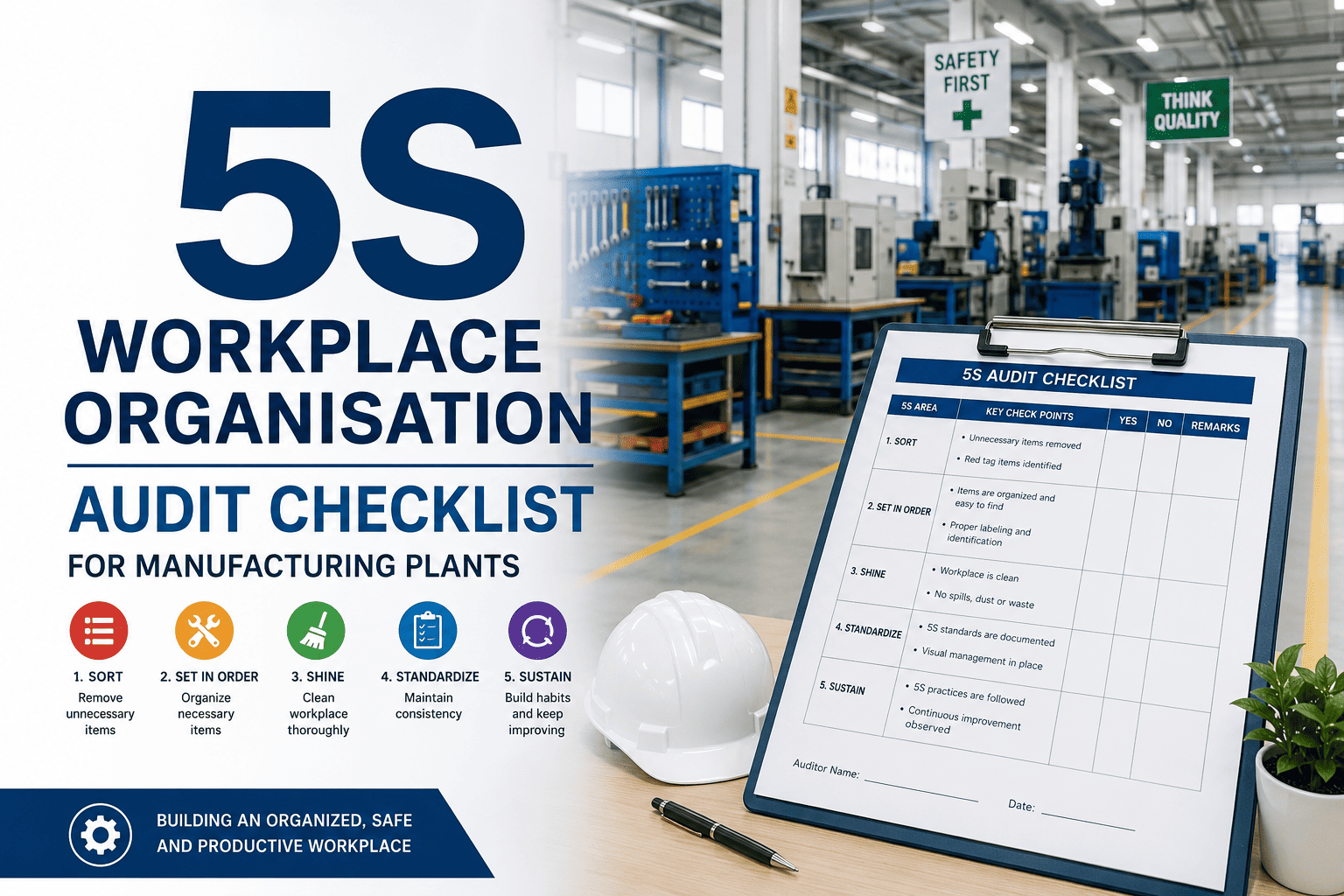
5S Workplace Organisation Audit Checklist for Manufacturing Plants
Score-based assessment framework evaluating Sort, Set in Order, Shine, Standardise, and Sustain across production areas, warehouses, and support zones with quantified improvement tracking.
30%
Reduction in safety incidents with sustained 5S
25%
Faster material retrieval in organized workspaces
90 days
Time to workplace erosion without audits
Monthly
Recommended formal audit frequency
5S Scoring System Guide
Each audit item receives a score from 0 to 5 based on observed conditions. Aggregate scores by pillar and zone to identify improvement priorities and track month-over-month progress.
5
Exceptional — Exceeds standard, visible innovation
4
Fully Compliant — Meets all standard requirements
3
Acceptable — Minor gaps, no safety impact
2
Poor — Multiple deficiencies, corrective action needed
1
Critical — Major non-compliance, immediate action required
0
Not Implemented — Standard absent or ignored
Pillar 01 — Sort (Seiri)
Sort: Eliminate Unnecessary Items
The Sort pillar focuses on removing items that do not add value to current operations. Red-tagging campaigns identify obsolete tools, expired materials, and redundant equipment that consume workspace and create visual clutter.
Score 0-5
Only necessary tools and materials present in work area — no obsolete equipment, unused fixtures, or expired inventory visible
Evidence: Visual inspection · Red-tag count · Auditor: Production Supervisor
Score 0-5
Personal items restricted to designated lockers — no unauthorized storage of personal belongings at workstations
Evidence: Workstation check · Auditor: Shift Lead
Score 0-5
Aisles and walkways completely clear — no materials staged in passageways or temporary overflow storage blocking egress
Evidence: Aisle width verification · Auditor: Safety Officer
Score 0-5
Broken or non-functional equipment removed immediately — no awaiting repair items stored indefinitely in production areas
Evidence: Equipment status tags · Auditor: Maintenance Coordinator
Score 0-5
Raw materials and work-in-process stored at minimum necessary quantities — excess inventory removed to central storage
Evidence: Inventory count vs standard · Auditor: Materials Handler
Score 0-5
Expired materials and obsolete parts segregated and removed — no outdated consumables or discontinued components in active storage
Evidence: Date code verification · Auditor: Quality Technician
Pillar 02 — Set in Order (Seiton)
Set in Order: Organize and Label
Set in Order ensures every item has a designated location with clear identification. Shadow boards, floor markings, and labeling systems allow any team member to locate tools and return them correctly without supervision.
Score 0-5
All tools stored in designated locations — shadow boards or tool foam accurately outline each tool position
Evidence: Visual match to shadow · Auditor: Tooling Coordinator
Score 0-5
Labels legible and current — all storage locations identified with clear text, no faded or missing labels
Evidence: Label condition check · Auditor: Production Supervisor
Score 0-5
Floor markings intact and visible — aisle boundaries, storage zones, and safety areas clearly delineated with fresh paint or tape
Evidence: Line condition survey · Auditor: Facilities Team
Score 0-5
Frequently used items positioned within easy reach — high-frequency tools stored at waist height, low-frequency items on upper shelves
Evidence: Ergonomic assessment · Auditor: Industrial Engineer
Score 0-5
Work instructions posted at point of use — current procedures visible and accessible without leaving workstation
Evidence: Procedure availability check · Auditor: Quality Supervisor
Score 0-5
Color coding system consistently applied — materials, tools, and zones use standardized colors per facility visual standard
Evidence: Color code compliance · Auditor: Lean Coordinator
Automate your 5S audit schedule and scoring with mobile checklists that calculate pillar scores in real time — track improvement trends month-over-month across all production zones.
Pillar 03 — Shine (Seiso)
Shine: Clean and Inspect
Shine combines cleaning with inspection. Regular cleaning exposes developing equipment issues, leaks, and damage that are hidden by dirt and debris, turning routine housekeeping into predictive maintenance.
Score 0-5
Work surfaces clean and free of debris — no accumulated dust, metal shavings, or process residue on equipment or benches
Evidence: White-glove test · Auditor: Production Supervisor
Score 0-5
Floors swept and free of spills — no oil patches, coolant drips, or slip hazards present in production aisles
Evidence: Floor condition check · Auditor: Safety Officer
Score 0-5
Equipment wiped down and inspected — machines cleaned daily with inspection for leaks, cracks, and wear during cleaning process
Evidence: Cleaning log with findings · Auditor: Maintenance Technician
Score 0-5
Cleaning tools and supplies properly stored — brooms, mops, and cleaning agents returned to designated locations after use
Evidence: Cleaning station check · Auditor: Shift Lead
Score 0-5
No active fluid leaks present — hydraulic, pneumatic, coolant, and lubricant systems inspected with no visible drips or pooling
Evidence: Leak inspection record · Auditor: Mechanical Technician
Score 0-5
Damaged or worn components tagged for repair — cracked guards, loose fasteners, and worn parts identified during cleaning
Evidence: Defect tags issued · Auditor: Equipment Operator
Pillar 04 — Standardise (Seiketsu)
Standardise: Create Consistency
Standardise embeds the first three S principles into documented procedures and visual standards. Without standardization, workplace organization depends on individual effort and collapses during staff turnover or production pressures.
Score 0-5
5S standards documented and accessible — written procedures or visual guides available at each workstation defining expected conditions
Evidence: Procedure availability · Auditor: Training Coordinator
Score 0-5
All team members trained on area-specific 5S requirements — training records current for 100% of assigned personnel
Evidence: Training matrix · Auditor: HR / Training Manager
Score 0-5
Responsibility assignments clearly posted — zone owners and 5S champions identified with names and photos visible in each area
Evidence: Responsibility board check · Auditor: Lean Manager
Score 0-5
Before-and-after photos displayed — visual reference images show acceptable vs unacceptable conditions for each zone
Evidence: Visual standard boards · Auditor: Production Supervisor
Score 0-5
Checklists and schedules posted — daily cleaning tasks and weekly audit dates visible with completion tracking
Evidence: Schedule board review · Auditor: Shift Lead
Pillar 05 — Sustain (Shitsuke)
Sustain: Maintain and Improve
Sustain measures whether 5S discipline persists over time without direct supervision. Sustainment requires leadership reinforcement, audit accountability, and visible recognition of high-performing zones.
Score 0-5
Standards consistently followed between audits — no evidence of temporary cleanup before scheduled inspections
Evidence: Unannounced spot checks · Auditor: Plant Manager
Score 0-5
Corrective actions from previous audits completed — all findings closed with documented evidence within agreed timelines
Evidence: Action item closure rate · Auditor: Continuous Improvement Lead
Score 0-5
Audit scores improving or stable month-over-month — trend analysis shows sustained performance without regression
Evidence: Historical score tracking · Auditor: Lean Manager
Score 0-5
Management visibly participates in 5S activities — leadership conducts gemba walks and reviews audit results with teams
Evidence: Gemba walk log · Auditor: Operations Manager
Score 0-5
Recognition system active — top-performing zones acknowledged through awards, communication boards, or incentive programs
Evidence: Recognition records · Auditor: HR / Plant Manager
Scoring Benchmarks
5S Audit Score Interpretation
Practitioner Insights
What Lean Managers Say About 5S Audits
01
The failure mode of most 5S programs is treating audits as punitive inspection rather than coaching opportunities. When supervisors walk the floor with teams and explain the why behind each standard, scores improve 30% within two cycles because people understand the purpose.
Continuous Improvement Manager, Electronics Manufacturing
02
Digital 5S audits with photo evidence changed our culture. Paper forms allowed score inflation and memory disputes. Now every score links to a timestamped photo, and teams cannot argue about baseline conditions when improvement photos sit right next to them.
Plant Manager, Automotive Component Supplier
03
Sustain is the hardest pillar because it requires changing behavior, not just organizing tools. We publish audit scores in the cafeteria and celebrate top performers at monthly meetings. Peer recognition drives consistency better than any policy ever did.
Lean Coordinator, Food Processing Facility
Common Questions
5S Audit Frequently Asked Questions
How often should formal 5S audits be conducted?
Formal scored audits should occur monthly for each production zone, with weekly spot checks by shift supervisors. New 5S implementations require weekly formal audits for the first 90 days to reinforce standards and catch erosion early. High-traffic or critical areas may benefit from twice-monthly audits during initial rollout.
Who should conduct 5S audits?
Audits should rotate between supervisors, lean coordinators, and cross-functional team members to prevent bias and bring fresh perspectives. Avoid having zone owners audit their own areas. Best practice includes peer audits where production teams audit adjacent zones, creating accountability and knowledge sharing across departments. Consider
digital audit assignment features for rotation tracking.
What score indicates 5S program health?
Mature 5S programs should maintain facility-wide average scores above 80% with no individual zone below 70%. Scores below 60% indicate a zone requiring immediate intervention. More important than absolute score is trend direction — consistent month-over-month improvement demonstrates cultural adoption even if starting from a low baseline.
How do you prevent score inflation in 5S audits?
Score inflation happens when auditors are pressured to show improvement or when standards lack objective criteria. Prevent this by using photo-documented evidence for each scored item, rotating auditors regularly, conducting random spot-checks by senior leadership, and defining clear scoring rubrics with visual examples for each score level.
Digital platforms with mandatory photo requirements eliminate inflation by creating objective records.
What is the biggest mistake in 5S implementation?
The biggest mistake is launching 5S as a one-time cleanup event rather than a continuous discipline. Facilities hold cleanup days, take before photos, celebrate completion, then abandon auditing. Without monthly scored audits and visible leadership reinforcement, workplaces revert to baseline within 12 weeks. Sustainment requires permanent audit schedules and accountability systems.
Transform 5S Audits into Data-Driven Improvement
OxMaint digitizes your 5S audit process with mobile scoring, automatic calculations, photo documentation, and trend dashboards that show month-over-month progress across all zones. Eliminate paper forms and prove continuous improvement to leadership and customers.