A well-designed maintenance department structure is the operational backbone of every high-performing manufacturing plant. When roles are clearly defined, reporting lines are logical, and KPIs are assigned at every level, maintenance teams respond faster, reduce unplanned downtime, and deliver measurable cost savings. Yet most plants still run with informal team structures built on habit rather than design — creating accountability gaps, shift handover failures, and reactive maintenance cultures that drain profitability. OxMaint helps plant managers and reliability leaders build structured, data-driven maintenance operations by replacing fragmented workflows with a connected CMMS that organizes work orders, PM schedules, asset records, and team performance in one platform. Sign Up Free to see how OxMaint structures your maintenance team's daily operations, or Book a Demo to explore how plant managers use OxMaint to redesign their maintenance department for maximum efficiency.
Structure Your Maintenance Team Around a Live CMMS
OxMaint gives every role in your maintenance department — from planner to technician — a connected platform for work orders, PM schedules, and real-time asset data. Stop managing teams through spreadsheets and shift handover notes.
Why Maintenance Department Structure Determines Plant Performance
An unstructured maintenance team creates invisible costs — duplicated work orders, missed PMs, unowned assets, and no clear escalation path when critical equipment fails. A properly designed maintenance org chart aligns every technician, supervisor, and planner to defined responsibilities and measurable outcomes. Without this alignment, even well-funded maintenance programs underperform. OxMaint connects your org structure directly to operations — each role in your hierarchy gets the right level of access, the right work queue, and the right KPI visibility. Book a Demo to see how maintenance directors use OxMaint to assign accountability across multi-shift plant environments.
Unstructured Maintenance Team
No clear ownership of assets or areas
Breakdown responses depend on who is available
PM completion relies on individual memory
KPIs tracked manually — if tracked at all
Shift handovers lose critical equipment context
Outsourcing decisions made without cost data
OxMaint-Structured Team
Every asset assigned to a named trade or technician
Breakdown work orders routed by criticality and role
PM schedules auto-generated per asset and interval
Live KPI dashboards per team, shift, and department
Digital shift handover with full work order history
Asset lifecycle cost data supports make-vs-buy decisions
Core Roles in a Manufacturing Maintenance Department
Effective plant maintenance team organization starts with clearly defined roles at each level. Below are the core positions every structured maintenance department should include — with responsibilities mapped to OxMaint's workflow model. Sign Up Free to configure your team roles and permission levels inside OxMaint today.
Maintenance Manager / Director
Owns the department budget, headcount planning, and KPI performance. Sets maintenance strategy, approves capital work, and reviews reliability reports. In OxMaint: full dashboard access, compliance export, cost analysis.
Maintenance Planner / Scheduler
Plans and schedules all preventive and corrective work orders. Coordinates parts, tools, and contractor access. In OxMaint: creates PM task lists, manages work order backlogs, and tracks schedule compliance.
Maintenance Supervisor
Manages shift teams and daily work order execution. Handles escalations and coordinates emergency breakdowns. In OxMaint: assigns and prioritizes work orders, monitors technician progress in real time.
Reliability Engineer
Analyzes failure patterns, drives RCA investigations, and optimizes PM frequencies. In OxMaint: accesses full asset maintenance history, failure data, and MTTR/MTBF analytics to guide proactive decisions.
Trade Technicians
Execute mechanical, electrical, HVAC, and instrumentation work orders. Record work completed, parts used, and observations in the field. In OxMaint: receive mobile work orders, log time, parts, and close tasks with photos.
Stores / Parts Controller
Manages spare parts inventory levels, reorder points, and vendor relationships. In OxMaint: parts linked directly to assets and work orders — consumption tracked automatically against each job completed.
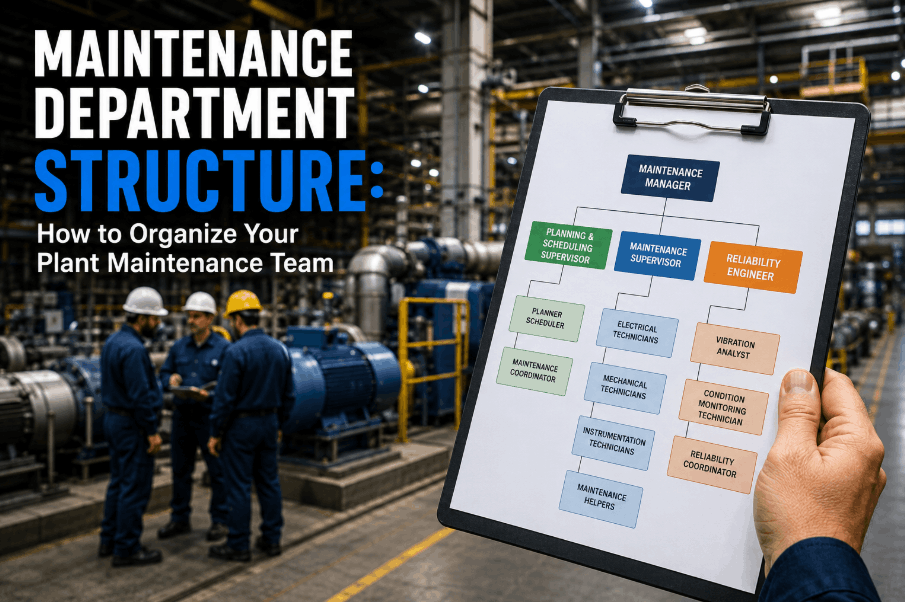
Maintenance Department Hierarchy: Org Chart Structure
Maintenance Manager / Director
Reliability Engineer
Maintenance Planner / Scheduler
Stores / Parts Controller
Maintenance Supervisor — Day Shift
Maintenance Supervisor — Night Shift
Mechanical Tech
Electrical Tech
HVAC Tech
Instrumentation Tech
Shift Patterns and Coverage Models for Plant Maintenance
Model 01
Day Shift Only
Suitable for single-shift plants. Full maintenance team available during production. On-call coverage outside hours. Best for low-criticality asset environments.
Model 02
Dual Shift Coverage
Day and afternoon shifts staffed with maintenance technicians. Planned PMs during off-peak windows. Supervisor per shift with shared planner resource.
Model 03
24/7 Rotating Crew
Three or four rotating crews with full trade coverage at all times. Required for continuous process plants. Digital shift handover critical to prevent knowledge loss.
Model 04
Hybrid In-House and Contract
Core in-house team handles routine and critical work. Specialist contractors brought in for shutdowns, capital projects, and low-frequency OEM-specific tasks.
Maintenance KPIs by Role and Department Level
Scroll →
| Role / Level |
Primary KPIs |
OxMaint Data Source |
Review Frequency |
| Maintenance Manager |
Maintenance cost per unit, OEE impact, budget vs. actual |
Cost reports, asset lifecycle analysis |
Monthly |
| Reliability Engineer |
MTBF, MTTR, repeat failure rate, PM compliance % |
Asset maintenance history, failure log |
Weekly |
| Maintenance Planner |
Schedule compliance, backlog hours, work order aging |
Work order queue, PM completion data |
Weekly |
| Maintenance Supervisor |
Work order completion rate, response time, open breakdowns |
Live work order dashboard |
Daily |
| Trade Technician |
Tasks completed, PM tasks closed on time, parts accuracy |
Mobile work order records |
Per shift |
Outsourcing vs. In-House: Structuring the Right Maintenance Model
Keep In-House
Critical Asset Maintenance
Equipment directly tied to production output. In-house teams respond faster, accumulate asset-specific knowledge, and reduce dependency on third-party availability.
Consider Contract
Specialist Trade Work
Low-frequency OEM tasks, statutory inspections, high-voltage electrical, pressure vessel testing. Use contractors where licensing or infrequency makes in-house cost prohibitive.
Hybrid Model
Shutdown and Capital Work
Planned shutdowns and capital projects require surge capacity. In-house teams coordinate and supervise; contractors provide volume labor under maintenance manager oversight.
Evaluate with Data
Using OxMaint Cost Analysis
OxMaint tracks per-asset maintenance cost over time — giving managers the data to compare in-house labor cost against contract rates for any equipment category or trade.
How OxMaint Supports Every Level of Your Maintenance Department
One Platform
All roles — manager, planner, supervisor, technician — connected in a single CMMS with role-based access
34%
Average reduction in unplanned downtime within 90 days of structured PM program deployment on OxMaint
Live KPIs
Real-time dashboards for every level — shift technician to maintenance director — without manual reporting
Mobile-First
Technicians receive, execute, and close work orders from the shop floor — no paper, no radio, no delays
Build a Maintenance Department That Runs on Data, Not Memory
OxMaint gives every role in your plant maintenance team a connected digital workflow — from technician on mobile to manager on dashboard. See how manufacturing plants use OxMaint to redesign their maintenance org structure and onboard their first maintenance team today.
Frequently Asked Questions
What is the ideal maintenance department structure for a mid-size manufacturing plant?
A mid-size plant typically needs a maintenance manager, one planner/scheduler, two shift supervisors, trade technicians per discipline, and a reliability engineer for PM optimization. OxMaint supports this structure with role-based access and per-shift work order queues.
How do I assign KPIs to each role in my maintenance team?
KPIs should align to each role's control — technicians own task completion rates, supervisors own response time, planners own schedule compliance, and managers own cost and OEE. OxMaint auto-generates these metrics per role from live work order data.
Should maintenance report to operations or have its own reporting line?
Best practice for complex plants is a standalone maintenance department reporting directly to plant management — preserving independence for safety, compliance, and asset reliability decisions. OxMaint supports either structure through configurable role hierarchies.
How does OxMaint handle shift handovers in a 24/7 maintenance environment?
OxMaint maintains a live work order log and asset status visible across all shifts. Outgoing supervisors close or defer tasks with notes; incoming supervisors see the full picture instantly — no verbal handover gaps.
How quickly can a maintenance team get structured and operational in OxMaint?
Most teams are fully onboarded — roles configured, assets imported, PMs linked, and technicians live on mobile — within one to two weeks.
Sign Up Free and follow the guided setup, or
Book a Demo for a structured onboarding walkthrough.
Free to Start — No Credit Card Required
Every Role. Every Shift. Every Asset — Managed in One Maintenance Platform.
OxMaint replaces fragmented maintenance team workflows with a structured, role-based CMMS built for plant operations. Start organizing your maintenance department today.
-in-manufacturing.png)
.png)

.png)