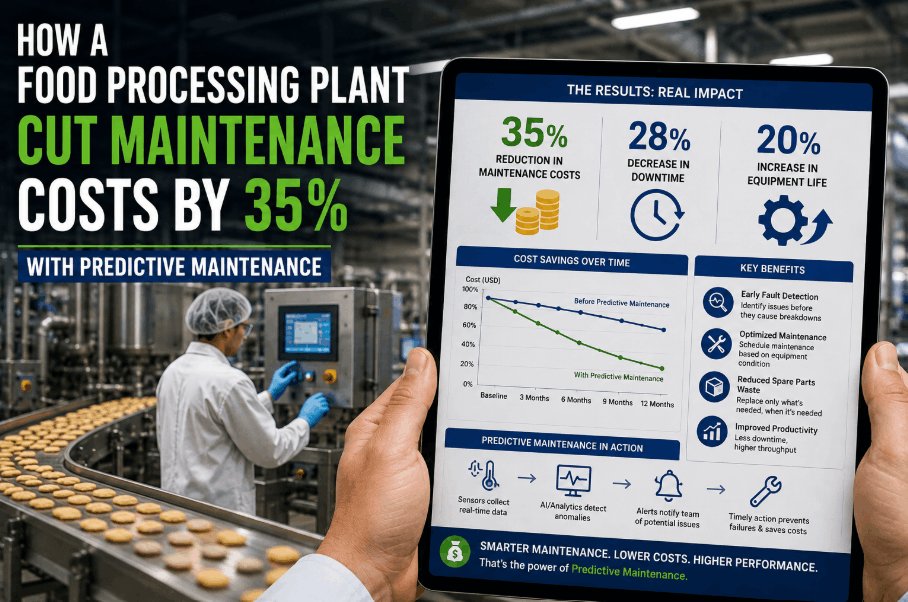
A mid-size food processing manufacturer in the U.S. Midwest was bleeding over $2.1 million annually in avoidable maintenance costs — driven by unplanned line stoppages, reactive repairs, and mounting FSMA compliance exposure. Scheduled PMs were missing the mark, equipment was failing between inspections, and every emergency repair added hours of production loss and documentation chaos. Within nine months of deploying Oxmaint's predictive maintenance platform, the plant reduced total maintenance costs by 35%, eliminated unplanned downtime on three critical filling lines, and completed its first zero-violation FSMA audit cycle. Book a Demo to see how Oxmaint applies to your food processing operation.
See What Oxmaint Can Do for Your Plant
Food manufacturers trust Oxmaint to reduce downtime, cut maintenance costs, and stay FSMA-compliant — all in one platform.
The Challenge
Reactive Maintenance Was Draining Margins and Risking Compliance
$2.1M
Annual maintenance-related cost burden across filling, conveying, and refrigeration systems
620 hrs
Unplanned downtime annually across 9 critical food-grade production assets
71%
Average OEE — below the 78–85% benchmark for high-throughput food processing
4–9 hrs
Average repair duration per breakdown including sanitation re-certification delays
The facility ran 300+ production days per year across two to three shifts, processing packaged goods for retail distribution. Equipment included rotary fillers, inline conveyors, industrial refrigeration compressors, CIP systems, and automated labeling units. Beyond operational losses, every unplanned breakdown triggered a mandatory sanitation inspection and documentation cycle under FSMA — extending downtime by 1.5–3 hours per incident and creating audit trail gaps that put compliance status at risk. Sign Up Free to start monitoring your food processing equipment today.
The Solution
AI Predictive Maintenance Built for Food Manufacturing — From Sensor to Work Order
01
Food-Grade Sensor Deployment on Critical Assets
Vibration and temperature sensors installed on rotary fillers, refrigeration compressors, and conveyor drive motors. Current monitoring applied to all motors above 3kW. Wireless, IP69K-rated units required no equipment modification or production stoppage — 67 sensor points deployed across 9 assets in under three weeks.
02
AI Model Training on Failure Patterns and Seasonal Load Cycles
Oxmaint's machine learning algorithms trained on 22 months of historical maintenance records, breakdown logs, and seasonal production schedules. Models established baseline operating signatures per asset, accounting for load variance during peak production runs — enabling accurate anomaly detection even under variable throughput conditions.
03
Real-Time Monitoring with Compliance-Linked Alert Workflows
Continuous sensor analysis triggers mobile alerts ranked by urgency and asset criticality. Maintenance supervisors and QA leads receive simultaneous notifications when food-contact equipment shows degradation patterns — allowing proactive intervention before failure, and before a mandatory sanitation reset is triggered mid-production.
Book a Demo to see the alert workflow live.
04
FSMA-Ready Digital Work Orders and Maintenance Logs
Every predictive alert auto-generates a structured work order with fault diagnosis, recommended action, required parts, and estimated labor. Completed work orders are digitally timestamped and stored in Oxmaint's audit-ready maintenance log — providing inspectors with complete, organized maintenance history without manual documentation backfill.
Measured Results
35% Cost Reduction and Zero FSMA Violations — Nine-Month Performance Data
71% → 86%
OEE improvement from baseline to month 9 post-deployment across monitored filling lines
35%
Total maintenance cost reduction — exceeding the initial target of 25%
620 → 340 hrs
Unplanned downtime reduction — 45% decrease through predictive interventions
0 Violations
FSMA audit findings in the first full compliance cycle post-implementation
Cost-Benefit Breakdown
Implementation Cost
$148,000
Sensors, platform licenses, integration, and training over 6 weeks
Annual Savings
$1.94M
$1.47M production recovery + $315K maintenance cost reduction + $155K compliance risk avoided
Payback Period
7.2 months
Full cost recovery from deployment start through avoided losses and reduced labor
Three-Year ROI
1,290%
Total benefit $5.82M against $148K implementation cost over 36 months
Cut Maintenance Costs and Protect Compliance — Starting Today
Oxmaint gives food manufacturers real-time equipment visibility, predictive failure alerts, and FSMA-ready digital maintenance records in one platform.
Sign Up Free and start your free trial with deployment consultation included.
Technical Implementation
How AI Caught Critical Failures Before They Hit the Production Floor
Case 1
Rotary Filler Bearing Wear Detection
Asset
12-head rotary liquid filler — beverage packaging line
Detection
Vibration amplitude up 31% over 8 days — Oxmaint alert triggered at day 6
Action
Bearing replaced during scheduled Saturday sanitation window
Outcome
Avoided 14-hour mid-week shutdown including mandatory CIP cycle
Case 2
Refrigeration Compressor Overload Risk
Asset
Industrial ammonia refrigeration compressor — cold storage unit
Detection
Discharge temperature trending up — valve seal degradation signature with 12-day lead time
Action
Seal kit procured and installed during planned downtime window
Outcome
Prevented compressor failure — avoided $80K+ in product spoilage exposure
Case 3
Conveyor Drive Motor Current Imbalance
Asset
Main packing conveyor drive motor — end-of-line packaging
Detection
Phase current asymmetry indicating rotor wear — flagged 9 days before projected failure
Action
Motor serviced and lubricated — rotor bearing within tolerance post-service
Outcome
Extended motor life by 7+ months and avoided unscheduled line stoppage
Before vs After
Maintenance Performance Transformation — Key Metrics Comparison
| Performance Metric |
Before Oxmaint |
After 9 Months |
Improvement |
| Overall Equipment Effectiveness |
71% |
86% |
+15 percentage points |
| Unplanned Downtime Hours/Year |
620 hours |
340 hours |
-45% reduction |
| Mean Time Between Failures |
32 days |
68 days |
+113% increase |
| Average Repair Duration |
7.4 hours |
3.1 hours |
-58% reduction |
| Maintenance Cost per Production Hour |
$38.20 |
$24.80 |
-35% reduction |
| Emergency Spare Parts Orders |
52 per year |
11 per year |
-79% reduction |
| FSMA Audit Violations |
3–5 findings/cycle |
0 findings |
100% clean cycle |
| Predictive Alert Accuracy |
N/A |
89% |
New capability |
Plant Director Perspective
What Changed on the Production Floor
"
Before Oxmaint, every breakdown was a fire drill — and in food processing, that fire drill comes with a mandatory sanitation reset and a compliance clock ticking in the background. Now our maintenance team plans two weeks ahead. Work orders arrive with the parts already reserved and the procedure already written. Our FSMA audit this year was the cleanest in eight years because every intervention was documented automatically. We didn't just cut costs — we changed how this plant operates. The ROI paid for itself before we even finished the first quarter review.
Book a Demo if you want to see what that actually looks like in practice.
Platform Capabilities
Oxmaint Features That Delivered These Results in Food Manufacturing
AI Monitoring
Real-Time Equipment Health for Food Lines
Continuous sensor analysis across fillers, compressors, conveyors, and CIP systems. ML models detect degradation patterns 7–21 days before failure — giving maintenance teams time to act without triggering a production stoppage or sanitation reset.
FSMA Compliance
Audit-Ready Digital Maintenance Records
Every work order is digitally timestamped, linked to the triggering alert, and stored in a structured maintenance log. Oxmaint gives FSMA auditors an organized, complete maintenance history — eliminating manual documentation and compliance gaps.
Sign Up Free to set up your compliance log.
Predictive Alerts
Failure Prediction with Lead Time Estimates
Oxmaint predicts not just that failure will occur — but when. Alerts include estimated time to failure, allowing maintenance planning around production schedules, sanitation windows, and shift changeovers without disrupting throughput.
Parts Integration
Automated Spare Parts Reservation
Predictive alerts cross-reference spare parts availability automatically. If stock is low, procurement alerts are raised with the failure date as context — eliminating the emergency orders and expediting fees that inflate maintenance budgets in reactive environments.
Work Planning
Auto-Generated Predictive Work Orders
Work orders are created automatically from alerts — pre-populated with fault diagnosis, recommended procedure, required parts, and labor estimates. Technicians arrive prepared rather than diagnosing on site, cutting average repair time by more than half.
OEE Analytics
Downtime Tracking with Cost Impact Quantified
Real-time OEE by asset, line, and plant level. Every downtime event is tracked by root cause with production cost impact calculated automatically — giving plant managers the data to justify maintenance investment to corporate finance teams.
Common Questions
Food Plant Managers Ask These Before Deploying Oxmaint
Can Oxmaint integrate with our existing ERP or food safety management systems?
Yes. Oxmaint integrates with SAP, Oracle, Microsoft Dynamics, and major food safety platforms via API. Work orders, parts consumption, and maintenance logs can sync directly to your ERP maintenance module — eliminating duplicate data entry.
How does Oxmaint help with FSMA compliance documentation?
Every Oxmaint work order is digitally timestamped and linked to the sensor alert that triggered it. This creates an automatic, structured audit trail covering what was detected, when it was acted on, and what was done — fully ready for FSMA inspections without manual backfill.
How long does deployment take in a food processing environment?
Most food plant deployments are completed in 3–5 weeks. Sensors are wireless and food-grade rated, requiring no equipment modification or production shutdown. AI model training begins immediately using your existing historical maintenance data.
What is the typical ROI timeline for food manufacturers?
Food processing plants typically see positive ROI within 6–9 months. Savings come from avoided downtime, fewer emergency repairs, lower parts expediting costs, and reduced compliance risk. The case study plant reached full payback in 7.2 months.
Sign Up Free to model your plant's potential savings.
How accurate are Oxmaint's failure predictions for food processing equipment?
Alert accuracy typically starts at 65–70% in month one and reaches 85–92% by month four as the AI learns your equipment's baseline patterns. Lead times range from 7–21 days depending on failure mode and asset type.
Stop Losing Production Hours to Predictable Equipment Failures
Food manufacturers using Oxmaint reduce maintenance costs by 30–40%, cut unplanned downtime by 40–50%, and complete FSMA audits with zero documentation gaps. Your equipment is already signaling when it will fail —
Book a Demo and let Oxmaint start listening. Free trial includes sensor deployment consultation and AI model setup on your historical data.
-in-manufacturing.png)
.png)

.png)