Poor lubrication practices cause 80% of premature bearing failures in manufacturing plants — and most of those failures could have been prevented with a structured lubrication programme. When lubricant selection, application frequency, and contamination control are left to informal habits rather than documented procedures, equipment reliability becomes a lottery. Facilities that implement formal lubrication management see bearing life extend by 3 to 5 times and lubricant waste drop by 40%. This checklist structures your lubrication programme around the six pillars of world-class lubricant management: storage hygiene, application procedures, contamination prevention, route optimisation, data capture, and continuous improvement. Use OxMaint's lubrication tracking system to schedule routes, track consumption, and flag overdue tasks before they become failures.
Lubrication Excellence · Reliability Engineering · Asset Performance
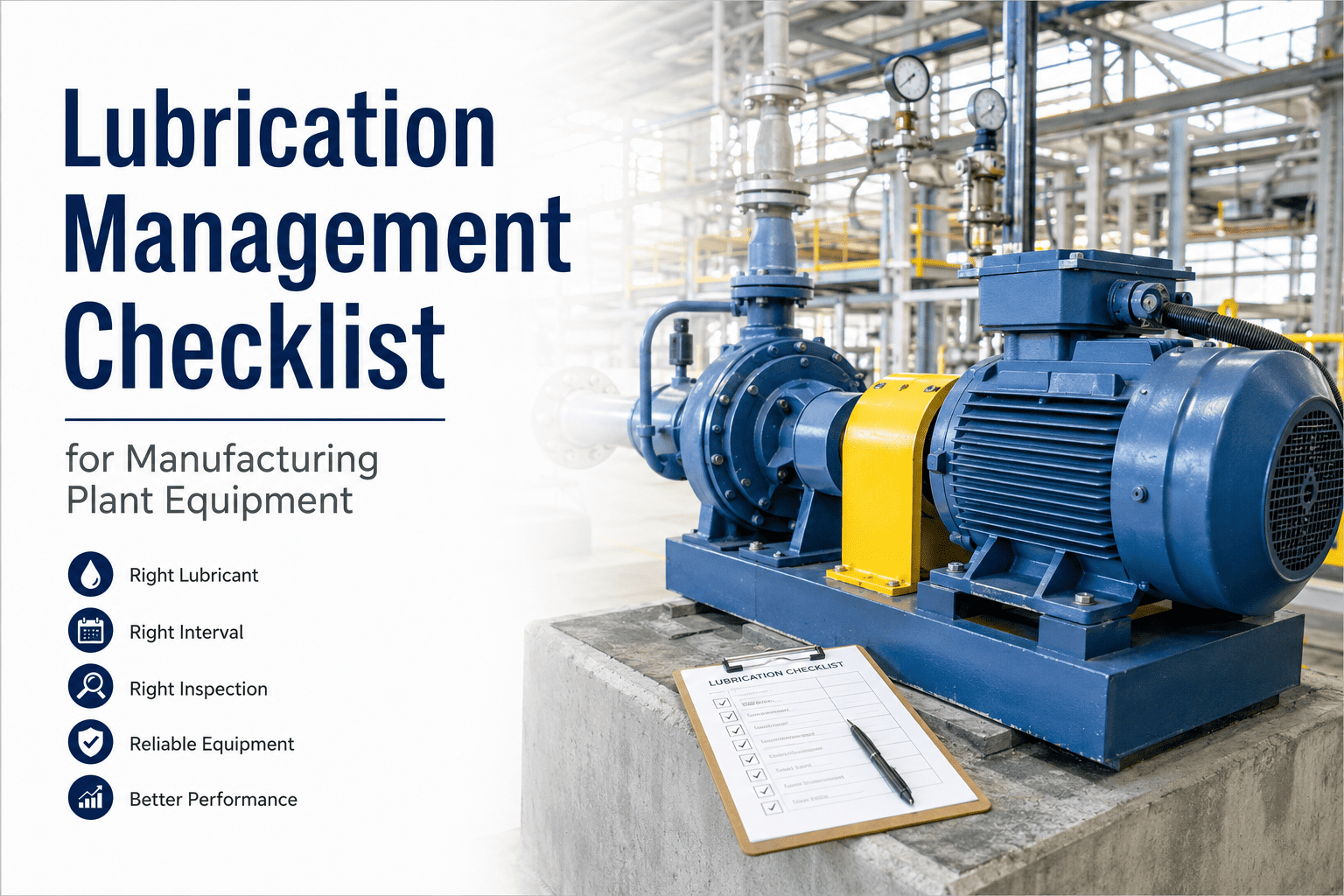
Lubrication Management Checklist for Manufacturing Plant Equipment
Six control pillars. One structured programme. Built for lubrication technicians, reliability engineers, and maintenance planners who need bearing life measured in years, not months.
80%
Of bearing failures caused by poor lubrication practices
3-5x
Bearing life extension with proper lubrication management
40%
Reduction in lubricant waste with route-based programmes
6 Pillars
Critical control areas in this lubrication checklist
Pillar 01
Lubricant Storage and Handling
Contaminated lubricants cause more damage than no lubrication at all. Water, dirt, and metal particles turn precision lubricants into abrasive slurries that accelerate wear by 10 to 20 times normal rates.
Lubricant storage room maintained between 15°C and 25°C with relative humidity below 50% — temperature swings cause condensation inside sealed containers
Action Owner: Storekeeper · Check: Weekly · Record: Storage conditions log
All lubricant containers stored horizontally with bungs at 3 and 9 o'clock position to prevent water pooling on seals; drums never stored upright outdoors
Action Owner: Warehouse Team · Standard: ISO 4406 cleanliness · Check: Daily
Colour-coded dispensing equipment assigned per lubricant type — never use the same pump for synthetic and mineral oils; cross-contamination voids lubricant warranties
Action Owner: Lubrication Technician · Standard: NLGI guidelines · Record: Equipment register
Desiccant breathers installed on all bulk oil storage tanks — replace silica gel when colour indicator shows 70% saturation or every 6 months
Action Owner: Utilities Technician · Check: Monthly · Record: Breather change log
Grease gun nozzles wiped clean before and after every application; grease stored in sealed cartridges, never decanted into open containers
Action Owner: Lubrication Technician · Standard: NLGI EP2 handling · Check: Every use
Pillar 02
Lubricant Selection and Specification
Using the wrong lubricant is as destructive as using none at all. Viscosity mismatches, incompatible additives, and temperature-range errors cause rapid equipment degradation.
Lubricant master list maintained and current — every asset tagged with lubricant type, ISO viscosity grade, NLGI number, and re-lubrication interval
Action Owner: Reliability Engineer · Record: Lubricant register · Update: Quarterly
Bearing lubrication charts displayed at every lubrication point — charts show lubricant type, quantity in grams or shots, and frequency per OEM specifications
Action Owner: Maintenance Planner · Standard: OEM maintenance manuals · Check: Monthly
Grease compatibility verified before any product substitution — lithium and calcium greases are not interchangeable; mixing incompatible greases causes soap separation
Action Owner: Lubrication Engineer · Standard: NLGI compatibility chart · Record: Change log
Stop Guessing. Start Tracking Every Lubrication Task Digitally.
OxMaint schedules lubrication routes by asset, tracks grease shots per bearing, and alerts you when tasks are overdue. No spreadsheets. No paper rounds that disappear.
Pillar 03
Lubrication Application Procedures
Correct lubricant applied incorrectly delivers zero reliability benefit. Over-greasing destroys seals, under-greasing starves bearings, and contaminated application tools introduce abrasive particles.
Grease quantity measured in calibrated shots or grams using grease meters — never apply grease based on time or until it purges from seals; that causes over-packing
Action Owner: Lubrication Technician · Tool: Grease meter · Standard: 1 shot = 1 gram
Bearing temperature monitored during greasing on high-speed equipment — stop greasing if temperature rises more than 5°C; excess grease causes churning and heat
Action Owner: Condition Monitoring Tech · Tool: Infrared thermometer · Check: During application
Relief plugs opened during greasing on sealed bearings — allows old grease to purge without over-pressurising bearing housing; close relief plug after purge stops
Action Owner: Mechanical Technician · Standard: SKF lubrication guide · Frequency: Every application
Oil level checked with equipment stopped and at operating temperature — thermal expansion changes apparent oil level by up to 15% between cold and hot states
Action Owner: Lubrication Technician · Check: Before every top-up · Record: Oil level log
Filter elements inspected before oil changes — metal particles in old filters indicate wear; photograph and send samples to reliability engineer for failure analysis
Action Owner: Lubrication Technician · Tool: Filter cutter · Record: Filter inspection photos
Pillar 04
Contamination Control Programme
Contamination is the leading cause of lubricant degradation. A single tablespoon of dirt in a gearbox oil sump can reduce gear life by 50%.
Bearing housings fitted with labyrinth seals or contact seals appropriate to environment — open bearings in dusty areas fail 10 times faster than sealed bearings
Action Owner: Mechanical Engineer · Standard: ISO 16587 seal selection · Check: Annual review
Oil analysis samples taken using dedicated sampling valves installed mid-stream — never sample from drain plugs or sight glasses; those locations give unrepresentative results
Action Owner: Reliability Technician · Standard: ASTM D4057 sampling · Frequency: Quarterly
Inline oil filters maintained at ISO 16/14/11 cleanliness or better for hydraulic systems; cleanliness codes verified by particle count analysis every 6 months
Action Owner: Hydraulics Engineer · Standard: ISO 4406 · Record: Particle count reports
Pillar 05
Lubrication Route Optimisation
Lubrication efficiency multiplies when tasks are grouped geographically and scheduled by actual need rather than arbitrary calendar intervals.
Lubrication routes planned to minimise travel time between points — group tasks by area and lubricant type; a well-planned route covers 40 to 60 points per shift
Action Owner: Maintenance Planner · Tool: Route planning software · Update: Monthly
Task frequencies based on equipment criticality and operating conditions — high-speed bearings need weekly attention; slow-speed gearboxes may need quarterly checks
Action Owner: Reliability Engineer · Standard: RCM analysis · Review: Annually
Lubrication tasks completed during planned production windows — never interrupt running equipment for routine greasing; schedule during changeovers or breaks
Action Owner: Production Scheduler · Coordination: Weekly planning meeting · Record: Task completion log
Pillar 06
Data Capture and Continuous Improvement
Lubrication programmes improve only when performance is measured. Tracking consumption, monitoring failures, and analysing trends reveal where the programme succeeds and where it fails.
Lubricant consumption tracked per asset per month — sudden increases indicate leaks or over-application; decreases suggest missed tasks or equipment modifications
Action Owner: Storekeeper · Tool: Inventory system · Report: Monthly variance report
Bearing failure root causes analysed and recorded — if lubrication-related failures exceed 10% of total bearing replacements, the programme needs immediate review
Action Owner: Reliability Engineer · Standard: ISO 15243 failure analysis · Review: Quarterly
Oil analysis trending charts maintained per asset — track viscosity, water content, particle count, and acid number; flag any parameter moving outside alarm limits
Action Owner: Condition Monitoring Analyst · Tool: CMMS trending module · Update: Every sample
Performance Tracking
Lubrication Programme KPIs
| Performance Indicator |
Measurement Method |
Target Value |
Review Frequency |
| Route Completion Rate |
Tasks completed on time / Total scheduled tasks |
98% or higher |
Weekly |
| Lubricant-Related Failures |
Bearing failures caused by lubrication issues / Total bearing failures |
Under 10% |
Monthly |
| Oil Analysis Compliance |
Samples taken on schedule / Total sampling points |
100% |
Monthly |
| Contamination Incidents |
ISO cleanliness code failures / Total oil samples |
Under 5% |
Quarterly |
| Lubricant Inventory Turns |
Annual consumption value / Average inventory value |
4 to 6 turns per year |
Annually |
Field Insights
What Lubrication Professionals Say
01
The difference between a lubrication task and a lubrication programme is documentation. If it is not recorded with asset ID, date, lubricant type, and quantity, it did not happen — and your audit trail proves nothing.
Lubrication Engineer, Automotive Manufacturing, 14 years
02
Most plants over-grease by 200% to 300% because technicians think more is better. It is not. Excess grease destroys seals, overheats bearings, and wastes money. Measure every shot.
Reliability Technician, Food Processing, 12 years
03
Oil analysis without action is theatre. If you sample the oil but never act on wear metal trends or contamination warnings, you are just paying a lab to generate reports nobody reads.
Condition Monitoring Specialist, Mining Equipment, 19 years
Common Questions
Lubrication Management FAQs
What training do lubrication technicians need to execute this checklist effectively?
Lubrication technicians need formal training in lubricant properties, application methods, contamination control, and oil analysis interpretation. Industry certifications like ICML MLT Level I or II provide standardised competency. On-the-job training should cover your specific equipment, lubricant types, and CMMS data entry procedures. Untrained technicians cause more lubrication failures than they prevent.
Make Lubrication Management Simple, Measurable, and Audit-Ready
OxMaint digitises every lubrication task — routes planned by asset location, quantities tracked per application, and oil analysis schedules automated. Your lubrication programme becomes visible, accountable, and continuously improving.