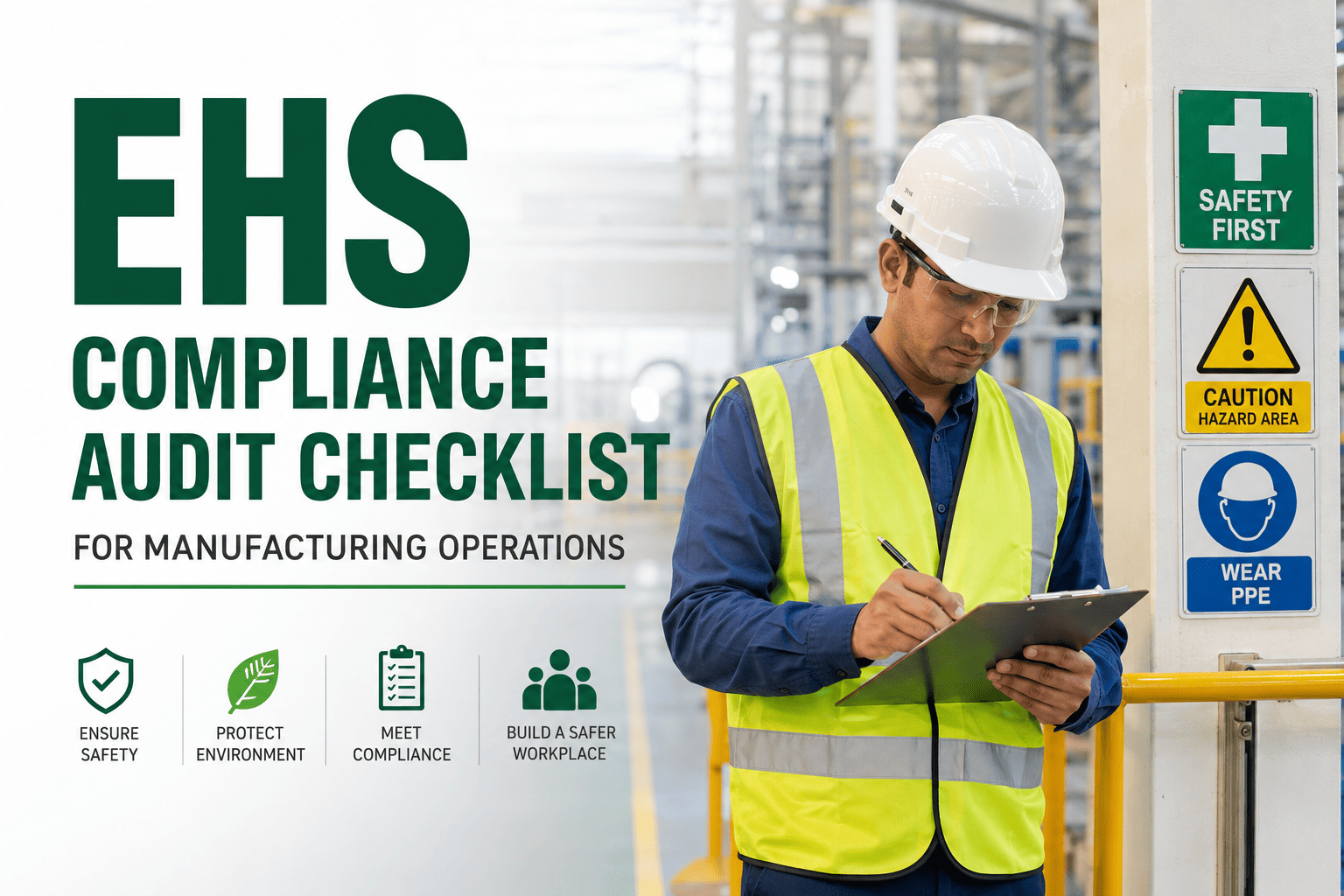
Environmental Health and Safety violations in manufacturing cost companies an average of $4.2 million per incident when fines, production shutdowns, and reputational damage are combined. Most violations are preventable — they result from missing documentation, expired permits, or lapses in routine inspections that would have been caught by a structured compliance audit programme. Facilities that conduct quarterly EHS self-audits reduce regulatory citations by 60% and insurance premiums by 15% to 25%. This checklist covers the eight compliance zones that trigger 85% of OSHA citations and environmental penalties across US manufacturing operations: chemical safety, waste management, emergency preparedness, personal protective equipment, machine guarding, confined spaces, lockout-tagout procedures, and ergonomic hazard controls. Start tracking your compliance status in real-time with OxMaint's EHS audit module where every finding auto-generates corrective actions with assigned owners and due dates.
Zone 01
Chemical Safety and Hazard Communication
OSHA 1910.1200 Hazard Communication Standard violations generate the highest citation volume in manufacturing — over 9,000 penalties annually. Missing Safety Data Sheets and unlabeled containers account for 70% of these violations.
Safety Data Sheet Management
SDS library current and accessible within 10 seconds at every work location — electronic access permitted if terminals never lose power or network connection
Regulation: OSHA 1910.1200(g) · Audit Owner: EHS Manager · Frequency: Quarterly
Every chemical container labeled with product identifier and hazard warnings matching Section 2 of SDS — temporary containers labeled before leaving the filling station
Regulation: OSHA 1910.1200(f) · Audit Owner: Production Supervisor · Frequency: Monthly walk
Annual hazard communication training documented with employee signatures, training date, chemical hazards covered, and trainer name — training repeated when new hazards introduced
Regulation: OSHA 1910.1200(h) · Record: Training attendance log · Frequency: Annually
Chemical Storage and Segregation
Incompatible chemicals segregated per NFPA 400 storage guidelines — acids separated from bases, oxidizers away from flammables, reactive materials isolated
Standard: NFPA 400 · Audit Owner: Chemical Safety Officer · Evidence: Storage layout map
Secondary containment provided for liquid chemical storage — containment capacity minimum 110% of largest container volume or 10% of total storage volume, whichever is greater
Regulation: 40 CFR 264.175 · Audit Owner: Environmental Coordinator · Frequency: Quarterly
Zone 02
Waste Management and Environmental Permits
Environmental penalties for improper waste handling average $37,500 per violation and can trigger immediate facility shutdowns. Expired permits or missing manifests create strict liability exposure regardless of actual environmental harm.
Hazardous Waste Compliance
Hazardous waste accumulation areas marked with start dates on containers — satellite accumulation limited to 55 gallons per container, must move to main storage within 3 days of reaching capacity
Regulation: 40 CFR 262.34 · Audit Owner: Waste Coordinator · Frequency: Weekly
Hazardous waste manifests signed and filed within required timeframes — retain manifests for minimum 3 years; track exception reports for shipments where signed manifest not returned within 45 days
Regulation: 40 CFR 262.40 · Record: Manifest filing system · Audit: Quarterly
Annual hazardous waste training completed for all personnel handling waste — training covers waste identification, container labeling, emergency response, and manifest procedures
Regulation: 40 CFR 265.16 · Record: Training certificates · Frequency: Annually before expiry
Environmental Permits and Reporting
Air quality permits current and operating limits not exceeded — monitor emission levels monthly and maintain records for 5 years minimum; notify regulatory authority within 24 hours of any exceedance
Regulation: 40 CFR 70 Title V · Audit Owner: Environmental Manager · Frequency: Monthly
Stormwater discharge monitoring completed per NPDES permit schedule — sample within first 30 minutes of discharge, analyze for permit parameters, submit DMRs by 28th of following month
Regulation: 40 CFR 122 NPDES · Record: DMR submission log · Frequency: Per permit schedule
EHS compliance failures cost more than fines — they cost production days and customer trust. OxMaint tracks permit expiries, automates inspection schedules, and generates compliance reports instantly.
Zone 03
Emergency Preparedness and Response
Facilities must demonstrate emergency response capability through documented plans, trained personnel, and functional equipment. OSHA 1910.38 Emergency Action Plan violations carry penalties up to $15,625 per instance.
Emergency Action Plans
Written emergency action plan available and current — plan covers evacuation routes, assembly points, headcount procedures, emergency contacts, and shutdown procedures for critical equipment
Regulation: OSHA 1910.38(a) · Audit Owner: Safety Director · Review: Annually
Emergency evacuation drills conducted quarterly with participation documented — drills must test all shifts, measure evacuation time, and identify improvement opportunities
Regulation: OSHA 1910.38(e) · Record: Drill attendance and timing log · Frequency: Quarterly
Emergency lighting and exit signs functional at all times — battery backup tested monthly for 90-minute minimum runtime; replace any fixture failing to maintain illumination
Standard: NFPA 101 Life Safety Code · Audit Owner: Facilities Manager · Test: Monthly
Spill Response and Fire Safety
Spill response kits stocked and accessible within 50 feet of chemical storage areas — kits include absorbents, neutralizers, PPE, and disposal bags appropriate to stored chemicals
Standard: EPA SPCC 40 CFR 112 · Audit Owner: EHS Coordinator · Check: Monthly inventory
Fire extinguishers inspected monthly and serviced annually — monthly checks verify pressure gauge in green zone, seal intact, and nozzle unobstructed; annual service by certified technician
Regulation: OSHA 1910.157(e) · Record: Inspection tags · Frequency: Monthly visual, annual service
Zone 04
Personal Protective Equipment Programs
PPE violations appear in 40% of OSHA manufacturing inspections. Employers must conduct hazard assessments, provide appropriate PPE at no cost, and document training for every affected employee.
PPE Hazard Assessment and Provision
Written PPE hazard assessment completed for all work areas — assessment identifies hazards requiring eye, face, head, foot, hand, or hearing protection; reassess when processes change
Regulation: OSHA 1910.132(d) · Audit Owner: Industrial Hygienist · Update: When changes occur
PPE provided at no cost to employees and replaced when damaged — stock adequate sizes and types; document PPE issuance with employee signature and date
Regulation: OSHA 1910.132(h) · Record: PPE issuance log · Audit: Quarterly
PPE training documented with certification containing employee name, training date, topics covered, and trainer signature — retraining required when PPE types change or usage inadequacies observed
Regulation: OSHA 1910.132(f) · Record: Training certification forms · Frequency: As needed
Respiratory Protection Program
Annual fit testing completed for all respirator users — qualitative or quantitative testing per OSHA protocol; retest when respirator model changes or significant weight gain or loss occurs
Regulation: OSHA 1910.134(f) · Record: Fit test records · Frequency: Annually minimum
Medical evaluations completed before respirator use — physician or licensed healthcare professional evaluates ability to wear respirator using OSHA Appendix C questionnaire
Regulation: OSHA 1910.134(e) · Record: Medical clearance forms · Frequency: Before initial use
Zone 05
Machine Guarding and Power Transmission Safety
Machine guarding deficiencies cause over 18,000 amputations and lacerations annually in US manufacturing. OSHA 1910.212 requires guards on all moving parts where employee contact is possible during operation.
Point of Operation Guarding
Point of operation guards in place and functional on all machinery — guards prevent hands and fingers from contacting cutting edges, nip points, and rotating parts during normal operation
Regulation: OSHA 1910.212(a)(3) · Audit Owner: Safety Officer · Frequency: Monthly
Interlock switches tested and verified operational — machines must stop within safe distance when guards opened; never bypass or disable interlocks with jumper wires or tape
Standard: ANSI B11.19 · Audit Owner: Maintenance Manager · Test: Weekly
Belt and pulley guards secure on all power transmission equipment — guards completely enclose belts, chains, and rotating shafts; missing or damaged guards replaced before equipment restart
Regulation: OSHA 1910.219 · Audit Owner: Mechanical Supervisor · Frequency: Monthly walk
Zone 06
Confined Space Entry Procedures
Confined space incidents kill an average of 92 workers per year in the US. OSHA 1910.146 Permit-Required Confined Spaces standard mandates entry permits, atmospheric testing, and standby rescue capability.
Confined Space Identification and Permitting
All confined spaces identified and evaluated as permit-required or non-permit — post danger signs at permit-required spaces; maintain inventory list with hazard characteristics
Regulation: OSHA 1910.146(c) · Audit Owner: Safety Manager · Review: Annually
Entry permits completed before every permit-required confined space entry — permits list atmospheric test results, authorized entrants, attendants, entry supervisors, and emergency contacts
Regulation: OSHA 1910.146(f) · Record: Entry permit archive · Retention: 1 year minimum
Atmospheric testing conducted before entry and continuously monitored — test for oxygen 19.5% to 23.5%, flammable gases below 10% LEL, toxic gases below PEL
Regulation: OSHA 1910.146(d)(5) · Tool: Calibrated 4-gas monitor · Frequency: Every entry
Zone 07
Lockout-Tagout Energy Control
Failure to control hazardous energy causes 120 fatalities and 50,000 injuries annually. OSHA 1910.147 requires written energy control procedures for every machine with potential for unexpected startup or stored energy release.
Energy Control Procedures and Devices
Written lockout-tagout procedures documented for all equipment — procedures identify energy sources, shutdown steps, isolation points, stored energy dissipation, and verification methods
Regulation: OSHA 1910.147(c)(4) · Audit Owner: Maintenance Manager · Update: When equipment modified
Lockout devices uniquely identify authorized employees — locks never shared between employees; tags include warning, employee name, and installation date
Regulation: OSHA 1910.147(c)(5) · Record: Lock issuance log · Audit: Quarterly
Annual lockout-tagout retraining completed for authorized and affected employees — training covers procedure changes, new equipment, and observed deficiencies in energy control performance
Regulation: OSHA 1910.147(c)(7) · Record: Training rosters · Frequency: Annually minimum
Zone 08
Ergonomics and Repetitive Motion Hazards
Musculoskeletal disorders account for 33% of all workplace injury costs in manufacturing. While OSHA has no specific ergonomics standard, General Duty Clause 5(a)(1) applies when ergonomic hazards cause recognized serious injuries.
Ergonomic Hazard Controls
Ergonomic risk assessments completed for repetitive tasks — assess force requirements, repetition rates, awkward postures, and vibration exposure using REBA or NIOSH lifting equation
Standard: NIOSH Publication 94-110 · Audit Owner: Industrial Engineer · Frequency: New task or injury cluster
Material handling aids provided where manual lift weights exceed 50 pounds — use hoists, lift tables, or pallet jacks; train employees on proper lifting techniques and equipment use
Best Practice: NIOSH recommended weight limit · Record: Equipment deployment log · Review: Quarterly
Workstation adjustability provided for operators performing tasks over 4 hours per day — adjustable height tables, anti-fatigue mats, and tool balancers reduce static loading and cumulative trauma
Standard: ANSI/HFES 100 · Audit Owner: Facilities Planner · Implementation: As needed
Compliance Metrics
EHS Audit Performance Indicators
Expert Perspectives
EHS Compliance Insights from the Field
01
The biggest compliance failures I see are not technical violations — they are documentation gaps. You performed the inspection but did not record it. You trained the employee but lost the certificate. In a regulatory audit, undocumented compliance equals non-compliance.
EHS Director, Chemical Manufacturing, 16 years experience
02
OSHA does not accept good intentions as a defense. If your lockout procedure exists but employees are not following it, you failed on training and enforcement — both are citation-worthy. Compliance means the procedure is followed every single time without exception.
Safety Manager, Metals Fabrication, 22 years experience
03
Permit expirations are entirely preventable yet they still happen in half the facilities I audit. Set calendar reminders 90 days before expiry. Start renewal applications 60 days out. Never operate under an expired permit — regulatory agencies show zero tolerance for that violation.
Environmental Compliance Consultant, Multi-Industry, 19 years
Common Questions
EHS Compliance FAQs
How often should EHS compliance audits be conducted in manufacturing facilities?
Quarterly self-audits are the industry standard for high-hazard manufacturing environments. Lower-risk facilities can conduct semi-annual audits. Critical compliance areas like lockout-tagout and confined space should be audited monthly through supervisor observations. Third-party audits are recommended annually to identify gaps internal teams might overlook.
What records must be retained to demonstrate EHS compliance during regulatory inspections?
Training records must be retained for the duration of employment plus 30 years for exposure records. OSHA 300 logs kept for 5 years. Hazardous waste manifests for 3 years minimum. Air and water permit records for duration of permit plus 5 years. Confined space entry permits for 1 year. Maintain organized filing systems and backup copies offsite.
Who is qualified to conduct EHS compliance audits internally?
Internal auditors should have formal EHS training, knowledge of applicable regulations, and familiarity with facility operations. Certifications like CSP, CIH, or CHMM demonstrate competency. Auditors must be independent of the areas they audit to avoid conflicts of interest. Many facilities rotate audit assignments quarterly to maintain objectivity.
Turn EHS Compliance Into a Competitive Advantage, Not a Cost Center
OxMaint centralizes permit tracking, automates audit schedules, assigns corrective actions with accountability, and generates compliance reports instantly. Zero citations. Zero surprises. Zero excuses.