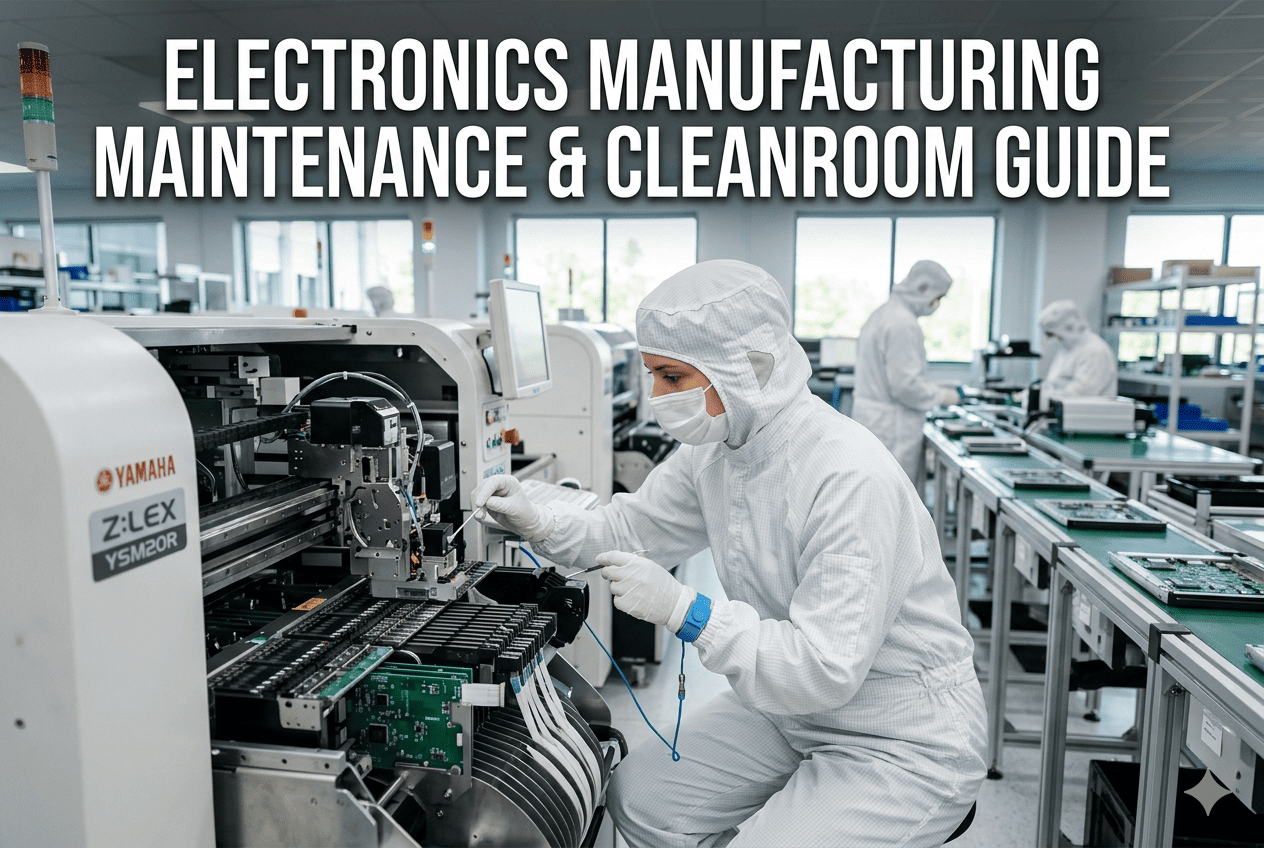
Inside a tier-one PCB assembly house in Penang last spring, a batch of 2,400 automotive ECU boards failed end-of-line AOI within a single shift. Every board traced back to one pick-and-place nozzle that had drifted 0.04 mm out of calibration over six weeks — a variance no operator would catch by eye, and no paper log was tracking. The root cause wasn't the nozzle. It was the fact that the last calibration record lived in a shift-supervisor's spreadsheet, the next one was scheduled "monthly-ish," and nobody owned the handoff. Yield dropped 11%, the customer chargeback hit $340,000, and the line sat for 14 hours. Electronics manufacturing doesn't fail dramatically — it fails silently, one micron at a time, which is exactly why you need a connected maintenance system you can start for free today.
The Stakes in Electronics Manufacturing
Three Invisible Losses Compounding in Every Fab and EMS Plant
33%
ESD-Related Failure Rate
Industry estimates suggest electrostatic discharge accounts for up to 33% of all semiconductor failures during manufacturing and handling — much of it as latent defects that escape end-of-line test.
$5B
Annual ESD Cost to Industry
The EOS/ESD Association estimates ESD damage costs the global electronics industry around $5 billion annually. The cost per damaged device escalates at every downstream stage — lowest at incoming, highest at the customer site.
$1M+
SMT Line Downtime Cost
A single mid-sized SMT line disrupted by equipment downtime has been documented to cost over $1 million annually in wasted labor and quality losses alone — before customer chargebacks.
15–20%
Throughput Gain Available
Plants that move from reactive to structured preventive maintenance on SMT lines routinely document 15–20% throughput gains — driven by fewer nozzle jams, calibration drifts, and reflow temperature excursions.
ISO 14644 Cleanroom Classes — and What Your Process Needs
ISO 14644-1 defines cleanroom cleanliness by particles per cubic meter at defined size thresholds, and the 2025 update to ISO 14644-5 strengthened operational requirements for personnel, cleaning, and maintenance programs. Every electronics process has a minimum class it can tolerate — go cleaner than needed and you burn energy; go dirtier and you lose yield.
ISO1
Class 1
≤10 particles/m³ at ≥0.1µm
Extreme-UV photolithography and sub-10 nm wafer processing. Requires unidirectional ULPA-filtered airflow and 500+ air changes per hour. Only the most advanced semiconductor fabs operate here.
ISO3
Class 3
≤1,000 particles/m³ at ≥0.1µm
Photolithography and deposition in mature-node semiconductor fabs, hard disk drive head assembly, critical optics. ULPA filters, full bunny suits, and rigorous gowning protocols mandatory.
ISO5
Class 5
≤3,520 particles/m³ at ≥0.5µm
Semiconductor wafer etch and packaging, MEMS assembly, high-end medical electronics. Requires 240–480 air changes/hour and continuous non-viable particle monitoring per ISO 14644-2.
ISO7
Class 7
≤352,000 particles/m³ at ≥0.5µm
Most SMT and PCB assembly lines, flat panel display production, medical device electronics, aerospace avionics assembly. Operates at 30–60 air changes/hour with HEPA filtration.
ISO8
Class 8
≤3,520,000 particles/m³ at ≥0.5µm
General electronics assembly, consumer-grade PCB production, connector and cable assembly, final packaging and inspection areas. Entry-level controlled environment with basic HEPA recirculation.
The SMT Line — Six Stages, Six Failure Modes Your CMMS Must Track
A modern SMT line isn't one machine — it's a sequenced chain where any single stage can bottleneck the entire facility. Each stage has characteristic failure signatures that cost yield when missed. Book a demo to see how Oxmaint maps each of these to scheduled tasks and sensor triggers.
01
Solder Paste Printer
Deposits solder paste through a stencil onto PCB pads
Primary failure modes
Stencil clogging, squeegee blade wear, paste viscosity drift. Needs cleaning every 5–10 boards — the most frequently skipped PM task on the line.
02
Pick-and-Place Machine
Places thousands of components per hour with micron-level precision
Primary failure modes
Nozzle wear and contamination, feeder jams, vision calibration drift, vacuum pressure loss. Weekly nozzle inspection cuts placement defects by 40%.
03
Reflow Oven
Melts solder paste at controlled temperature profile to form joints
Primary failure modes
Zone thermocouple drift, flux residue buildup, belt speed variance, nitrogen concentration loss. A 5°C profile drift can cause cold joints across an entire shift.
04
AOI Inspection
Automated optical inspection catches placement and solder defects post-reflow
Primary failure modes
Camera calibration drift, lighting degradation, false-accept rate rising silently. Missed defects here escape into finished goods and customer returns.
05
X-Ray / ICT
Verifies hidden joints (BGA, QFN) and in-circuit function
Primary failure modes
X-ray tube aging, fixture wear, probe contamination, test program version drift. Calibration every 1,000 cycles is standard but rarely enforced without a system.
06
Coating & Packaging
Conformal coating, final inspection, ESD-safe packaging for dispatch
Primary failure modes
Coating thickness variance, spray nozzle clogging, ESD bag seal integrity, lot traceability gaps at packout. The last point is where recalls live or die.
Built for SMT, PCB & Cleanroom Environments
Six Stages. One Connected System. Zero Calibration Records Lost to a Spreadsheet.
Oxmaint unifies your SMT line PMs, cleanroom monitoring schedules, ESD audits, and calibration logs into one asset hierarchy — so the next drifting nozzle, drifting thermocouple, or overdue particle count never hides in someone's inbox.
The Four Pillars of Electronics Plant Contamination & ESD Control
Contamination and electrostatic discharge are the two quiet yield killers of electronics manufacturing. Controlling them is less about new equipment and more about enforcing consistency across four operational pillars — each of which breaks down without a system of record.
Pillar 01
Cleanroom Environmental Monitoring
Continuous particle counts, pressure differentials between zones, temperature, humidity, and air-change verification. ISO 14644-2 requires periodic testing and trending — not just at certification. Missed monitoring cycles invalidate audit records.
Particle count logs
ΔP monitoring
T/RH trending
HEPA/ULPA integrity
Pillar 02
ESD Protected Area (EPA) Compliance
Wrist-strap verification at shift start, ionizer balance within ANSI/ESD S20.20 limits, grounded mat resistance, ESD flooring continuity. Even a 5V static event can destroy modern advanced-node ICs.
Wrist-strap daily log
Ionizer balance
Grounding audits
EPA recertification
Pillar 03
Equipment Calibration & PM Schedule
Pick-and-place vision calibration, reflow thermocouple checks, stencil printer alignment, AOI camera calibration. Every tool has a defined interval — the challenge is enforcing the schedule and keeping the evidence trail audit-ready.
Calibration logs
PM compliance %
Torque / gauge checks
Audit evidence export
Pillar 04
Gowning, Entry & Personnel Control
The most effective contamination control is behavioral. Personnel gowning discipline, airlock protocols, material staging, and trained-operator traceability per the 2025 update to ISO 14644-5 all require documented operational control programs.
Gowning compliance
Training records
Access logs
Material entry audits
Paper-Based vs. Oxmaint — The Maintenance Reality Gap
Most electronics plants haven't replaced paper checklists and calibration binders because the ones they have technically "work." The problem isn't presence — it's evidence, compliance rate, and recall-readiness. Here's what actually differs under audit.
| Operational dimension |
Paper / spreadsheet workflow |
Connected CMMS (Oxmaint) |
| PM schedule compliance |
Typically 55–70% — tasks missed or forgotten between shifts |
95%+ with automated reminders and mobile notifications |
| Calibration evidence |
Signed paper forms in binders, risk of loss or fraud |
Timestamped digital records with photo evidence and technician sign-off |
| Cleanroom particle log review |
Weekly manual summaries, trends invisible until failure |
Continuous logging with automated threshold alerts |
| ESD wrist-strap verification |
Paper initialled daily, rarely verified in depth |
Mobile check-in with device ID, operator, and pass/fail record |
| Work order cycle time |
4–8 hours average from request to technician arrival |
Under 60 minutes with mobile push notifications |
| Audit-readiness (ISO 14644, IPC-A-610) |
3–5 days to assemble evidence package for an auditor |
One-click filtered export, ready at the start of the walk-through |
| Traceability at recall |
Manual reconstruction from logs, binders, batch records |
Lot-to-workorder-to-technician chain in seconds |
What Oxmaint Delivers for Electronics & Semiconductor Plants
Oxmaint is a CMMS that treats electronics manufacturing as the calibration-heavy, contamination-sensitive, evidence-demanding environment it actually is — not a generic factory. Here's what changes the day you move your cleanroom, SMT, and ESD programs into one platform.
01
Asset Hierarchy for Every Machine Class
Stencil printers, pick-and-place machines, reflow ovens, AOI, X-ray, ICT, wave solder, and cleanroom support equipment — all organized in a parent-child structure with feeders, nozzles, cameras, and thermocouples as child assets.
Parts, manuals, and histories are one tap away on the line
02
Calibration Management Built In
Every calibration event — pick-and-place vision, reflow thermocouple, stencil printer alignment, ICT probe — tracked with due dates, certificates of calibration, and auto-escalation when overdue.
100% audit-ready calibration trail in one export
03
Cleanroom PM & Monitoring
Scheduled particle count walks, HEPA/ULPA integrity checks, differential pressure audits, and gowning inspection routes — all mobile-friendly with photo evidence and pass/fail capture against ISO 14644-5 operational control programs.
Audit evidence generated as work happens, not after
04
ESD EPA Compliance Routines
Daily wrist-strap verification, weekly ionizer balance checks, monthly floor-to-ground resistance audits, annual EPA recertification — all scheduled, tracked, and exportable for ANSI/ESD S20.20 audits.
ESD programs become a system, not a stack of paper forms
05
Sensor-Triggered Work Orders
Connect reflow oven thermocouples, cleanroom particle counters, and pressure sensors. When a parameter drifts out of spec, Oxmaint auto-creates a prioritized work order and notifies the right technician with mobile push.
Excursions are caught before they become yield loss
06
OEE, Yield & Defect Dashboards
Live OEE calculated per line and per shift, defect trending by machine and operator, MTBF and MTTR on critical SMT assets. Identify which feeder, which nozzle, which zone is quietly consuming a disproportionate share of your scrap budget.
Data-driven decisions replace tribal maintenance knowledge
Frequently Asked Questions
Direct answers to the questions electronics and semiconductor maintenance leaders bring to Oxmaint evaluations — from SMT shops to ISO Class 5 wafer-packaging facilities.
Does Oxmaint actually fit the precision requirements of electronics manufacturing?+
Yes. Oxmaint handles calibration intervals, certificate-of-calibration storage, ESD audit routines, and cleanroom PM schedules natively — the four areas a generic CMMS typically forces you to bolt on with spreadsheets.
Book a walkthrough to see your own asset mix configured.
How does Oxmaint support ISO 14644 and ISO 14644-5:2025 compliance?+
Oxmaint lets you build operational control programs as scheduled PM routes — particle count walks, HEPA integrity tests, gowning audits, pressure differential checks — with timestamped evidence captured on mobile. All records are filterable and exportable for auditors in a single click, matching the 2025 ISO 14644-5 expectations for documented OCPs.
Can we track ESD wrist-strap checks and ionizer balance in Oxmaint?+
Yes — daily wrist-strap verifications, ionizer balance checks against ANSI/ESD S20.20, grounding audits, and EPA recertifications are all configurable as recurring work orders with mobile pass/fail capture, photo evidence, and technician attribution.
Sign up free to try it on your EPA zones.
What equipment classes are pre-configured for SMT and PCB production?+
Oxmaint ships with asset templates for solder paste printers, pick-and-place machines, reflow ovens, AOI, X-ray inspection, ICT, wave solder, selective solder, and conformal coating lines — with typical PM intervals and failure-mode libraries preloaded. You customize from there, not from zero.
How long does implementation take for a typical EMS or PCB assembly plant?+
A typical 80–200-asset electronics plant goes live within 2–4 weeks. Setup covers asset loading, PM and calibration scheduling, ESD program configuration, cleanroom routes, and mobile user onboarding. Most teams run parallel with their existing system for two weeks, then retire paper.
Does Oxmaint integrate with the sensors and line systems we already have?+
Yes. Oxmaint connects to particle counters, pressure sensors, temperature probes, and reflow oven thermocouples via standard industrial protocols. When readings exceed defined thresholds, work orders generate automatically.
Book a demo to see the integrations mapped to your stack.
Electronics Manufacturing CMMS
From Paper Binders to Audit-Ready in One Platform.
Cleanroom monitoring, ESD verification, calibration management, SMT line PMs, and line-side mobile work orders — unified. Ship better boards, pass audits cleanly, and stop losing yield to maintenance records that live in someone's head.
33%
ESD failures addressable