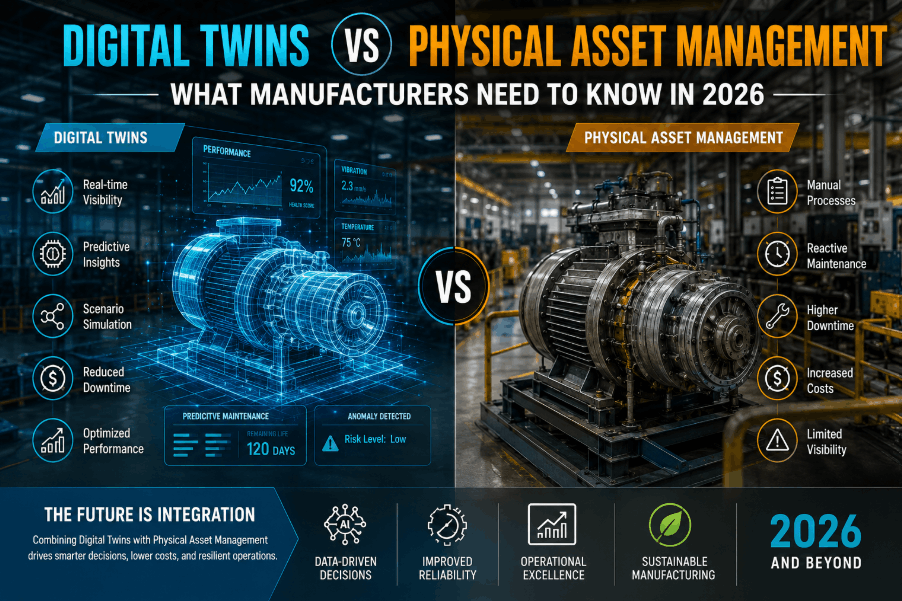
In 2026, the conversation around digital twin vs asset management has shifted from theoretical to urgent. As manufacturers face mounting pressure to reduce unplanned downtime, extend equipment lifespan, and optimize capital spending, digital twins are being positioned as the next leap beyond traditional CMMS and physical asset management. But the question isn't whether digital twins are impressive — it's whether they're the right investment for your plant today, or whether a well-implemented asset management platform delivers more real-world ROI with a fraction of the risk and cost.
What Is a Digital Twin in Manufacturing — And What It Actually Requires
A manufacturing digital twin is a real-time virtual replica of a physical asset, production line, or entire facility — continuously updated with live sensor data to simulate behavior, predict failures, and model operational scenarios before they happen in the real world. The concept is compelling: instead of reacting to equipment failure, your virtual model flags a bearing degradation pattern three weeks early and schedules a precision intervention. But building and sustaining a digital twin requires significant prerequisites — IoT sensor infrastructure, a clean and structured asset data foundation, integration middleware, and engineering resources capable of building and validating the simulation models themselves. Before any manufacturer considers a digital twin for predictive maintenance, those data foundations must already exist. You can Sign Up Free on OxMaint to start building that structured asset data layer today — the one most digital twin deployments reveal was missing all along.
A live mirror of a physical asset continuously updated via IoT sensors, PLCs, and operational data streams — enabling simulation before physical action.
Digital twins analyze behavioral patterns to predict failures days or weeks in advance — reducing unplanned downtime through mathematically-driven maintenance triggers.
Test process changes, capacity increases, and maintenance strategies virtually before applying them to production — reducing risk on high-value assets.
Requires dense sensor networks, edge computing infrastructure, and data pipeline architecture — representing significant upfront capital investment before any model runs.
Each digital twin model must be built, calibrated, and validated by engineers familiar with the physical asset — a resource-intensive process often underestimated in planning.
A digital twin is only as accurate as the data feeding it. Gaps, sensor drift, or incomplete asset histories produce misleading predictions — making clean CMMS data foundational.
Physical Asset Management vs Digital Twin: The Core Difference
Physical asset management — delivered through a CMMS or EAM platform — focuses on tracking, maintaining, and optimizing real assets through structured work orders, preventive maintenance schedules, parts inventory, and performance history. A digital twin extends this by creating a virtual simulation layer on top of physical data. The critical distinction: physical asset management is operational and proven; a digital twin is predictive and data-intensive. For plants without structured maintenance data, the twin has nothing accurate to mirror. If you want to Book a Demo to see how OxMaint builds the data foundation that makes future digital twin adoption possible, our team can walk through your asset portfolio specifically.
| Capability | Physical Asset Management (CMMS) | Digital Twin |
|---|---|---|
| Work Order Management | Full | Not included |
| Preventive Maintenance Scheduling | Full | Informed by twin data |
| Real-Time Asset Monitoring | Via integrations | Native |
| Predictive Failure Modeling | AI-assisted in modern CMMS | Full simulation |
| Parts & Inventory Control | Full | Not included |
| Scenario / What-If Simulation | Not included | Core capability |
| IoT Infrastructure Required | Optional | Mandatory |
| Implementation Time | 2–8 weeks | 12–36 months |
| Total Cost of Ownership | Low–Medium | Very High |
| Data Foundation Required | Builds it | Requires it pre-existing |
5 Key Differences Between Digital Twin and Physical Asset Management
Understanding the digital twin vs CMMS decision requires examining five operational dimensions — not just feature lists. Each dimension determines whether your plant is ready for twin investment or whether optimizing physical asset management delivers more ROI right now.
Physical asset management improves how you respond to and prevent failures. Digital twins simulate what hasn't happened yet — modeling failure scenarios before they occur. For most plants, maximizing preventive and condition-based maintenance through a well-configured CMMS eliminates 60–80% of unplanned downtime without simulation infrastructure.
A CMMS builds structured asset history over time through technician inputs and work orders. A digital twin requires continuous, high-frequency sensor data from every monitored asset — which means dense IoT deployment before the twin provides any value. Plants without clean asset records are not digitally ready for twin technology.
A modern cloud CMMS like OxMaint can be fully operational in 2–8 weeks with live work orders in the first week. Digital twin deployments for manufacturing assets typically require 18–36 months from sensor installation to validated model — with full ROI realization extending to year 3 or 4 in most enterprise case studies.
CMMS platforms serve maintenance planners, technicians, and operations managers. Digital twin programs require simulation engineers, data scientists, IoT architects, and domain experts who understand both the physical asset physics and the modeling environment — a skills profile most mid-size manufacturers don't have in-house.
Physical asset management applies equally across every asset class in your plant. Digital twins are economically justifiable only for high-value, high-consequence critical assets — turbines, large compressors, mission-critical production lines — where simulation ROI outweighs significant per-asset development costs.
Digital Twin Implementation Cost vs CMMS: What Manufacturers Actually Spend in 2026
The cost gap between digital twin implementation and cloud CMMS deployment is one of the most underreported factors in the digital twin asset tracking conversation. Here is what real manufacturer deployments look like at scale.
When Does a Digital Twin Actually Make Sense for Manufacturing Plants?
Digital twin for predictive maintenance is not a universal upgrade — it is a targeted solution for specific asset profiles and organizational maturities. Use this framework to evaluate genuine readiness.
How OxMaint Builds the Foundation for Both Physical Asset Management and Future Digital Twin Readiness
OxMaint was built for the manufacturing reality that sits between basic work order tracking and full digital twin deployment. The platform delivers complete physical asset management — structured work orders, preventive and condition-based maintenance, real-time parts inventory, mobile technician workflows, and deep asset performance analytics — while generating the clean, structured asset data that any future digital twin integration requires. Plants that Book a Demo with OxMaint consistently discover that three to six months of structured CMMS data gives them more actionable maintenance intelligence than years of disconnected manual records. For manufacturers exploring CMMS digital twin integration as a long-term path, OxMaint's open API architecture and IoT-ready data model position the platform as the operational layer that feeds future simulation environments — without requiring twin investment to deliver immediate ROI. Sign Up Free and begin building the asset data infrastructure your operation needs today, regardless of where your digital twin strategy lands tomorrow.
Digital Twin ROI in Manufacturing: What the Numbers Say for 2026
When digital twin manufacturing ROI is measured honestly — accounting for full infrastructure costs, implementation timelines, and ongoing engineering maintenance — the business case is genuinely strong only for a narrow band of asset types and organizational profiles. Understanding where value concentrates helps manufacturers avoid over-investment in simulation technology before the operational foundation is ready to support it. Plants that Sign Up Free on OxMaint and build structured maintenance operations first consistently reach that digital-twin-ready state faster than plants attempting twin deployment without a clean asset data layer. And for manufacturers who Book a Demo, the OxMaint team can map out a realistic technology roadmap from where your plant is today to where digital twin investment becomes genuinely justified — without the pressure to over-invest prematurely.
Digital twins deliver proven ROI on assets where a single failure event costs $500K–$5M — large rotating machinery, continuous process equipment, and complex automated lines.
Twin-simulated energy modeling reduces consumption 8–15% on energy-intensive equipment — a strong secondary ROI driver for process manufacturers with high utility costs.
Digital twins enable simulation-based asset replacement forecasting — reducing premature capital replacement decisions and extending useful asset life by 15–25% in documented deployments.
Virtual asset models enable technician training on complex equipment without production risk — a growing ROI driver as manufacturers face skilled maintenance workforce shortages.
For heavily regulated industries, digital twin audit trails provide simulation-backed compliance evidence beyond standard CMMS records — valuable in aerospace and pharmaceutical contexts.
Standard rotating equipment, low-value assets, and plants without clean historical data rarely see digital twin ROI justify investment — physical asset management optimization delivers more per dollar spent.
![5-year-capital-maintenance-plan-template-for-manufacturing-facilities-[excel]](./manage-post-2k26/uploads/5-year-capital-maintenance-plan-template-for-manufacturing-facilities-[excel].png)