![5-year-capital-maintenance-plan-template-for-manufacturing-facilities-[excel]](./manage-post-2k26/uploads/5-year-capital-maintenance-plan-template-for-manufacturing-facilities-[excel].png)
A 5-year capital maintenance plan is the financial and operational blueprint that separates reactive plant management from long-range asset reliability strategy. For manufacturing facilities, capital maintenance planning means forecasting every major asset replacement, scheduled overhaul, shutdown window, and CapEx investment across a rolling five-year horizon — aligning maintenance investment with production targets, budget cycles, and regulatory requirements before failures dictate the agenda. Sign Up Free on OxMaint to connect your long-term capital maintenance plan to a live CMMS that tracks asset condition, maintenance history, and cost data — giving plant directors and CFOs the real-time intelligence needed to defend every line of the capital budget.
What Is a 5-Year Capital Maintenance Plan?
A 5-year capital maintenance plan is a structured, multi-year forecast that identifies every significant maintenance investment a manufacturing facility must make to sustain operational reliability, regulatory compliance, and asset performance over the next sixty months. Unlike annual maintenance budgets that react to the current year's breakdown history, a five-year capital plan takes a forward-looking position — projecting asset end-of-life timelines, major overhaul intervals, infrastructure upgrades, and replacement CapEx based on equipment age, condition data, and production forecasts. Book a Demo with OxMaint to see how live asset condition tracking feeds directly into your long-range capital planning process.
Projects major asset replacements and capital equipment upgrades across five budget years — enabling finance teams to model cash flow requirements before expenditure is triggered by failure.
Maps every major asset against its projected end-of-useful-life date, replacement cost, and recommended replacement window — providing procurement teams with multi-year lead time.
Coordinates major overhaul and shutdown events across the five-year horizon — aligning planned downtime with production schedules, contractor availability, and capital budget cycles.
Distributes capital investment across five fiscal years based on asset criticality, failure risk, and production impact — preventing budget spike years while ensuring high-criticality assets are prioritized.
What a 5-Year Capital Maintenance Plan Template Must Cover
A capital maintenance plan template that serves CFO and plant director audiences requires a structured framework that spans every dimension of long-range asset investment planning. The following components define a complete, decision-ready template for manufacturing environments.
The foundation of any capital maintenance plan is a complete, current asset register with criticality ratings assigned. Each asset must be classified by production impact, safety consequence, and replacement lead time — so capital prioritization decisions are tied to operational risk, not budget convenience. Without a maintained asset register, five-year plans are built on assumptions rather than data.
Each asset in the plan must carry an installation date, expected useful life, current condition rating, and remaining useful life estimate. Condition ratings should be updated from inspection findings, predictive monitoring data, and maintenance history — not estimated from the original commissioning date alone. Sign Up Free on OxMaint to capture structured inspection findings and condition ratings that feed directly into capital replacement forecasts.
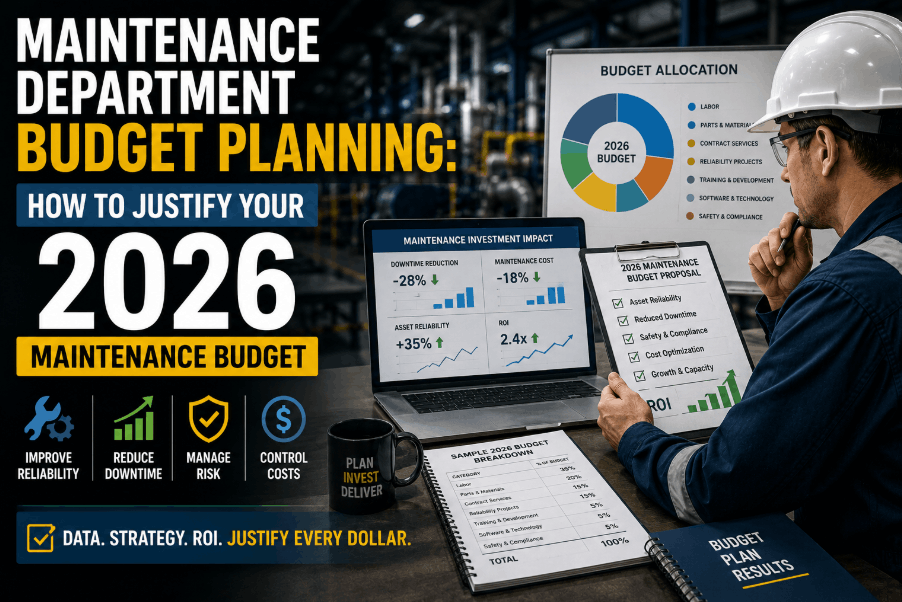
The core deliverable of the template: a year-by-year capital investment table mapping each planned asset replacement, major overhaul, or infrastructure upgrade to its fiscal year, estimated cost, cost basis (OEM quote, historical data, or benchmark), and responsible budget owner. This table is the primary artifact reviewed by CFOs in annual capital budget submissions and board-level facilities investment reviews.
Every capital plan requires a documented decision logic for when an asset should be replaced versus repaired — typically based on a repair-cost-to-replacement-cost ratio threshold (commonly 50–60%), asset age relative to expected life, parts availability risk, and energy efficiency gap. This framework prevents reactive capital decisions where emergency failures force unplanned purchases at premium cost.
Major maintenance events that require production downtime must be forecasted across the full five-year horizon. Each shutdown window must include planned downtime duration, scope summary, resource requirements, and estimated cost. Book a Demo with OxMaint to see how shutdown work order management and pre-planning tools integrate with your long-range capital schedule.
Capital expenditure driven by regulatory mandates — statutory inspection upgrades, pressure vessel recertifications, electrical safety compliance, environmental equipment — must be isolated in the plan as non-discretionary spend. Mixing compliance CapEx with reliability CapEx obscures the true flexibility of the capital budget and complicates regulatory audit documentation.
A five-year capital plan that presents a flat annual investment profile is not a plan — it is a wish list. Effective capital phasing models the realistic distribution of expenditure across years based on asset condition timelines, contractor availability cycles, and production capacity constraints, with a dedicated contingency reserve (typically 10–15%) for unforecast capital events. Sign Up Free on OxMaint to track actual-vs-planned capital spend in real time against your five-year forecast.
5-Year Capital Maintenance Plan: Template Structure Overview
The table below defines the core data fields required in each section of a production-ready five-year capital maintenance plan template for manufacturing facilities.
| Plan Section | Key Data Fields | Primary Audience |
|---|---|---|
| Asset Register | Asset ID, description, location, install date, OEM life, criticality rating | Maintenance Manager |
| Condition Assessment | Current condition score (1–5), last inspection date, remaining useful life estimate | Reliability Engineer |
| Replacement Schedule | Planned replacement year, replacement cost estimate, cost basis, procurement lead time | Plant Director / CFO |
| Overhaul Schedule | Overhaul year, scope summary, estimated downtime hours, estimated cost | Maintenance Planner |
| Shutdown Calendar | Shutdown window dates, duration, production impact, contractor requirement | Operations Director |
| Compliance CapEx | Regulatory driver, required completion date, estimated cost, responsible authority | EHS / Compliance Manager |
| CapEx Forecast Summary | Year 1–5 investment total, spend by asset class, budget vs. forecast variance | CFO / Finance Director |
| Contingency Reserve | Contingency % by year, trigger criteria, approval authority for release | Plant Director / CFO |
5-Year Capital Planning Lifecycle: 6 Stages
Building a credible, defensible five-year capital maintenance plan requires a structured process that connects asset condition intelligence to financial forecasting. Each stage has defined inputs, outputs, and stakeholder ownership.
Confirm the completeness and accuracy of the facility asset register — verifying installation dates, OEM specifications, nameplate data, and current location for all assets above the plan's cost threshold. An incomplete asset register produces a capital plan with blind spots that surface as unbudgeted emergency CapEx.
Conduct structured condition assessments on all assets above the plan threshold — using inspection findings, maintenance history, predictive monitoring data, and OEM age benchmarks to assign a remaining useful life estimate and replacement window. This stage is where OxMaint's asset history and inspection data directly feed capital planning decision-making.
Translate condition assessment outputs into discrete capital projects — each with a defined scope, preliminary cost estimate, and planned execution year. At this stage, replacement vs. repair decisions are made using the facility's documented decision framework, preventing scope creep or under-investment in high-criticality assets.
Develop cost estimates for each capital project using OEM quotes, historical project cost data, or industry benchmark rates — then distribute projects across the five-year horizon based on criticality ranking, production window constraints, and annual CapEx budget targets. Apply contingency reserves and escalation factors for outer years.
Present the five-year capital plan to plant directors, operations leadership, and finance — aligning on investment priorities, budget phase distribution, and contingency policy. Document approval decisions and any scope deferrals with rationale for future audit reference. Board-level facilities investment reviews typically require this documented approval chain. Book a Demo with OxMaint to see how asset data exports support capital budget submissions and executive reporting.
A five-year capital plan is a living document — reviewed and updated annually as asset conditions evolve, project costs are refined, and production priorities shift. Each annual refresh rolls the plan forward one year, updates condition assessments, incorporates completed-project actuals, and revalidates the investment priorities for the remaining horizon.
Capital Maintenance Plan KPIs and Financial Benchmarks
Use these industry benchmarks to evaluate whether your five-year capital maintenance plan is sized, phased, and performing at levels consistent with best-in-class manufacturing facility management.