.png)
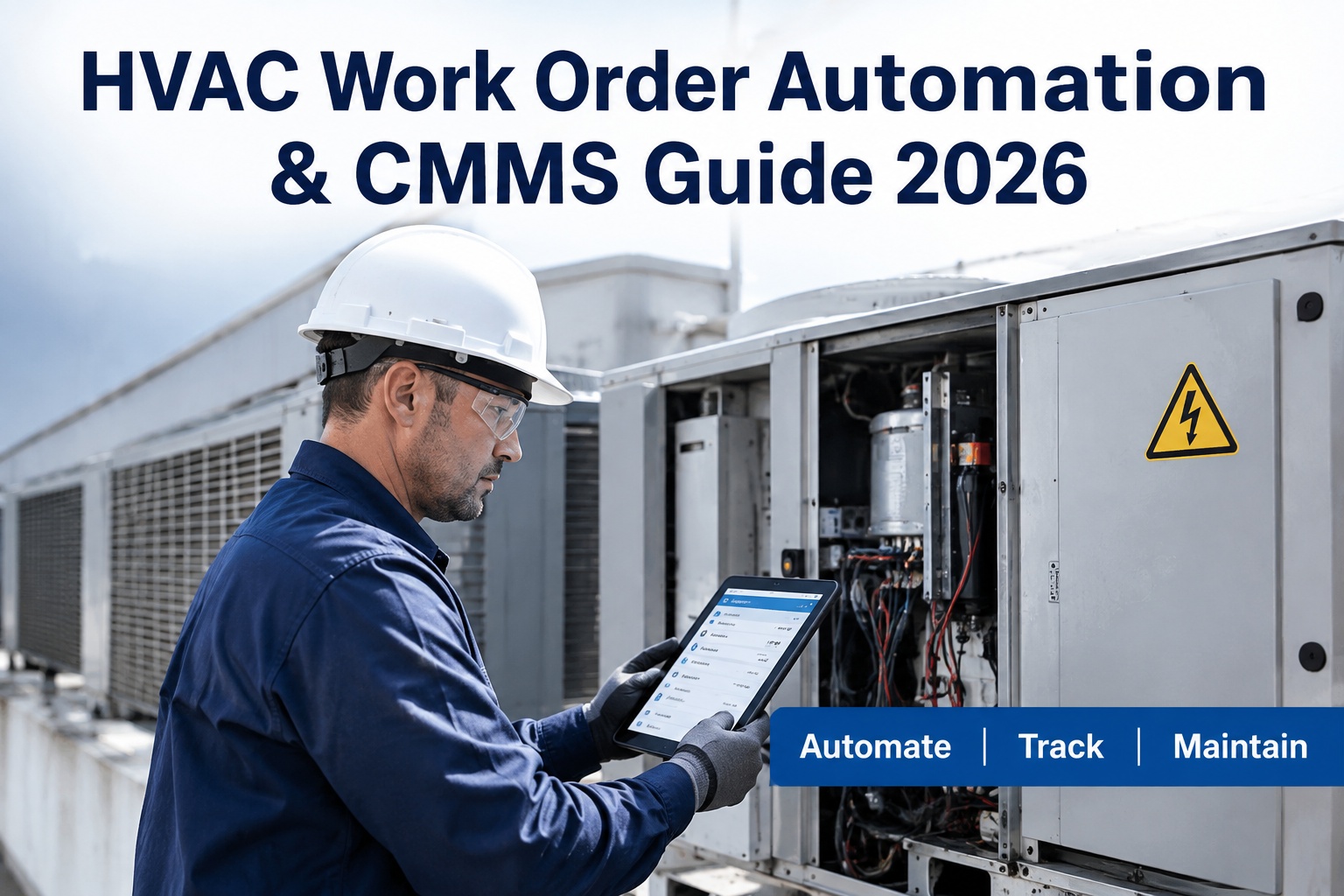
HVAC work order priority classification is the process of ranking maintenance tasks by urgency, safety impact, and operational criticality so that reliability teams resolve the most consequential failures first. A well-structured priority queue prevents minor filter changes from jumping ahead of life-safety chiller outages, cutting unplanned downtime by up to 40% and extending equipment life by 15–25%. The right CMMS enforces these rules automatically, ensuring every technician follows a consistent, defensible ranking system. Explore the framework below, then Start Free Trial to see how OxMaint automates the entire workflow.
HVAC PRIORITY CLASSIFICATION GUIDE
Is a 90-minute chiller outage losing $50K while your team clears a routine filter change?
Without a structured HVAC work order priority classification system, life-safety failures compete with cosmetic tasks in the same queue. OxMaint's CMMS automatically ranks every work order by criticality, safety impact, and asset downtime cost — so the right technician hits the right asset every time.
THE 4-TIER PRIORITY MATRIX
How to classify HVAC work orders by criticality
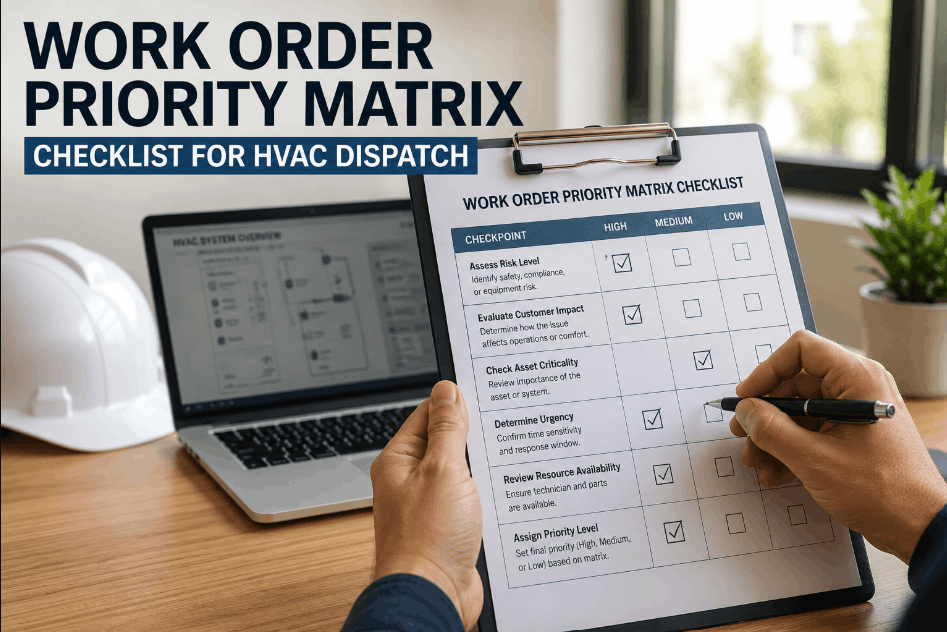
A defensible HVAC work order priority guide uses four tiers — Critical, High, Medium, and Low — mapped to response-time SLAs, safety impact, and asset redundancy. Here is the exact framework used by facilities managing 500+ assets.
Safety & life-safety systems
- Chiller plant failure in a data center or hospital OR
- Boiler loss during freezing conditions
- Refrigerant leak in an occupied space
- Makeup-air unit failure in a lab hood
Operations-critical assets
- AHU serving a cleanroom drifting out of spec
- RTU #4 tripping on high-pressure fault (N+1 lost)
- Cooling tower fan motor overheating
- BMS controller offline for a zone > 2,000 sq ft
Scheduled & preventive tasks
- Quarterly coil cleaning on AHU-7
- Belt tension adjustment on supply fan
- Filter replacement at 50% pressure-drop rise
- Calibration drift on a temp sensor
Cosmetic & deferred maintenance
- Paint touch-up on condenser fencing
- Minor condensate drip in unoccupied mechanical room
- Labeling and asset-tag updates
- Damper actuator noise with no performance impact
SAFETY-FIRST PRIORITIZATION
HVAC safety priority rules that override every other queue
In any CMMS priority classification, safety-critical HVAC tasks must auto-escalate above operational and cost-based logic. A refrigerant leak in an occupied space is never a P3 — even if the BMS says the zone is still cooling.
Life-safety override
Any work order tagged with a life-safety flag (refrigerant leak, gas leak, no-heat in a care facility) auto-promotes to P1 regardless of submitted priority. OxMaint enforces this at the form-validation layer.
Occupancy density multiplier
An AHU failure in a 500-person open-plan office carries a 2.5× criticality multiplier versus the same failure in a storage room. The CMMS cross-references occupancy data at dispatch time.
Regulatory & compliance flags
Tasks tied to Joint Commission, ASHRAE 90.1, or FDA 21 CFR Part 11 audits are tagged and cannot be down-prioritized without a documented manager override and reason code.
Redundancy-loss escalation
When an N+1 chiller trips, the still-running unit's open work orders auto-escalate one tier. OxMaint reads real-time status and re-ranks the queue without dispatcher intervention.
WORKED EXAMPLE
CMMS priority queue in action: a 180-asset commercial building
Consider a 320,000-sq-ft office complex running 180 HVAC assets on a spreadsheet-plus-email system. On a 95°F July afternoon, seven work orders land within 20 minutes. Here is how a manual queue vs. an OxMaint priority queue handles them.
| Incoming work order (2:15 PM) | Manual ranking | OxMaint auto-priority | Reasoning |
|---|---|---|---|
| Chiller-2 high-refrigerant-pressure trip | 3rd — dispatched at 3:10 PM | P1 — dispatched 2:18 PM | N+1 lost; $14K/hr downtime risk; auto-escalated |
| Refrigerant leak alarm, mechanical room B | 5th — not seen until 3:40 PM | P1 — dispatched 2:16 PM | Safety override; life-safety flag auto-promotes |
| AHU-9 supply fan belt squeal | 1st — loudest complaint | P3 — queued for next PM window | No performance impact; noise-only |
| VAV-34 stuck open, zone at 68°F | 4th | P2 — dispatched 2:45 PM | Occupied zone; comfort drift beyond 2°F setpoint |
| Filter change on RTU-1 (routine) | 2nd — pre-scheduled on calendar | P3 — held to scheduled date | Preventive task; no failure signal |
| BMS trending shows CT-1 fan motor amperage rising | 7th — not in queue at all | P2 — auto-created & queued | Predictive alert; failure predicted in 6 days |
| Condensate drip, unoccupied storage room | 6th | P4 — batched to weekend crew | No occupancy, no asset damage |
HOW OXMAINT HELPS
Automate HVAC priority classification in OxMaint's CMMS
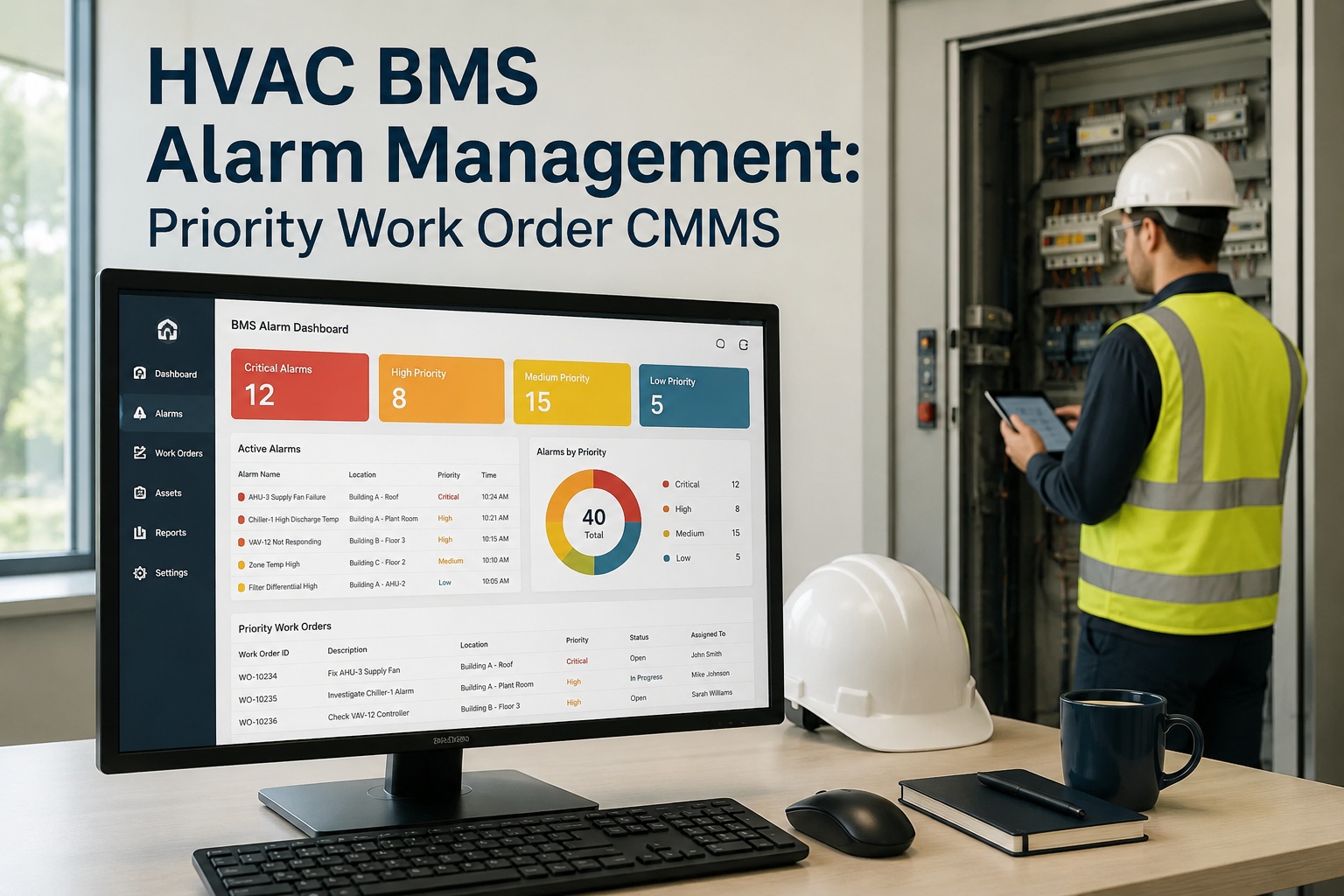
OxMaint replaces spreadsheet queues and whiteboard triage with an AI-driven priority engine that reads asset criticality, real-time sensor data, and occupancy context to rank every work order — then routes it to the right technician with the right parts.
Auto-priority at work-order creation
Technicians select the asset and failure mode; OxMaint assigns P1–P4 based on the asset's criticality matrix, occupancy zone, and current redundancy state — no manual guesswork.
Predictive escalation from sensor data
When vibration, amperage, or temperature trends breach AI thresholds, OxMaint auto-creates a P2 work order before the asset fails — and escalates to P1 if redundancy is lost.
Safety-flag enforcement
Life-safety and regulatory flags are hard-coded into the work-order form. A refrigerant-leak or no-heat task cannot be saved below P1 — and every override requires a reason code and manager sign-off.
SLA tracking & audit trail
Every priority change, dispatch timestamp, and completion is logged with user ID and GPS stamp. Export a compliance report in two clicks for Joint Commission, ASHRAE, or internal audits.
See OxMaint rank your HVAC work orders in real time
Book a 30-minute demo and we'll load your top 20 HVAC assets into a live priority queue — you'll watch a chiller-trip auto-escalate past a routine filter change in seconds.
FAQ
HVAC work order priority classification — your questions answered
What is HVAC work order priority classification?
HVAC work order priority classification is the system of ranking maintenance tasks into tiers — typically Critical (P1), High (P2), Medium (P3), and Low (P4) — based on safety impact, operational criticality, redundancy loss, and downtime cost. A CMMS enforces the rules automatically so dispatchers don't have to triage manually.
How do I set up a priority queue for HVAC maintenance in a CMMS?
Start by building an asset criticality matrix that scores each HVAC unit on occupancy impact, redundancy (N, N+1, 2N), regulatory exposure, and replacement cost. Map those scores to P1–P4 tiers with response-time SLAs. In OxMaint, you configure these rules once and the system auto-assigns priority at work-order creation — you can Start Free Trial and have a working queue in under an hour.
What makes an HVAC work order safety-critical?
A work order is safety-critical when the failure threatens occupant health or life — refrigerant leaks in occupied spaces, no-heat conditions in healthcare or senior-living facilities, combustion-gas leaks from boilers, or loss of ventilation in laboratory fume hoods. These tasks must auto-escalate to P1 with a ≤30-minute response SLA and cannot be downgraded without documented manager approval.
How does a CMMS prevent low-priority tasks from blocking critical ones?
A CMMS enforces priority by controlling the dispatch queue — P1 tasks are pushed to technicians first regardless of submission time, and the system can re-queue in-progress P3/P4 work when a P1 lands. OxMaint also reads real-time sensor and BMS data to auto-create and escalate work orders, so critical failures are never waiting behind a manually triaged list.
How often should HVAC priority classifications be reviewed?
Review your asset criticality matrix and priority rules at least annually, and after any major change — new occupancy use, added redundancy, regulatory update, or an incident that exposed a gap. OxMaint's analytics surface assets whose priority tier doesn't match their actual failure frequency, so you can recalibrate based on real data rather than guesswork. Book a Demo to see the recalibration workflow live.
Stop triaging HVAC work orders by gut feel
Deploy a CMMS priority queue that auto-ranks every task by safety, criticality, and downtime cost — and watch your response times drop from hours to minutes.
Free 14-day trial · No credit card