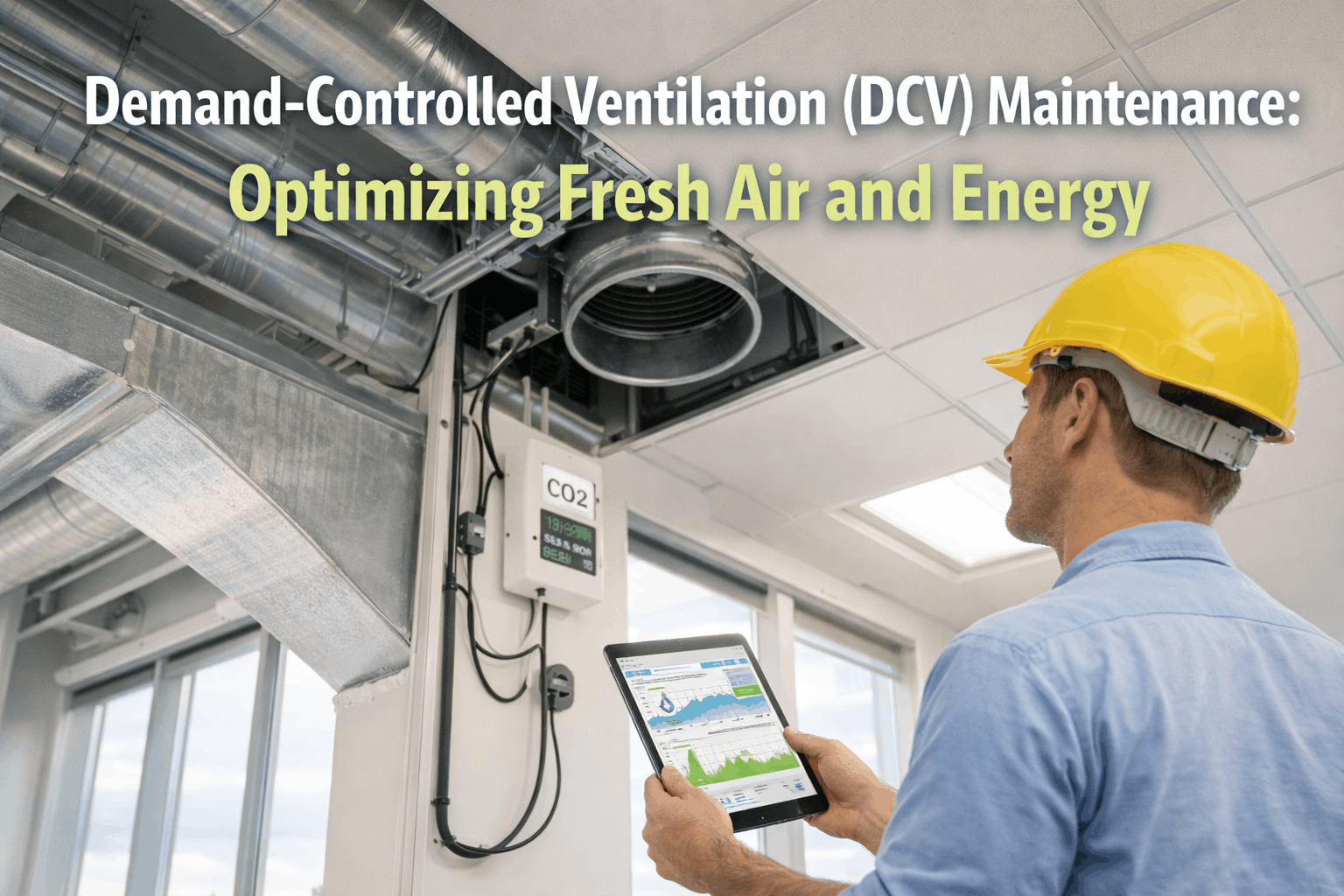
Demand controlled ventilation (DCV) is an HVAC strategy that automatically adjusts outdoor air intake based on real-time occupancy or CO2 levels, delivering typical HVAC energy savings of 15–30% on heating and cooling loads. This DCV optimization guide covers occupancy-based airflow, CO2 sensor integration, energy savings calculation, and how a modern CMMS streamlines DCV maintenance and performance monitoring so your facility stays compliant with ASHRAE 62.1 without over-ventilating empty spaces. If you want to stop wasting energy on unoccupied zones and automate the preventive maintenance that keeps sensors calibrated, you can Start Free Trial of OxMaint to see how AI-powered work orders and analytics tie DCV directly to measurable cost avoidance.
DCV Energy Guide 2026
Are you heating and cooling empty rooms? Demand controlled ventilation can cut HVAC energy waste by up to 30%.
Most buildings over-ventilate by 40–60% during low occupancy, flushing conditioned air outdoors. This guide shows you how to calculate DCV energy savings, tune CO2 ventilation control, and keep every sensor audit-ready with CMMS-driven maintenance.
The Cost of Inaction
Why demand controlled ventilation matters for HVAC energy savings in 2026
A 100,000 sq ft office building with fixed outdoor-air dampers typically spends $180,000–$250,000 per year on heating and cooling loads. Up to 60% of that conditioned air is wasted ventilating unoccupied meeting rooms, vacant floors, and off-hours zones.
Without DCV, your air handlers run at design-day capacity regardless of whether a conference room holds 40 people or zero. Demand control ventilation solves this by linking damper positions and fan speeds to real-time CO2 concentrations or occupancy counts, so you supply exactly the outdoor air ASHRAE 62.1 requires and not a cubic foot more. The result is lower utility bills, extended equipment life, and a defensible audit trail for building energy codes.
DCV Tuning Guide
How to calculate DCV energy savings: the ventilation control savings formula
Quantifying demand controlled ventilation ROI comes down to comparing fixed-rate airflow against occupancy-based airflow, then converting the difference into heating and cooling energy.
Annual Ventilation Control Savings Formula
Savings ($) = (CFR_fixed − CFR_DCV) × ΔT × 1.08 × Operating_Hours × Energy_Rate
CFR = conditioned airflow rate (CFM) · ΔT = average temperature difference between outdoor and supply air · 1.08 = BTU conversion constant · Energy_Rate = $/therm or $/kWh blended
Worked example: a 180-asset corporate campus in Chicago
Fixed ventilation delivers 20,000 CFM continuously during 2,500 annual operating hours. After DCV tuning, average airflow drops to 11,000 CFM because occupancy averages 55%. With a 35°F seasonal ΔT and a blended energy rate of $0.12/kWh, the campus saves roughly $42,000 per year on heating and cooling alone — before counting reduced fan energy from lower static pressure. A CMMS like OxMaint keeps the CO2 sensors calibrated on a 180-day interval so those savings don't erode from sensor drift.
| Building Type | Avg Floor Area | Annual HVAC Spend | DCV Savings % | Est. Annual Savings |
|---|---|---|---|---|
| Office (Class A) | 100,000 sq ft | $210,000 | 25% | $52,500 |
| K-12 School | 85,000 sq ft | $155,000 | 30% | $46,500 |
| Hospital Wing | 120,000 sq ft | $340,000 | 15% | $51,000 |
| Retail / Big-Box | 140,000 sq ft | $225,000 | 35% | $78,750 |
| University Lab | 60,000 sq ft | $280,000 | 20% | $56,000 |
How OxMaint Helps
CMMS demand ventilation: how OxMaint protects DCV performance monitoring
DCV savings decay 8–12% per year when CO2 sensors drift and dampers stick. OxMaint ties every sensor, AHU, and actuator to automated work orders and predictive analytics so your ventilation control savings hold — and you can prove it to any auditor.
Automated CO2 sensor calibration
Schedule 90- to 180-day calibration work orders on every duct and wall-mounted CO2 sensor. OxMaint auto-assigns the right technician, attaches OEM checklists, and closes the loop with digital sign-off — cutting sensor drift by up to 70%.
DCV performance monitoring
Pull BAS trend logs and CO2 ppm data into OxMaint dashboards. Spot zones drifting above 1,000 ppm or dampers stuck at 100% open, then trigger corrective work orders automatically before energy waste compounds.
Predictive damper & actuator maintenance
OxMaint AI analyzes actuator cycle counts and motor run-hours to predict failures 2–4 weeks in advance. Replace sticking damper actuators during planned downtime instead of losing DCV savings to a stuck-open outdoor-air louver.
ASHRAE 62.1 audit readiness
Every calibration record, work order, and sensor reading is timestamped and searchable. Generate a compliance report in under 60 seconds for any inspector — no more scrambling through paper logs or spreadsheets the night before an audit.
Step-by-Step
DCV optimization guide: a 4-month timeline from baseline to verified savings
Rolling out demand controlled ventilation is not a one-day project. Here is a realistic timeline most facilities teams follow, with the CMMS work-order milestones that keep it on track.
Baseline & sensor audit
Inventory every AHU, VAV, CO2 sensor, and occupancy sensor in OxMaint's asset register. Record setpoints, damper minimums, and current calibration status. Identify zones where fixed dampers are delivering 40%+ more outdoor air than ASHRAE 62.1 requires.
CO2 sensor integration & calibration
Replace or recalibrate sensors outside ±75 ppm accuracy. Integrate CO2 readings into the BAS and set DCV mode with a 1,000 ppm CO2 setpoint cap. Generate OxMaint PM triggers for quarterly calibration and semi-annual full-span checks.
DCV tuning & damper optimization
Tune PID loops and damper minimums so CO2 stays between 800–1,000 ppm at design occupancy. Log before/after CFM and fan kW in OxMaint analytics. Expect a 15–25% drop in outdoor-air load during the first full month of active DCV.
Verify savings & lock in PMs
Compare utility bills against the baseline month. Document realized savings in OxMaint's ROI dashboard. Lock in preventive maintenance schedules for sensors, actuators, and filters so performance holds year over year without manual chasing.
Comparison
Fixed ventilation vs demand controlled ventilation: what changes when you switch
The gap between a fixed-outdoor-air system and a tuned DCV strategy shows up in energy bills, occupant comfort complaints, and maintenance workload. Here is what shifts.
| Metric | Fixed Ventilation | DCV (Tuned + CMMS) |
|---|---|---|
| Outdoor air at 30% occupancy | 100% of design CFM | 35–45% of design CFM |
| Annual HVAC energy use | Baseline (100%) | 65–80% of baseline |
| CO2 sensor calibration tracking | Spreadsheets / clipboard | Automated work orders + alerts |
| Audit prep time | 2–3 days of manual gathering | Under 60 seconds via CMMS report |
| Damper failure detection | Found during complaint or inspection | Predicted 2–4 weeks early by AI analytics |
| Occupant IAQ complaints | Common in over-/under-ventilated zones | Reduced 40–60% with stable CO2 control |
See OxMaint on your assets — book a 30-minute demo
We will load your building's AHU and sensor list, show you automated DCV calibration work orders, and calculate your projected ventilation control savings live.
FAQ
Demand controlled ventilation: frequently asked questions
What is demand controlled ventilation in HVAC?
Demand controlled ventilation (DCV) is an HVAC strategy that modulates outdoor air intake based on real-time occupancy or CO2 levels rather than supplying a fixed airflow at all times. By tying damper positions and fan speeds to CO2 sensors or occupancy counts, DCV supplies only the ventilation air a space actually needs, which ASHRAE 62.1 permits as a dynamic reset method for achieving acceptable indoor air quality while reducing energy waste.
How much energy does DCV actually save?
Most commercial buildings see 15–30% HVAC energy savings after implementing DCV, with high-occupancy-variance spaces like theaters, classrooms, and retail hitting 30–40%. Savings depend on climate, occupancy swings, baseline ventilation rate, and how well sensors are maintained. A building that over-ventilates by 50% during low occupancy and pays $0.12/kWh can recover $0.30–$0.50 per sq ft annually, typically paying back the retrofit in 1–3 years.
How often should CO2 sensors be calibrated for DCV?
CO2 sensors should be calibrated every 6–12 months at minimum, with high-accuracy applications like hospitals and labs on a 90-day cycle. Sensor drift of 50–100 ppm can silently erode DCV savings by 8–12% per year. A CMMS like OxMaint automates calibration scheduling, assigns technicians, and stores digital records — you can Start Free Trial and set up your first sensor PM in under 10 minutes.
Is demand controlled ventilation required by code?
DCV is not universally mandated, but ASHRAE 90.1 requires demand control ventilation for spaces larger than 500 sq ft with design occupant density above 25 people per 1,000 sq ft, and many state energy codes (California Title 24, IECC 2021) extend that to additional occupancy types. Even where not required, DCV is recognized as an approved efficiency measure for LEED points and utility incentive programs.
How does a CMMS improve DCV maintenance?
A CMMS centralizes every asset record, calibration schedule, work order, and performance reading tied to your DCV system. Instead of tracking sensor calibrations on spreadsheets and finding failed dampers during occupant complaints, a platform like OxMaint triggers preventive work orders automatically, uses AI to predict actuator failures from run-hour data, and generates audit-ready compliance reports in seconds — protecting your ventilation control savings year after year.
Stop ventilating empty rooms. Start capturing DCV savings.
Book a demo and we will show you how OxMaint automates CO2 sensor calibration, predicts damper failures, and proves your energy savings to any auditor — all in one AI-powered CMMS.
Free 14-day trial · No credit card