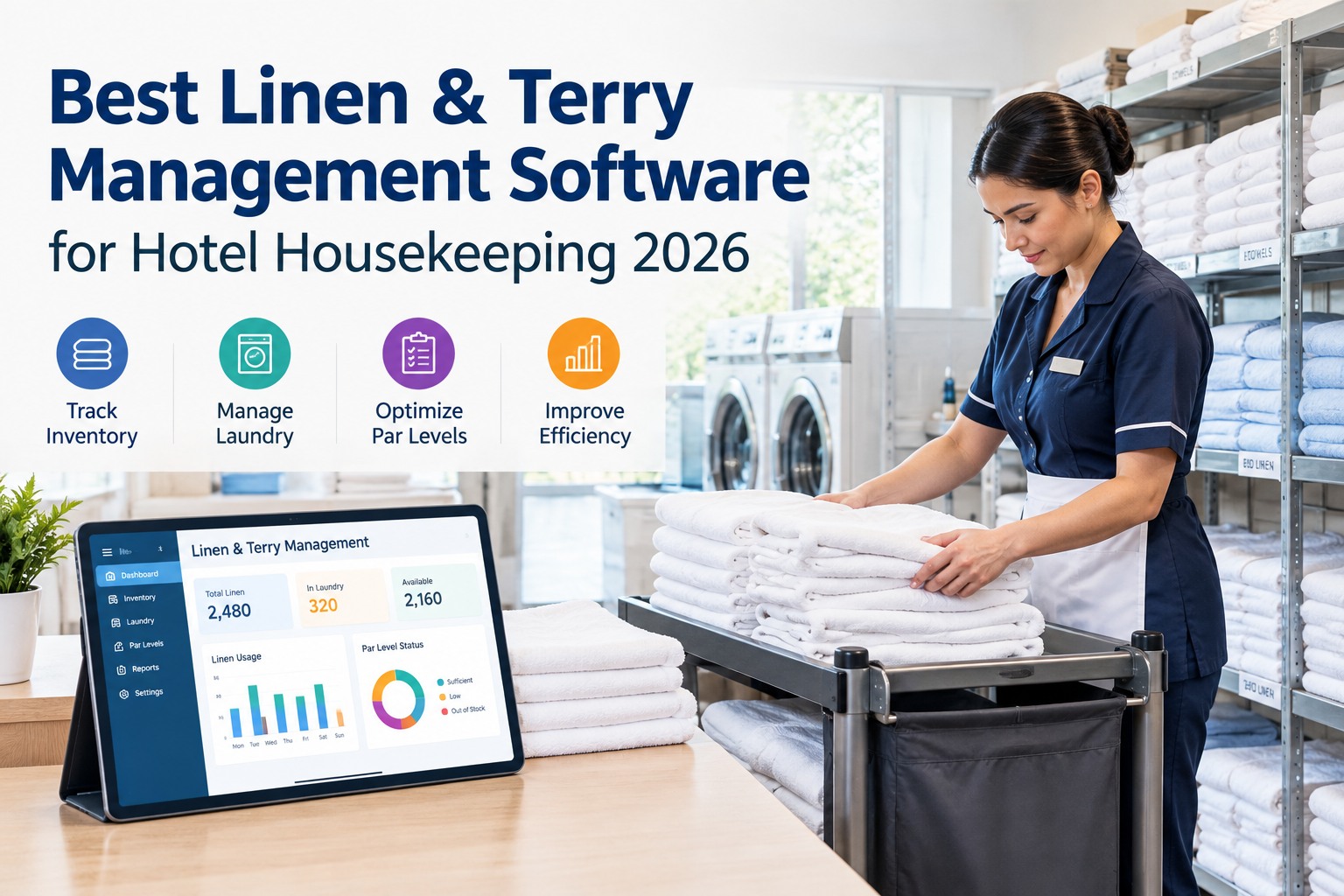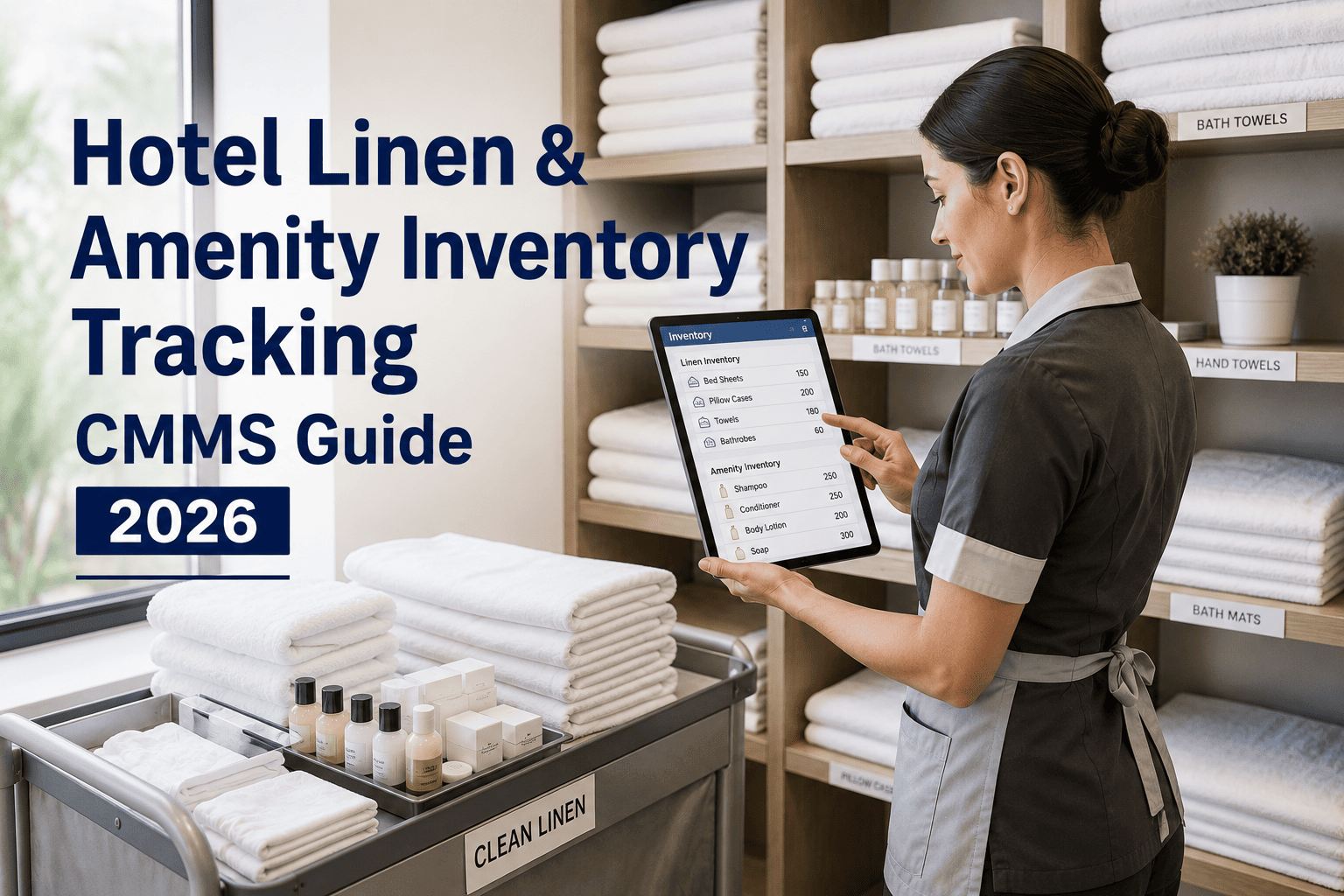
Hotel linen and amenity inventory tracking is where cost quietly walks out — every unaccounted-for terry set and every over-ordered amenity hits the P&L. A CMMS built for hotel linen and amenity inventory turns that mystery line into a managed cost center by tying par levels, physical inventory counts, and replacement cycles to live work orders. This 2026 guide covers the par-level math, loss tracking, and CMMS-integrated consumable inventory practices that housekeeping and engineering teams use to cut linen shrinkage 15–30 percent. See it on your property — Start Free Trial or read on for the full framework.
Hotel Linen & Amenity Inventory CMMS Guide 2026
Is your linen room a cost center or a black hole?
Hotels lose 3–5 percent of total linen inventory every month to theft, damage, and misplacement — yet most still track terry, sheets, and amenities on clipboards and spreadsheets. A CMMS-integrated linen and amenity inventory system closes the gap between par-level planning and real-time consumption, turning consumable spend from guesswork into a controlled, auditable cost center.
3–5%
Monthly linen shrinkage at hotels without CMMS-based par-level tracking
The Cost of Not Tracking
Why hotel linen and amenity inventory leaks money every night
A 200-room property carries 6,000–8,000 linen items and orders $30K–$60K in amenities annually — and without a consumable CMMS, 15–25 percent of that spend is unaccounted for.
$50K
Average annual linen replacement cost for a 200-room hotel without par-level controls
15–30%
Reduction in linen shrinkage when CMMS-based tracking and loss logging replace manual counts
4 hrs
Weekly housekeeping supervisor time lost to spreadsheet reconciliation and stockouts
2.5x
Over-ordering multiplier for amenities when reorder points are guessed instead of CMMS-tracked
A 180-room boutique hotel spending $42K per year on linen replacement and amenities tracked replenishment on a shared Google Sheet. After implementing CMMS-based par-level inventory, the property cut amenity over-ordering by 28 percent and reduced emergency linen purchases from twice monthly to once per quarter — saving $11,800 in year one.
Par-Level Math
How to calculate par levels for hotel linen with a CMMS
Par level is the minimum stock of each linen type needed to operate at full occupancy with one full changeover reserve. Most full-service hotels run 3 par (in use, in laundry, in reserve) — but the formula must be tied to live occupancy data, not a static annual guess.
Par-Level Formula
Par = (Rooms × Linen Sets per Room) × Par Multiplier
Example: 200 rooms × 4 terry sets × 3 par = 2,400 terry items minimum stock
Reorder Point Formula
Reorder = Par Level − (Daily Usage × Lead Time in Days)
Example: 2,400 − (120 items/day × 5 days) = reorder at 1,800 items
When these formulas live inside a CMMS, reorder triggers fire automatically as housekeeping logs dirty-linen counts and laundry returns through mobile work orders. No weekly spreadsheet update, no stockout surprises during a sold-out weekend.
Tracking Cadence
Hotel linen physical inventory cadence: monthly, quarterly, annual
Physical counts are the backbone of loss tracking — but most properties do them once a year and wonder why the numbers never reconcile. A CMMS-driven cadence spreads the workload and catches shrinkage early.
Monthly
High-value amenity spot count
Count top 5 amenity SKUs (shampoo, conditioner, body wash, coffee pods, water) against CMMS-logged consumption. Variance over 5 percent triggers a loss investigation work order.
Quarterly
Full linen inventory by category
Count terry, sheets, pillowcases, duvet covers, and bed pads floor by floor. Compare physical count to CMMS par level — items below reorder point auto-generate purchase requests.
Semi-Annual
Linen condition audit
Inspect 10 percent of stock for thread count degradation, staining, and fraying. Flag items past replacement cycle in the CMMS asset register and schedule disposal work orders.
Annual
Full replacement-cycle reconciliation
Reconcile total linen lifecycle against purchase records, laundry cycles logged, and retirement data. Reset par levels for the next 12 months based on CMMS analytics on occupancy and wear rates.
Comparison
CMMS hotel linen inventory vs. spreadsheet tracking
The gap between a spreadsheet and a CMMS-integrated consumable inventory system is the gap between guessing and knowing. Here is what changes when you switch.
| Capability | Spreadsheet / Manual | CMMS (OxMaint) |
|---|---|---|
| Par-level monitoring | Static, updated weekly or monthly | Real-time, auto-triggers reorder at threshold |
| Loss & shrinkage tracking | Discovered during annual count — months late | Flagged within 24–48 hrs via variance work orders |
| Replacement-cycle visibility | No cycle tracking — replace when torn | Lifecycle per item, auto-retirement at wash-count limit |
| Amenity consumption analytics | Monthly PO totals only | Per-floor, per-room-type, per-occupancy breakdown |
| Audit readiness | Manual report compilation — 2–3 days | One-click export, full digital trail |
| Multi-property rollup | Separate files per property | Unified dashboard across all properties |
How OxMaint Helps
How OxMaint CMMS solves hotel linen and amenity inventory
OxMaint ties linen counts, amenity consumption, and replacement cycles directly to work orders and preventive maintenance schedules — so housekeeping and engineering operate from one live data source, not three disconnected systems.
Automated par-level reorder triggers
Set par levels and reorder points per linen category and amenity SKU. When stock drops below threshold — logged via mobile work orders — OxMaint auto-generates a purchase request. Properties cut stockouts by 80 percent and over-ordering by 25 percent.
Replacement-cycle tracking per item
Track wash-count and lifecycle for every linen category. OxMaint flags items past their replacement threshold and schedules retirement work orders automatically — extending useful life 10–15 percent and eliminating premature disposal.
Variance & loss investigation workflows
When physical counts deviate from CMMS records beyond your set tolerance, OxMaint creates a loss-investigation work order assigned to the right manager. Catch shrinkage in days, not months — cutting unexplained loss 15–30 percent.
Consumable analytics by floor & room type
See amenity consumption broken down by floor, room type, and occupancy level. OxMaint analytics surface over-consumption patterns and under-stocked categories — giving GMs and executive housekeepers the data to negotiate vendor contracts and right-size orders.
See OxMaint manage your linen and amenity inventory live
Book a 30-minute demo and we will map your property's par levels, replacement cycles, and loss-tracking workflows inside OxMaint — before you commit to anything.
FAQ
Hotel linen and amenity inventory tracking — your questions answered
What is a par level in hotel housekeeping and how does a CMMS manage it?
A par level is the minimum stock of each linen or amenity item needed to operate at full occupancy with a reserve for laundry turnaround — typically 3 par for linens (in use, in laundry, in reserve). A CMMS like OxMaint tracks real-time stock levels against par and automatically triggers reorder requests when inventory drops below the threshold, eliminating manual count-and-order cycles.
How often should hotels do physical linen inventory counts?
High-value amenity SKUs should be spot-counted monthly, full linen inventory by category quarterly, condition audits semi-annually, and a full replacement-cycle reconciliation annually. A CMMS makes this cadence manageable by logging counts through mobile work orders and auto-flagging variances — book a demo to see the workflow on your property's data.
How much does a CMMS reduce hotel linen loss and shrinkage?
Hotels that switch from spreadsheet tracking to a CMMS-integrated linen inventory system typically reduce shrinkage 15–30 percent in the first year. The gains come from faster variance detection (days instead of months), automated loss-investigation work orders, and replacement-cycle tracking that prevents both over-ordering and stockouts.
Can a CMMS track hotel amenities as well as linens?
Yes. OxMaint treats amenities as consumable inventory items with their own par levels, reorder points, and consumption analytics. Housekeeping logs amenity usage through mobile work orders, and the CMMS breaks down consumption by floor, room type, and occupancy — giving you vendor-negotiation data that spreadsheets cannot provide.
Is it hard to switch from spreadsheets to a CMMS for linen tracking?
No. OxMaint onboarding includes importing your current linen categories, amenity SKUs, par levels, and vendor lead times — most properties are live within 1–2 weeks. Housekeeping staff use a simple mobile interface to log counts and consumption, and the system handles reorder triggers, variance flags, and replacement-cycle tracking automatically. Start Free Trial to test it with your own inventory data.
Stop guessing. Start managing your linen and amenity inventory.
Join the hotels using OxMaint to turn consumable spend into a controlled, auditable cost center — with real-time par levels, automated reorders, and loss tracking that actually works.
Free 14-day trial · No credit card