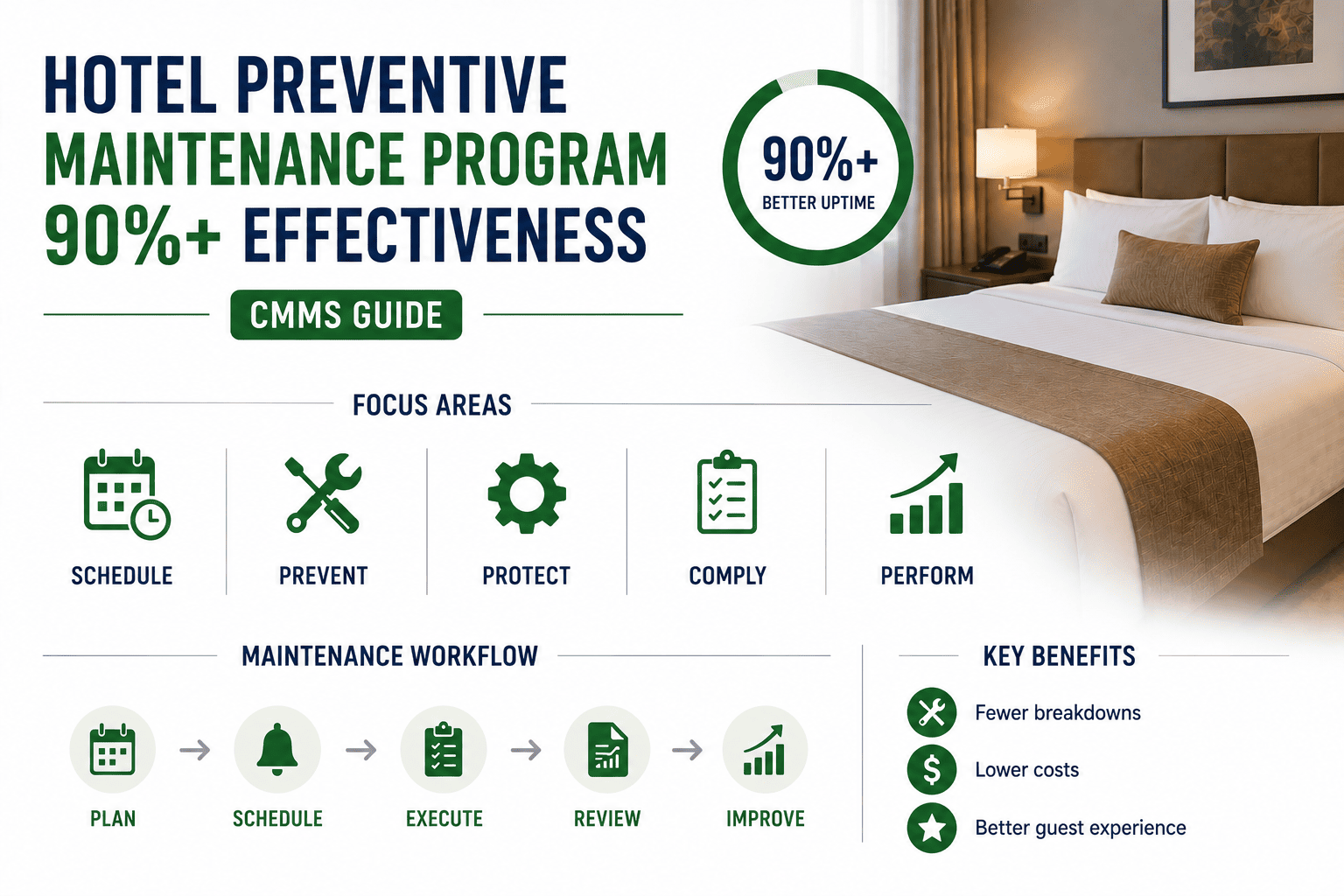
A hotel's chiller unit breaks down at 2 AM on the hottest night of summer. The temperature in guest rooms climbs above 78°F. Guests demand refunds. The emergency service call costs $3,500. Parts are rushed overnight. Installation takes 12 hours. The hotel loses $12,000 in room revenue from guests moving to competitors. Total cost: $15,500. The chiller could have been maintained routinely for $200 per year—a maintenance cost that would have prevented this exact failure. This is the reactive vs. preventive maintenance problem: unplanned repairs cost 2–5x more than planned maintenance, consume 70–80% of engineering shift hours, and deliver guest-damaging failures. Yet most hotel engineering teams still operate in reactive mode because nobody tracks the true cost of emergency repairs. Sign Up Free with Oxmaint to shift from emergency firefighting into structured preventive maintenance, eliminate the cost multiplier, and protect guest satisfaction. Book a Demo to see how hotels reduce maintenance costs by 28–35% while increasing PM compliance from 40% to 90%+ within 90 days through automated scheduling and real-time compliance visibility. This guide breaks down the financial case for preventive maintenance and the CMMS workflows that make it happen.
The Financial Impact of Reactive Maintenance: The True Cost of Emergencies
Hotels often cite budget constraints as the reason they cannot invest in preventive maintenance programs. Yet when you calculate the true cost of reactive maintenance—including after-hours labor premiums, emergency parts pricing, guest compensation, and lost revenue from out-of-service rooms—preventive maintenance is not a cost. It is a profit driver. A filter that costs $45 to replace during a routine 30-minute PM visit costs $280 to replace as an emergency call when guests complain the AC is not working and the filter is clogged. The difference is not the part cost. It is the premiums (3–4x labor rate), lost room revenue, and guest dissatisfaction. When 60–70% of your maintenance team is consumed by reactive work, PM never happens. Equipment degrades faster. Failures accelerate. Costs compound. Book a Demo to see how a CMMS breaks this cycle by automating PM scheduling so your team has scheduled capacity for preventive work.
Reactive vs. Preventive: How to Categorize Tasks and Build a Discipline
The shift from reactive to preventive starts with categorizing every maintenance task into three buckets: urgent reactive repairs (guest-facing failures), routine preventive maintenance (calendar or usage-based), and long-term capital projects. Without this categorization, supervisors treat all work as urgent and PMs get deferred indefinitely. Sign Up Free to set up automated PM scheduling that feeds preventive tasks into the same queue as reactive work, with priority logic that protects PM from being displaced.
- HVAC failure, no heat/AC, water leak, toilet overflow, locked-out guest, electrical failure
- Consume 60–70% of shift time in reactive-focused hotels; must be addressed immediately
- Track these metrics to identify patterns: recurring HVAC failures on same units, plumbing leaks on specific floors, frequent lock resets
- Root cause analysis: Is this unit aging and needs replacement? Is there a design flaw? Should we upgrade this system?
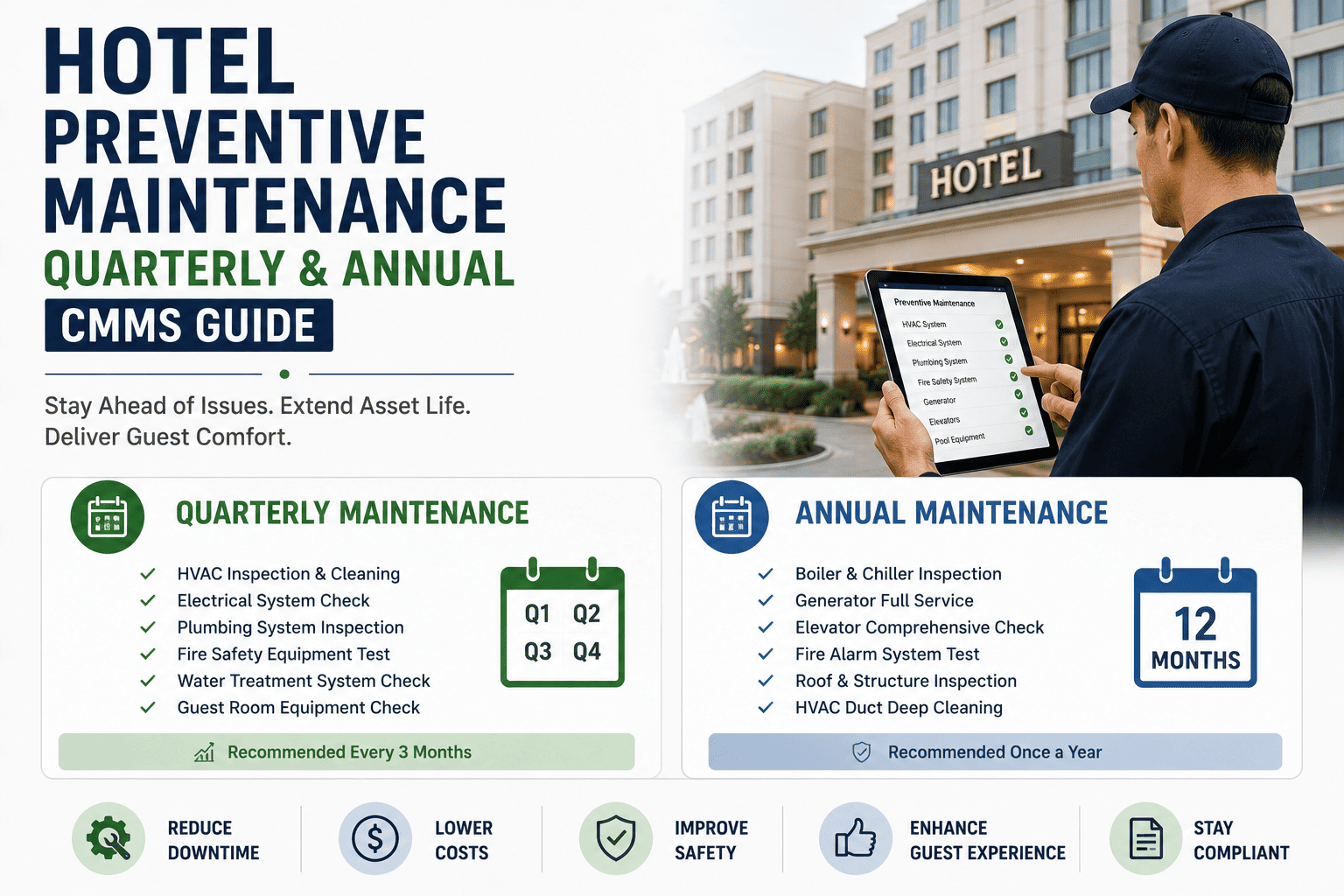
- HVAC: Filter changes (monthly), coil cleaning (quarterly), refrigerant checks (semi-annual), compressor service (annual)
- Plumbing: Line inspections (quarterly), pressure tests (semi-annual), fixture repairs (as needed)
- Electrical: Panel testing (annual), breaker checks (semi-annual), emergency light testing (monthly)
- Set auto-generate: PM work orders create automatically at scheduled intervals, visible in same queue as reactive work, cannot be deleted only completed or rescheduled with justification
- Equipment reaching end-of-life: HVAC replacement, chiller upgrade, electrical panel modernization, boiler replacement
- Planned during off-peak seasons; requires vendor coordination, permits, guest communication
- Track equipment age and maintenance history in CMMS; when repair costs exceed 50% of replacement cost, trigger capital planning discussion
- CMMS data shows which assets consume most maintenance labor; capital decisions shift from gut feel to evidence
The PM Compliance Trap: Why Scheduled Maintenance Gets Deferred and How to Prevent It
Most hotel engineering teams intend to do preventive maintenance. They just don't do it consistently. Without a CMMS, PM exists in a separate system from reactive work—a separate binder, a separate calendar, a separate mental model. When a guest calls with an AC complaint, that reactive request jumps the queue. The PM binder sits on the shelf. By shift-end, the PM never happened. Over weeks, PMs accumulate. The PM backlog becomes invisible until equipment fails. Then emergency costs spike. Hotels break this cycle by putting PM in the same CMMS queue as reactive work, with protection rules that prevent low-priority work from displacing scheduled PMs. Sign Up Free to enforce PM discipline automatically.
Define PM schedule for each asset: "HVAC-101 needs filter change monthly, coil clean quarterly, refrigerant check semi-annually." System generates work orders automatically at 2 AM when nobody is working. Orders appear in technician queue at shift start. No manual scheduling, no forgotten items.
Schedule PM in the same queue as reactive work but with priority protection. Rule: "If PM completion rate falls below 85% this month, no P4 (low-priority) work orders route to technicians until PM is caught up." Forces PM prioritization when backlog grows.
Real-time visibility into PM completion rate per technician per week. If a tech is 60% PM-compliant (should be >90%), supervisor gets alert. Conversation happens: Is the tech overloaded? Do they need training? Is the PM schedule unrealistic for your staffing?
PM work orders cannot be closed without photographic evidence. Filter change? Take a photo of old and new filter. Coil cleaning? Photo before and after. Creates accountability and compliance audit trail for brand inspections.
When a PM is more than one week overdue, system flags it. Two weeks? Alert escalates to chief engineer. Three weeks? Alert goes to GM. Prevents silent accumulation of deferred maintenance that leads to catastrophic failures.
When a PM is skipped, technician documents reason: "Guest request took precedence," "Part not in stock," "Equipment inaccessible." Data reveals bottlenecks: Is staffing too lean? Do you need to stock more parts? Is the building layout delaying PM access?
Cost Comparison Table: Reactive vs. Preventive Maintenance for Key Systems
| Equipment Type | Preventive Maintenance Task | PM Cost (Planned) | Reactive Repair Cost (Emergency) | Cost Multiplier | Guest Impact |
|---|---|---|---|---|---|
| HVAC Filter | Monthly replacement: 30 min labor + $45 filter | $85 | $280 (after-hours call + compressor damage risk) | 3.3x | None if scheduled; guest discomfort if delayed |
| Chiller Unit | Annual service: coil cleaning, refrigerant check: 4 hours labor + parts | $450 | $3,500–$8,000 (emergency service + parts + compressor replacement) | 5–10x | 24–48 hour room outages; guest refunds; lost bookings |
| Toilet/Valve | Quarterly inspection & seal replacement: 1 hour labor + $35 parts | $75 | $650 (emergency call + water damage + room closure + cleanup) | 8.7x | Immediate guest complaint; room out of service for 8+ hours |
| Elevator | Monthly maintenance per code: contracted service | $250 | $1,500+ (emergency repair + Code Red fees + liability insurance) | 6x | Trapped passengers; liability exposure; regulatory violation |
| Boiler | Annual inspection & servicing: 2 hours + parts | $320 | $2,800 (emergency replacement parts + rush service + fuel surcharge) | 8.75x | No heat in winter; entire property affected; health/safety issue |
| Door Lock | Quarterly lubrication & check: 15 min labor | $22 | $120 (emergency locksmith + guest frustration + security risk) | 5.5x | Guest locked out; perception of poor security; negative review |
Frequently Asked Questions: Reactive vs. Preventive Maintenance Strategy
We were spending $45K per month on maintenance, and 80% was emergency repairs. My chief engineer said we didn't have budget for preventive work. But after we implemented Oxmaint and actually tracked our costs, we realized emergency calls were costing us 5x more. Within 90 days of forcing PM compliance through the CMMS, our total monthly cost dropped to $32K. Now we spend time fixing things systematically instead of fighting fires at 3 AM. Guests are happier because failures happen less often. Our team is happier because they're not burned out.
—Jennifer Walsh, General Manager, 280-room independent hotel, Denver, Colorado