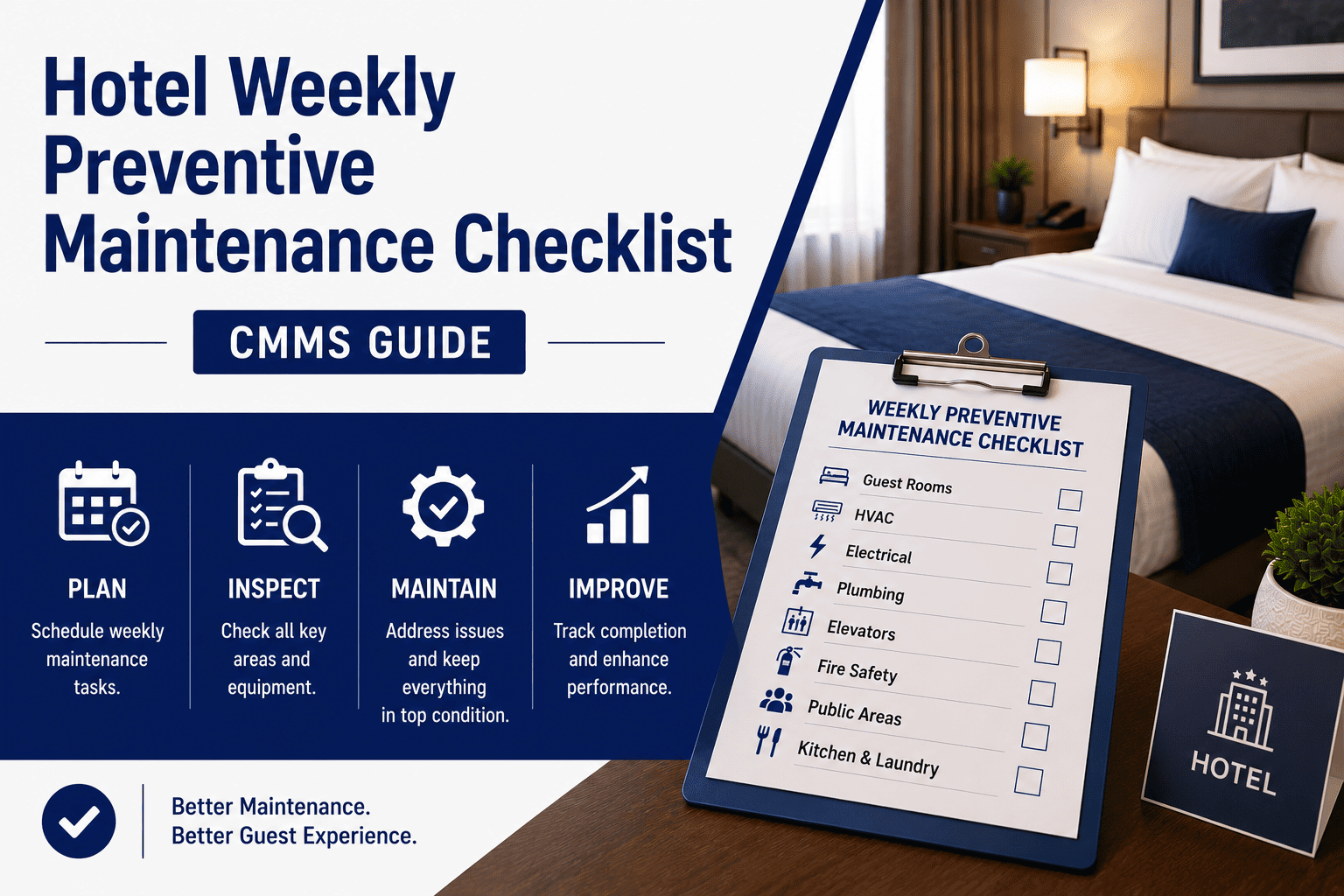
Hotel weekly preventive maintenance is the strategic middle ground where daily walk-bills fall short and monthly deep-downs arrive too late — it is where filter integrity, drain flushing, life-safety tests and equipment inspection actually get done before they become guest complaints. A properly built CMMS weekly checklist turns that middle layer from a clipboard ritual into a closed-loop work order system that survives staffing turnover, seasonal ramp and multi-property expansion. This guide breaks down the task library, coverage across mechanical/plumbing/electrical/life-safety, and the CMMS structure that keeps weekly PM consistent. Ready to operationalize it? Start Free Trial and run your first weekly PM cycle today.
Weekly PM · CMMS Guide · 2026
Is your weekly PM actually preventing failures — or just paperwork?
The hotel weekly checklist is where the daily-vs-monthly compromise lives. Filters, drains, safety systems and equipment inspections land here — and 62% of properties still run them on clipboards that vanish with the next shift change. A CMMS-anchored weekly PM closes that loop with photos, signatures, escalations and audit trails that survive turnover.
Weekly Task Library
The four-system coverage every hotel weekly PM must touch
A defensible weekly PM program covers four asset families. Missing any one of them is the most common gap we audit in multi-property portfolios — and the one most likely to surface during an AHLEI or brand-standard inspection.
Mechanical & HVAC
RTU filter inspection, belt tension, condensate line flush, cooling tower drift check, pump bearing temp log. Targets ISO 55000-aligned asset health.
- Filter pressure-drop reading
- Belt deflection <¾ inch
- Condensate drain flush
- Pump vibration spot-check
Plumbing & Water
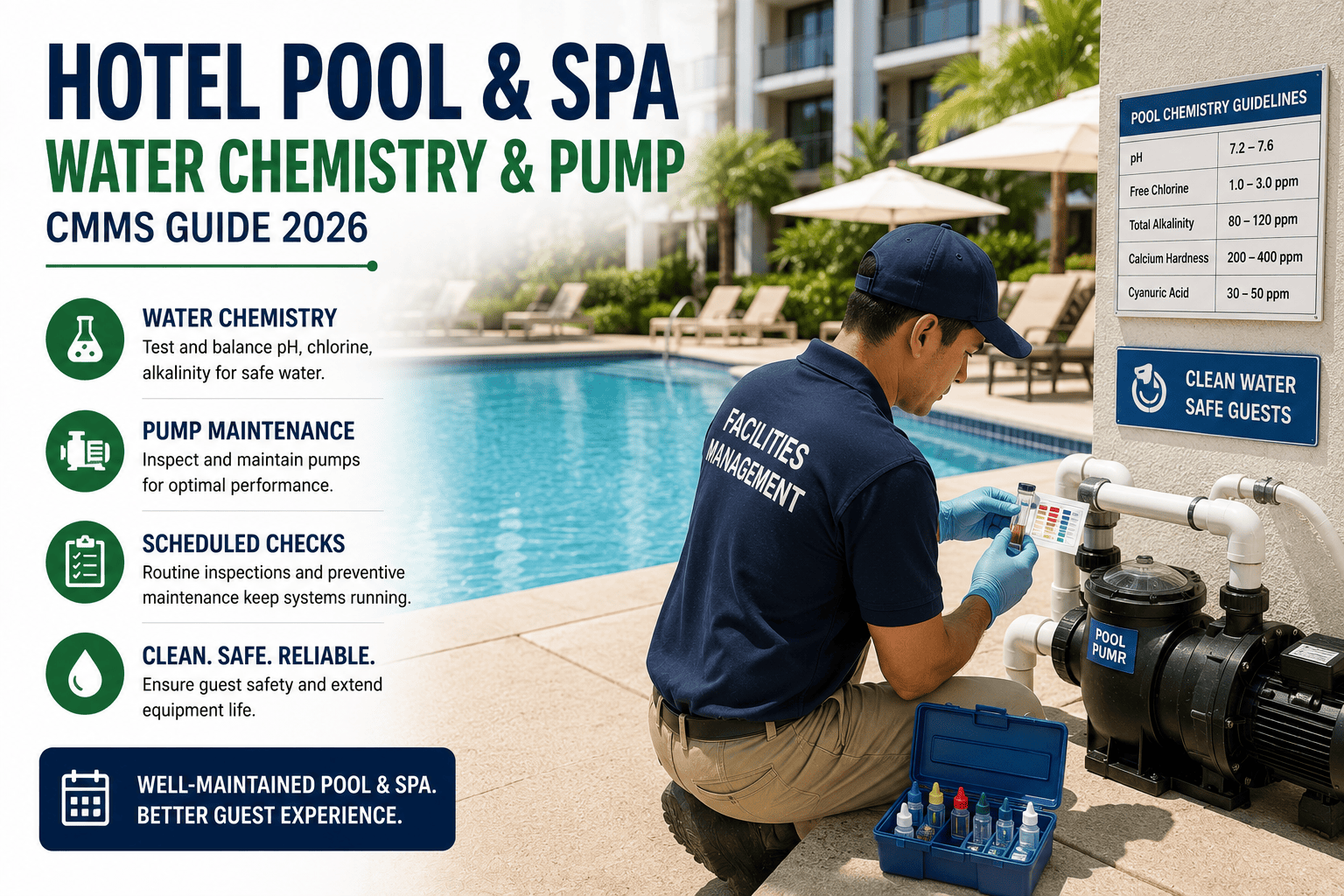
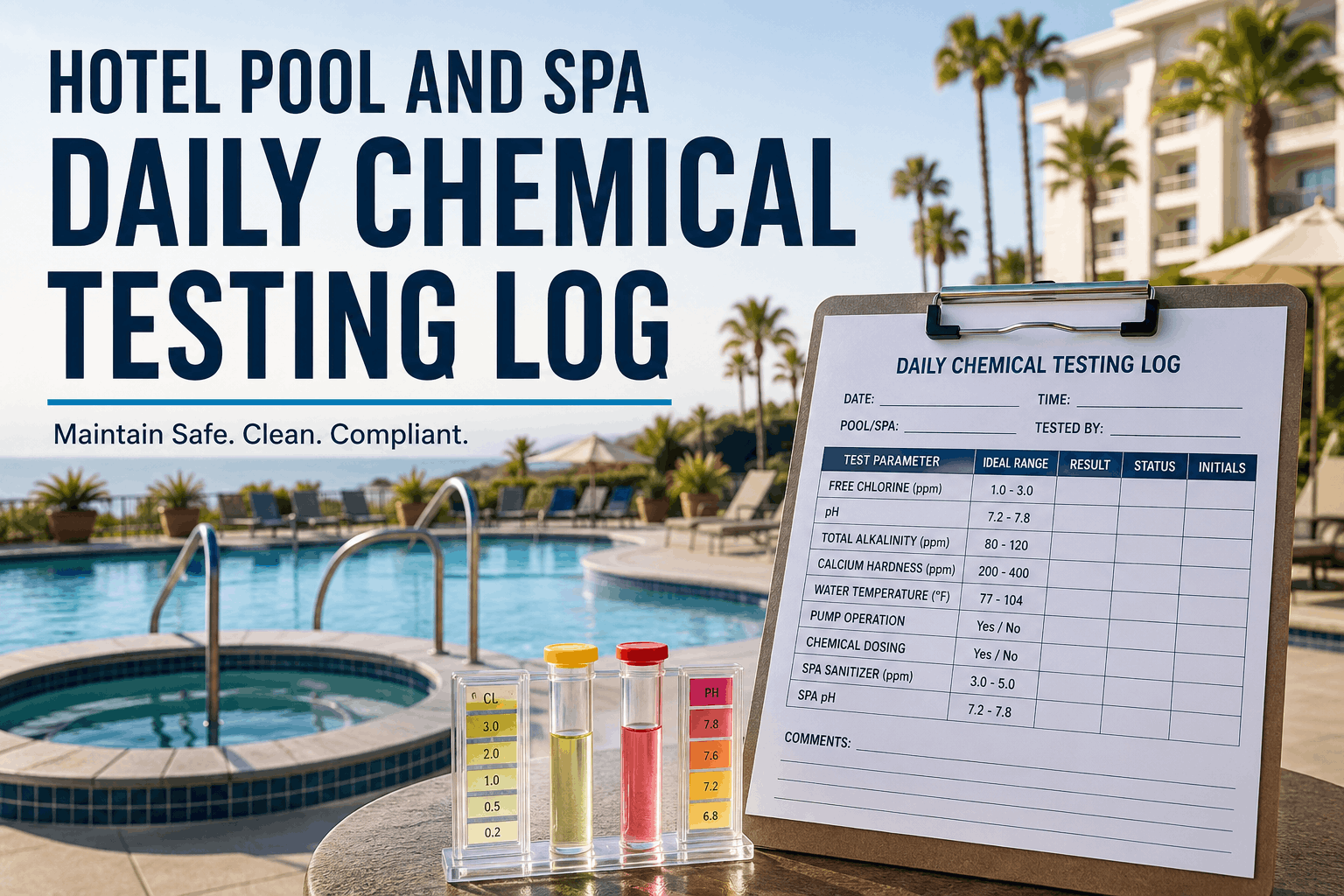
Floor drain flushing, water heater anode check, mixing valve temp verification, pool chemistry deep test — total alkalinity and combined chlorine.
- Drain flush & trap prime
- Total alkalinity 80–120 ppm
- Combined chlorine <0.2 ppm
- HW recirc return >120°F
Electrical & Power
Panel thermography spot scan, generator no-load run, ATS transfer test, emergency lighting 30-second lamp push. NFPA 110 weekly readiness.
- Gen-set 30-min no-load run
- ATS auto-transfer signal
- Exit lamp battery push-test
- Breaker thermal spot scan
Life Safety & Fire
Sprinkler valve position, fire pump churn start, extinguisher tag scan, kitchen Ansul inspection, smoke detector function test rotation.
- Valve tamper switch normal
- Fire pump 10-min churn
- Extinguisher tag photo log
- Ansul fusible link check
Pool Chemistry Deep Test
Total alkalinity and combined chlorine: the two readings clipboards miss
Daily pool tests check free chlorine and pH. The weekly deep test catches the two chemistry drift indicators that precede 80% of cloudiness and CDC MAHC violations — and they belong inside the CMMS as numeric fields, not check-boxes.
Total Alkalinity (TA)
TA buffers pH against bounce. Below 80 ppm, pH swings wildly with bather load; above 120 ppm, chlorine effectiveness drops and scaling begins on heat exchangers — a hidden cost on the boiler side.
Combined Chlorine (CC)
CC = Total Cl − Free Cl. When combined chlorine exceeds 0.2 ppm, chloramines are building — that "pool smell" guests complain about. The CMMS should auto-trigger a superchlorination work order at this reading.
Worked example
A 220-key resort in Florida was logging daily free chlorine at 2.0 ppm every morning, yet guest complaints about "chlorine smell" kept rising. The weekly deep test — added to the CMMS as a numeric capture field — revealed combined chlorine at 0.6 ppm for three consecutive weeks. Auto-triggered breakpoint chlorination work orders cleared the chloramine load in one cycle and complaint volume dropped 71% the following month. The entire fix cost less than $40 in calcium hypochlorite.
CMMS Weekly Task Structure
What a CMMS-enforced weekly task looks like vs a clipboard task
The difference between a weekly PM that survives turnover and one that doesn't is structure. A CMMS task carries mandatory fields, escalation rules and an audit trail — the clipboard carries a signature and hope.
| Task attribute | Clipboard / paper log | CMMS-enforced weekly PM |
|---|---|---|
| Task assignment | Handed to whoever is on shift | Auto-routed by skill, zone and certification |
| Numeric readings | Written in a notebook, never re-read | Captured as fields with min/max validation |
| Photo proof | Not required | Mandatory photo on close-out for safety tasks |
| Escalation on failure | Verbal handoff, often lost | Auto-creates corrective WO + notifies supervisor |
| Audit trail | Paper filed in a binder | Timestamped, signed, exportable to PDF/CSV |
| Turnover resilience | Walks out the door with the tech | Lives in the asset record, not the employee |
| Compliance readiness | Days to assemble for inspection | One-click brand-standard and CDC MAHC report |
Built-In Resilience
Keeping weekly PM consistent through staffing turnover
Hospitality maintenance sees 38% annual technician turnover on average. The weekly checklist that lives in a CMMS — not in a departing tech's head — is the single biggest defense against PM drift across seasons and property transitions.
faster onboarding of new maintenance techs when weekly PM tasks carry step-by-step instructions, photos of the asset, and pass/fail criteria inside the CMMS work order.
weekly PM completion rate at properties running CMMS-enforced checklists, versus 61% at clipboard-dependent properties audited across a 14-property portfolio.
in retraining costs when a tech leaves — the task library, asset history and failure patterns stay in the system, not in tribal knowledge that walks out the door.
Turn your weekly PM into a closed-loop system this quarter
Deploy a pre-built hotel weekly PM checklist library in under 48 hours — mechanical, plumbing, electrical, life safety and pool chemistry, all in one CMMS.
FAQ
Weekly preventive maintenance CMMS — what teams ask
Why should weekly PM live in a CMMS instead of on a clipboard or spreadsheet?
A clipboard records that a task was done; a CMMS records who did it, when, what readings they took, what photo proof exists, and what corrective work order auto-triggered if a reading failed. For a 150-room property running 40+ weekly tasks, that difference is the line between preventing a $6,000 chiller failure and explaining one to ownership after the fact. Spreadsheets get you halfway — no auto-escalation, no mobile capture, no audit trail. You can spin up a full CMMS trial at app.oxmaint.ai and import your existing checklist in an afternoon.
How often should pool total alkalinity and combined chlorine be tested?
Free chlorine and pH get a daily dip test. Total alkalinity and combined chlorine are weekly deep-test readings — they drift more slowly but are the leading indicators of cloudiness, scaling and chloramine buildup. TA should sit in the 80–120 ppm band; combined chlorine above 0.2 ppm means it is time for breakpoint chlorination. Both belong in the CMMS as numeric capture fields with automatic pass/fail thresholds, not as checkbox "done" entries.
What does a complete hotel weekly PM checklist cover?
A complete weekly program spans four asset families: mechanical and HVAC (filter pressure-drop, belt tension, condensate flush, pump bearing temp), plumbing and water (drain flushing, water heater anode, mixing valve temps, pool chemistry deep test), electrical and power (generator no-load run, ATS transfer test, emergency lamp push-test, panel thermal spot scan), and life safety and fire (sprinkler valve position, fire pump churn start, extinguisher tag scan, kitchen Ansul inspection).
How does the CMMS handle weekly PM when technicians change shifts or leave?
Every weekly task is attached to the asset, not the employee. When a tech leaves, the task library, pass/fail criteria, step-by-step instructions, reference photos and full failure history stay in the system. A replacement tech sees the same work order with the same validation rules on day one — onboarding time drops roughly 3× compared to paper-based properties where tribal knowledge walks out the door. Want to see the handoff in action? Book a walkthrough at calendly.com/oxmaintapp/30min.
What is the ROI of moving hotel weekly PM into a CMMS?
Properties typically see 25–35% fewer unplanned equipment failures in the first six months, a 15% drop in third-party repair spend, and measurably higher brand-standard inspection scores. A 180-asset boutique hotel spending roughly $42K annually on reactive repairs can redirect $10K–14K of that into preventive work within two quarters — the CMMS subscription is a fraction of that swing, and payback generally lands inside the first quarter of full deployment.
Run your first CMMS-enforced weekly PM cycle this week
Pre-loaded hotel task library, pool chemistry deep-test templates, auto-escalation on failed readings, and a one-click compliance report. Everything your team needs to stop relying on clipboards.
Free 14-day trial · No credit card