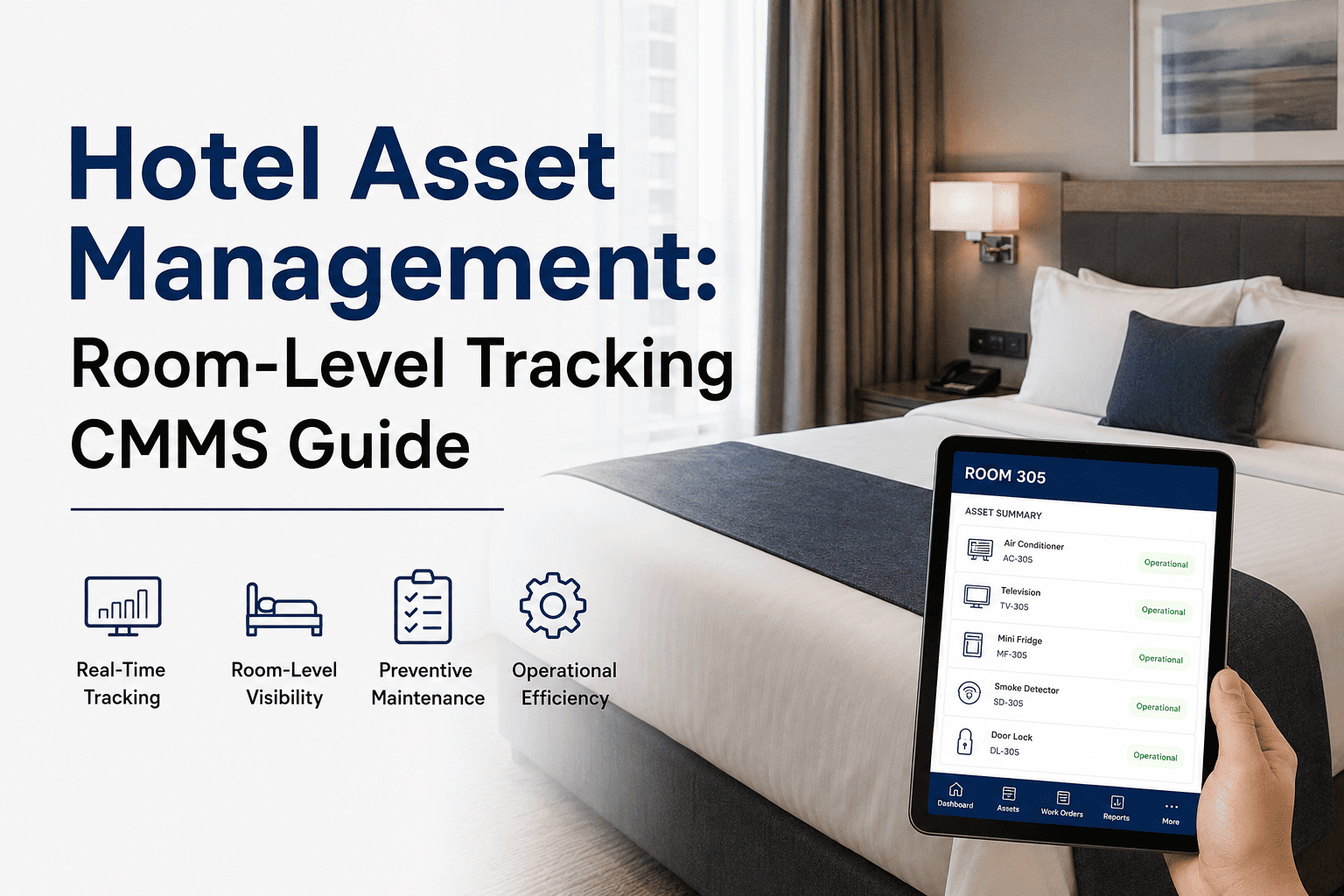
Hotel asset management at the room level is where portfolio thinking meets operational reality — every PTAC unit, plumbing fixture, television, and piece of furniture in every guest room tracked, tagged, and preventively maintained through a central CMMS. A room-level tracking CMMS gives maintenance and reliability teams a living asset registry tied to work orders, warranties, and capital planning, eliminating the blind spots that cause reactive breakdowns and guest complaints. This guide walks through the structure, tagging conventions, and preventive maintenance linkage required to build a hotel asset registry that scales across hundreds of rooms. See how OxMaint makes the transition from spreadsheets to a fully searchable room-level asset CMMS when you Start Free Trial.
CMMS Hotel Asset Guide 2026
Can you name every asset in every room — right now?
Most hotels track assets at the building level and lose visibility the moment a PTAC fails in Room 412. Room-level CMMS tracking changes that: every valve, TV, mattress, and mini-fridge registered, tagged, and linked to preventive maintenance so failures are predicted, not reacted to.
Asset Registry Structure
How to Build a Hotel Asset Registry with Room-Level CMMS Tracking
A hotel asset registry is only as good as its hierarchy. The ISO 55000 asset management standard emphasizes structured asset identification as the foundation for lifecycle planning — and in hospitality that means mapping from property down to the individual room and the specific asset inside it. A room-level CMMS guide follows a five-tier hierarchy so any technician can locate, repair, and log work against a single, unambiguous asset record.
Hotel Property Node
Top-level record: property name, address, brand standard tier, and total key count. For multi-property portfolios this is where roll-up reporting begins.
Building or Wing Identifier
Separate tower, low-rise, or auxiliary buildings. Critical for resorts and convention hotels where a single property spans multiple structures with different mechanical systems.
Floor Level Record
Floor number with zone designation (e.g., east corridor, west wing). Enables floor-level preventive maintenance sweeps and faster emergency response routing.
Individual Guest Room Unit
The room number becomes a parent container — Room 412 holds child assets. This is the heart of room-level CMMS tracking: every work order, PM trigger, and guest complaint rolls up to this node.
Individual Equipment or FF&E Item
The leaf-level asset: PTAC unit, LED TV, shower valve, mattress set, mini-fridge, or HVAC thermostat. Each carries a unique QR tag, install date, warranty expiry, and PM schedule.
Room-Level Tagging
What Assets to Track in Each Hotel Room — PTAC, TV, Furniture & Plumbing
A typical 150-room hotel carries 1,000–1,400 tracked room-level assets. The categories below represent the minimum viable asset registry for CMMS hotel asset management. Each category is tied to a preventive maintenance frequency and a replacement lifecycle benchmark drawn from industry FF&E standards.
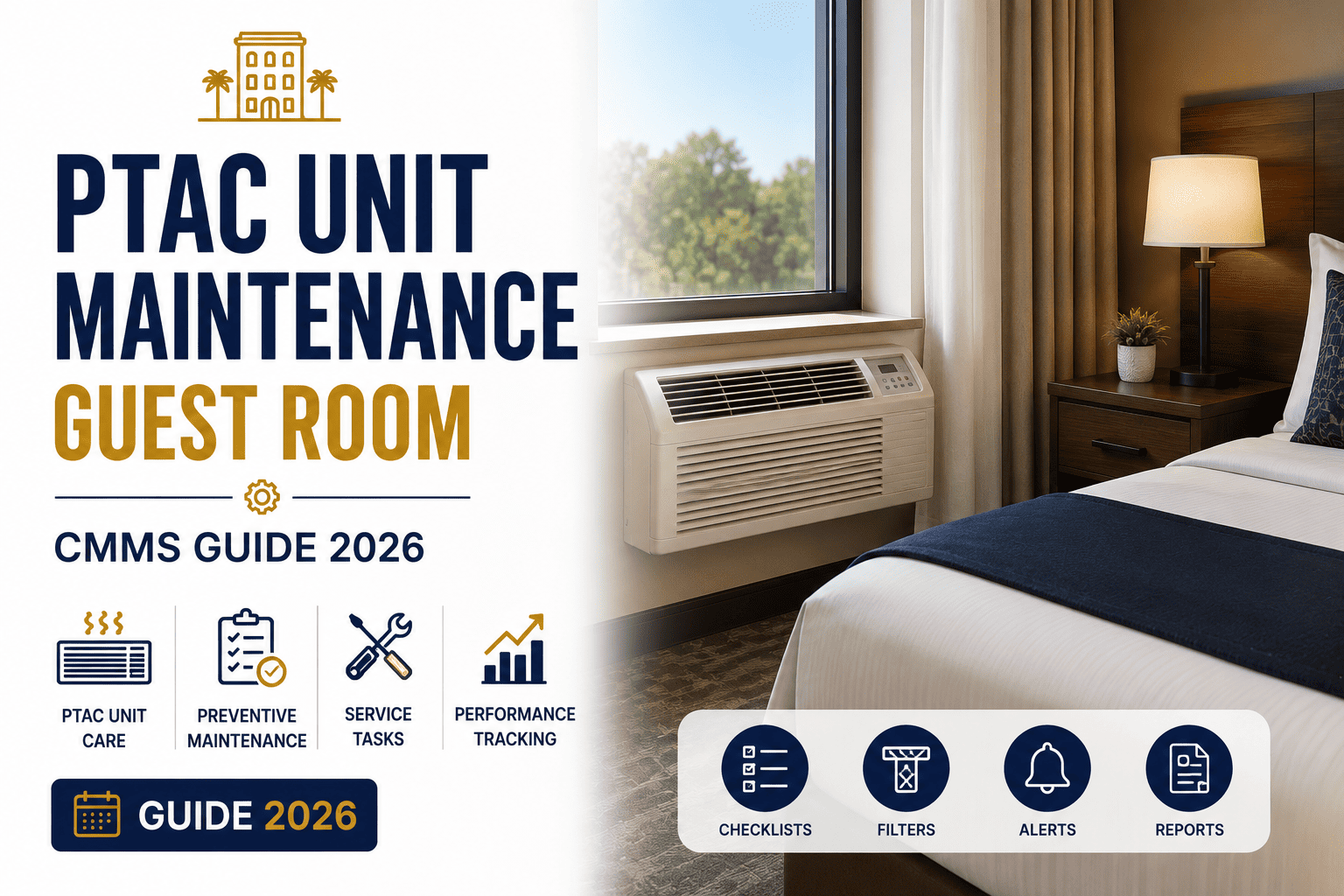
HVAC & PTAC Units
~150 units (1 per room)
- PM frequency: Quarterly filter clean, annual coil descale
- Lifecycle: 7–10 years (PTAC), 12–15 (split systems)
- Track: Refrigerant charge, filter size, compressor model
In-Room Electronics
~450 items (TV, clock, phone per room)
- PM frequency: Annual firmware / connectivity check
- Lifecycle: 5–7 years (TVs), 8–10 (phones)
- Track: Serial number, smart-cast MAC, warranty expiry
Plumbing Fixtures
~600 fixtures (shower valve, faucet, toilet)
- PM frequency: Bi-annual aerator clean, annual valve inspection
- Lifecycle: 10–15 years (valves), 20+ (porcelain)
- Track: Cartridge model, shut-off valve location, leak history
Furniture & FF&E
~750 items (bed, desk, chair, drapery)
- PM frequency: Semi-annual deep-clean & condition check
- Lifecycle: 5–7 years (upholstery), 10–12 (case goods)
- Track: Vendor, fabric spec, refurbish vs replace date
Worked Example
The Cost of Not Tracking: A 150-Room Hotel Scenario
Consider a 150-room select-service hotel running asset management on spreadsheets. PTAC units are serviced only when guests complain, plumbing fixtures fail without warning, and warranty claims are missed because install dates live in a binder that nobody opens. The numbers below illustrate what reactive, untracked maintenance actually costs per year — and what a room-level CMMS recovers.
Annual Reactive Cost Formula
Unplanned repairs + Guest-comp rooms + Warranty write-offs + OT labor = $78,400 / yr
| Cost Category | Spreadsheet-Based (Reactive) | Room-Level CMMS (Proactive) | Annual Savings |
|---|---|---|---|
| PTAC emergency repairs | $24,000 (120 calls @ $200) | $8,400 (42 calls @ $200) | $15,600 |
| Plumbing leak damage | $18,000 (6 incidents) | $4,500 (1.5 incidents) | $13,500 |
| Missed warranty claims | $11,200 | $0 (auto-alerted) | $11,200 |
| Overtime & rush parts | $14,000 | $5,200 | $8,800 |
| Guest-comp rooms (down time) | $11,200 (56 room-nights) | $2,800 (14 room-nights) | $8,400 |
| Total Annual Cost | $78,400 | $20,900 | $57,500 |
The same hotel deploying OxMaint room-level CMMS tracking typically sees payback in under 4 months. The $57,500 recovered reflects only hard savings — guest satisfaction scores and online review ratings improve in parallel, driving RevPAR uplift that dwarfs the maintenance savings.
How OxMaint Helps
How OxMaint Powers Hotel Asset Management at Room Level
OxMaint is an AI-powered CMMS and EAM platform built for maintenance and reliability teams that need granular asset visibility. For hotels, that means a room-level asset registry where every PTAC unit, TV, shower valve, and furniture piece lives as a tracked record — linked to work orders, PM schedules, warranties, and spare-parts inventory in a single system. Here is what that looks like in practice.
Room-Level Asset Registry with QR Tagging
Generate QR codes for every asset, scan from a phone to pull up the full history — install date, PM log, warranty, parts used. Cuts asset lookup time by 80% and eliminates "which PTAC was that?" confusion.
Automated PM Scheduling by Asset Type
Set PM triggers by asset category — quarterly PTAC filter cleans, bi-annual plumbing inspections — and OxMaint auto-generates work orders assigned to the right technician. Cuts unplanned downtime 30–50%.
Predictive Analytics & Warranty Alerts
AI flags assets with rising failure patterns before they break, and warranty-expiry alerts fire 30 days out so you claim before coverage lapses. Typical 150-room hotel recovers $11K+ in missed warranty claims annually.
Renovation & Capital Planning Dashboard
FF&E lifecycle data rolls into a capital-planning view: see which rooms hit refurbishment threshold in the next 12–24 months and budget with confidence. Replaces gut-feel renovation cycles with data-driven phased plans.
CMMS Hotel Renovation Planning
Using Room-Level Asset Data for FF&E Lifecycle & Renovation Planning
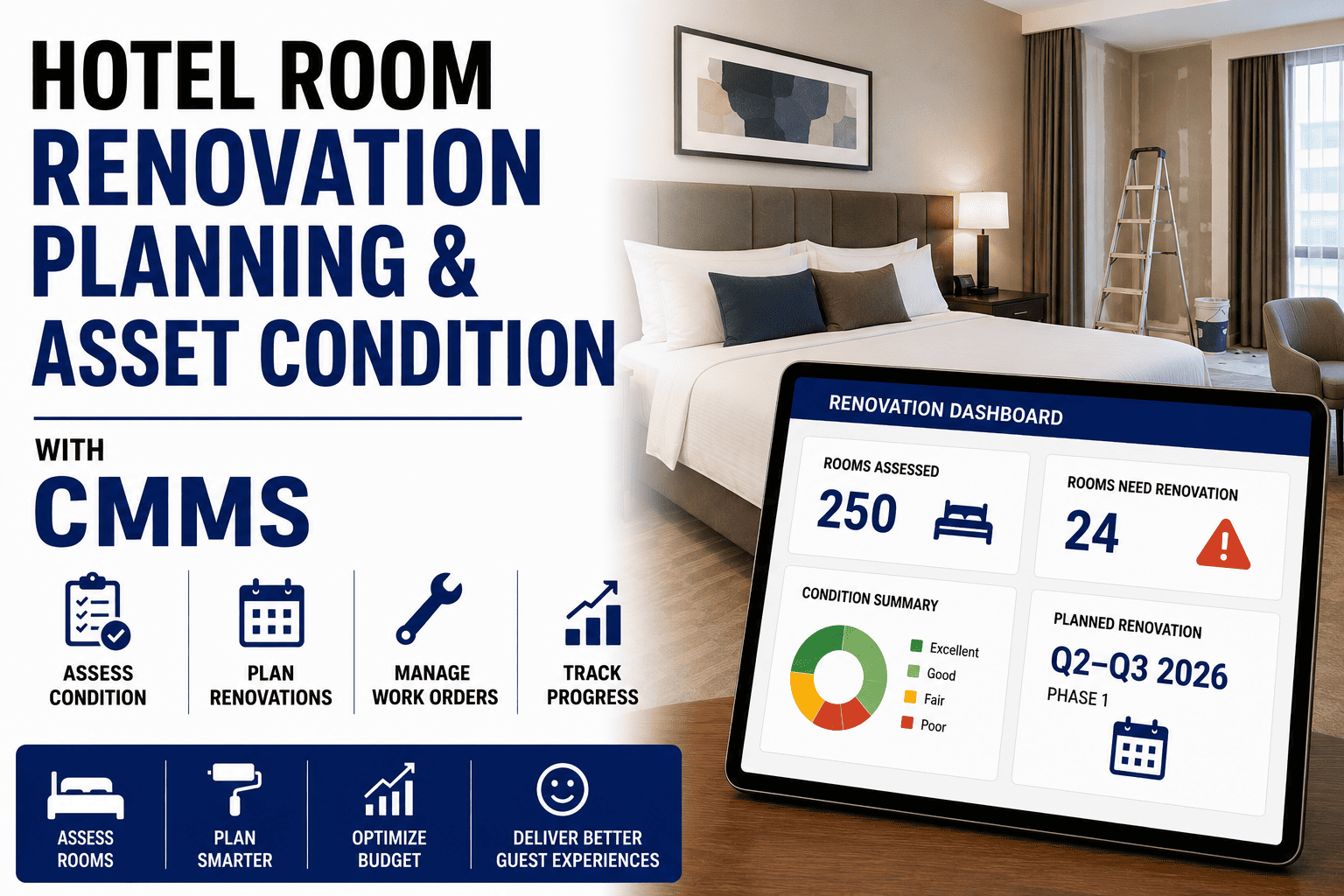
Hotel renovation planning is traditionally driven by calendar cycles — "refurb every 7 years" — regardless of actual asset condition. A room-level CMMS flips that model. When every mattress, carpet, and PTAC unit carries an install date, condition score, and repair history, capital planning becomes condition-based rather than calendar-based. OxMaint's renovation dashboard aggregates asset age and condition by room, floor, or wing, showing exactly which rooms cross the replacement threshold within a 12-, 24-, or 36-month horizon.
"We moved from a wall of binders to OxMaint room-level tracking and found $23K in PTAC units still under warranty we didn't know about. The system paid for itself in the first quarter."
— Director of Engineering, 240-room full-service hotel, Orlando
See OxMaint on your assets — book a 30-minute demo
Walk through a live room-level asset registry, QR-tagged PM workflows, and the renovation planning dashboard with an OxMaint specialist. We will map it to your property's key count and asset mix.
FAQ
Hotel Asset Management & Room-Level CMMS — Frequently Asked Questions
What is hotel asset management at the room level?
Room-level hotel asset management means tracking every individual asset — PTAC, TV, shower valve, mattress, mini-fridge — to the specific guest room it occupies, inside a CMMS. Instead of knowing "the hotel has 150 PTAC units," you know "Room 412's PTAC is a Friedrich WD15, installed March 2021, coil last descaled September 2025, warranty expires March 2026." This granularity enables targeted PM, accurate warranty claims, and condition-based renovation planning. OxMaint structures this as a five-tier hierarchy: Property > Building > Floor > Room > Asset.
How does a CMMS improve hotel preventive maintenance?
A CMMS like OxMaint auto-generates preventive maintenance work orders based on asset type, usage triggers, or calendar intervals — so quarterly PTAC filter cleans and bi-annual plumbing inspections never get skipped. Each PM work order is linked to the specific room-level asset record, carrying model numbers, parts lists, and service history. Hotels typically cut unplanned breakdowns 30–50% and reduce overtime spend by routing PM work into planned shifts. You can see it live when you Book a Demo.
What assets should a hotel track in a CMMS asset registry?
At minimum, a hotel room-level CMMS should track: HVAC/PTAC units, in-room electronics (TVs, phones, thermostats), plumbing fixtures (shower valves, faucets, toilets), FF&E (beds, desks, chairs, drapery), and safety equipment (smoke detectors, sprinkler heads). Common-area assets — elevators, boilers, pool pumps, laundry equipment — belong in the same registry under a building or system parent. A 150-room hotel typically registers 1,000–1,400 room-level assets plus 200–400 common-area assets.
How long does it take to implement a room-level CMMS in a hotel?
A 150-room hotel can be fully live on OxMaint in 2–4 weeks. The process involves importing your existing asset list (or conducting a walk-through audit), generating QR tags, attaching them to assets, and configuring PM schedules by asset type. OxMaint provides onboarding support and pre-built hotel asset templates so the registry structure is ready on day one. Most properties see the first PM work orders flowing within the first week of go-live.
Can a CMMS help with hotel FF&E renovation planning?
Yes — this is one of the highest-ROI uses of a room-level CMMS. Because every FF&E item carries an install date, condition score, and repair history, OxMaint's renovation dashboard shows which rooms, floors, or wings cross the replacement threshold over the next 12–36 months. Hotels that switch from fixed 7-year renovation cycles to condition-based phasing typically reduce CapEx by 12–15% by avoiding premature replacement and sequencing work to minimize room downtime during peak season.
Start tracking every room-level asset today
Join hotels using OxMaint to cut unplanned downtime, recover missed warranty claims, and plan renovations with real asset data — not binders and guesswork.
Free 14-day trial · No credit card