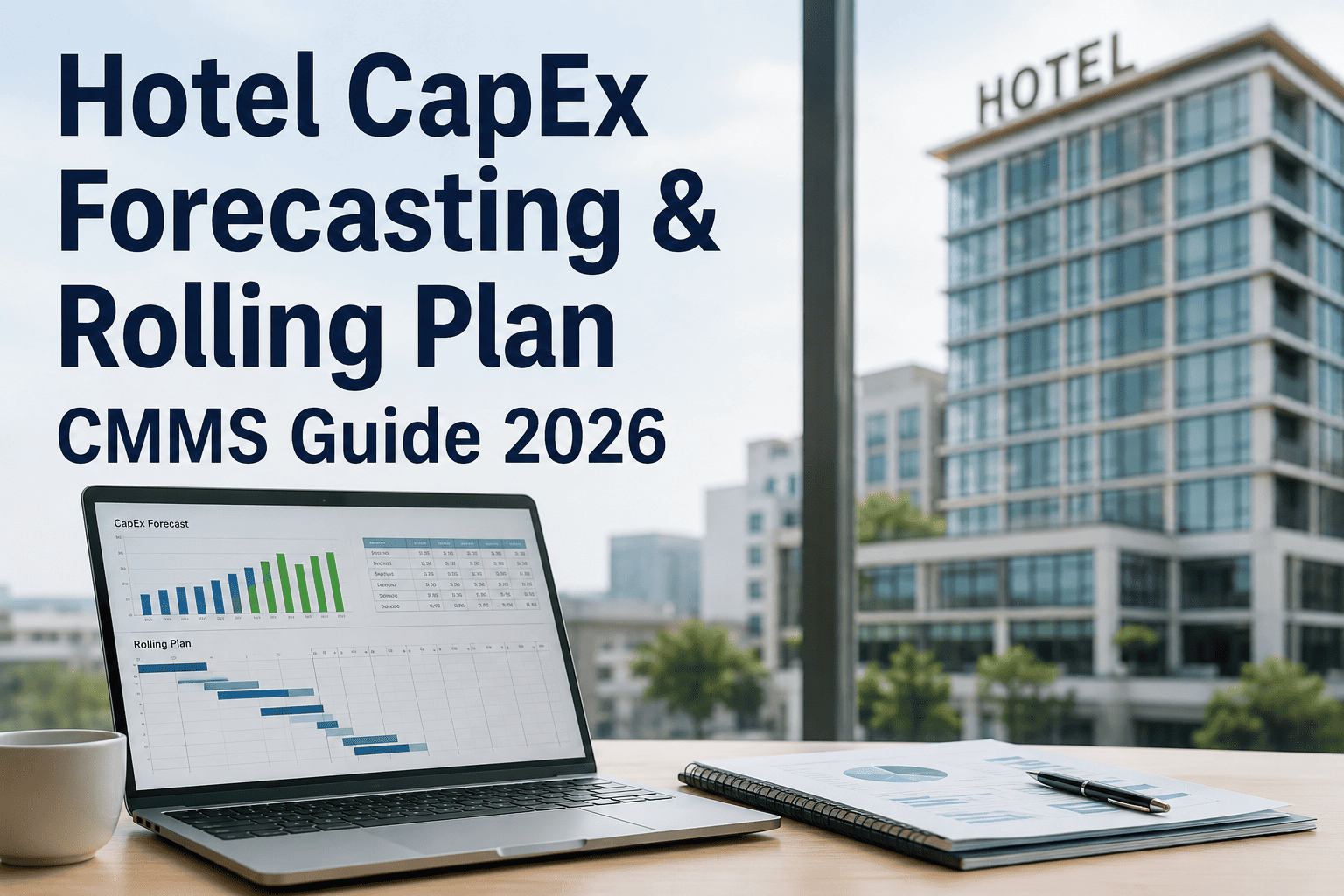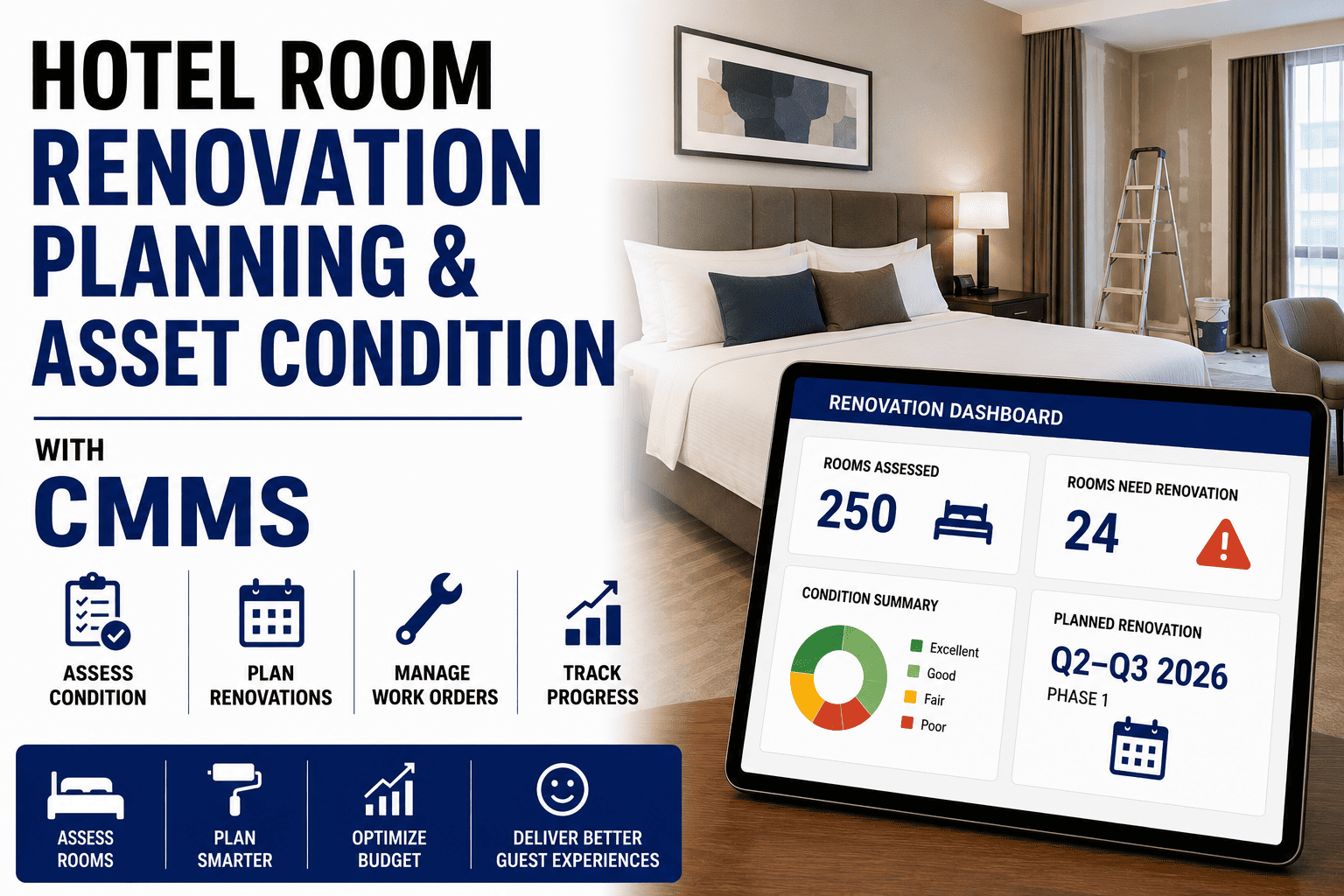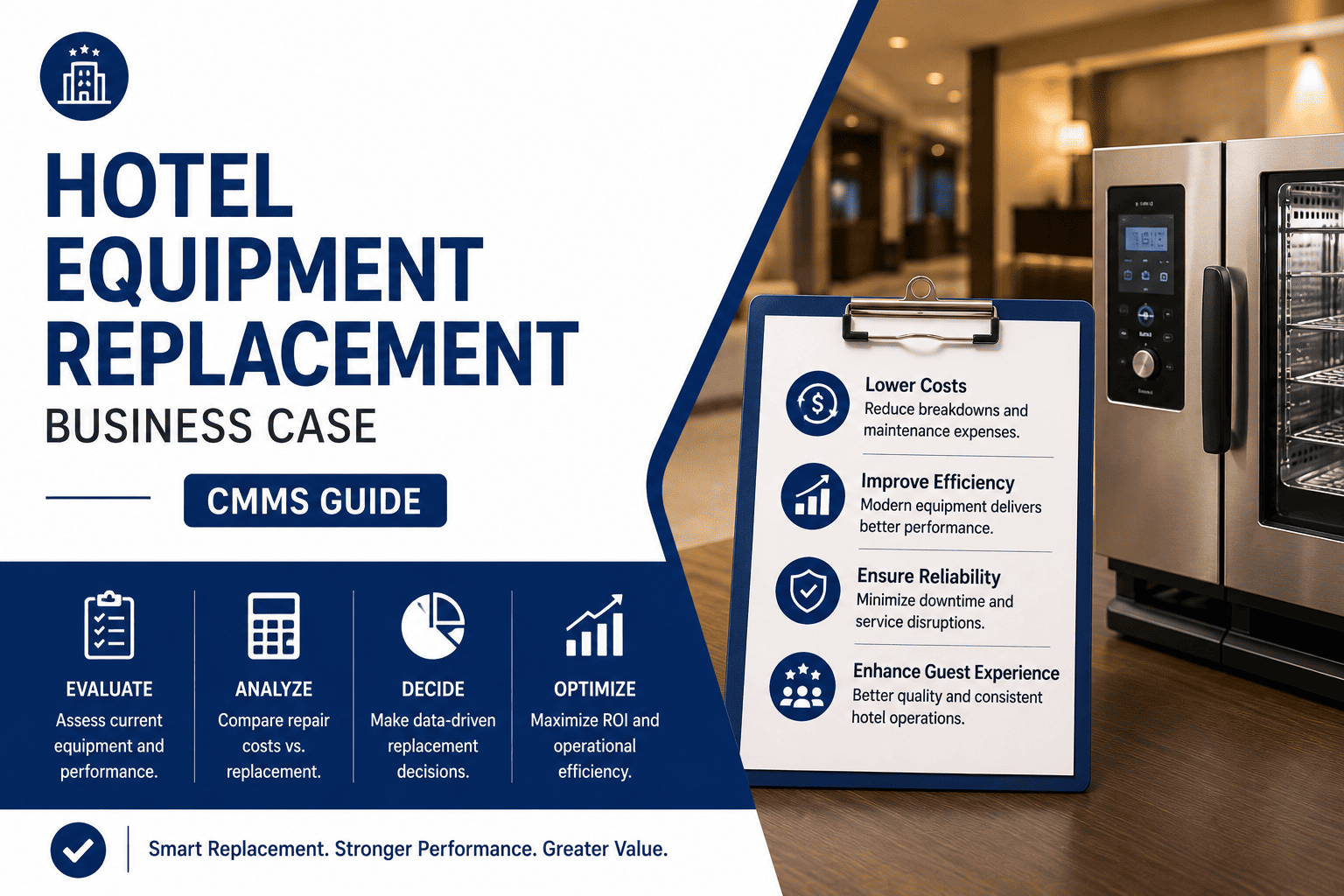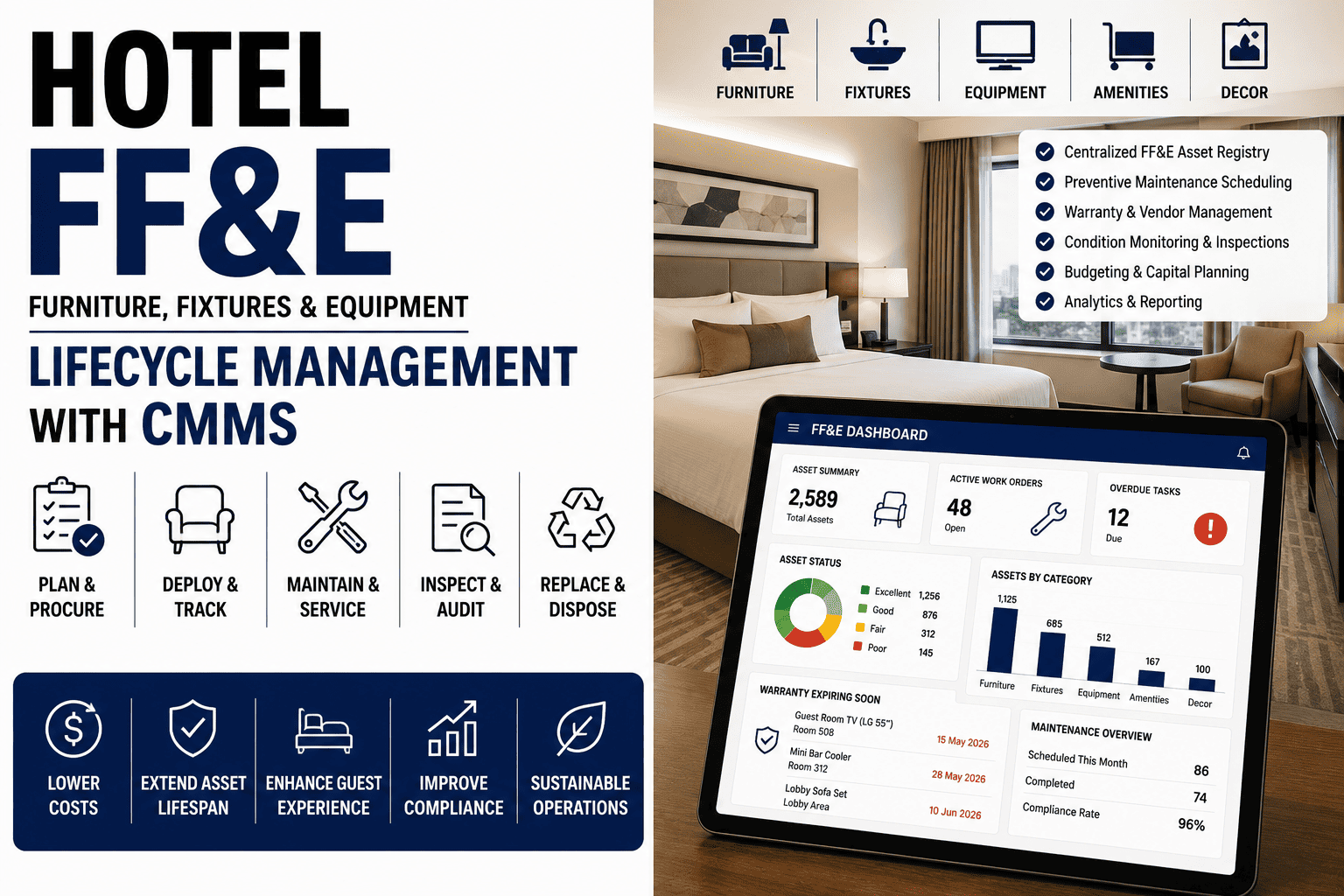
Hotel FF&E — furniture, fixtures, and equipment — typically represents 12–18% of a property's total development cost and drives the single largest discretionary capital line after real estate, yet most hotels still manage these assets on spreadsheets and walk-through clipboard audits. A purpose-built hotel FF&E management CMMS replaces that guesswork with condition scores, replacement-cycle forecasts, and depreciation-aligned capital budgets that auditors and ownership groups accept without debate. This guide maps the full FF&E lifecycle — from category-level lifespans to condition-based renewal — and shows how OxMaint turns refurbishment planning into a documented, defensible discipline. Ready to stop reacting to broken assets? Start Free Trial and see your first asset register live in under an hour.
Is your next hotel refurbishment a planned project — or a $500K surprise?
Most hotels replace FF&E reactively, paying 18–30% more per cycle in rush procurement, downtime, and guest-compensation costs. OxMaint's CMMS tracks every furniture, fixture, and equipment asset from install to replacement — so capital budgets are predictable, defensible, and aligned with depreciation schedules.
Hotel FF&E replacement cycle benchmarks by category
Hotel FF&E spans dozens of asset classes, each with a distinct service life and failure pattern. Without a CMMS that tracks condition by individual asset, hotels default to blanket PIP-driven replacements every 7 years — scrapping usable furniture while missing failing HVAC units. The benchmarks below reflect industry-standard replacement cycles for a typical full-service hotel; OxMaint lets you set custom lifecycles per asset and alerts you 6–12 months before each asset reaches its replacement window.
| FF&E Category | Expected Life | Replacement Cost / Unit | Cycle Trigger | Depreciation Method |
|---|---|---|---|---|
| Guestroom case goods (furniture) | 7–10 years | $1,200–$2,800 / room | Condition score + brand PIP | 7-year straight-line |
| Guestroom mattresses | 5–7 years | $400–$900 / set | Guest complaint threshold | 5-year straight-line |
| Lighting fixtures & sconces | 8–12 years | $150–$1,200 / fixture | LED driver failure rate | 7-year straight-line |
| HVAC PTAC / VTAC units | 7–10 years | $800–$1,600 / unit | Repair-cost ratio > 60% | 10-year MACRS |
| Soft goods — drapery, bedding | 3–5 years | $600–$1,400 / room | Brand standard refresh | 5-year straight-line |
| Lobby & public-area furniture | 10–15 years | $2,500–$8,000 / piece | Wear scoring + design cycle | 10-year straight-line |
| F&B equipment — ovens, coolers | 10–14 years | $4,000–$25,000 / unit | Condition + service history | 12-year MACRS |
| Artwork, mirrors, decorative FF&E | 8–12 years | $200–$3,000 / piece | Brand refresh calendar | 7-year straight-line |
How condition-based FF&E renewal replaces calendar-driven replacement
Calendar-driven replacement — "replace all mattresses in Year 5" — wastes capital on assets that still have 2–3 years of service life while missing assets that failed in Year 3. Condition-based renewal scores each FF&E asset on a 1–5 scale using inspection data, work-order history, and guest-complaint volume, then triggers replacement only when the score crosses a threshold you define. OxMaint automates the scoring, the inspections, and the budget forecast in one workflow.
Score below 2.5 triggers replacement planning; score 2.5–3.5 triggers preventive maintenance; score above 3.5 = healthy. OxMaint recalculates automatically after every inspection or work order.
When a single PTAC unit's repair estimate exceeds 60% of a new unit — and the asset is past 70% of its expected life — OxMaint flags it for replacement and routes the approval to your capital workflow.
A 220-room full-service hotel saved $312K in one PIP cycle
Before OxMaint, this property spent $1.4M on a blanket FF&E replacement at PIP — replacing all 220 mattresses, all lobby seating, and 140 light fixtures regardless of condition. After implementing OxMaint's condition-based scoring, the next PIP cycle identified that 68 mattresses scored above 3.5 (healthy), 90 light fixtures had 4+ years of service life remaining, and 14 lobby chairs needed reupholstering — not replacement. The property spent $1.09M instead of $1.4M, directed $312K into high-priority HVAC upgrades, and passed brand inspection with zero FF&E deficiencies.
Integrating FF&E lifecycle planning with hotel capital budgeting
A CMMS that only tracks work orders doesn't serve the capital planning conversation. OxMaint bridges maintenance and finance by mapping every FF&E asset to its depreciation schedule, remaining useful life, and projected replacement cost — then rolls those numbers into a 5-year capital forecast that ownership, asset managers, and brand field reps can review in a single dashboard. No more rebuilding capex models from scratch every PIP season.
Asset Register with Depreciation Mapping
Import every FF&E asset with purchase date, original cost, depreciation method, and remaining useful life. OxMaint syncs with your accounting system so the CMMS and the general ledger always agree — no reconciliation fire-drills at year-end.
Condition Inspections on Mobile
Housekeeping and engineering teams log condition scores on a phone or tablet during routine walks. Photos attach to the asset record; low scores auto-generate replacement candidates for the next capital cycle.
5-Year Replacement Forecast
OxMaint projects which assets will cross the replacement threshold each year for the next 5 years, with estimated costs adjusted for inflation and brand-standard upgrades — giving finance a defensible number, not a guess.
PIP & Brand-Standard Alignment
Map each asset to its brand standard requirement and PIP cycle date. OxMaint flags assets that will fail the next PIP inspection 12 months in advance — so you procure in the off-season at 15–20% lower pricing.
How OxMaint's CMMS solves hotel FF&E lifecycle management
OxMaint was built for the realities of hotel maintenance — high asset volume, brand compliance pressure, rotating staff, and ownership that demands audit-ready documentation. These are the four capabilities that most directly cut FF&E spend and eliminate capital-budget surprises.
Per-Asset Condition Tracking
Every FF&E item gets a live condition score updated by inspections, work orders, and guest feedback. Hotels using OxMaint report 40% fewer premature replacements and 25% fewer guest complaints about room condition within 90 days.
5-Year Capital Forecast Engine
Auto-generate a rolling 5-year FF&E replacement forecast tied to depreciation schedules and condition scores. Finance teams replace 20+ hours of spreadsheet modeling with a dashboard that updates in real time.
Brand PIP & Compliance Tracking
Map every FF&E asset to its brand standard and PIP inspection date. OxMaint flags deficiencies 6–12 months early, giving you time to procure in off-season pricing windows and pass inspections without emergency spend.
Predictive Failure Alerts
OxMaint's AI analyzes work-order frequency, repair-cost trends, and age to predict which FF&E assets will fail next — so you replace the right unit before it triggers a guest complaint, a service call, or a negative review.
CMMS FF&E depreciation tracking: closing the gap between maintenance and finance
Most hotels maintain two disconnected FF&E records: a maintenance log (often paper or Excel) and a fixed-asset register in the accounting system. The two never match — so maintenance replaces an asset finance still shows as fully depreciated, or finance retires an asset maintenance is still repairing. OxMaint eliminates this gap by maintaining a single source of truth where condition, cost, depreciation, and replacement status live on one asset record.
- Two FF&E registries — maintenance spreadsheet + accounting ledger — never reconcile
- Depreciation retirement is manual; finance finds out about replacements 30–60 days late
- No link between condition score and remaining book value — capital decisions lack data
- Audit prep for FF&E takes 40+ hours per property, per year, pulling paper records
- Insurance claims for damaged FF&E lack documentation — claims denied or underpaid
- Single FF&E asset record — condition, cost, depreciation, photos, and work history in one place
- Replacement auto-triggers depreciation retirement notification to finance in real time
- Condition score + book value + replacement cost visible on every asset before capex decisions
- Audit-ready FF&E report exports in one click — 40 hours become 10 minutes
- Full asset history with photos strengthens insurance claims and speeds settlements
"Before OxMaint we couldn't tell ownership which FF&E assets were end-of-life and which had three years left — it was all gut feel. Now our 5-year capex forecast is generated from real condition data, and our last PIP came in 22% under budget because we only replaced what actually needed replacing."
See your hotel's FF&E lifecycle in one dashboard
Book a 30-minute demo and we'll load a sample of your asset data — see condition scores, replacement forecasts, and PIP readiness before you commit to anything.
Hotel FF&E CMMS: frequently asked questions
These are the questions hotel engineering directors and asset managers ask most when evaluating a CMMS for FF&E lifecycle management.
What is hotel FF&E lifecycle management in a CMMS?
Hotel FF&E lifecycle management in a CMMS is the practice of tracking every furniture, fixture, and equipment asset from installation through replacement — using condition scores, service history, and depreciation data to forecast when each asset should be renewed. OxMaint automates this with mobile inspections, AI-driven condition scoring, and a 5-year capital forecast that updates in real time. You can Book a Demo to see the full workflow on sample hotel data.
How long should hotel FF&E last before replacement?
Hotel FF&E service life ranges from 3–5 years for soft goods (drapery, bedding) to 10–15 years for lobby furniture and F&B equipment. Guestroom case goods typically last 7–10 years, mattresses 5–7 years, and PTAC HVAC units 7–10 years. OxMaint lets you set custom lifecycles per asset category and alerts you 6–12 months before each asset reaches its replacement window — so you avoid both premature replacement and overdue failures.
How does a CMMS integrate FF&E condition tracking with capital budgeting?
A CMMS like OxMaint links each FF&E asset's condition score, repair history, and remaining useful life to its depreciation schedule and projected replacement cost — then rolls those numbers into a 5-year capital forecast. When a condition score drops below your threshold, the asset appears on the replacement plan with an estimated cost, so finance gets a defensible, data-driven capex number instead of a spreadsheet guess.
Can OxMaint track FF&E depreciation and generate audit-ready reports?
Yes. OxMaint maintains each asset's purchase date, original cost, depreciation method (straight-line or MACRS), and remaining book value on the same record as its condition score and work-order history. A single click exports an audit-ready FF&E report covering condition, depreciation, replacement status, and full service history — turning a 40-hour annual audit prep into a 10-minute task.
How much does hotel FF&E management software cost?
OxMaint's CMMS for hotel FF&E management is priced per property and scales with asset volume — most full-service hotels recover the annual subscription cost through a single avoided premature replacement or one off-season procurement saving. Pricing includes mobile inspections, condition scoring, capital forecasting, and unlimited users. Start Free Trial for 14 days at no cost, or Book a Demo for a custom quote based on your property's asset count.
Stop guessing. Start forecasting your FF&E lifecycle.
Join the hotels that cut FF&E capital spend 20–30% per cycle with condition-based renewal, audit-ready asset records, and a 5-year forecast that ownership trusts.
Free 14-day trial · No credit card