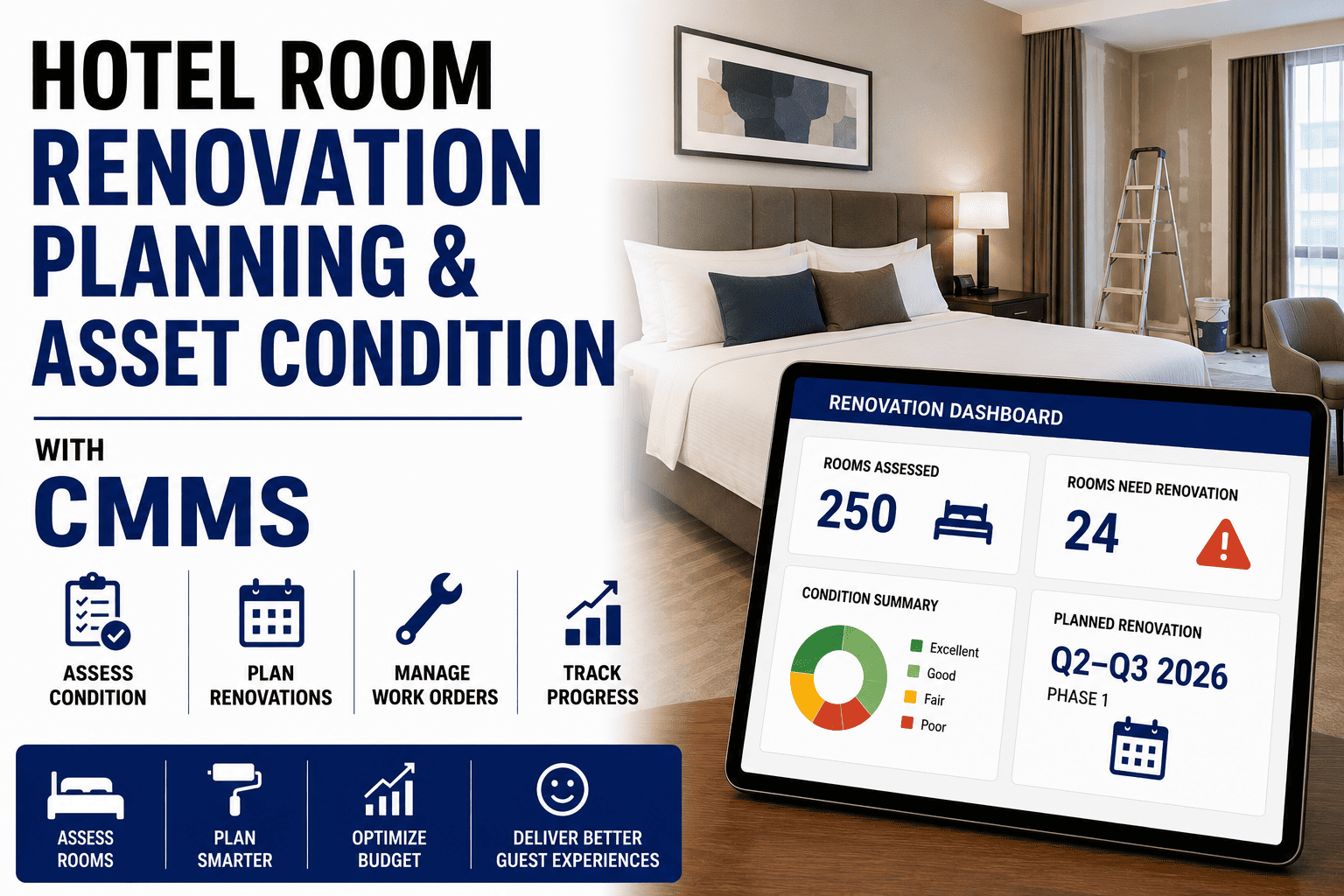
Hotel room renovation planning succeeds or fails on the quality of your asset condition data — the hotels that renovate profitably base scope, timing and capital requests on room-level condition records, not gut feel or a five-year-old spreadsheet. A CMMS built for hotel renovation readiness turns every work order, inspection and preventive-maintenance check into a live renovation-planning dataset: you know exactly which FF&E, HVAC units, plumbing fixtures and finishes are approaching end-of-life, room by room, before you sign a contractor. This guide walks through the 2026 renovation planning cycle — asset condition tracking, renovation triggers, phased scheduling and scope development — and shows how an AI-powered CMMS like OxMaint turns ballpark estimates into defensible, data-backed capital requests. If you want to see the platform on your property's assets first, Start Free Trial or keep reading.
CMMS Hotel Renovation Guide · 2026
How much of your renovation budget is a guess?
Most hotels renovate on a fixed cycle — and replace assets that still have 40% useful life left, while missing the HVAC coils and shower valves that fail six months post-renovation. Asset-condition data from a CMMS changes that: scope every room by live condition scores, not by the calendar.
Renovation Triggers
What triggers a hotel room renovation — and why the calendar is wrong
A 5-year or 7-year renovation cycle feels disciplined, but it ignores the fact that assets in Room 312 and Room 418 age at completely different rates based on occupancy, guest behavior, housekeeping practices and mechanical load.
Condition-Score Thresholds
When a room's composite asset condition score drops below 60/100 — calculated from inspection data, work-order history and remaining useful life across all room assets — it enters the renovation candidate pool automatically.
Repeat-Failure Clustering
Three or more reactive work orders on the same asset class (e.g., mini-fridge, shower cartridge, PTAC unit) within a 90-day window signals end-of-life — not a repair problem. OxMaint flags this pattern automatically.
Guest-Experience Decline
Condition data correlated with guest review scores for specific room types tells you which floors are dragging your property's rating down — and which finishes or fixtures are the likely culprits.
Compliance & Code Gaps
Fire-life-safety inspections, ADA audits and brand-standard reviews surface deficiencies that must be corrected during renovation — your CMMS should link each deficiency to the specific room and asset.
Worked Example
A 220-room full-service hotel used OxMaint's condition-score reports to pull 64 rooms into a 2026 renovation phase instead of the originally planned 110 rooms. The remaining 46 rooms had HVAC units and soft goods with 3+ years of useful life — the CMMS data proved it. Result: $840K in deferred capex redirected to lobby and F&B upgrades, with zero post-renovation guest complaints on the rooms that were skipped.
Scope Development
How to build renovation scope from CMMS asset condition data
Renovation scope is where budget is won or lost. The most profitable hotel operators develop scope room-by-room, using CMMS data to categorize every asset into one of four action bands — and they generate contractor-ready scope sheets in hours, not weeks.
| Condition Score | Asset State | Renovation Action | CMMS Data Source | Budget Impact |
|---|---|---|---|---|
| 85–100 | Like-new | Retain — inspect only | PM logs, inspection checklists | Minimal |
| 70–84 | Minor wear | Refurbish (refinish, reupholster) | Work-order history, photos | Low |
| 50–69 | Significant wear | Replace during renovation phase | Condition surveys, failure forecasts | Medium |
| Below 50 | End-of-life / failed | Immediate replacement — priority room | Reactive WO frequency, downtime logs | High (unavoidable) |
Renovation Scope Formula
Renovation Scope (per room) = Σ (Assets scoring < 70 × Replacement Cost) + Σ (Assets 70–84 × Refurbishment Cost) + Compliance Deficiencies × Correction Cost
OxMaint runs this calculation automatically across every room in your property, ranked by total scope cost — so you can phase your renovation from the worst-condition rooms first and build a defensible capital request in minutes.
Phased Renovation CMMS
Phased renovation scheduling: minimize out-of-service rooms and protect RevPAR
The average hotel loses $180–$320 per night in RevPAR for every room out of service during renovation. Phased renovation planning with a CMMS lets you batch rooms by floor, wing or mechanical zone — and schedule work around occupancy forecasts, group blocks and seasonal demand.
Data Audit & Condition Baseline
Import all room assets into OxMaint. Run baseline condition assessments on every room. Generate the renovation candidate list ranked by condition score and projected replacement cost.
Scope Finalization & Capital Request
Export CMMS scope sheets per room — every asset, its condition, action and cost. Submit capital request with data-backed justification. Approvals move faster when the numbers are defensible.
Contractor Onboarding & PM Conversion
Convert renovation scope into work orders in OxMaint. Assign contractor crews, set due dates, and track completion room-by-room. Housekeeping and front desk see real-time room status.
Phased Execution & Live Tracking
Execute in 20–30 room batches. OxMaint tracks work-order completion, punch-list items and post-renovation inspections. Any deficiency becomes a tracked work order before the room goes back in service.
Post-Renovation Audit & Baseline Reset
Re-score every renovated room. Reset condition baselines for new FF&E and mechanicals. Set new PM schedules in OxMaint. Your next renovation cycle now starts from accurate, current data.
How OxMaint Helps
CMMS capabilities that make hotel renovation planning data-driven
OxMaint brings four specific capabilities to hotel renovation readiness — each tied to a measurable outcome that protects your renovation budget and accelerates payback.
Room-Level Asset Condition Tracking
Every FF&E item, fixture and mechanical asset is tracked by room with a live condition score updated by every inspection and work order. No more spreadsheet guesswork — you know exactly which rooms need what, and when.
Outcome: Eliminate 31% of premature-replacement waste and build scope sheets in hours.
Phased Renovation Scheduling
Group renovation candidates by floor, wing or zone. Schedule work-order batches around occupancy forecasts and group blocks. Front desk and housekeeping see live room status — no more calling the GM to ask if Room 412 is ready.
Outcome: Cut average out-of-service time per room by 20–35%.
Capital Request Dashboards
Export renovation scope with full condition-score justification, cost breakdowns and asset-level history. Your capital request arrives with data ownership can't challenge — because every dollar traces back to a specific asset in a specific room.
Outcome: Capital approval cycles shortened from months to weeks.
Post-Renovation Baseline Reset
After renovation, OxMaint re-scores every room, sets new PM schedules for new assets and resets condition baselines. Your next renovation cycle starts from accurate data — not from a spreadsheet someone forgot to update three years ago.
Outcome: 100% audit-ready asset records from day one post-renovation.
Cost of Inaction
What spreadsheets and calendar-based renovation actually cost your hotel
Most hotels still plan renovations in Excel with a 5-year FF&E cycle and a brand-standard checklist. The hidden costs compound every year the data gap persists.
"We renovated 110 rooms and replaced everything by default. Six months later, OxMaint's data showed us 46 of those rooms had assets with 3+ years of life left. That was $840K we could have spent elsewhere — and now we never will again."
— Director of Engineering, 220-room full-service hotel
See OxMaint on your property's assets — book a 30-minute demo
Walk through a room-level condition report, phased renovation schedule and capital-request export with your actual asset data. No generic slides — just your rooms, your assets, your numbers.
FAQ
Hotel room renovation planning & CMMS: frequently asked questions
How does a CMMS help with hotel room renovation planning?
A CMMS like OxMaint tracks every room asset — FF&E, HVAC, plumbing, electrical — with a live condition score updated by inspections and work orders. Instead of renovating on a fixed 5-year cycle, you renovate the rooms that actually need it, scope replacement based on real condition data, and generate contractor-ready scope sheets and capital requests with full justification. You can Start Free Trial to see your room-level data immediately.
What is an asset condition score and how is it calculated for hotel rooms?
An asset condition score is a 0–100 rating that reflects an asset's remaining useful life, failure history and inspection results. OxMaint calculates it automatically by combining preventive-maintenance logs, reactive work-order frequency, inspection checklist data and age-based depreciation. A room's composite score is the weighted average of all assets in that room — rooms below 60 typically enter the renovation candidate pool.
How do I schedule a phased hotel renovation with a CMMS?
OxMaint lets you group renovation-candidate rooms by floor, wing or mechanical zone, then schedule work-order batches around your occupancy forecast and group blocks. Contractor crews receive assigned work orders with due dates, and front desk, housekeeping and engineering all see live room status — reducing average out-of-service time per room by 20–35% compared to manual tracking.
Can OxMaint export renovation scope for capital requests and contractors?
Yes. OxMaint generates room-by-room scope sheets listing every asset, its condition score, recommended action (retain, refurbish or replace), estimated cost and supporting work-order history. This gives ownership a defensible capital request and gives contractors a clear, itemized scope — eliminating the change orders and scope disputes that typically add 10–15% to renovation budgets.
How long does it take to implement a CMMS for hotel renovation planning?
Most hotels are live on OxMaint in 2–4 weeks. Asset import, room-level setup, condition baseline assessments and PM schedule configuration are handled by OxMaint's onboarding team. You can also Book a Demo to see a personalized walkthrough of your property's data before committing.
Stop guessing. Start renovating with data.
Join the hotels using OxMaint to cut renovation waste, protect RevPAR and build capital requests that ownership approves on the first pass. Your room-level condition data is waiting.
Free 14-day trial · No credit card