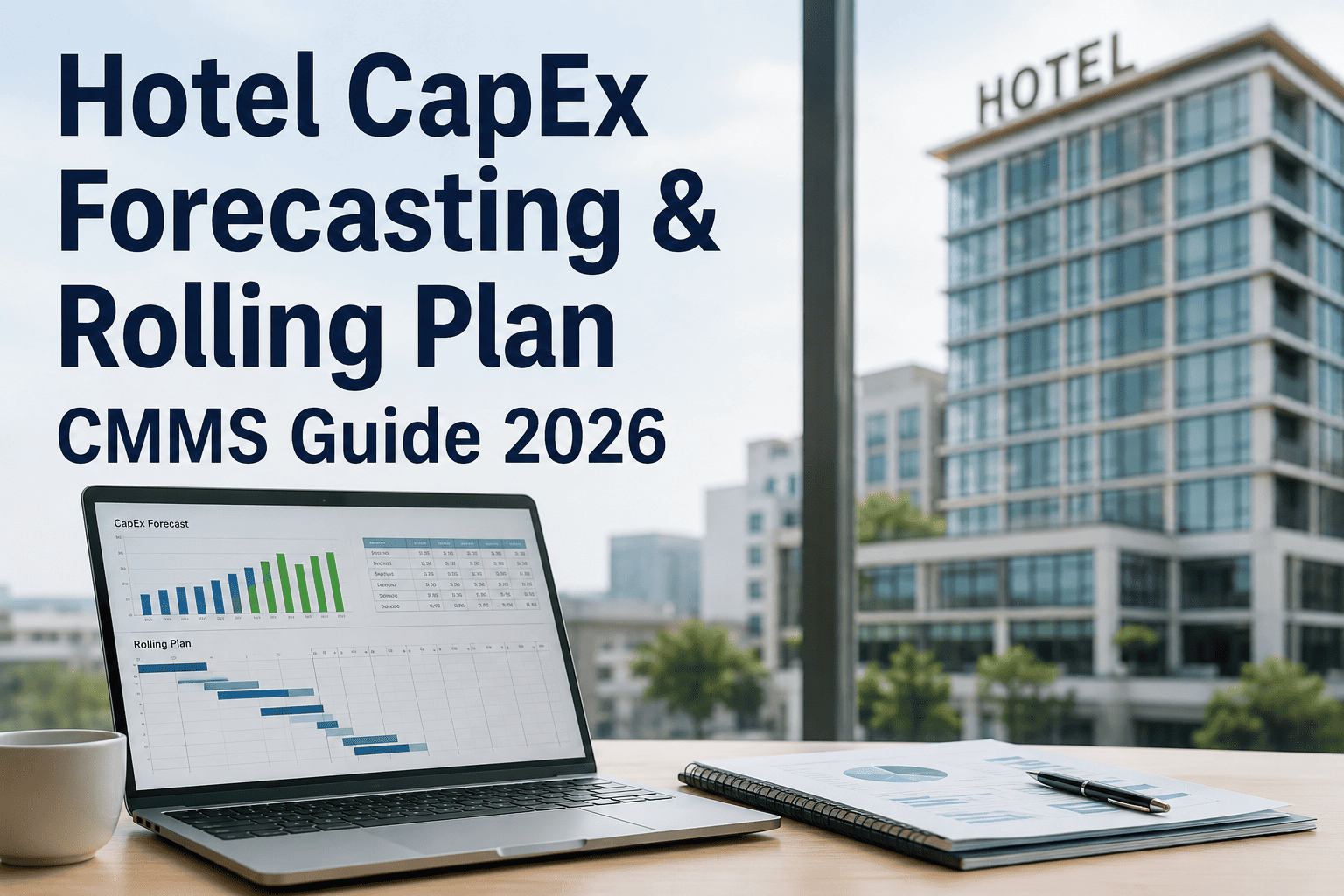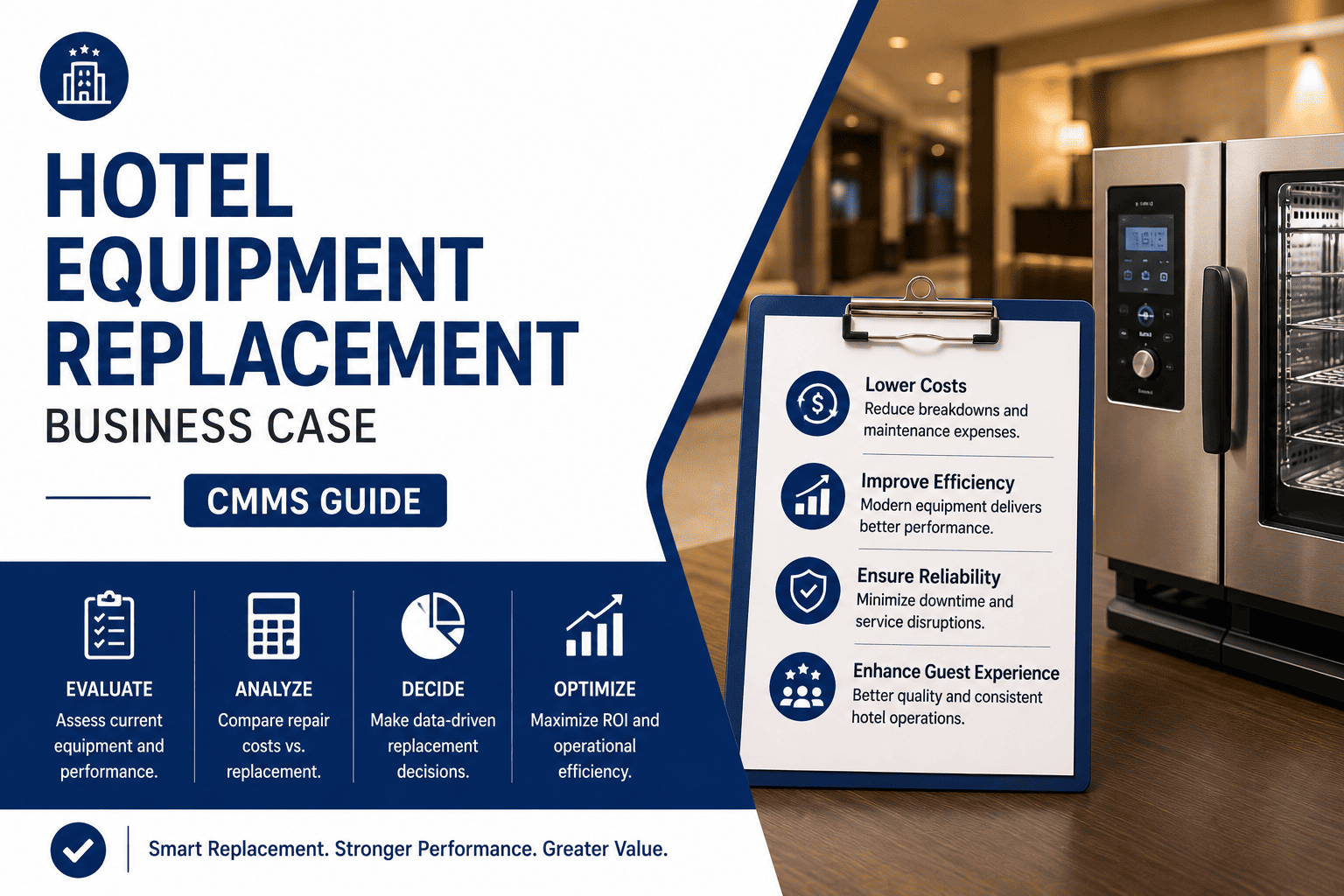
Building a hotel equipment replacement business case that actually gets capital approved requires more than a maintenance log — it demands cumulative repair-cost tracking, total cost of ownership modeling, and CMMS-based asset condition data that a CFO or asset manager can defend. This replacement guide walks hospitality maintenance and reliability teams through the proactive replacement justification process: quantifying downtime cost, energy savings, guest-impact risk, and the financial framework that turns reactive repair decisions into strategic capital investments. OxMaint's AI-powered CMMS platform automates the data collection and reporting you need to build that case in hours, not weeks — and you can Start Free Trial today to see your own asset data turned into replacement-ready business cases.
CMMS Hotel Replacement Guide 2026
Is that aging hotel asset still worth repairing — or is it quietly draining your P&L?
A defensible equipment replacement business case turns gut-feel repair decisions into board-ready capital requests. OxMaint tracks every repair dollar, downtime hour, and condition metric so your justification holds up under CFO scrutiny.
Why Most Hotel Replacement Cases Fail
The hidden cost of "just repair it again"
A 250-room hotel averages 180–220 major repairable assets — boilers, chillers, RTUs, laundry equipment, kitchen ranges, elevators. Industry benchmark studies show that hospitality properties spend 30–40% more on emergency repairs than peers with proactive replacement programs, and that each deferred replacement compounds: a chiller limping along at 62% efficiency can quietly add $18,000–$25,000 per year in excess energy and repair costs before it finally fails during peak season.
"We replaced the same commercial icemaker three times in two years before we realized we'd spent 140% of a new unit's cost on parts and emergency labor — and that doesn't count the guest complaints."
— A scenario playing out in hotels without CMMS-driven replacement tracking
The Replacement Justification Framework
How to model a hotel equipment replacement business case with CMMS data
A capital request that survives CFO review rests on five quantifiable pillars. Each one can be pulled directly from a properly configured CMMS — or painfully reconstructed from paper work orders and utility bills. Here's the formula-driven approach asset managers approve.
Cumulative Repair Cost Ratio
When CRC exceeds 0.50 on a critical asset, the replacement business case crosses its first defensible threshold. At 0.70–0.80, continued repair is almost never the right financial decision — yet most hotels don't track this ratio at all.
Total Cost of Ownership Delta
Compare the projected cost of keeping the current asset for 24 more months against the TCO of a replacement — including purchase, install, lower energy use, warranty coverage, and reduced downtime exposure. A positive TCO Δ is the headline number in your capital request.
Downtime Cost Exposure
Quantify what a mid-season failure actually costs. A boiler outage during a sold-out weekend at $189 ADR with 250 rooms is $47K in lost revenue alone — before contractor premiums and brand-standards penalties hit.
A CMMS hotel replacement case built on these three formulas gives you the proactive replacement justification your asset manager needs: hard numbers, not opinions. OxMaint automatically aggregates parts, labor, and contractor costs by asset, flags CRC thresholds, and exports a one-page TCO snapshot ready for capital review.
TCO Comparison Table
Repair vs. replace: 24-month cost comparison
Below is a worked example for a 15-year-old central chiller in a 200-room hotel. The numbers reflect typical hospitality ranges — your CMMS asset history produces the exact figures for your property.
| Cost Category | Keep & Repair (24 mo.) | Replace Now | Difference |
|---|---|---|---|
| Parts & consumables | $18,400 | $2,100 (warranty) | −$16,300 |
| Labor & contractor calls | $12,600 | $3,800 | −$8,800 |
| Energy (excess consumption) | $21,000 | $7,500 | −$13,500 |
| Downtime risk exposure | $28,500 | $1,200 | −$27,300 |
| Capital outlay (new unit) | $0 | $54,000 | +$54,000 |
| 24-Month Total | $80,500 | $68,600 | −$11,900 |
Payback in this example: 22 months. Beyond that, the replacement saves $9,500+/year and eliminates peak-season failure risk. Without CMMS-based asset condition tracking, most hotels never see this comparison until the asset has already failed.
How OxMaint Helps
CMMS capabilities that make your replacement case write itself
OxMaint turns every work order, parts issue, and condition reading into the evidence your capital request needs. Here's how four specific capabilities map to the hotel equipment replacement business case.
Cumulative Repair Cost Tracking
OxMaint automatically rolls up parts, labor, and contractor costs by asset and flags the CRC threshold (0.50, 0.70) the moment it's crossed — so you know instantly which assets have crossed into "replace, don't repair" territory.
Predictive Condition Monitoring
AI-driven vibration, temperature, and run-time analytics predict failure windows 30–90 days out, letting you schedule replacements during low-occupancy periods and avoid 3.2x peak-season downtime premiums.
One-Click TCO & Capital Justification Reports
Export a board-ready replacement business case in one click: asset history, CRC ratio, energy benchmarks, downtime exposure, and the TCO comparison — formatted the way CFOs and asset managers expect.
Asset Lifecycle & Warranty Tracking
Track warranty end dates, service-life benchmarks, and depreciation schedules alongside repair history — so your replacement case includes the full financial picture, including remaining warranty value and salvage timing.
Step-by-Step Replacement Timeline
From CRC alert to approved capital — a 90-day replacement roadmap
Here's how a hotel maintenance team moves from a CMMS-triggered replacement alert to an approved capital request, using the data and reporting OxMaint automates at each step.
CMMS flags CRC threshold breach
OxMaint alerts the Maintenance Director when an asset's cumulative repair cost ratio crosses 0.50 — automatically pulling 24 months of parts, labor, and contractor data to contextualize the flag. No manual data mining required.
TCO model + downtime exposure quantified
The team runs OxMaint's TCO comparison report, which benchmarks the aging asset against a replacement using energy data, failure-frequency trends, and occupancy-impact modeling. Downtime cost exposure is calculated using real ADR and occupancy feeds.
Business case packaged for capital review
OxMaint exports a one-page justification document: CRC trend chart, TCO delta, downtime risk, energy savings, and guest-impact avoidance — the exact format asset managers and CFOs approve. Three vendor quotes attach to the record.
Replacement scheduled during low-occupancy window
Capital approved. OxMaint schedules the replacement work order during the property's lowest-occupancy week, auto-assigns the contractor, reserves spare parts from inventory, and generates the post-install PM schedule — all from the original asset record.
See Your Replacement Cases Write Themselves
Stop defending repair decisions with gut feel — show your CFO the data
Book a 30-minute demo and we'll connect OxMaint to your top 20 critical assets and show you exactly which ones have crossed the replacement threshold — before they fail during peak season.
Frequently Asked Questions
Hotel equipment replacement business case: what teams ask most
What is a hotel equipment replacement business case?
A hotel equipment replacement business case is a data-driven capital request that justifies replacing an aging asset by comparing the total cost of continued repair against the cost of a new unit — including energy savings, downtime avoidance, and guest-impact reduction. A CMMS like OxMaint automates the data collection and report generation so the case is built on hard numbers, not estimates.
When should a hotel replace equipment instead of repairing it?
The industry benchmark is the cumulative repair cost (CRC) ratio: when annual repair costs exceed 50% of replacement cost, or when a 24-month repair projection exceeds the TCO of a new asset, replacement is almost always the better financial decision. OxMaint flags these thresholds automatically so your team acts before a peak-season failure forces an emergency capital spend.
How does a CMMS help justify hotel equipment replacement?
A CMMS tracks every work order, parts issue, labor hour, and contractor cost by asset — giving you the cumulative repair history, energy benchmarks, and failure-frequency data your CFO needs to approve capital. OxMaint goes further by auto-generating TCO comparison reports and CRC alerts; you can Book a Demo to see your own assets analyzed in real time.
What metrics should a hotel replacement business case include?
A defensible replacement case includes: cumulative repair cost ratio, projected 24-month repair spend, energy consumption delta, downtime cost exposure (based on ADR and occupancy), guest-satisfaction impact, warranty status, and the total cost of ownership comparison. OxMaint aggregates all of these into a single exportable report — eliminating the spreadsheet work that usually delays capital requests by weeks.
How long does it take to build a replacement business case with OxMaint?
Once your assets and work orders are in OxMaint, a replacement business case report can be generated in under two minutes — the platform automatically pulls repair history, calculates the CRC ratio, benchmarks energy costs, and formats the TCO comparison. Most hotels are fully onboarded within 2–4 weeks; you can Start Free Trial and begin importing asset data today.
Ready to Build Your First Replacement Case?
Turn maintenance data into capital your CFO will approve
Join hotels using OxMaint to cut repair overspend 25–40%, eliminate peak-season failures, and get replacement capital approved faster — with data, not opinions.
Free 14-day trial · No credit card