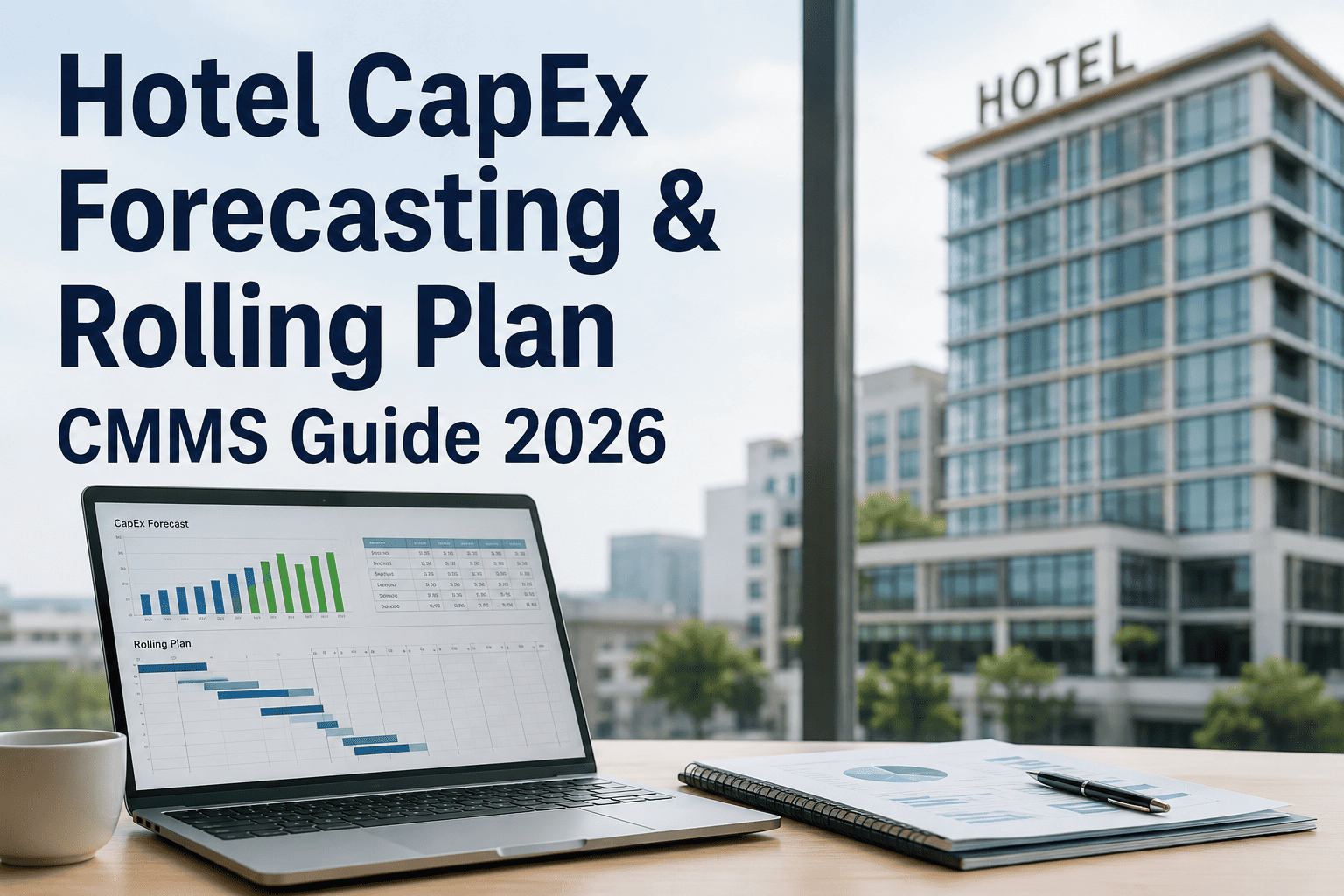
Hotel CapEx forecasting shifts from reactive guesswork to a strategic, data-driven rolling plan when asset condition data, lifecycle modeling, and CMMS analytics are combined. For hotel asset managers and chief engineers, a rolling capital expenditure plan replaces the annual scramble with a continuously updated 3- to 5-year outlook, ensuring equipment like RTUs, boilers, and laundry systems are replaced at the optimal time. This 2026 guide covers how to build a hotel CMMS capital budget using condition-based replacement triggers and lifecycle phasing. To see how modern maintenance software streamlines this process, you can Start Free Trial today.
Hotel CapEx Guide 2026
Is your hotel's capital expenditure plan based on data or guesswork?
Annual budgets fail when assets degrade unpredictably. A rolling plan CMMS uses real-time condition data and lifecycle modeling to forecast capital needs 3-5 years out, cutting emergency replacement costs by up to 40%.
The CapEx Foundation
Why hotel CapEx forecasting needs a rolling plan approach
In hospitality, 60-70% of annual capital budgets are consumed by emergency replacements and deferred maintenance fallout. Traditional annual CapEx forecasting forces asset managers to predict equipment failure 12-18 months in advance with outdated spreadsheets. A rolling plan CMMS solves this by updating capital forecasts quarterly or bi-annually, shifting the conversation from "What broke this year?" to "Which assets are entering the failure zone next?"
Condition-Based Replacement
How to use condition data for hotel capital budget justification
CMMS hotel capital justification requires hard data. When seeking ownership approval for a $250K chiller replacement, saying "it's old" fails. Saying "this RTU has 12 open work orders this quarter, MTBF dropped 35%, and condition assessments show 72% degradation" secures funding. Condition-based replacement hotel strategies rely on four key data streams generated by your CMMS.
Asset Condition Scoring
Objective 1-100 scores derived from inspection checklists, vibration analysis, and thermal imaging. Assets scoring below 45 trigger automatic CapEx review.
Lifecycle & MTBF Tracking
Comparing actual Mean Time Between Failures against manufacturer baselines to identify equipment entering the wear-out phase.
Cost-to-Repair vs. Replace Ratio
When YTD repair costs exceed 60% of replacement value, the CMMS flags the asset for immediate rolling plan inclusion.
Risk & Criticality Index
Mapping asset failure impact on guest satisfaction and safety. High-criticality assets (elevators, fire pumps) get prioritized CapEx funding.
CapEx Forecasting Formula
Calculating optimal replacement timing with CMMS data
A rolling CapEx hotel CMMS uses a straightforward formula to calculate the exact year an asset should be replaced. By combining remaining useful life (RUL), degradation rate, and financial thresholds, maintenance teams can pinpoint the optimal replacement year to present to ownership.
Optimal Replacement Year (ORY) Formula
ORY = Current Year + (Current Condition Score / Annual Degradation Rate)
Trigger Flag: If (YTD Repair Cost / Replacement Cost) > 0.60, move ORY forward by 1 year.
Real-World Scenario
A 180-key property tracking a commercial laundry system in their CMMS notes a condition score of 65 with an annual degradation rate of 15 points. YTD repair costs hit $8,500 against a $45,000 replacement cost (ratio: 0.18). Using the formula: ORY = 2026 + (65/15) = 2030. Because the repair ratio is below 0.60, no acceleration is triggered. The asset is securely placed in the 2030 rolling plan, allowing ownership to allocate funds without emergency pressure.
Implementation Timeline
Building your hotel CapEx rolling plan in 4 phases
Transitioning from annual guessing to a CMMS hotel rolling plan requires a structured rollout. Following these four phases, a typical 200-room hotel can migrate fully to a rolling forecast in under 90 days.
Asset Hierarchy Setup
Map all critical equipment (HVAC, plumbing, electrical) into the CMMS with install dates, costs, and OEM specs. Establish parent-child relationships.
Condition Baseline
Conduct facility-wide condition assessments. Input scores, photos, and failure history into the CMMS to generate initial degradation curves.
Forecast Generation
Run CMMS analytics to produce the first 5-year rolling CapEx forecast, prioritized by risk index and financial impact.
Quarterly Review
Establish a recurring review cycle. Update condition scores and work order data to automatically shift the rolling forecast timeline.
CMMS Hotel CapEx Plan
How OxMaint powers hotel capital budget justification
OxMaint transforms hotel CapEx forecasting from a manual spreadsheet exercise into an automated, AI-driven strategy. By leveraging real-time work order data, predictive maintenance algorithms, and condition tracking, OxMaint gives asset managers the exact documentation needed to justify capital budgets to ownership.
Predictive Degradation Modeling
AI analyzes historical work orders and sensor data to predict asset failure, automatically adjusting the 5-year rolling CapEx plan without manual calculations.
Automated Condition Scoring
Digital inspections feed directly into asset profiles, updating 1-100 condition scores in real-time so your capital budget is always based on current reality.
CapEx Reporting Dashboards
One-click reports comparing repair costs vs. replacement value, projected failure dates, and guest-impact risk metrics, ready for ownership presentations.
Spare Parts & Inventory Ties
Link capital replacements to inventory forecasting so spare parts for new assets are scheduled for delivery exactly when installations occur, cutting downtime.
Stop Guessing. Start Forecasting.
See how OxMaint builds your hotel's rolling CapEx plan in minutes.
Join asset managers using data to secure capital funding and eliminate emergency replacements.
Frequently Asked Questions
Hotel CapEx forecasting & rolling plan CMMS FAQs
What is a rolling CapEx plan in a hotel CMMS?
A rolling CapEx plan is a continuously updated 3- to 5-year capital expenditure forecast. Unlike annual budgets, a rolling plan CMMS updates replacement timelines quarterly based on real-time asset condition data, work order history, and degradation rates. This allows hotels to shift funding dynamically as equipment health changes. You can Start Free Trial to build your first rolling plan.
How does condition-based replacement work for hotel equipment?
Condition-based replacement uses data from inspections, sensor readings, and repair histories to determine when an asset actually needs replacing, rather than relying on age alone. A CMMS tracks metrics like MTBF and repair-to-replace cost ratios; when an asset hits predefined thresholds, it is automatically flagged for inclusion in the capital budget.
How do you justify a hotel capital budget to ownership?
Capital budget justification requires proving ROI and risk mitigation. A CMMS provides hard data: total lifetime repair costs, current condition scores, projected failure dates, and the financial impact of guest dissatisfaction due to downtime. Presenting a data-backed replacement timeline is far more effective than using age-based estimates.
What is the difference between OpEx and CapEx in hotel maintenance?
OpEx (Operating Expenditure) covers routine, day-to-day maintenance costs like filter changes, minor repairs, and labor. CapEx (Capital Expenditure) covers major renovations and equipment replacements that extend the life or value of the asset. A CMMS tracks both, ensuring high OpEx on a failing asset triggers a CapEx review.
How long does it take to implement a hotel CapEx forecasting CMMS?
A typical hotel can implement a CMMS and generate its first rolling CapEx forecast in 60 to 90 days. This involves setting up the asset hierarchy, inputting baseline condition data, and configuring degradation formulas. To see the setup process firsthand, Book a Demo with our team.
Ready to Modernize?
Transform your hotel's capital planning with OxMaint.
Replace spreadsheets with AI-driven condition data and secure your capital budget with confidence.
Free 14-day trial · No credit card