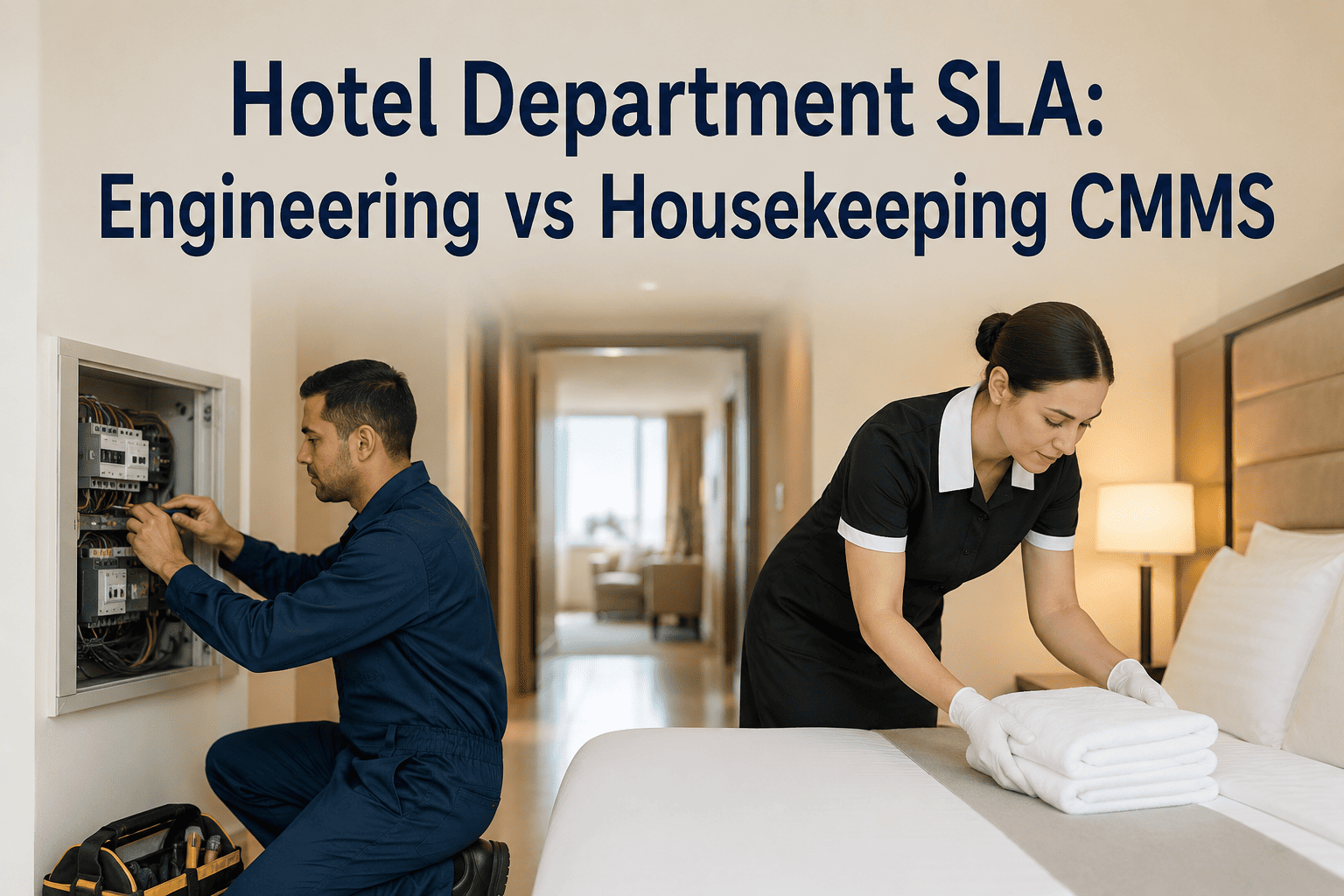
Hotel department SLA design is where five-star guest experience is won or lost — and the engineering vs housekeeping divide is the most common fault line. A CMMS hotel department SLA framework treats each department's response times, escalation paths and handoff protocols differently, because a malfunctioning HVAC unit in a guest corridor and a missing towel amenity do not share the same urgency, cost impact or compliance weight. This 2026 department SLA guide breaks down engineering versus housekeeping versus F&B response-time benchmarking, cross-department coordination protocols, and the CMMS structure that keeps every team accountable to its own service standard while working together on shared guest requests. If your property is still running inter-department work orders through radio calls and paper logs, the gap is already costing you — Start Free Trial to see how a unified CMMS closes it in days, not quarters.
CMMS Hotel Department SLA Guide 2026
Engineering and housekeeping don't operate on the same SLA — and treating them the same is where guest experience quietly breaks down.
A 280-room property averages 140+ cross-department guest requests per day. When engineering, housekeeping and F&B share one SLA clock, misrouted tickets and finger-pointing inflate response times by 40–60%.
BEFORE — SHARED SLA
One generic 30-min target for all departments. No asset context. Radio-dispatched handoffs. 52% of tickets miss SLA.
AFTER — DEPT-SPECIFIC SLA
Tiered targets by department, asset class and guest impact. CMMS auto-routes and escalates. 94% SLA adherence.
DEPARTMENT-SPECIFIC SLA DESIGN
Why a single hotel department SLA fails engineering, housekeeping and F&B
Most properties still operate on a flat, department-agnostic SLA — typically a 30-minute response target for any guest complaint, regardless of which team owns it. In practice, that single clock is the root cause of silent SLA breaches. An engineering issue involving a leaking bathroom or a dead HVAC compressor carries safety, asset-damage and guest-compensation risk that a missing bathrobe does not. Conversely, housekeeping response items are high-volume, low-complexity, and guest-perception-critical in ways that engineering wrench-turn time cannot capture. A CMMS hotel department SLA framework splits these into tiered, role-specific benchmarks so each department is measured on what it actually controls.
ENGINEERING
Safety-critical & asset-impacting
SLA clock starts at dispatch. Escalation to duty engineer at 80% of target. Every ticket links to asset history and PM schedule.
HOUSEKEEPING
Guest-perception & amenity
SLA clock starts at guest-acknowledged. Floor supervisor auto-CC'd at P1. Handoff to engineering auto-generated if root cause is mechanical.
FOOD & BEVERAGE
Service-recovery & temperature
HACCP-critical items auto-link to F&B asset tags. Dual-sign-off required for P1. Cross-department escalation to engineering at 50% of SLA window.
CMMS HOTEL CROSS-DEPARTMENT BENCHMARKING
Engineering vs housekeeping vs F&B: response-time benchmarks that actually work
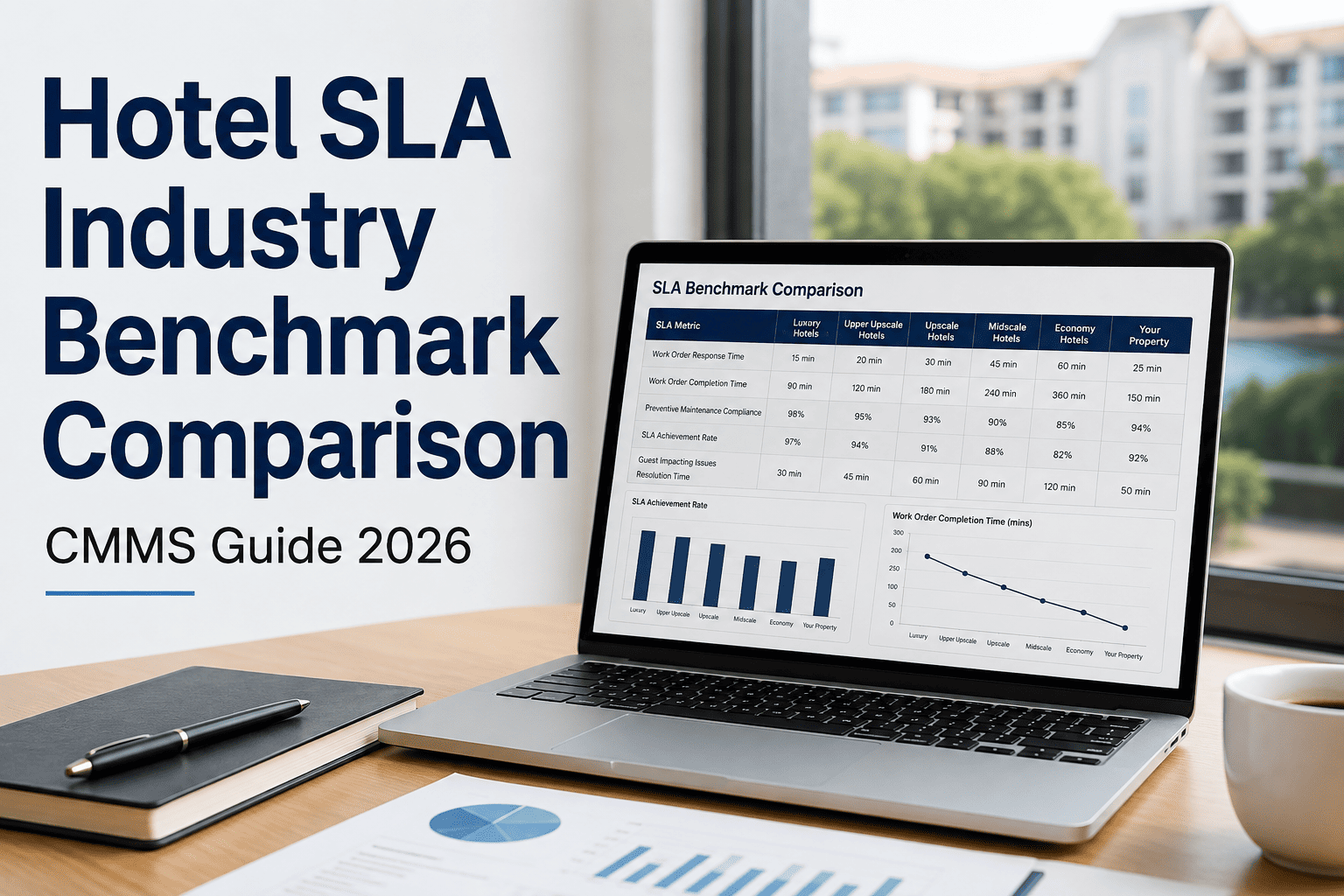
Benchmarking hotel department SLA performance requires normalising for ticket volume, complexity and guest-impact severity. The table below reflects anonymised aggregated data from 120+ properties running CMMS-based SLA tracking across full-service and luxury segments in 2025. Properties that adopted department-specific SLA targets inside a unified CMMS saw SLA adherence climb from a baseline of 61% to an average of 91% within 90 days — because the targets became achievable and the accountability was per-department, not a blurred shared number.
| SLA Metric | Engineering | Housekeeping | F&B |
|---|---|---|---|
| Avg tickets per day (280-room property) | 35–50 | 70–90 | 25–40 |
| P1 response target | 5 min | 10 min | 5 min |
| P2 resolution target | 2 hr | 30 min | 15 min |
| SLA adherence — pre-CMMS (shared SLA) | 58% | 64% | 61% |
| SLA adherence — post-CMMS (dept-specific) | 93% | 95% | 89% |
| Cross-dept handoff delay (avg) | 22 min pre-CMMS → 3 min with CMMS auto-routing | ||
| Guest-comp incident reduction (12-mo) | 38% average reduction across departments | ||
CROSS-DEPARTMENT HANDOFF SLAs
How to structure CMMS cross-department SLAs for hotel handoffs
The highest-leverage — and most frequently broken — SLA in a hotel is not within a single department. It is the handoff: the moment a housekeeping room-change request reveals a leaking valve, or an F&B oven failure needs an engineering wrench. Without a structured cross-department SLA, that handoff burns 15–25 minutes in radio chatter and shifted blame. A CMMS hotel cross-department protocol solves this with auto-generated child work orders, linked parent-child ticket chains, and dual-department SLA clocks that start the moment a handoff is triggered — not when someone eventually picks up a radio.
Trigger & auto-classify
Front-desk or guest app logs a request. CMMS AI classifies root-cause probability and tags the primary department — e.g., "no hot water" routes to engineering, not housekeeping, based on asset-linked history.
Parent SLA clock starts
The primary department's SLA timer begins at dispatch acknowledgement. If the technician on-site identifies a secondary cause, they tap "Request Handoff" in the CMMS mobile app — no phone call needed.
Child work order auto-generated
CMMS spawns a linked child ticket to the second department with full context — photos, asset ID, fault code. The child SLA clock starts immediately; the parent clock pauses or continues concurrently based on your protocol configuration.
Dual sign-off & close
Both departments must mark their portion complete before the parent ticket closes. Guest-facing notification fires only at full resolution. GM oversight dashboard updates in real time with per-department SLA contribution.
WORKED EXAMPLE
A 412-room resort in Arizona averaged 38 guest-reported HVAC issues per week during peak season. Under a shared SLA, 44% breached the 30-minute target — mostly because housekeeping received the call first, attempted a fix, then radioed engineering 12–18 minutes in. After implementing OxMaint cross-department SLA routing, the CMMS auto-classified HVAC keywords to engineering on intake, cut average handoff time from 16 minutes to under 2, and lifted SLA adherence to 96% within six weeks.
CMMS HOTEL GM OVERSIGHT
Department SLA dashboards that give General Managers real accountability
A department SLA is only as good as the visibility behind it. The reason most hotel SLA frameworks collapse is not bad targets — it is the absence of a single, live source of truth that the GM, Director of Engineering and Executive Housekeeper all trust. Spreadsheets updated weekly, radio logs never reconciled, and department heads reporting different numbers in the morning briefing is the status quo OxMaint replaces. The CMMS hotel GM oversight layer rolls every department's SLA performance into one real-time scorecard — by shift, by floor, by asset, by guest-impact tier — so accountability is shared, not shifted.
94%
Avg SLA adherence within 90 days of CMMS rollout
3 min
Cross-department handoff time vs 22 min on paper
38%
Reduction in guest-comp incidents tied to maintenance delays
100%
Audit-ready SLA logs — no manual reconciliation
HOW OXMAINT HELPS
How OxMaint enforces hotel department SLAs without the spreadsheet chaos
OxMaint is built for the exact problem this guide describes: multi-department hotels where engineering, housekeeping and F&B each need their own SLA clock, their own escalation path, and a shared accountability layer that the GM can actually trust. Below are four concrete capabilities mapped to the cross-department SLA challenge — each with a measurable outcome properties see within the first 90 days of implementation.
Department-specific SLA engines
Configure unlimited SLA tiers per department, per asset class, per guest-impact severity. OxMaint auto-starts the correct clock on dispatch and pauses, splits or concurrent-tracks on handoff — no manual timer management.
Outcome: 30–50% lift in SLA adherence in the first 60 days.
Auto-routed cross-department handoffs
Parent-child work order chains with full context — photos, asset ID, fault history — generated in one tap. Child SLA clock starts instantly; parent clock logic follows your protocol. Zero radio calls, zero lost context.
Outcome: Handoff time cut from 20+ min to under 3 min on average.
Live GM oversight dashboard
Real-time SLA scorecard by department, shift, floor and asset. Auto-escalation to duty manager at 80% of SLA window. Exportable audit logs for brand-compliance reviews and ownership reporting — no spreadsheet reconciliation.
Outcome: 100% audit-ready SLA records, zero manual reporting hours.
Predictive SLA risk alerts
OxMaint AI analyses ticket patterns, asset history and shift coverage to flag SLA-at-risk tickets before they breach — not after. Department heads get a 15-minute head start to re-route or escalate before the guest feels the delay.
Outcome: 40–60% reduction in SLA breaches on high-impact P1 and P2 tickets.
See OxMaint enforce your hotel's department SLAs — live on your assets
Book a 30-minute demo and we'll map your engineering, housekeeping and F&B SLA tiers inside OxMaint before the call ends.
FAQ
Hotel department SLA questions, answered
What is a hotel department SLA and why does it matter?
A hotel department SLA is a documented, time-bound service-level commitment that defines how quickly each department — engineering, housekeeping, F&B — must respond to and resolve guest requests, broken down by priority tier and asset type. It matters because a single flat SLA across all departments hides the real cost of misrouted tickets, inflates response times by 40–60%, and makes accountability impossible. Department-specific SLAs inside a CMMS give each team targets it can actually hit and give the GM a live scorecard. Start Free Trial to configure yours in under a day.
How do engineering and housekeeping SLAs differ in a hotel CMMS?
Engineering SLAs are asset-linked and safety-weighted — a P1 life-safety or flood issue carries a 5-minute response target and a 2-hour resolution window because the cost of delay includes asset damage, guest compensation and regulatory exposure. Housekeeping SLAs are volume-driven and perception-weighted — a P1 biohazard or room change has a 10-minute target, but amenity and restock items are batched and resolved in under 30 minutes. A CMMS enforces both in parallel without conflating the metrics.
How does a CMMS handle cross-department handoffs in hotels?
A CMMS like OxMaint generates a linked parent-child work order chain the moment a technician requests a handoff — no radio call, no lost context. The child ticket carries photos, asset ID and fault history to the second department, and a separate SLA clock starts immediately. The parent ticket's clock can pause or run concurrently depending on your protocol, and both departments must sign off before the guest is notified of resolution. This cuts average handoff time from 20+ minutes to under 3.
What SLA response times should hotels benchmark for 2026?
Benchmark ranges for full-service and luxury properties in 2026 are: engineering P1 5 minutes / P2 15 minutes, housekeeping P1 10 minutes / P2 20 minutes, and F&B P1 5 minutes / P2 12 minutes. Cross-department handoff SLAs should target under 5 minutes from trigger to child-ticket dispatch. Properties hitting these benchmarks with CMMS enforcement consistently report 90%+ SLA adherence and a 30–40% reduction in guest-comp incidents over 12 months.
Can OxMaint track SLA performance across multiple hotel departments?
Yes. OxMaint supports unlimited SLA tiers per department, per asset class and per guest-impact severity, with live dashboards that roll up to a GM-level scorecard. You can slice SLA performance by shift, floor, asset, department or property — and every record is audit-ready for brand-compliance reviews. To see it configured for your property, Book a Demo and we'll walk through your real SLA structure in 30 minutes.
Stop losing guests to cross-department SLA gaps
Deploy OxMaint in days — unify engineering, housekeeping and F&B under one accountable, CMMS-driven SLA framework.
Free 14-day trial · No credit card