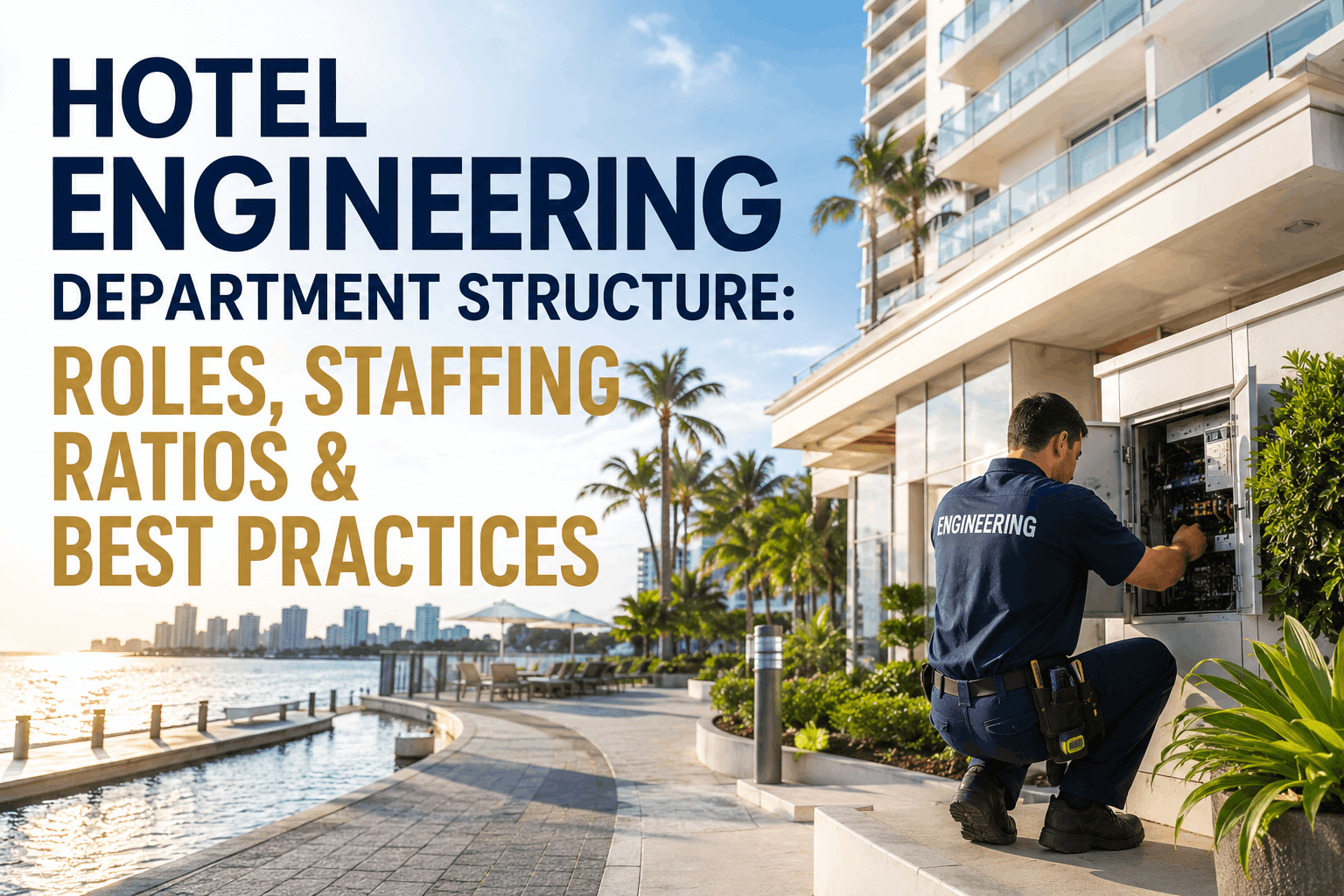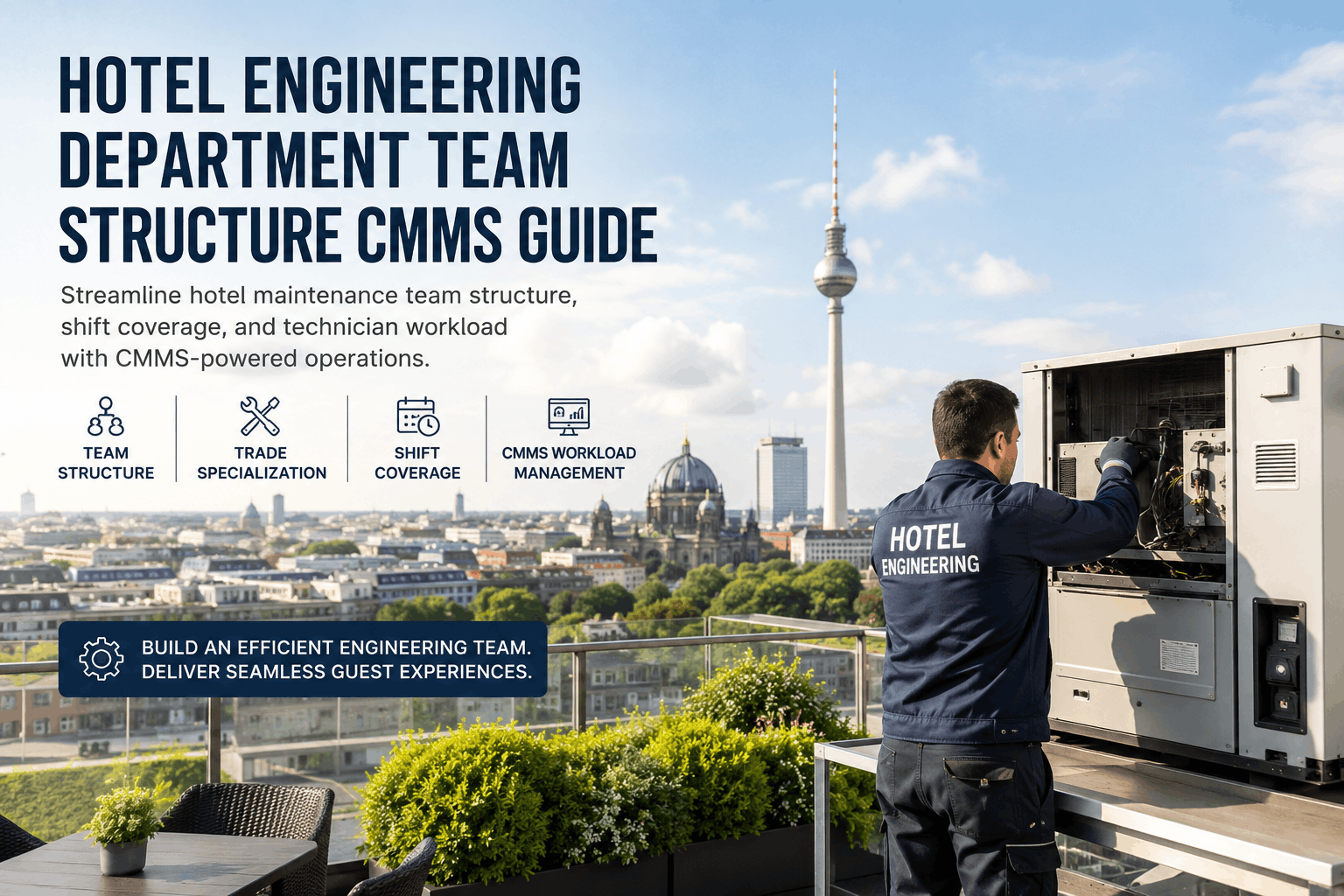
A 200-room hotel operates with a Chief Engineer, two full-time technicians, and one part-time assistant. That 3.5 FTE is typical for the property size. Yet without a structured reporting system, these four people operate independently. The chief engineer spends 50% of their time doing hands-on repairs instead of managing the team, strategic planning, and vendor coordination. Technicians lack clear skill assignments, so a plumbing problem gets routed to the nearest person regardless of their background. The assistant is doing general work instead of focused tasks. Result: 40% of potential output is wasted on coordination and misassignment. Hotels that organize their engineering department around clear roles, skill specialization, and CMMS-driven workload visibility improve output by 25–30% without hiring additional staff. Sign Up Free with Oxmaint to structure your engineering department, assign technicians by skill and zone, and eliminate the coordination chaos that prevents skilled work. Book a Demo to see how engineering team structure translates into faster repairs, better compliance, and measurable KPI improvement. This guide outlines the organizational framework every hotel needs and the CMMS features that enforce it.
Defining the Four Roles: Chief Engineer, Assistant Engineer, Technicians, and Helpers
Hotel engineering departments succeed when roles are clearly defined and accountability is enforced. Without structure, job titles become meaningless. A Chief Engineer who spends 60% of time on hands-on repairs is not managing. A technician without assigned skills or zones is a generalist whose output is 40% lower than a specialized technician. A CMMS enforces these boundaries by using role-based access control: what each position can see, assign, and report on. Book a Demo to configure your specific organizational structure in Oxmaint.
Budget management, capital planning, regulatory compliance, brand standards, vendor contracts, fire/life safety systems, energy management. Hands-on technical work: 10–30% maximum depending on property size. Span of control: 5–15 direct reports. USA salary range: $65K–$95K depending on property size and market.
Shift supervisor, daily dispatch management, work order prioritization, emergency response coordination, PM compliance monitoring, technician training, inventory oversight. Specialization: often HVAC, electrical, or plumbing. Hands-on work: 40–60% of time. Span of control: 3–8 technicians per shift. USA salary: $48K–$65K.
Expert in specific trade: HVAC, electrical, plumbing, or appliance repair. Executes PM per spec, handles complex repairs, mentors junior technicians, trains others on their specialty. Often carries on-call responsibility. Hands-on work: 80–90% of time. USA salary: $48K–$65K depending on certification and experience.
Broad maintenance skills across multiple trades at competent level. Handles routine repairs, guest room issues, equipment inspection, parts replacement. Works under supervision of assistant engineer or senior tech. Hands-on work: 90% of time. USA salary: $32K–$48K depending on market and experience.
Support tasks: parts inventory management, tool maintenance and organization, equipment cleaning, simple repairs under direct supervision, grounds and exterior work. Provides capacity for routine PM tasks. Hands-on work: 100% of time. USA salary: $22K–$32K depending on market.
Staffing Ratios: How Many Engineers Does Your Hotel Size Need?
Hotel engineering staffing is not one-size-fits-all. A 150-room select-service property runs lean compared to a 300-room full-service hotel with pool, kitchen, and banquet facilities. Equipment age, building condition, and amenities drive workload. Use these industry-standard ratios as starting points, then adjust based on actual CMMS workload data. Sign Up Free to get workload analytics that tell you whether your team is correctly sized.
- Staff: 1.5–2 FTE (one lead technician, one general tech or part-time shared resource)
- Lead technician must have broad skills; limited room for specialization
- Heavy reliance on outsourcing: elevators, fire systems, specialized HVAC
- PM discipline is critical; reactive work will consume entire shift without structured scheduling
- Staff: 2.8–3.6 FTE (1 chief + 1 assistant + 1–2 technicians + part-time helper)
- Chief engineer: 30–50% hands-on, 50–70% administrative; cannot do all supervision alone
- One technician should specialize in HVAC; second in plumbing/electrical
- 24/7 coverage via on-call rotation; outsource specialized systems beyond core competency
- Staff: 4–5 FTE (1 chief + 1 assistant + 2–3 technicians + part-time helper)
- Chief engineer: 10–20% hands-on, 80–90% management; assistant chief handles day-to-day dispatch
- Technician specialization: HVAC, electrical/plumbing, appliances/equipment, and general rotation
- 24/7 on-call with backup; external vendors for elevators, fire systems, chillers
Skill Assignment and Zone Ownership: How CMMS Eliminates Dispatch Guesswork
In hotels without a CMMS, supervisors make 40–50 routing decisions per day based on who happens to be available. An HVAC complaint goes to whoever answers the radio. A plumbing issue gets assigned to the person who is currently idle. Result: 30–40% of work orders are routed to technicians without relevant skills, creating misdiagnoses and repeat failures. A CMMS eliminates guesswork by enforcing skill-based routing. Every technician is tagged with certifications and zone assignments. Every work order auto-routes to the tech whose skills match and whose current load is lowest. Sign Up Free to configure skill tags and zone assignments for your team.
Chief Engineer Time Allocation: Hands-On Work vs. Management vs. Planning
A Chief Engineer's time is finite. If they spend 70% on hands-on repair work, management and strategic planning never happen. KPIs go unmonitored. Capital planning doesn't exist. Compliance audits reveal gaps nobody knew about. CMMS dashboards help chiefs allocate their time based on what only they can do: strategy, compliance, vendor management, and team leadership. Sign Up Free to get real-time visibility into your team's workload so you know when hands-on help is actually needed vs. when it is a management problem masquerading as capacity.
Emergency response, complex troubleshooting, specialized repairs no technician is trained for, mentoring junior staff on difficult jobs. Should never exceed 30% in properties with 200+ rooms and proper delegation. If hand-on work is >50%, staffing or skills gap exists.
Work order review, technician assignment, priority management, shift handover, SLA monitoring, PM compliance oversight, inventory management, vendor coordination for routine issues. CMMS automation reduces this time; with good assistants, it can drop to 35–40%.
Capital budget planning, equipment replacement strategy, brand compliance, health/safety regulatory updates, team development, training, process improvement. Most neglected area in reactive-focused hotels. Should be minimum 20% for sound operations.
General Manager updates, department head meetings, vendor communications, incident reporting, documentation. Necessary overhead that cannot be eliminated, but can be streamlined with digital systems (no more manual logs or email searching).
Frequently Asked Questions: Hotel Engineering Department Structure
I was trying to manage five technicians without any structure. Everyone was doing everything. An HVAC problem went to whoever answered the radio, not the person trained in HVAC. Our repeat failure rate was insane. After we set up Oxmaint and assigned skill tags and zones, HVAC problems routed to our HVAC guy. Plumbing to our plumbing person. Repair time dropped 30%. Repeat failures fell by 40%. I finally had time to do my job instead of being another technician.
—Robert Gonzales, Chief Engineer, 240-room full-service hotel, Phoenix, Arizona