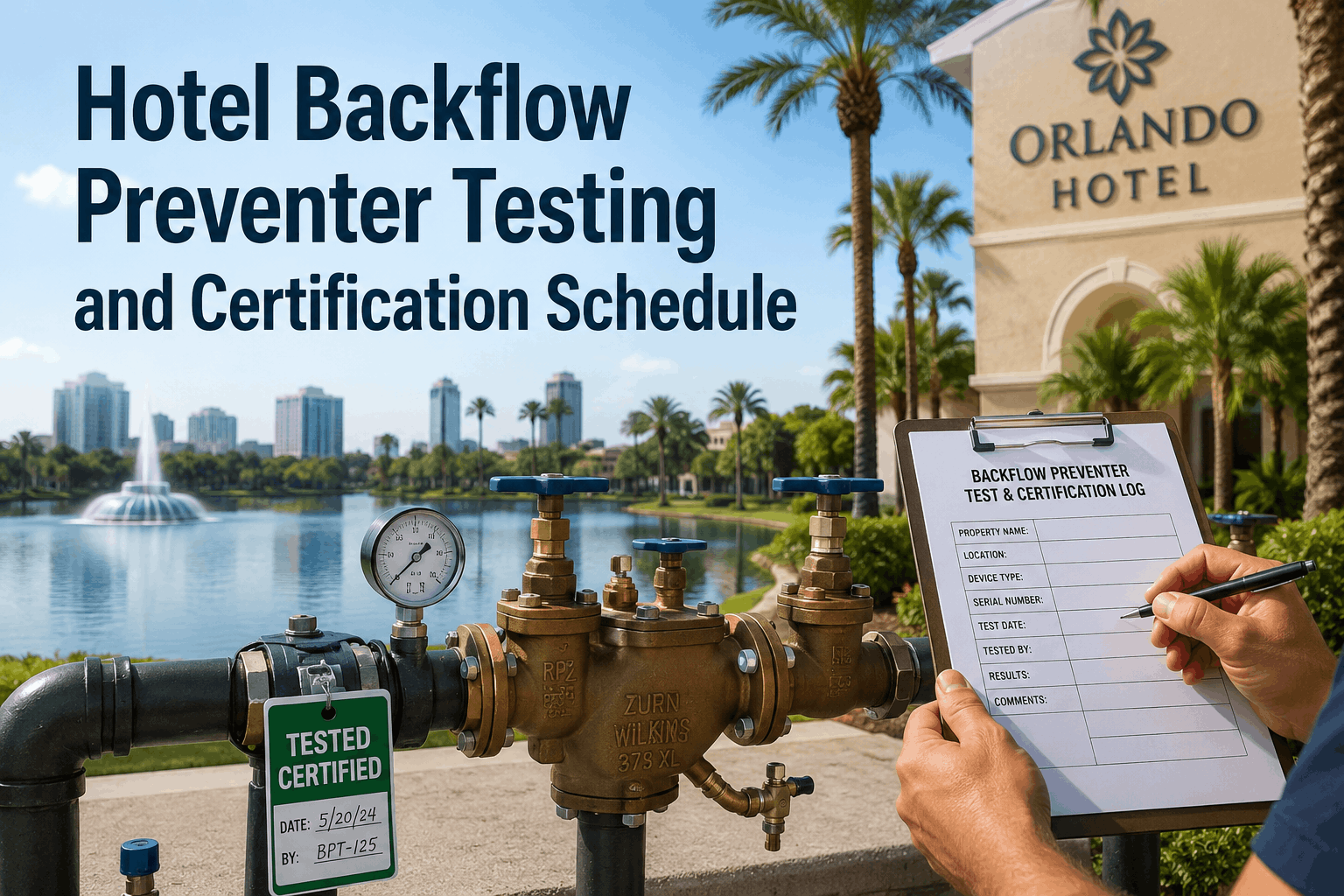
Hotel Backflow Preventer Testing and Certification Schedule
By Alex Jordan on June 18, 2026
A single failed backflow preventer can contaminate an entire hotel's drinking water supply with chemicals, sewage, or other hazardous materials — exposing guests to illness and the hotel to liability claims of $500,000–5,000,000. Yet most hotels treat backflow preventers as "set and forget" plumbing components, discovering failures only when a health department inspector cites a violation or, worse, when contaminated water reaches guest rooms. Annual testing is not optional — it is required by federal, state, and local cross-connection control regulations. Start a free trial with Oxmaint to schedule and track backflow preventer testing and certification, or book a demo to see how hotel engineering teams use Oxmaint's plumbing compliance module to maintain water safety and regulatory compliance.
HOTEL PLUMBING · BACKFLOW PREVENTION · WATER SAFETY · 2026
Hotel Backflow Preventer Testing and Certification Schedule: Annual Testing Log for Cross-Connection Control and Health Department Compliance
Reduced pressure zone (RPZ) testing, double check valve inspection, cross-connection control, annual certification logging, health department compliance, and plumbing code requirements — the complete guide to backflow preventer testing and certification for hotels.
$500K–5MPotential liability from a water contamination incident caused by backflow
12 monthsMaximum interval between backflow preventer tests in most jurisdictions
100%Compliance required — no exceptions for hotels serving public water
24 hrsTime to file test results with local health department (varies by jurisdiction)
Why Backflow Preventer Testing Is Non-Negotiable — The Science of Cross-Connection Control
Backflow is the reversal of water flow in a plumbing system — allowing contaminated water from sinks, boilers, cooling towers, fire sprinklers, or irrigation systems to flow back into the potable water supply. This reversal can be caused by backpressure (pumps or elevated systems) or backsiphonage (loss of supply pressure). Backflow preventers are mechanical devices that allow water to flow in only one direction. They fail mechanically — seals wear, springs weaken, and check valves stick — and the only way to verify they are functioning is annual testing. Start a free trial or book a demo to see how Oxmaint's plumbing compliance module tracks test schedules and certification records.
1
Backflow
Reversal of water flow — contaminated water enters potable supply
Causes: Backpressure (pumps, elevated tanks) or backsiphonage (main line break).
Backflow preventers stop this — but only if they are functioning.
2
Cross-Connection Control
Physical connection between potable and non-potable water
Any connection where contaminated water could backflow into drinking water.
Eliminate or protect all cross-connections with approved backflow preventers.
3
Annual Testing Requirement
Backflow preventers must be tested annually in most jurisdictions
Failed devices must be repaired or replaced immediately.
Test results filed with health department — compliance verified.
Types of Backflow Preventers — Testing Requirements for Each
Hotels typically have multiple types of backflow preventers, each with different testing procedures. Understanding which devices are on your property and their testing requirements is essential for compliance. Oxmaint's asset tracking module stores the type, location, and test history for every backflow preventer in your hotel.
Backflow Preventer Types — Hotel Applications and Testing
Reduced Pressure Zone (RPZ)
Highest protection — required for high-hazard connections
Applications: Boilers, cooling towers, fire sprinkler systems, chemical feed systems. Testing: Annual — includes differential pressure relief valve test.
High Hazard
Double Check Valve (DCVA)
Moderate protection — required for low-hazard connections
Applications: Irrigation systems, domestic water supplies without chemical treatment. Testing: Annual — check both check valves for tight shut-off.
Low-Moderate Hazard
Pressure Vacuum Breaker (PVB)
Protects against backsiphonage only — not backpressure
Applications: Irrigation systems at lower elevations. Testing: Annual — verify air inlet valve operation and spring tension.
Limited Protection
Double Check Detector (DCDA)
Used in fire sprinkler systems — detects unauthorized water use
Applications: Fire suppression systems. Testing: Annual — check both check valves and the detector meter calibration.
Fire Protection
Annual Backflow Preventer Testing Protocol — 5-Step Process
Testing must be performed by a certified backflow tester (licensed by the state or local jurisdiction). The test protocol below follows industry standards and regulatory requirements. Oxmaint's plumbing compliance module tracks tester certification, test dates, and results, generating alerts when any device is overdue.
Protect Your Water Supply — Automate Your Backflow Preventer Testing Schedule
Oxmaint's plumbing compliance module tracks annual testing due dates, tester certifications, test results, and health department filing — ensuring your hotel never misses a compliance deadline.
Compliance Requirements — What Health Departments Expect
Most state and local health departments require annual backflow preventer testing for all commercial properties connected to public water systems. Specific requirements vary by jurisdiction, but the general framework below applies to most US jurisdictions. Oxmaint's compliance module stores local regulatory requirements and generates alerts when test results are due for filing.
Backflow Compliance — Regulatory Requirements
Annual Testing
Every backflow preventer must be tested annually
Test by certified tester. Document test results. File with health department within required timeframe (typically 24–72 hours).
Mandatory
Certified Tester
Tests must be performed by licensed/certified backflow testers
Verify tester certification is current. Store tester credentials in CMMS. Ensure tester is authorized by your jurisdiction.
Qualified
Test Report Filing
Test results must be filed with the local health department
Filing requirements vary — some jurisdictions accept digital submission, others require paper forms. Know your local requirements.
Documentation
Failed Device Action
Failed devices must be repaired or replaced immediately
If a device fails testing, repair or replace within 30 days (some jurisdictions require 14 days). Retest after repair and file updated results.
Corrective
Record Retention
Maintain test records for 3–5 years
Store all test reports, repair records, and correspondence with health department. CMMS provides audit-ready records for inspections.
Audit
Common Backflow Preventer Test Failures and Corrective Actions
Understanding the most common test failures allows engineering teams to proactively maintain devices and reduce the risk of compliance violations. Oxmaint's maintenance history module tracks repair and replacement history for each backflow preventer, identifying patterns that indicate recurring issues.
1
Check Valve Leakage
Failure to hold tight shutoff — allows backflow
Most common failure. Caused by debris, worn seats, or damaged seals.
Clean or replace check valve seats and seals. Retest. If recurring, consider device replacement.
2
Relief Valve Failure (RPZ)
Relief valve fails to open at correct differential pressure
Caused by debris, corrosion, or incorrect spring tension.
Clean relief valve, replace springs or diaphragm. Retest. If recurring, replace the relief valve module.
3
Shutoff Valve Failure
Inlet or outlet shutoff valve does not close fully
Caused by debris, corrosion, or worn valve seats.
Clean or replace shutoff valve seats. If recurring, consider replacing the valve assembly.
4
Pressure Loss
System pressure drop across the device exceeds acceptable limits
Caused by internal obstruction or partially closed shutoff valves.
Inspect for debris, verify valves are fully open. If pressure loss continues, check for internal damage.
"
Our health department inspector arrived unannounced and asked for our backflow preventer test records. We had no system — some devices were tested, some weren't, and we couldn't prove when any of them were last tested. We received a citation and a 30-day deadline to bring all devices into compliance. We implemented Oxmaint's backflow tracking module and tested all 12 devices within 15 days. The inspector returned, reviewed our digital records, and closed the citation. We'll never be caught without records again.
Director of Engineering — 350-room Full-Service Hotel, US Midwest
Frequently Asked Questions — Backflow Preventer Testing and Certification
How often should backflow preventers be tested?
Annually is the standard requirement in most jurisdictions. Some states require testing every 6 months for high-hazard devices (RPZ). Always check your local health department requirements — they vary by state, county, and city. Oxmaint tracks your jurisdiction's specific testing frequency and generates work orders accordingly. Start a free trial to configure local compliance rules.
Who is qualified to test backflow preventers?
Testing must be performed by a certified backflow tester who has completed an approved training course and holds a valid certification from the state or local jurisdiction. Certification typically requires classroom training, hands-on testing, and passing a written and practical exam. Certification must be renewed every 1–3 years depending on the jurisdiction. Oxmaint tracks tester certification expiration dates. Book a demo to see certification tracking.
What happens if a backflow preventer fails the annual test?
If a device fails testing, it must be repaired or replaced immediately (within 30 days in most jurisdictions, 14 days in some). The device must be retested after repair and a new test report filed with the health department. The old test report and the new report should both be retained. Oxmaint tracks the status of failed devices and generates work orders for repair and retest. Start free to configure repair workflows.
Where are backflow preventers typically located in a hotel?
Common locations include: main water service entrance (reduced pressure zone device), boiler room (RPZ), cooling tower makeup water (RPZ or double check), irrigation system (double check or PVB), fire sprinkler system (double check detector), and laundry or kitchen equipment (reduced pressure or double check). Each device must be tagged with identification and test history. Oxmaint tracks device locations and provides QR code labels for easy field identification.
Never Miss a Backflow Compliance Deadline Again — Automate Your Testing Schedule.
Oxmaint's plumbing compliance module tracks annual testing due dates, tester certifications, test results, and health department filing — protecting your water supply and your compliance record. Free to start.