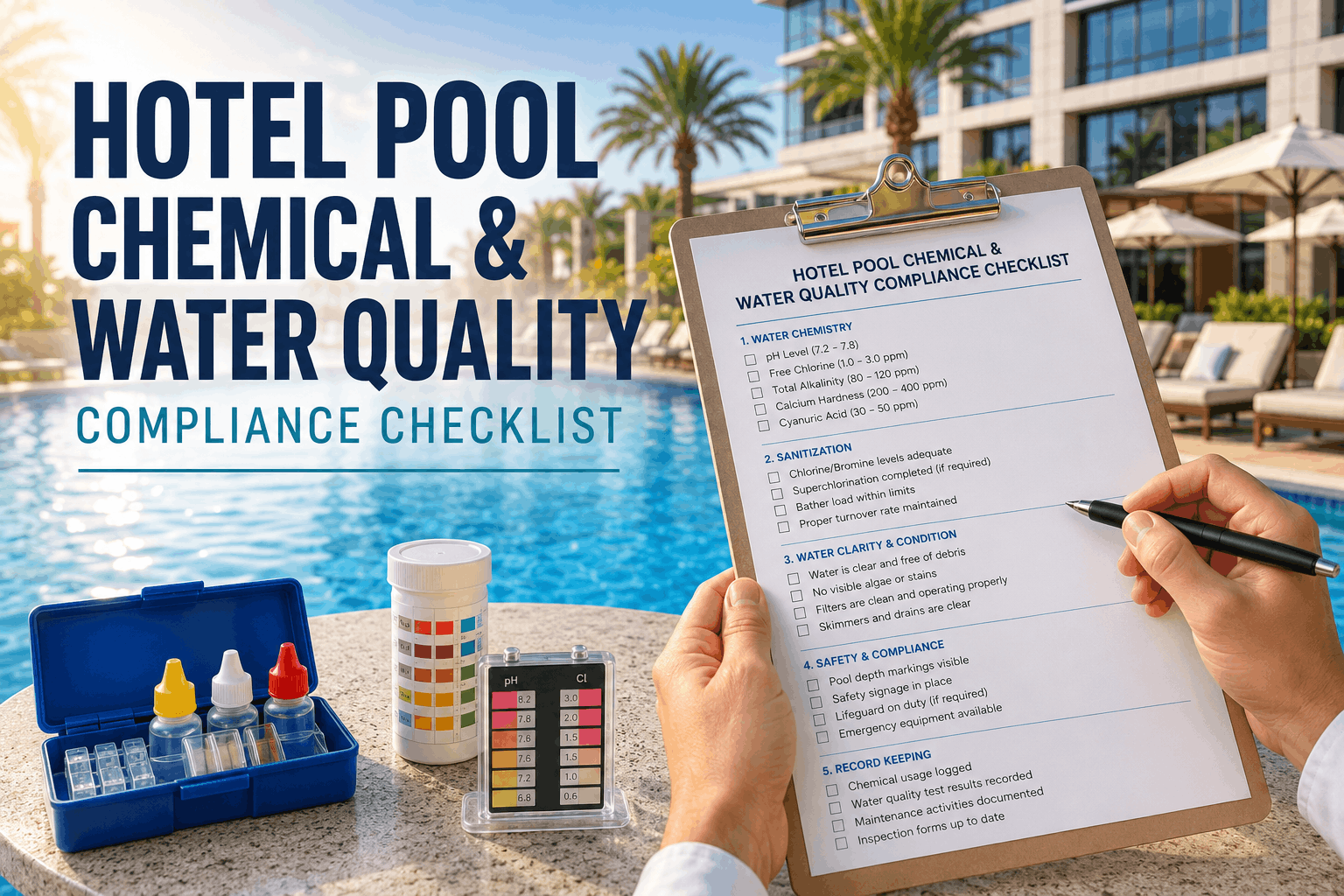
Hotel Pool Chemical & Water Quality Compliance Checklist
By Alex Jordan on May 30, 2026
A missed pool chemistry test is more than oversight — it's a health code violation that triggers immediate closure in most USA jurisdictions. One 5-star hotel's pool was shut down for 48 hours after combined chlorine tested at 0.8 ppm (four times the legal 0.2 ppm limit) and the last water chemistry log was three days old. The violation cost $150K in lost amenity revenue, public health department posting, and reputation damage. Most USA states require pool chemical testing minimum 2x daily (opening and midday) with all results logged in dated records inspectors can request at any time. Hotels missing a single daily test face $4,000–$25,000 fines plus potential closure orders. Oxmaint automates daily pool chemistry testing schedules, sends pre-test reminders to qualified operators, logs all results digitally, and generates audit-ready compliance documentation — ensuring every pool operates at peak safety with zero health code violations.
Ensure Pool Safety & Health Code Compliance2x daily chemical testing automated. Digital logging. Compliance documentation. Zero violations. Guest safety guaranteed 365 days/year.
Out of range = chlorine ineffective; guest skin/eye irritation
Alkalinity
80–120 mg/L
80–120 mg/L
Weekly
Imbalance causes pH swings; water cloudiness
Total Disinfectant (spa)
—
2–10 ppm (bromine alternative)
2x daily
Below min = pathogen survival; closure
1. Daily Morning Pool Chemistry Testing (Opening Test — 7:00–9:00 AM)
Morning test conducted before pool opens to guests. Qualified operator uses test kit or electronic analyzer. All results recorded in dated log (digital or paper with backup photo). Results must be retained minimum 1–3 years per state code.
2. Midday Pool Chemistry Testing (1:00–3:00 PM During Guest Occupancy)
Midday test verifies chemistry stability under occupancy load. Higher guest count (especially weekends/holidays) increases chlorine demand and pH drift. Test from different area of pool than morning test to verify even distribution.
Automate Pool Safety & ComplianceOxmaint schedules 2x daily testing, logs results digitally, tracks health code compliance, and stores audit-ready documentation for inspectors.
Hotel Pool Chemical Compliance FAQ — USA Health Code & Guest Safety
1. What happens if we miss one daily pool chemistry test?
Health code violation. Fines: $4,000–$15,000 depending on jurisdiction. Multiple missed tests trigger immediate closure order. Closed pool loses $500–$3,000/day in amenity revenue. Insurance may deny liability claims if injury occurs during missed test period. Oxmaint prevents this with automated daily reminders and instant logging.
2. What is combined chlorine and why is the 0.2 ppm limit so strict?
Combined chlorine = chlorine that has bonded with organic matter (sweat, urine, cosmetics) and lost disinfecting power. Combined chlorine >0.2 ppm indicates heavy organic load. Immediate closure required if >0.2 ppm on inspection. This is most-violated pool parameter — causes immediate health department action. Super-chlorination needed when combined chlorine detected.
3. What is the cost of a pool closure due to chemical violation vs. compliance testing cost?
Closure cost: $500–$3,000/day in lost amenity revenue + $4,000–$25,000 fine + reputation damage = $50K–$100K+ total impact. Compliance testing cost: $50–$100/day for qualified operator time + test supplies + system maintenance = $2,000–$3,000/month. ROI is immediate — prevent one closure and compliance costs are paid back.
4. Can we automate chlorine dosing to avoid manual testing?
Automated chemical controllers reduce testing burden but do NOT eliminate manual testing requirement. Health codes still require operator to physically test and log results 2x daily. Automated systems supplement manual testing but cannot replace documented compliance records. Always maintain digital or paper log with timestamps and operator signature.
5. How long must pool testing records be retained?
USA standard: 1–3 years minimum depending on state. Some states require 3 years. Digital storage in Oxmaint with photo backup ensures records are permanently available for health department inspections. Missing records are treated same as missed tests — violations.
6. What operator certification is required to test pool chemistry?
Requirements vary by state/locality. Some require Certified Pool Operator (CPO) certification (course + exam). Others require general facility staff with documented training. Confirm your state requirements. Document all operators who conduct testing in compliance file. Oxmaint tracks operator training/certification status.
7. Can guests' sweat and urine really cause health code violations?
Yes — this is primary cause of combined chlorine buildup. High-occupancy periods (summer, weekends) increase organic load. Heavy guest use can increase combined chlorine from <0.1 ppm to 0.3+ ppm in hours. Super-chlorination after peak occupancy is standard practice. Closing pool for 2–4 hours after heavy-use day for super-chlorination is preventive.
8. What is super-chlorination and when is it required?
Super-chlorination = raising free chlorine to 5–10 ppm to oxidize combined chlorine and organic matter. Required when: combined chlorine >0.2 ppm detected, after heavy guest-use days, weekly preventive treatment. Raises free chlorine above safe guest range temporarily. Pool must be closed during super-chlorination (2–12 hours), then retested before reopening. Prevents combined chlorine violations.
"Our 3-pool, 2-spa hospitality property had inconsistent testing and paper logs that inspectors couldn't trust. We received a 'conditional use' violation for poor record-keeping. One missed test and we'd face closure. Switched to Oxmaint pool testing module. Morning and midday tests auto-scheduled. Operator taps 3 parameters into mobile app — time and result automatically logged with timestamp. Digital records backed up. No more paper logs lost or illegible. Inspector visited 3 months later and immediately signed off on compliance — the digital records were professional and complete. No violations. Pool amenity fully operational, fully compliant." — David Wu, Facilities Manager, Riverside Resort & Spa
Keep Pools Safe & Compliant Year-RoundDaily testing automated. Chemical logging digital. Compliance audits instant. Guest safety guaranteed. Zero violations. Oxmaint is the pool operator's safeguard.