Hotel Pool Maintenance Checklist for Water Quality Compliance Guest Safety and Equipment Reliability
By Liam Neeson on March 24, 2026
A hotel pool that turns green on a Saturday morning during a sold-out weekend cannot wait until Monday for service. Combined chlorine at 0.8 ppm — four times the legal limit of 0.2 ppm — will trigger a mandatory 48-hour closure and a public health department citation posted in the county database. The root cause is almost never a chemical system failure. It is almost always a missed daily test. Every pool closure, every health citation, every guest complaint about cloudy water traces back to the same failure: maintenance tasks that were not tracked, tests that were not logged, and inspections that were not completed on schedule. Sign up free to put every pool and spa chemistry test on an automated daily schedule, or book a demo to see Oxmaint's pool compliance log in action.
Closure Trigger — Combined Chlorine above 0.2 ppm
A pool closed for 48 hours during a peak weekend loses the amenity revenue, generates a public health department record, and takes an average of 3 days to recover full guest trust. The fix costs less than 5 minutes of daily testing.
48 hrs
Mandatory closure for a chemistry violation during a health inspection
2x daily
Minimum water chemistry testing required for hotel pools under health codes
1–3 yrs
Period chemical test logs must be retained on-site for health inspector review
4 hrs
Time a chemical feed system outage takes to drop pool from compliant to closure-level chemistry
Water Chemistry: Target Ranges at a Glance
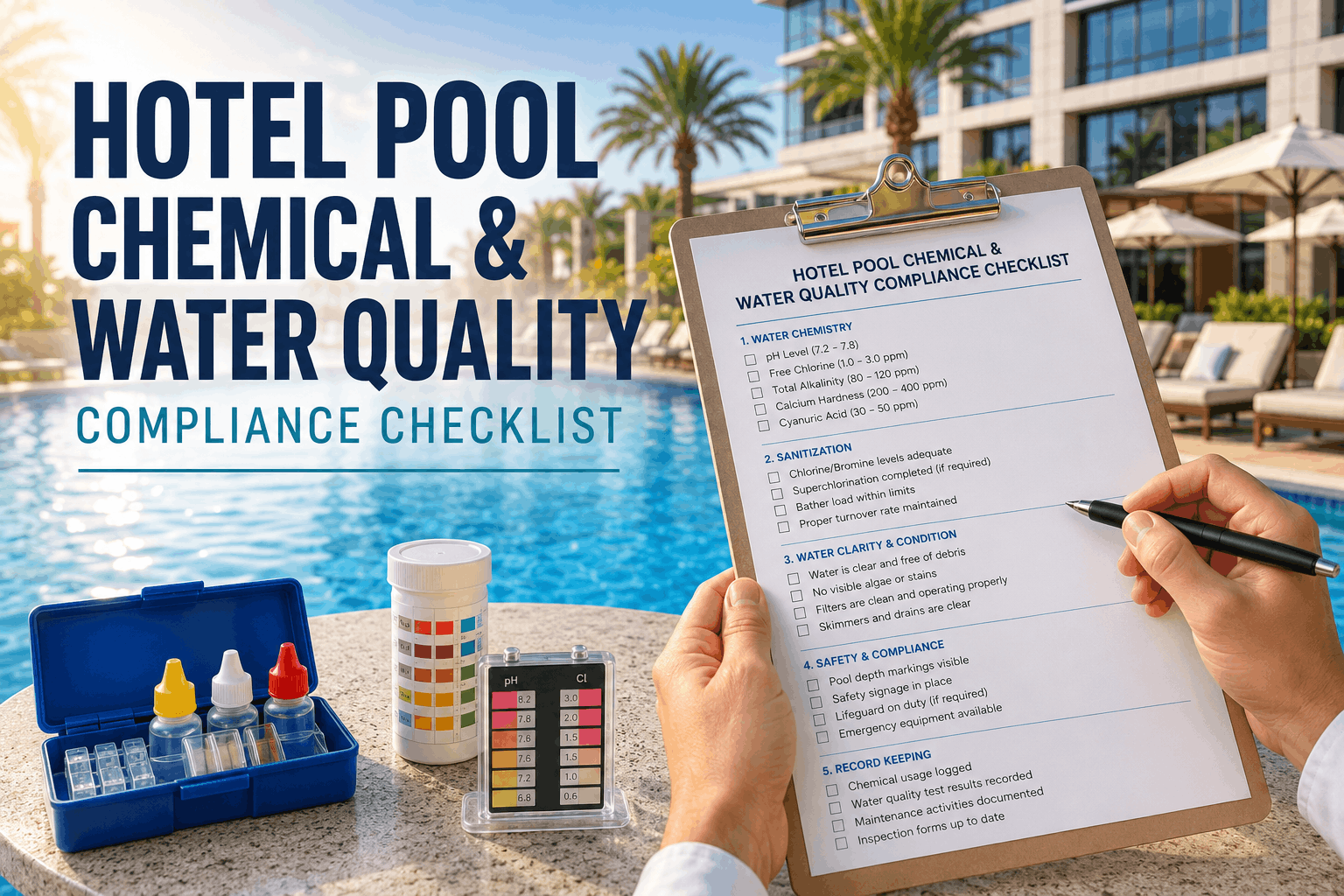
Every pool closure starts with chemistry drift that was not caught in time. The visual below shows the target ranges for each parameter, the acceptable operating zone, and the closure trigger level. Book a demo to see how Oxmaint flags chemistry drift before it reaches a closure-trigger reading.
Spa maximum is 104°F per most state health codes. Log temperature at each test interval.
Complete Hotel Pool Maintenance Checklist
DailyWeeklyMonthlyQuarterlyAnnual
Water Chemistry Testing and Chemical Logs
State health codes require logs retained on-site 1–3 years — missing logs are treated as a violation
DailyWeekly
Test free chlorine, total chlorine, and calculate combined chlorine at pool opening and midday minimum. Record at mid-pool, 18 inches below surface. Do not open pool if free chlorine is below 0.5 ppm.
Daily x2
Test and log pH at the same location at each testing interval. Record reading, target range, and any chemical added with volume in ounces. Corrective action required within 2 hours of any out-of-range reading.
Daily x2
Verify chemical automation controller is in AUTO mode, reading correctly, and that feed lines are not kinked or air-locked. Check chemical storage levels — sodium hypochlorite, muriatic acid, and CO2 cylinders.
Daily
Test total alkalinity and calcium hardness weekly. Imbalance in either parameter makes it impossible to hold stable pH and chlorine — upstream correction is more efficient than reactive dosing.
Weekly
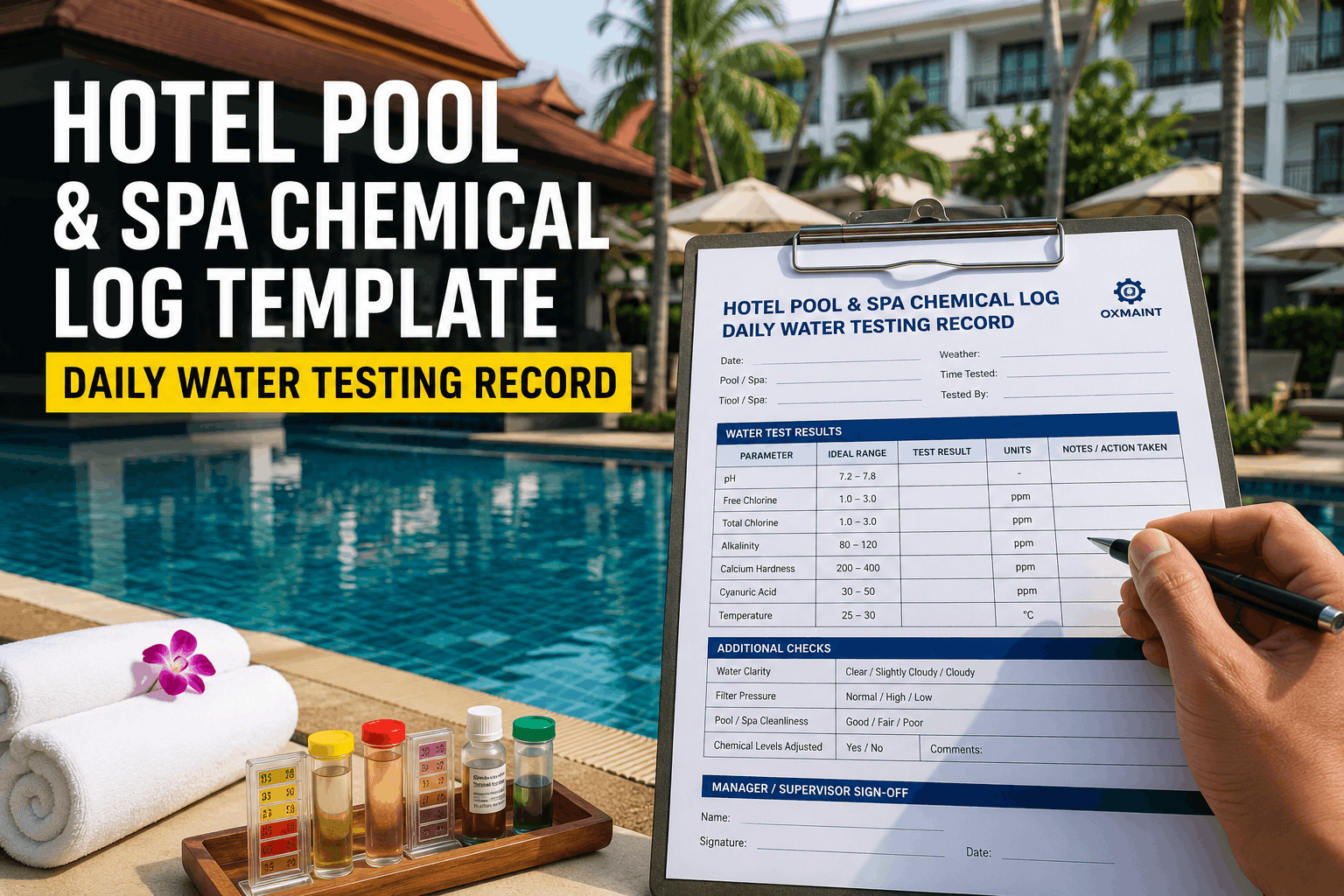
Log all test results, readings, adjustments, and corrective actions with timestamp and tester name. Chemical log must be retained on-site and presented to health inspectors on request. Never backdate or estimate entries.
Every test
Most cited violation: Chemical log entries missing, backdated, or not retained on-site at time of inspection.
Circulation, Filtration, and Pump Systems
Filter pressure differential is the single most reliable indicator of filter media condition and system health
DailyMonthly
Record filter inlet and outlet pressure gauge readings daily. A pressure differential 8–10 psi above baseline indicates the filter requires backwashing. Log readings with date and shift — trending pressure helps predict cleaning cycles.
Daily
Inspect pump motor for unusual noise, vibration, or heat weekly. Check pump strainer basket and clear any debris — a blocked strainer reduces flow rate and accelerates impeller wear. Log condition and findings.
Weekly
Backwash sand or DE filter when differential pressure rises 8–10 psi above clean baseline, or as required by inspection results. Never backwash on a fixed schedule without reading pressure — premature backwashing wastes filter media.
As needed
Inspect all skimmer baskets, main drain covers, and return fittings monthly. Confirm VGB-compliant anti-entrapment drain covers are present, secure, and undamaged — missing or cracked covers are a federal VGB Act violation.
Monthly
Full pump and filter service by certified technician annually — impeller inspection, mechanical seal check, O-ring replacement, multiport valve service, and filter media inspection or replacement as required.
Annual
Federal VGB Act: Missing or non-compliant anti-entrapment drain covers on pool and spa floors are a mandatory correction — pool must be closed until resolved.
Pool Heater and Temperature Control
Spa maximum 104°F is a mandatory shutdown threshold under most state health codes
DailyQuarterly
Log pool and spa water temperature at each chemistry test interval. Verify spa is at or below 104°F before opening — exceeding this limit is a mandatory shutdown trigger in most jurisdictions. Log temperature with tester name.
Daily
Inspect heater exterior for corrosion, scaling, or unusual noise monthly. Verify gas pressure (for gas heaters) or element condition (for electric heaters). Clean heat exchanger of scale deposits that reduce thermal efficiency.
Monthly
Full heater service by certified technician quarterly — burner assembly inspection for gas units, element resistance test for electric units, thermostat calibration, and safety cutout verification. File service report in asset record.
Quarterly
Spa temperature above 104°F — immediately reduce to below 104°F and document corrective action before reopening.
Pool Deck, Safety Equipment, and Signage
ADA pool lift compliance, depth markers, and safety signage are individually cited violations at health inspections
DailyAnnual
Inspect pool deck for slip hazards, standing water, cracked coping, or damaged tiles daily before opening. Wet pool decks with damaged non-slip surfaces are among the most common sources of guest injury claims at hotels.
Daily
Verify all safety equipment is present and accessible daily — life ring with line, reaching pole, first aid kit, and CPR instructions posted visibly. Missing safety equipment at inspection results in mandatory closure until restocked.
Daily
Check ADA pool lift battery charge and operation weekly. A non-functional ADA lift is a federal ADA Title III violation — it must be operational during all pool operating hours or the pool must close.
Weekly
Inspect all depth markers, "No Diving" signage, pool rules signs, and operating hours posting monthly. Signage must be permanent, legible, and meet minimum size requirements per local health code.
Monthly
Annual full structural inspection — check pool shell, coping, tiles, and plaster for cracks, staining, or deterioration. Inspect pool fencing, gates, and self-latching hardware to confirm compliance with local barrier requirements.
Annual
Most cited: Non-operational ADA lift, missing safety equipment, and illegible depth markers each trigger individual citations.
Pool Water Quality TrackingChemical Log ManagementEquipment PM Scheduling
Automated chemistry logs. Zero missed tests. Always audit-ready.
Oxmaint generates a complete dated chemical log automatically from mobile test entries — timestamped, technician-attributed, and available on demand when an inspector arrives. Book a demo to see it.