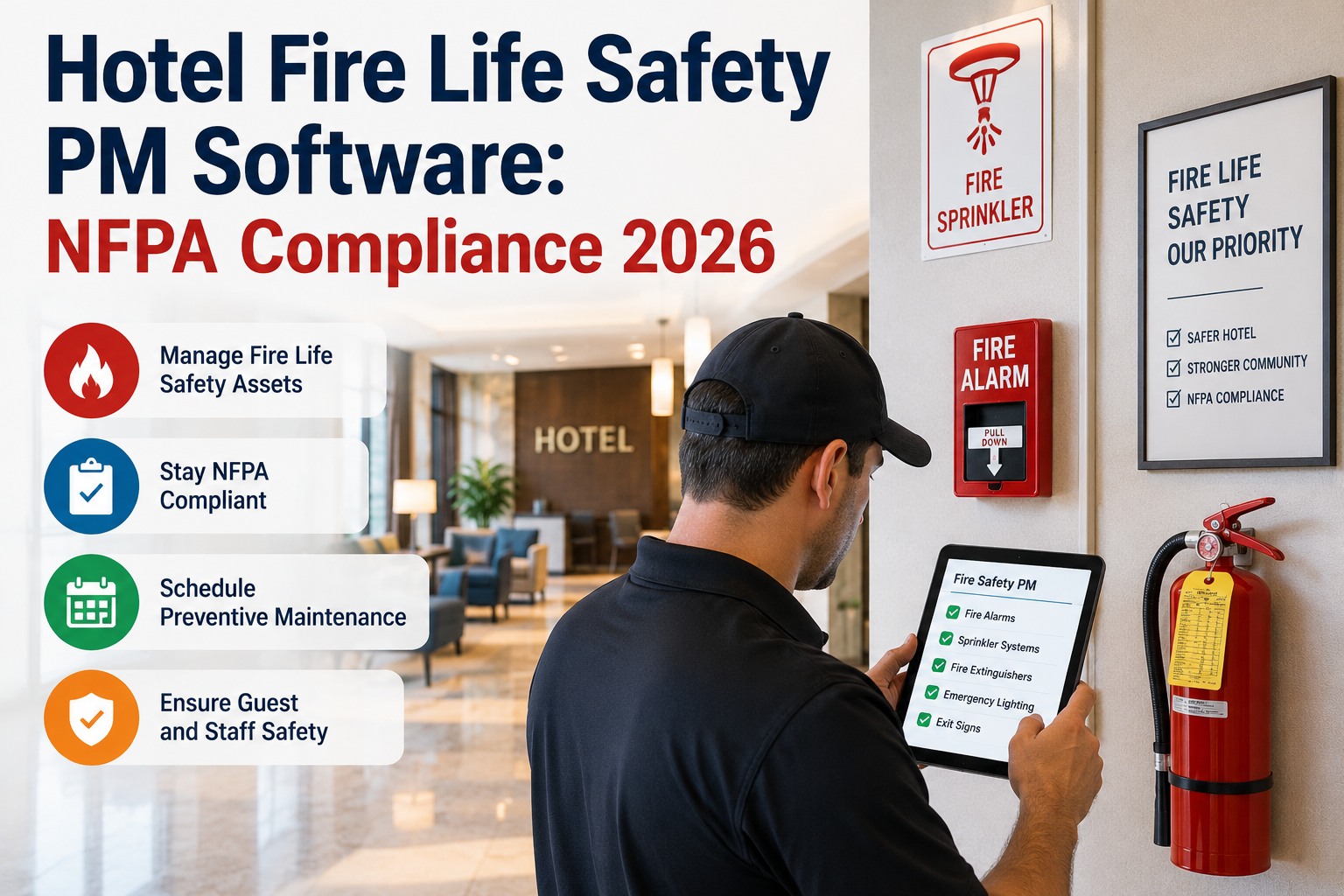
Hotel Fire Safety Maintenance Checklist for NFPA Compliance Life Safety Systems and Emergency Readiness
By Liam Neeson on March 24, 2026
An estimated 3,900 hotel and motel fires are reported to U.S. fire departments every year — causing 15 deaths, 150 injuries, and $76 million in property loss annually. The harder truth: most of these incidents are preventable. NFPA fire codes exist precisely because untested alarms, uninspected sprinklers, and blocked exits cost lives. Fire marshals do not distinguish between equipment that was never serviced and equipment that was serviced but never documented — both result in the same citation, the same fine, and the same liability exposure. Sign up free to schedule every NFPA inspection interval automatically, or book a demo to see how Oxmaint keeps your fire safety records audit-ready year-round.
Fire marshals cite documented-but-late inspections identically to inspections never performed. A sprinkler waterflow test completed 11 days past its 90-day interval is a violation — full stop.
3,900
Hotel fires reported to U.S. fire departments every year
$76M
Annual hotel fire property loss in the U.S.
$16,000+
Max OSHA penalty per serious fire safety violation
46%
Of hotel fires caused by cooking — the highest single source
NFPA Standards That Govern Hotel Fire Safety
Hotels are classified as assembly and residential occupancies under NFPA — which means multiple overlapping codes apply simultaneously. Understanding which standard governs each system is the first step to building a defensible compliance calendar. Book a demo to see how Oxmaint maps each of these standards to automatic inspection schedules for your property.
NFPA 72
Fire Alarm Systems
National Fire Alarm and Signaling Code. Governs fire alarm control panels, smoke detectors, heat detectors, manual pull stations, and notification appliances. Requires quarterly, semi-annual, and annual testing intervals.
NFPA 13 / 25
Sprinkler Systems
Installation and inspection standard for automatic sprinkler systems. NFPA 25 governs ongoing ITM — weekly gauge checks, quarterly waterflow tests, annual full inspections, and 5-year flow tests.
NFPA 10
Fire Extinguishers
Standard for portable fire extinguishers. Mandates monthly visual inspections, annual maintenance, and 6- or 12-year internal servicing. Every unit must be tracked as a documented asset.
NFPA 101
Life Safety Code
The master code for means of egress, fire doors, emergency lighting, exit signage, and evacuation systems. Annual inspections required. The 2024 edition expanded emergency action plan requirements.
NFPA 96
Kitchen Suppression
Ventilation control and fire protection for commercial cooking. Semi-annual hood suppression service and inspection required. Grease buildup blocking nozzles is among the most cited violations in hotels.
OSHA 1910
Employee Safety
29 CFR 1910.157 for portable extinguishers and 1910.165 for employee alarm systems. OSHA requires a documented emergency evacuation program for all hotel employees — guests included.
The Complete Hotel Fire Safety Maintenance Checklist
Inspection Frequency
MonthlyQuarterlySemi-AnnualAnnual5-Year
Fire Alarm Systems
NFPA 72 — Fire Alarm Control Panel, Detectors, Pull Stations, Notification
MonthlyQuarterlyAnnual
Inspect the Fire Alarm Control Panel (FACP) face for any active trouble, supervisory, or alarm signals — a silenced but unresolved trouble signal is a NFPA 72 violation at inspection. Photograph the display on every visit.
Monthly
Test supervisory signals quarterly and verify response at the FACP within the code-required timeframe. Document device address, location, and result for every test.
Quarterly
Test smoke detectors in elevator lobbies semi-annually per NFPA 72 Table requirements. Record device address and technician identity on each test record.
Semi-Annual
Physically activate each manual pull station annually per NFPA 72 Table 14.4.2.2. Stations that fail activation must be repaired and retested before the inspection record closes.
Annual
Conduct full-system annual test of all initiating devices and notification appliances. Every device must be individually documented — batch records without device-level data do not satisfy NFPA 72.
Annual
Most cited violation: FACP with silenced trouble signals unresolved at time of inspection.
Automatic Sprinkler Systems
NFPA 13 / NFPA 25 — The most complex record-keeping requirement of any hotel fire system
QuarterlyAnnual5-Year
Inspect wet-pipe system pressure gauges weekly — readings must be within acceptable range and consistent with normal system pressure. Log each reading with date and technician.
Weekly
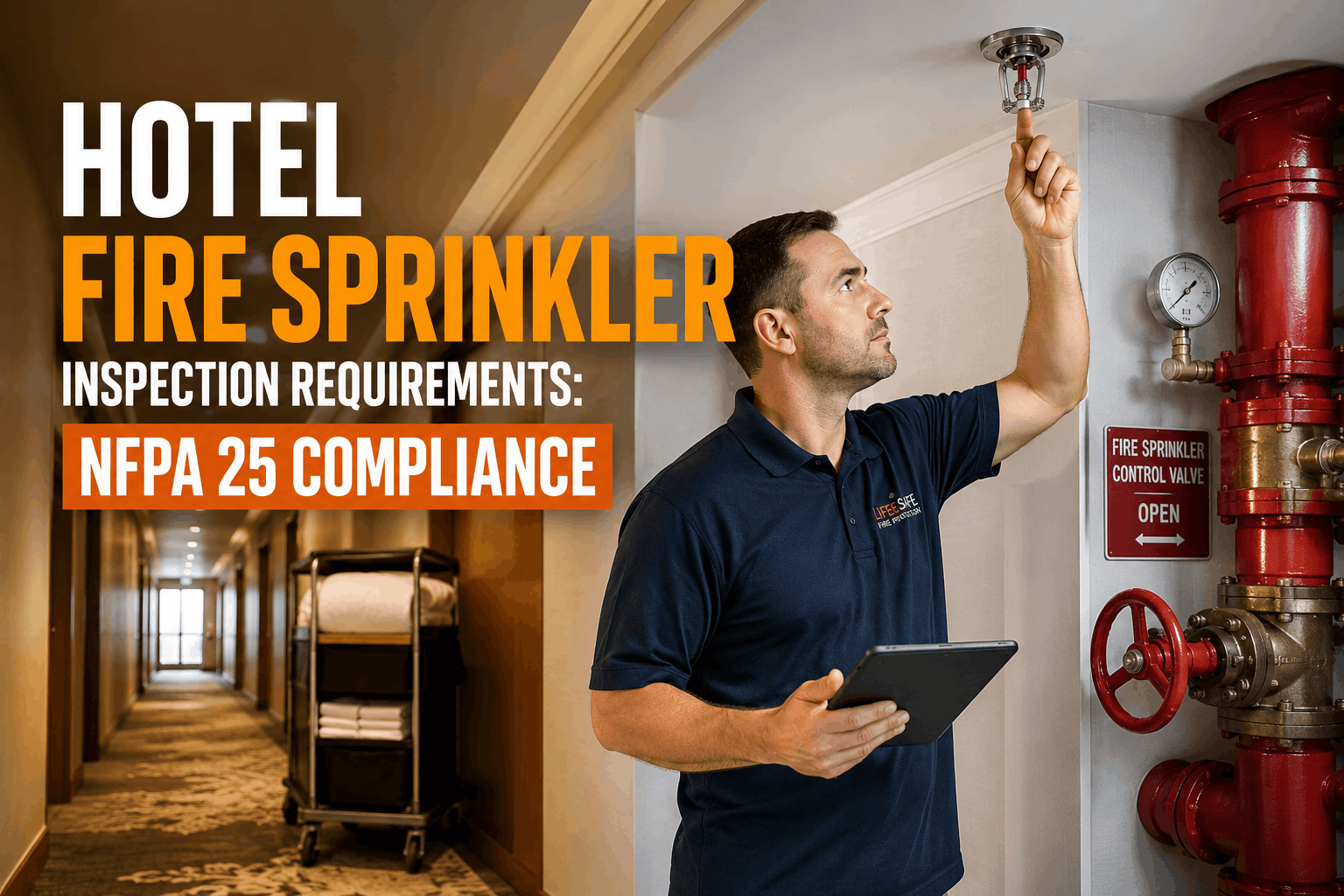
Inspect all OS&Y gate valves, post indicator valves, and butterfly valves quarterly — a control valve that is only partially open reduces discharge density in a fire event, a critical NFPA 25 deficiency.
Quarterly
Open the inspector's test valve on the most hydraulically remote branch line quarterly. Verify waterflow alarm signals at the FACP within 90 seconds of valve opening.
Quarterly
Visually inspect all sprinkler heads annually — confirm free from corrosion, paint overspray, loading, and mechanical damage. Verify 18-inch clearance below deflectors is maintained in all areas.
Annual
Verify spare sprinkler head cabinet is stocked with correct type and quantity of spare heads plus the installation wrench. An empty or incorrect spare cabinet is a citable NFPA 25 deficiency.
Annual
Conduct full internal pipe inspection and flow test every 5 years per NFPA 25 — records from this test are among the first documents requested during insurance audits and post-incident investigations.
5-Year
Most cited violation: Incomplete sprinkler records — most commonly found deficiency during hotel fire inspections.
Fire Extinguishers
NFPA 10 — Every unit is a tracked asset requiring individual documentation
MonthlyAnnual
Conduct monthly visual inspection of every extinguisher — verify unit is present, fully charged, pin intact, no visible corrosion or damage, and inspection tag current. Record findings per unit.
Monthly
Perform annual maintenance inspection by a certified technician — pressure test, internal component check, and recharge as required. Non-functional extinguishers at inspection constitute your first line of defense failure.
Annual
Assign every unit a unique identifier with location tag, installation date, and complete maintenance history. OSHA fines exceeding $16,000 per serious violation apply when extinguisher records are missing or incomplete.
Ongoing
Most cited violation: Missing or incomplete extinguisher inspection tags and unit-level maintenance records.
Inspect every corridor fire door and stairwell door — must self-close and latch fully from any open position. A propped-open fire door or disabled self-closer is a critical NFPA 101 violation requiring immediate corrective action.
Monthly
Inspect all egress corridors for clear width of minimum 44 inches — permanently stationed housekeeping carts or vending machines in egress corridors are NFPA 101 violations. Photograph all obstructions with location and date.
Monthly
Test emergency lighting monthly with a 30-second functional test. Conduct the annual 90-minute full battery drain test per NFPA 101 — battery degradation often passes the 30-second test for up to 18 months before failure becomes apparent.
Monthly + Annual
Verify all exit signs are illuminated 24/7, visible from any point in corridors, and located within required distances from exits. Walk every corridor and stairwell from a guest perspective — unfamiliar with the layout, in smoke-reduced visibility.
Monthly
Confirm evacuation maps are posted in every guest room and at elevator banks on every floor. After any renovation, remodel, or layout change, update all evacuation maps before the work area reopens.
Annual + Post-Renovation
Most cited violation: Emergency light battery failure found during annual 90-minute test — unit had been passing the 30-second monthly test as battery degraded slowly over 18 months.
Kitchen Suppression Systems
NFPA 96 — Cooking is the #1 cause of hotel fires at 46% of all incidents
Semi-Annual
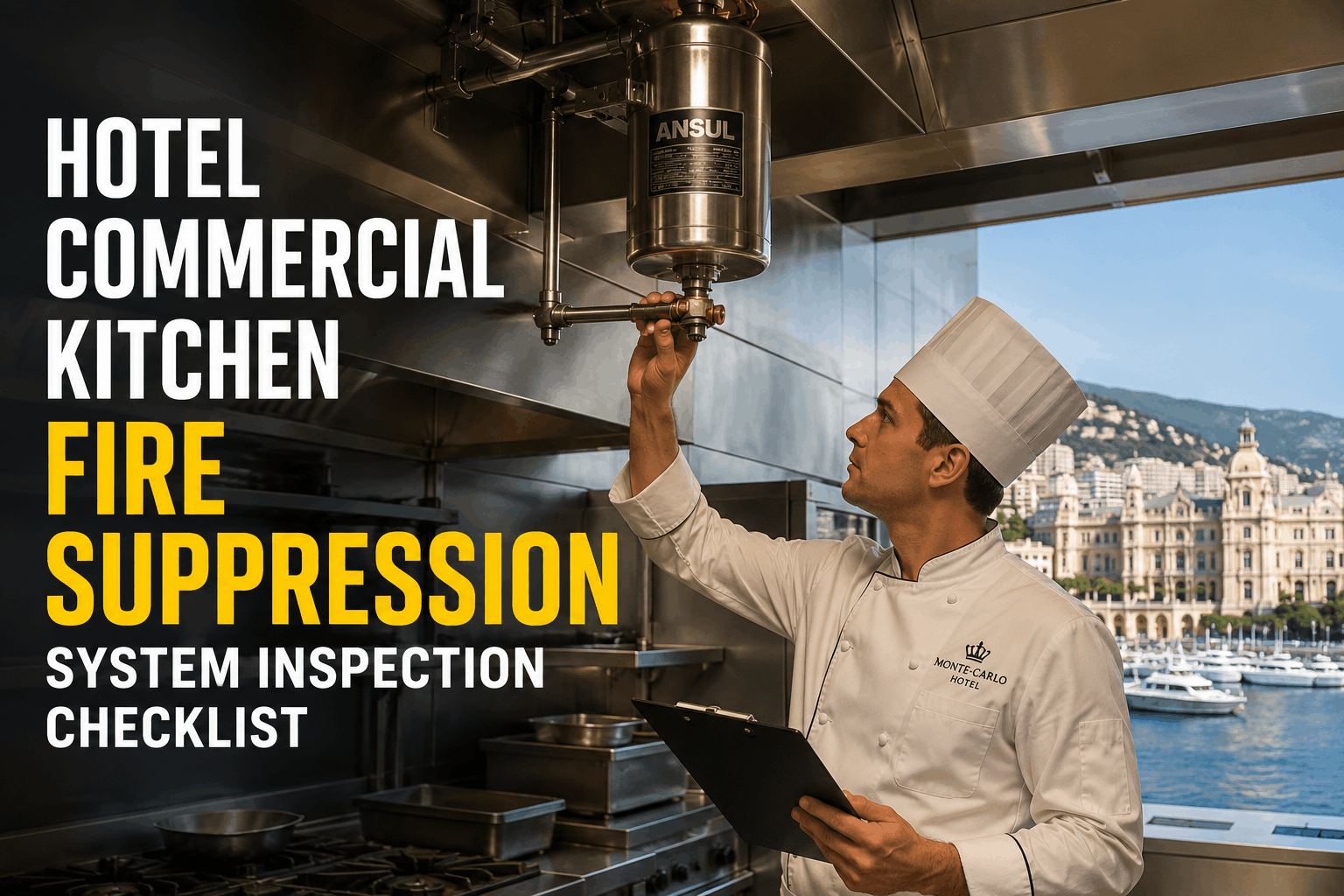
Have the kitchen hood suppression system inspected and serviced by a certified technician semi-annually per NFPA 96. Grease buildup blocking suppression nozzles is among the most cited violations in hotel food service areas.
Semi-Annual
Schedule regular hood duct cleanings — grease accumulation in ductwork is the primary accelerant in kitchen fires that extend beyond the hood area into the structure.
Semi-Annual
Verify that wet chemical suppression agent has not passed its service life and that fusible links are in place. Document suppression agent type, quantity, and service date on the system inspection tag.
Semi-Annual
Most cited violation: Greasy nozzle blockage and missing or expired semi-annual service documentation.
Never Miss an NFPA Inspection Interval Again
Oxmaint's Fire Safety Compliance Calendar schedules every monthly, quarterly, semi-annual, and annual interval automatically — with technician sign-off required before any inspection record closes. Book a demo to see audit-ready records in action.
OSHA maximum per serious fire safety violation. Fire code fines vary by jurisdiction — from hundreds to tens of thousands per citation.
License Suspension
Closure Risk
Authorities may issue orders requiring immediate compliance — including operational shutdown until deficiencies are corrected and re-inspected.
Insurance Exposure
Claims Denied
Insurers raise premiums or limit coverage for non-compliant properties. Documented violations make injury lawsuits nearly indefensible in court.
Brand Penalties
Franchise Risk
Properties operating under franchise agreements face additional corporate audits, penalties, and potential termination of the franchise agreement when cited for fire safety violations.
How Oxmaint Makes NFPA Compliance Automatic
01
Build Your Fire Safety Asset Registry
Register every fire safety asset — alarm panels, sprinkler zones, extinguisher units, emergency lights, fire doors, suppression systems — via QR scanning. Each asset carries its full inspection and maintenance history.
02
Activate the NFPA Compliance Calendar
Oxmaint maps every NFPA standard to its required interval — monthly, quarterly, semi-annual, and annual — and schedules inspections automatically. No missed intervals. No manual tracking.
03
Close Inspections with Digital Sign-Off
Technicians complete inspections on mobile — with photo capture, device-level result logging, and required sign-off before any record closes. Partial records cannot be marked complete.
04
Pull Any Audit Record Instantly
When a fire marshal arrives, your complete inspection history — timestamped, technician-attributed, and device-specific — is available on demand. No paper trails. No scrambled filing. No gaps.
Fire Safety Compliance CalendarInspection SchedulingAudit-Ready Records
Keep Your Hotel Compliant. Keep Your Guests Safe.
Automatic NFPA interval scheduling across all six fire systems
Device-level inspection records with required technician sign-off