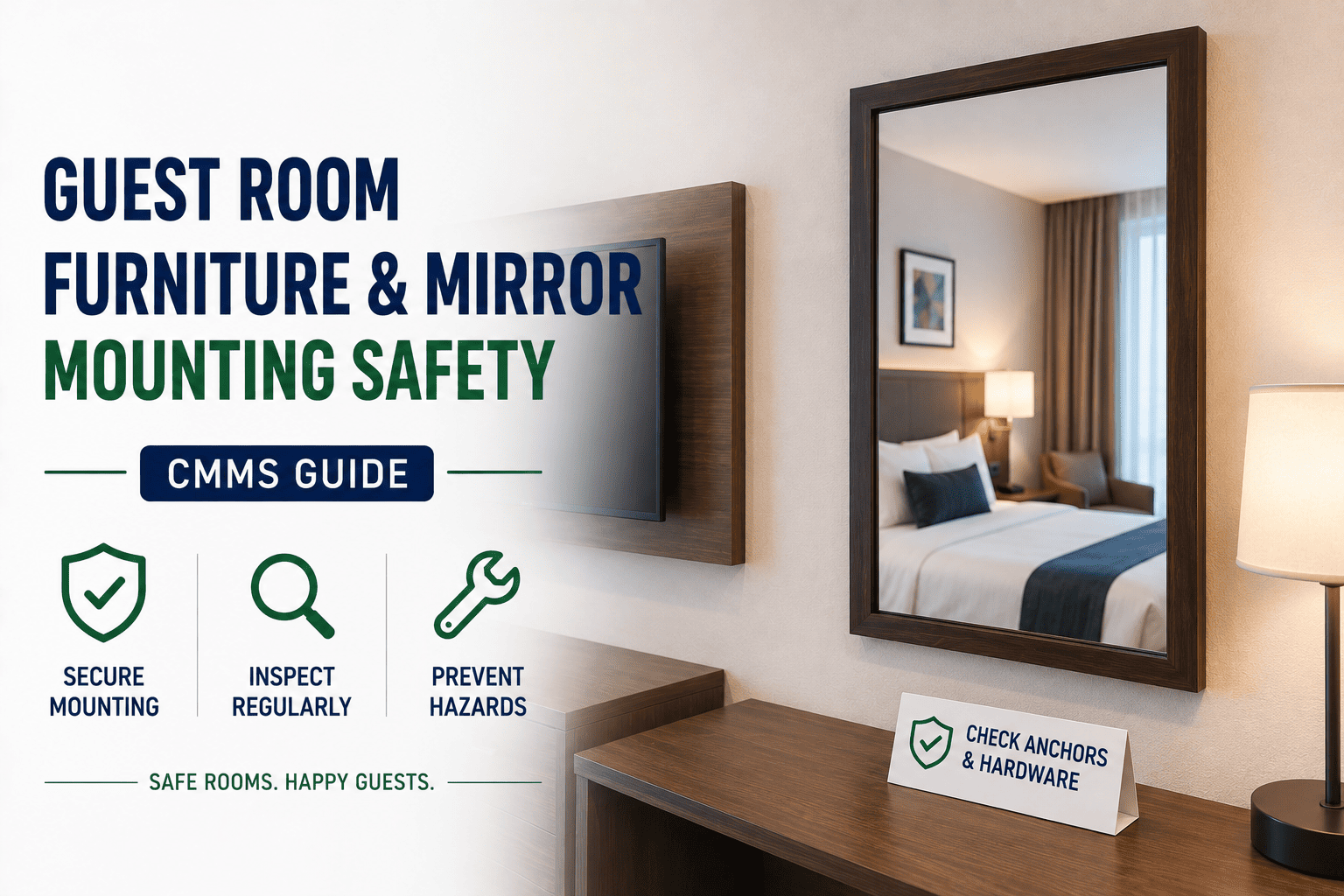
A falling headboard, an unanchored wardrobe, or a mirror that detaches at 2 a.m. is not a maintenance ticket — it is a liability event, an insurance claim, and in the worst case a guest-safety incident that ends up in litigation. Hospitality operators running 200+ rooms routinely carry six-figure FF&E risk exposure because wall anchors corrode, luggage rack joints loosen, and headboard cleats pull out of studs that were never properly located during the last renovation. This guide lays out a CMMS-driven furniture and mirror mounting safety program built around mounting hardware inspection, weight-rating verification, documented PM cadence, and photographic close-out — the same framework our teams use to Start Free Trial and convert ad-hoc room checks into a defensible, auditable cycle.
When a headboard falls, it isn't a work order — it's a lawsuit.
Furniture and mirror mounting failures are among the top five high-consequence guest room risks in hospitality. A documented CMMS inspection cycle — anchors, weight ratings, PM cadence, photographic close-out — is the difference between a closed claim and a seven-figure settlement.
Why furniture mounting is a Tier-1 liability, not a cosmetic check
Hospitality insurers now classify unanchored or degraded FF&E mounting as a "foreseeable hazard" — meaning a property that cannot produce inspection records is exposed to negligence per se arguments in court.
Worked example — a 240-room select-service property replaced its paper room-check sheet with a CMMS furniture safety cycle: quarterly mirror/headboard inspections, annual luggage rack load tests, and photo close-out on every work order. In year one it logged 17 mounting repairs before failure, zero guest incidents, and reduced its general liability premium by 8% at renewal because the broker could show 100% inspection compliance.
Four furniture-safety inspection streams every CMMS must run
Each stream has its own trigger, asset type, pass/fail criteria, and remediation SLA. Bundling them into a single "room check" is how things get missed — separating them is how a CMMS creates accountability.
Every wall-mounted mirror, framed art above 5 lb, and decorative glass panel gets a documented check: anchor type (molly, toggle, lag into stud), quantity of anchor points versus weight, substrate condition, and a 10-second lateral push test. CMMS mobile form captures pass/fail, photo, and technician ID. Failed mirrors are red-tagged and the room is blocked until re-mount with a rated security cleat.
Headboards are the single highest-incident FF&E item. Inspect cleat engagement, lag-bolt torque (target 25–30 in-lb into a stud, never drywall-only), and frame-to-wall gap. For wall-mounted nightstands and desks, verify French cleat security and confirm the rated load is not exceeded by guest items. Pull-test with a calibrated spring scale to 25% of rated load; log the reading.
Folded luggage racks hide fatigue in hinge rivets and strap stitching. Apply a 110 lb static load centered on the deck for 60 seconds, then inspect for permanent deflection, rivet walk-out, and strap tear. Replace any rack with >3mm permanent set. CMMS auto-generates the next test date and flags racks overdue for replacement based on cycle count.
Tall freestanding pieces (armoires, dressers over 30") require anti-tip bracket verification per ASTM F2057. Confirm bracket is anchored into a stud, strap is intact, and drawer-extension does not create a tip moment. For properties in seismic Zones 3 and 4, this stream also covers artwork security hangers and flexible-mount verification on all wall décor over 3 lb.
The 12-month furniture safety PM calendar
A defensible program spaces inspections so no mounting hardware goes more than 90 days unchecked and no load-bearing item goes more than 180 days. Here is the cadence a CMMS enforces automatically.
The mounting safety inspection matrix
A CMMS form is only as good as its fail criteria. These are the field-level thresholds technicians check against — every line item maps to a pass, a conditional pass, or an automatic room-block.
| Asset / Component | Inspection Point | Pass Criteria | Auto-Fail Trigger | CMMS Action |
|---|---|---|---|---|
| Wall-mounted mirror | Anchor quantity & type | ≥ 4 anchors; min 2 into stud or rated toggle | Drywall-only with plastic expansion | Block room · re-mount within 4 hrs |
| Mirror / glass | Lateral push test | Zero movement at 10 lb lateral force | Any visible deflection or rocking | Red-tag · engineer review |
| Upholstered headboard | Cleat & lag engagement | Cleat fully seated; lag torque 25–30 in-lb | Lag spins or pulls with hand pressure | Block room · same-day re-mount |
| Luggage rack | 110 lb static load, 60 s | No permanent deflection; rivets flush | >3 mm permanent set or rivet walk-out | Replace rack · scrap & log |
| Wall-mounted nightstand | French cleat + rated load | Cleat into ≥ 2 studs; load ≤ 35 lb | Cleat into drywall only | Block room · re-install |
| Armoire / tall dresser | Anti-tip bracket (ASTM F2057) | Bracket into stud; strap taut | Missing, loose, or drywall-only bracket | Block room · immediate repair |
| Artwork > 5 lb | Security hanger / seismic hook | Two-point security hanger; Zone 3+ uses seismic | Single nail or sawtooth hanger | Re-hang within 24 hrs |
| Wall-mounted TV (in-room) | Mount arm & lag verification | Full-motion arm rated ≥ 4× TV weight; lags into stud | Any lag into drywall; arm droop > 5° | Block room · AV + maintenance |
What an undocumented mounting failure actually costs
Operators under-estimate furniture-mounting risk because the line item "room inspection" buries the exposure. The real cost surfaces only when a claim hits — and by then the absence of CMMS records multiplies the payout.
Turn furniture safety from a clipboard into a defensible record.
Deploy a CMMS furniture & mirror mounting inspection cycle in days — not quarters. Mobile forms, photo close-out, auto-scheduled PM, and an audit-ready compliance report for your next insurance renewal.
Guest room furniture & mirror mounting safety — the questions operators ask
How often should mirrors and headboards be inspected in a hotel guest room?
Quarterly is the defensible standard for mirrors, headboards, and wall-mounted nightstands; semi-annual for luggage racks; annual for freestanding anti-tip verification. The cadence exists so no anchor goes more than 90 days unchecked — the window in which corrosion, vibration, and housekeeping impact most commonly loosen hardware. A CMMS auto-schedules each stream and escalates overdue rooms to the GM.
What weight rating should a guest room mirror mounting hold?
A wall-mounted mirror must be anchored to hold a minimum of 4× its own weight, with at least two anchor points engaging a wall stud or a rated toggle (never a plastic expansion sleeve in drywall alone). For mirrors over 30 lb, use a security cleat rated for the full load. The CMMS form should capture anchor type, count, stud engagement, and a photo — that record is what an adjuster will ask for. You can Start Free Trial to deploy the form library today.
Can a CMMS really reduce my general liability premium?
Yes — brokers report 8–12% credits at renewal when a property can show 100% inspection compliance with photo close-out and a documented remediation SLA. The credit is largest for properties that previously had no FF&E safety records at all, because the carrier's exposure to negligence-per-se arguments drops sharply once a defensible cycle exists.
What happens if a technician fails an item during a room inspection?
The CMMS should auto-block the room from the front desk, generate a high-priority work order with the photo and fail reason attached, and notify the maintenance supervisor. Critical fails (drywall-only mirror, missing anti-tip bracket) trigger a same-day re-mount SLA; non-critical fails (corroded but functional anchor) get a 72-hour window. No room returns to inventory until a pass is logged.
How long does it take to roll out a furniture safety CMMS program?
A 200-room property can go live in 5–7 business days: day 1–2 form configuration, day 3–4 technician training on the mobile app, day 5–7 a full-property baseline inspection. The first cycle is the slowest because it surfaces every legacy mounting defect at once — subsequent quarterly cycles average 7 minutes per room. Book a walkthrough via Book a Demo to see the deployment plan for your property.
Stop inspecting furniture on a clipboard. Start documenting it on a CMMS.
Every room. Every anchor. Every quarter. Photo-verified, audit-ready, and automatically scheduled — the way guest room safety should have always been run.
Free 14-day trial · No credit card