An MRI scanner holds liquid helium at −269°C and books patients weeks in advance which is why every day of downtime costs a disproportionate share of hospital revenue. An uncontrolled magnet quench alone runs $30,000–$80,000 in helium refill plus weeks offline. This guide is a practical MRI maintenance plan — the six subsystems that fail, the PM cadence that catches drift, and the predictive signals to watch. Every schedule, checklist & alert runs in OXMAINT AI, the CMMS software built for medical imaging.
Medical Imaging · MRI PM & Predictive · Healthcare CMMS · 2026
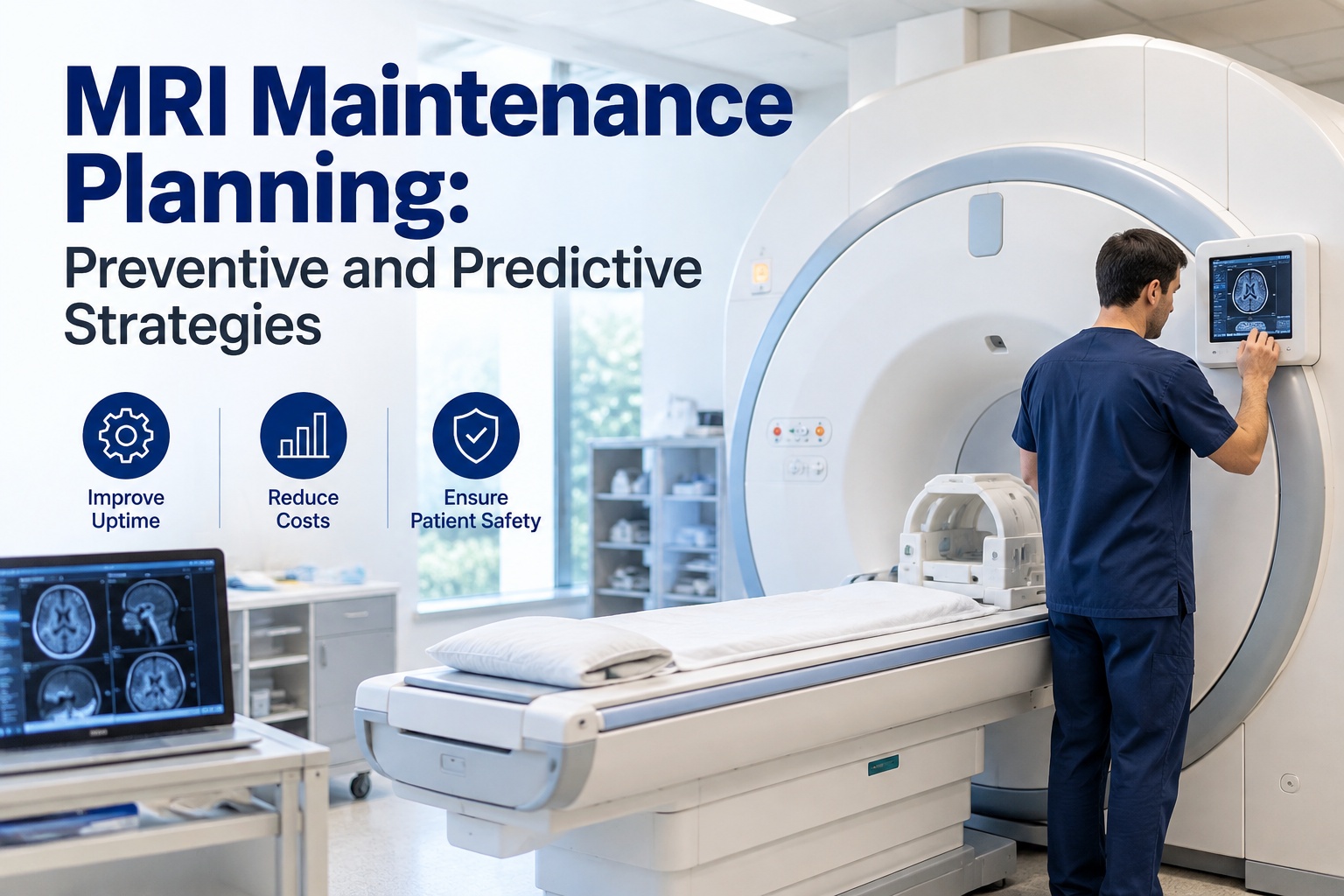
MRI Maintenance Planning: Preventive and Predictive Strategies
Keep your MRI scanner running at OEM spec — with a subsystem-by-subsystem PM cadence, cryogen & cold-head monitoring, and predictive alerts that catch quench-risk weeks in advance. OXMAINT AI, an AI-powered CMMS, turns every reading, inspection and defect into a tracked work order & audit-ready record.
−269 °C
temperature of liquid helium in the magnet
$30K–$80K
direct cost of an uncontrolled quench event
37%
of hospital revenue derived from imaging
$180K / yr
avg. reactive-maintenance loss per radiology dept
Why MRI Maintenance Is a Different Discipline
An MRI is not another hospital asset. It's a superconducting magnet in a Faraday cage running a helium refrigeration cycle in a room the ferromagnetic detection system won't let a metal clipboard into. Its failure modes are unique, its OEM protocols non-negotiable, and its downtime cost measured in tens of thousands of dollars per day. A generic PM template won't hold. Start free and build a proper MRI-specific PM cadence in OXMAINT AI.
Cryogenic Magnet
Liquid helium at −269°C keeps the magnet superconducting. Lose control of helium level or boil-off rate and you risk a quench.
Field Homogeneity
Shim performance drifts silently. Sub-spec homogeneity means degraded image quality & risk of accreditation findings.
RF Environment
The Faraday cage & RF coils must stay intact. Any breach introduces artifacts & forces costly troubleshooting.
Regulatory Weight
TJC, DNV GL, HFAP & ACR require documented PM & QC. An unsigned WO is an open audit finding.
The 6 Subsystems That Actually Fail
MRI maintenance is easiest to think about as six distinct subsystems — each with its own failure mode, cadence and OEM protocol. Miss any one and the rest can't compensate. Here's the anatomy of what you're actually maintaining. Book a demo to see all 6 subsystems mapped in OXMAINT AI.
01
Cryogen & Magnet System
Liquid helium reservoir, superconducting coils, pressure & level sensors. The single most consequential subsystem — a quench here is the $30K–$80K event.
Failure signal: Helium level drift, rising boil-off rate, pressure anomalies
02
Cold Head & Compressor
Re-liquefies helium vapor to keep boil-off zero. Requires routine oil tests, absorber replacements & scheduled service by hour count.
Failure signal: Rising cold-head temperature, compressor vibration, service-hour approaching limit
03
Gradient Coils & Amplifiers
The workhorse of image formation. Heat, acoustic-noise changes & performance drops signal failure that worsens fast without intervention.
Failure signal: Elevated coil temp, amplifier fault codes, acoustic signature change
04
RF Coils & Faraday Cage
Surface & body coils degrade with use — cracked lenses, bent pins, connector damage. Faraday cage breaches introduce image artifacts.
Failure signal: SNR degradation, visible coil damage, cage door seal wear
05
Chiller & Cooling Loop
The room-side water/glycol loop that pulls heat off the compressor. A silent failure here cascades straight into a helium boil-off event.
Failure signal: Flow rate drop, coolant temperature rise, chiller-fault log entries
06
Safety & Quench Path
Quench pipe, ferromagnetic detection, emergency stop chain, magnet-room signage. Not "maintenance" in the usual sense — but non-negotiable safety.
Failure signal: Quench pipe blockage, FMD sensor fault, missing safety signage
The PM Cadence — Daily, Weekly, Monthly, Quarterly, Annual
MRI PM is layered — some tasks run every morning before first patient, others quarterly with a vendor engineer, others annually with a medical physicist. OXMAINT AI enforces each cadence with the right task template, the right skill requirement, and the right OEM reference. Here's the layered schedule. Sign up free and load the MRI PM template on your scanner.
Preventive Alone Isn't Enough — Predictive Catches What PM Misses.
Even at 100% PM compliance, an MRI can drift toward failure between visits. Predictive maintenance closes that gap — continuous monitoring of helium pressure, cold-head temperature, chiller flow & RF performance to catch degradation weeks before it becomes a quench. OXMAINT AI ingests every reading, sets alert thresholds per subsystem, and turns any excursion into a routed work order.
The Predictive Signal Watchlist
Predictive maintenance on an MRI isn't a black-box AI model — it's a disciplined watchlist of physical signals with clear thresholds. Each one has an early-warning band and a red-alert band. OXMAINT AI monitors them continuously against those thresholds & fires a WO the moment one crosses. Book a demo to see the watchlist alert in OXMAINT AI.
The Quench-Prevention Protocol
Every MRI maintenance program should treat quench prevention as its highest-priority workflow. Not because quenches are common — they aren't — but because a single one wipes out weeks of revenue and tens of thousands of dollars in helium alone. Here's the 5-step protocol OXMAINT AI enforces on every scanner. Sign up free and enforce the protocol on your fleet.
1
Daily helium read → OXMAINT AI
Lead tech logs the reading each morning. Trend is auto-plotted; anomalies are flagged before the shift starts.
2
60% threshold → Refill planned
OXMAINT AI opens a scheduled refill WO with vendor contact & target date the moment the reading crosses 60%.
3
55% threshold → Refill firmly scheduled
Refill must be on the calendar with confirmed vendor slot. Below this level, boil-off rises non-linearly.
4
Cold-head service tracked by hour
Runtime-hour PM in OXMAINT AI, not calendar-only. Absorber & cold-head service fires at OEM hour count regardless of date.
5
Quench pipe inspection quarterly
External termination checked for blockage, bird nesting & water intrusion. Photographed & logged in OXMAINT AI.
Compliance & Audit Trail — What Inspectors Actually Ask For
TJC, DNV GL, HFAP & ACR audits all want the same thing: proof the PM ran, on schedule, by a qualified technician, with the finding & disposition documented. A WO marked complete with no signature, timestamp or photo evidence is an open finding regardless of whether the task was physically done. OXMAINT AI enforces the audit trail at closure. Book a demo to see the audit trail on a live WO.
✓
Timestamped WO created against the correct asset record
✓
Assigned technician with documented qualification for the task
✓
Signed & time-stamped completion — not backdated
✓
Photo evidence & readings captured on the OXMAINT AI mobile app
✓
Findings, disposition & follow-up WOs linked in one record
✓
Immutable audit trail — one-click export for TJC / DNV / HFAP / ACR
What OXMAINT AI Gives a Radiology Biomed Team
OXMAINT AI is built for medical imaging — MRI cryogen logs, CT tube heat unit tracking, RF coil QC, ACR-aligned checklists — not adapted from generic asset management. Here's what a radiology biomed & engineering team gets on day one. Sign up free and go live on your first scanner in days.
MRI-Specific PM Templates
Daily, weekly, monthly, quarterly & annual cadences pre-built for cryogen, cold head, gradient, RF, chiller & safety subsystems.
Cryogen Log & Alerts
Helium level, boil-off & cold-head trends charted live. 60% and 55% thresholds auto-trigger refill WOs with vendor contact.
Predictive Watchlist
Seven high-consequence signals monitored continuously against OEM bands — any excursion becomes a routed WO before the shift ends.
Mobile QC Capture
Technologists complete phantom QC & RF coil checklists on the OXMAINT AI mobile app — photo evidence, timestamped, signed.
TJC / DNV / ACR Audit Trail
Every PM, QC & corrective WO on an immutable record — one-click export for inspection or accreditation.
Multi-Modality Support
Separate templates for MRI, CT, X-ray & ultrasound — CT tube heat units, X-ray calibration, transducer QC all in one platform.
"
We had our first near-quench about three years back. Helium was in the low 50s, the cold head was drifting warm, and the log book had a Post-it note about scheduling a refill "sometime soon." We got lucky. When we moved onto OXMAINT AI, the first thing we did was set the 60% and 55% thresholds & connect the daily reading as a required WO closure. Nine months later we've had two refills — both scheduled two weeks in advance, both completed without impacting a single patient scan. The predictive watchlist has also flagged two rising cold-head temperatures that turned into planned service calls instead of after-hours emergencies. It's not that the platform is complicated — it's that the discipline is now enforced.
Director of Biomedical Engineering · Multi-Site Radiology Group
Frequently Asked Questions
How often does an MRI need preventive maintenance?
Multiple cadences run in parallel. Daily QC by the lead technologist (helium level, cold-head temp, phantom scan), monthly biomed checks (compressor oil, coolant logs), quarterly OEM service (cold-head absorber, quench pipe inspection), and an annual medical physicist survey for ACR-aligned accreditation. OXMAINT AI runs all five schedules simultaneously per scanner.
What is an MRI quench and how do we prevent one?
A quench is the sudden loss of superconductivity in the MRI magnet, causing rapid uncontrolled boil-off of liquid helium. Direct cost is typically $30,000–$80,000 in helium refill plus days-to-weeks of downtime. Prevention is disciplined: daily helium reading, refill planned at 60%, firmly scheduled at 55%, and cold-head service on runtime hours — the 5-step protocol OXMAINT AI enforces.
What's the difference between preventive and predictive MRI maintenance?
Preventive is calendar- or hour-triggered — a task runs because it's due. Predictive is signal-triggered — a task runs because a monitored parameter (helium trend, cold-head temp, RF SNR, chiller flow) has drifted toward failure. Modern MRI programs run both: preventive as the baseline, predictive as the gap-closer between PM visits.
Can OXMAINT AI handle other imaging modalities besides MRI?
Yes — CT (tube heat unit tracking, dose calibration), X-ray (kVp/mA output verification, dose meter checks), ultrasound (transducer dead-element counts, probe QC) all have dedicated templates. One platform for the whole radiology fleet.
How fast can OXMAINT AI be deployed for MRI maintenance?
Most biomedical & radiology engineering teams are live in 5–10 business days — import the imaging fleet, load the MRI-specific PM templates, connect cryogen readings, and start generating tracked PMs & predictive alerts from day one.
Zero Quench Days. Every PM On Record.
Run your MRI on a real preventive + predictive plan — subsystem PMs, cryogen thresholds, predictive watchlist, quench-prevention protocol & audit-ready records — all on OXMAINT AI.


.png)

-(1).jpg)
.jpg)