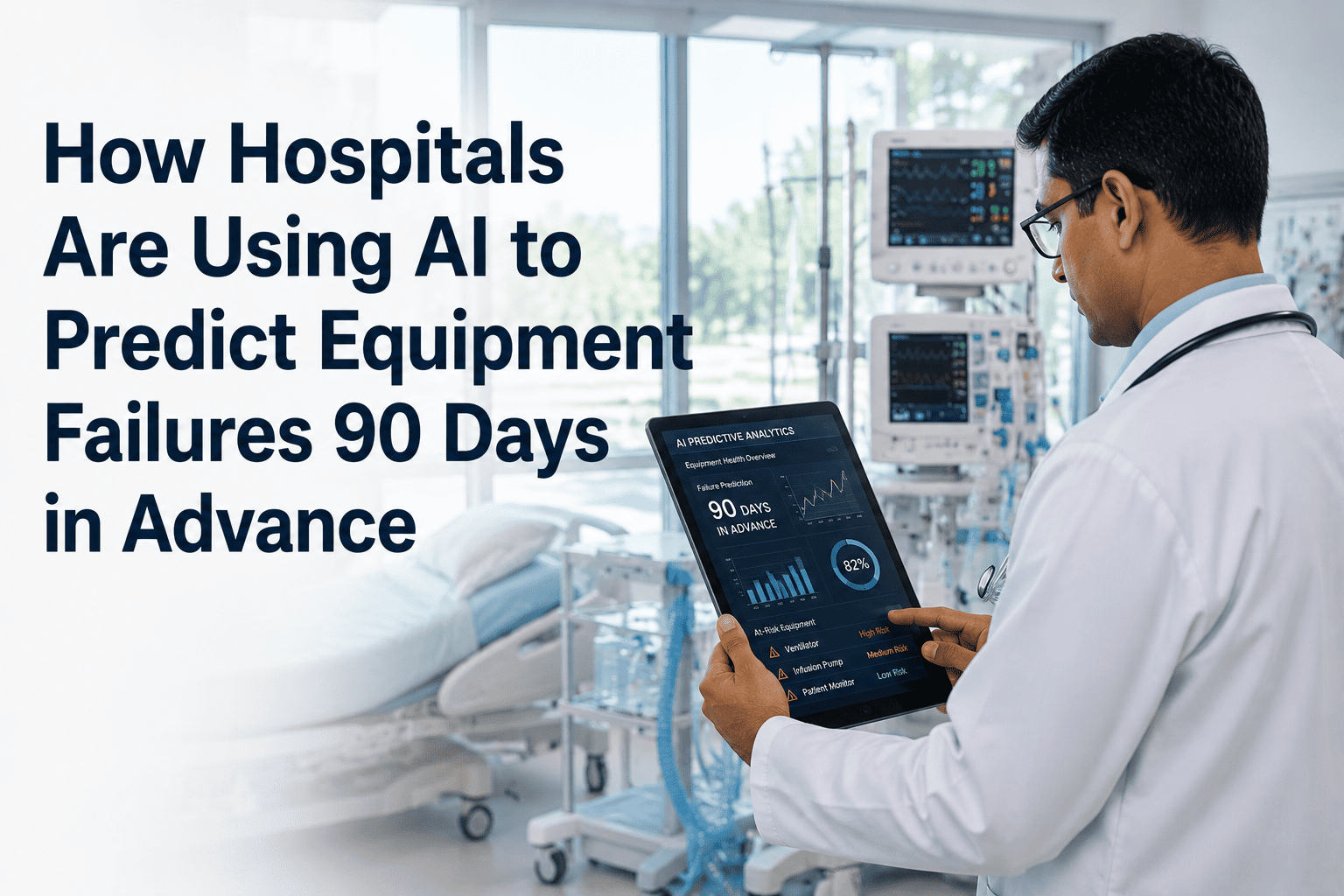
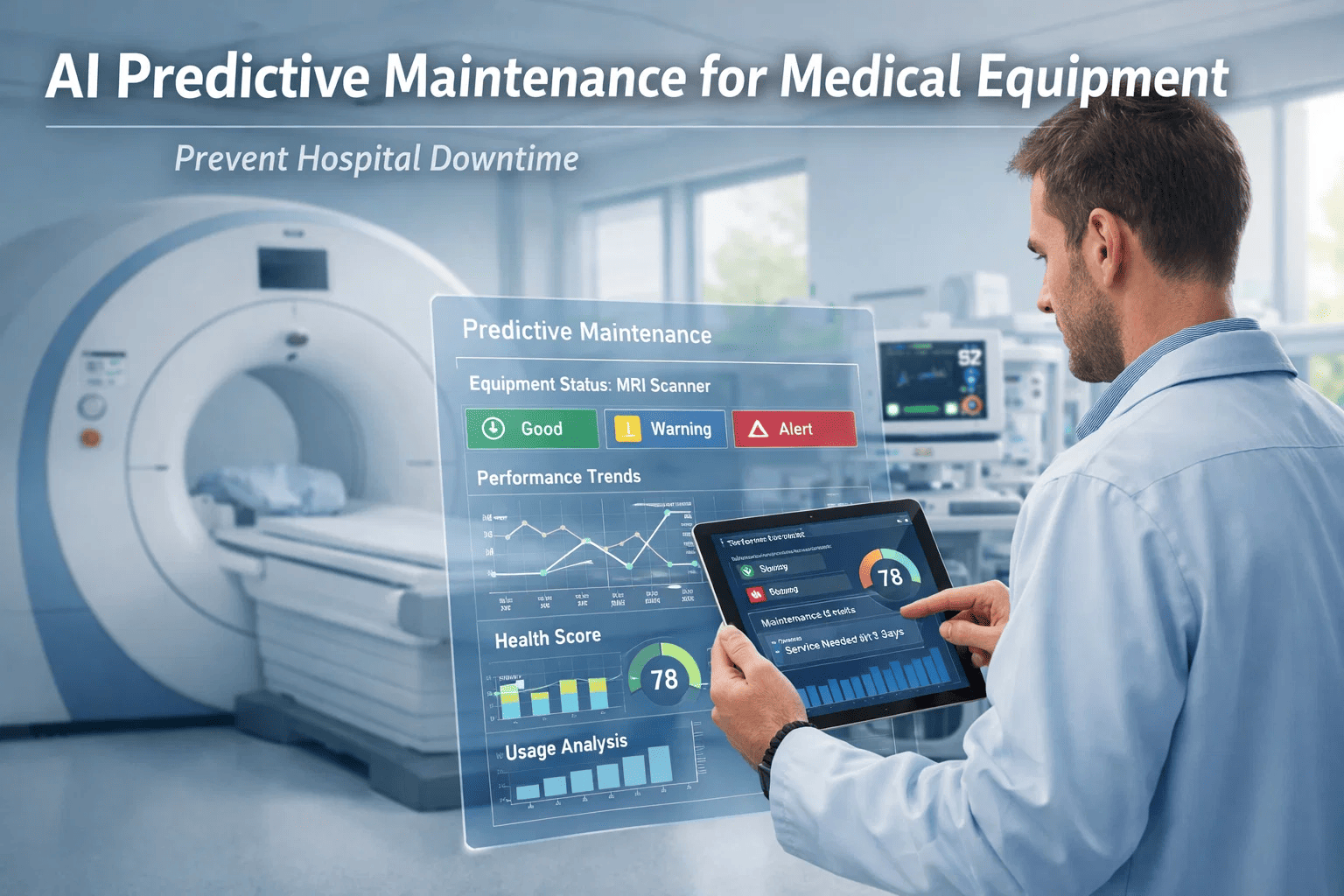
Hospital equipment failures do not announce themselves in advance — they surface at the worst possible moment, mid-procedure, during peak census, when the engineering team is two staff short. Predictive maintenance in healthcare changes that dynamic entirely by using AI, sensor data, and condition scoring to identify degradation before it becomes a failure event. This guide breaks down exactly how it works, what it costs you to ignore it, and how leading health systems are deploying it now. Ready to move from reactive to proactive — start a free trial for 30 days and book a demo to walk through the platform with your team.
$1.5M+
Annual unplanned downtime cost for a mid-size hospital
48–72h
Average early warning lead time with AI sensor monitoring
36%
Of equipment failures are preventable with scheduled maintenance
4.8x
Emergency repairs cost more than planned maintenance
What Is Predictive Maintenance in Healthcare?
Predictive maintenance in healthcare is a data-driven strategy that uses AI analytics, IoT sensors, and real-time condition scoring to detect equipment degradation before it causes failure. Unlike scheduled preventive maintenance — which runs on fixed calendar intervals — predictive maintenance triggers interventions based on actual equipment behavior: vibration patterns, temperature drift, cycle anomalies, and performance deviation from baseline. In a hospital environment where imaging equipment, HVAC, sterile processing systems, and life-safety assets run 24/7 under regulatory scrutiny, this is the difference between a controlled service window and an unplanned shutdown. If your team is still operating on time-based PM alone, start a free trial to see what condition-based monitoring looks like in practice, or book a demo and we will map it to your specific asset portfolio.
Core Components of a Healthcare Predictive Maintenance System
IoT Sensor Integration
Real-time monitoring of vibration, temperature, pressure, and runtime data from clinical equipment, HVAC, and building systems — feeding into a central analytics layer
AI Anomaly Detection
Machine learning models trained on equipment baselines that flag deviations 48–72 hours before they escalate into failure events — with severity scoring and prioritization
Condition-Based Work Orders
Maintenance interventions triggered automatically by condition thresholds — not calendar dates — ensuring technicians are dispatched exactly when needed, not before or after
Asset Lifecycle Forecasting
Rolling CapEx projections driven by real condition scores and degradation rates — giving CFOs and directors data-backed replacement timelines instead of age-based guesses
Why Traditional Maintenance Fails Healthcare Facilities
Healthcare facilities carry one of the most complex asset portfolios of any industry. Calendar-based PM works until it does not — and in a hospital, "does not" means clinical disruption, regulatory exposure, and budget overruns that compound year over year.
Imaging Equipment
MRI Downtime Costs $86,620 Per Day
A single unplanned MRI failure triggers patient cancellations, diversion to competing facilities, and scheduling backlogs that take weeks to clear. Calendar PM cannot predict the coil failure that causes it.
HVAC and Sterile Zones
HVAC Failures Compromise Sterile Environments
Pressure differential drops in OR suites and negative pressure isolation rooms are not visible until the system fails. By then, infection control protocols are already breached and a Joint Commission citation is in progress.
Reactive Cost Spiral
Emergency Repair Premium Runs 60–80% Higher
After-hours OEM callouts, expedited parts procurement, and emergency labor rates turn a $2,000 scheduled repair into a $9,000 reactive incident — with no budget line prepared to absorb it.
Compliance Gaps
Audit Exposure From Incomplete PM Records
Joint Commission Environment of Care standards require documented evidence of PM completion for every regulated asset. Paper logs and disconnected spreadsheets produce gaps that trigger citations and corrective action plans.
No Early Warning
Failures Discovered After the Fact
Without sensor-based condition monitoring, facilities teams learn about equipment degradation when it fails — not 48 to 72 hours before, when a targeted intervention would cost a fraction of the emergency repair.
CapEx Guesswork
Capital Budgets Built on Vendor Estimates
Without condition-based lifecycle data, CFOs rely on OEM age guidelines and gut-feel assumptions for replacement timing. Equipment that should last 15 years gets replaced at 10 — or runs to catastrophic failure at 12.
Siloed Data
No Portfolio Visibility Across Sites
Health systems managing 5 or 30 facilities have no standardized view of asset performance, PM compliance rates, or maintenance spend across the network. Every site operates on its own disconnected system.
Technician Inefficiency
Paper Workflows Burn 20–30% of Shift Time
Technicians spending a third of their shift on manual data entry, paper logs, and asset history hunting are technicians not maintaining equipment. Mobile-first execution eliminates this drag on every work order.
How AI-Powered Predictive Maintenance Works — Step by Step
Oxmaint is built for healthcare operational complexity — not adapted from a generic work order system. The platform layers IoT sensor data, AI condition scoring, and automated PM triggers into a single operational view. See it mapped to your environment — start a free trial for 30 days at no cost, or book a demo with our healthcare operations team.
Step 01 — Data Collection
Continuous Sensor Monitoring Across All Assets
IoT sensors on clinical equipment, HVAC, electrical, and building systems stream real-time data — temperature, vibration, pressure, runtime hours, cycle counts — into a central analytics layer 24 hours a day.
Step 02 — AI Analysis
Anomaly Detection Against Equipment Baselines
AI models trained on each asset's performance baseline flag deviations before they reach failure thresholds. Severity is scored and prioritized automatically — not every alert is critical, and the system knows the difference.
Step 03 — Alert Generation
48–72 Hour Early Warning Before Critical Failure
When condition scores drop below threshold, maintenance alerts are triggered with enough lead time to schedule a controlled intervention — before the failure event, not after. Average lead time: 48 to 72 hours.
Step 04 — Work Order Dispatch
Condition-Based Work Orders Sent to Mobile
Technicians receive condition-triggered work orders on mobile with full asset history, recommended actions, and parts requirements. No manual dispatch, no paper trail, no data entry lag between field and system.
Step 05 — Documentation
Audit-Ready Records Generated Automatically
Every intervention captures technician identity, timestamps, parts used, and resolution notes with digital signatures. Joint Commission documentation is built from work order data — no manual compilation before a survey.
Step 06 — CapEx Forecasting
Live Condition Data Drives Multi-Year Capital Planning
Asset condition scores feed directly into rolling 5 to 10 year CapEx replacement forecasts. CFOs and directors get capital planning data grounded in real equipment health — not vendor guidelines or age-based rules of thumb.
Step 07 — Portfolio View
Multi-Site Reporting for Health System Leaders
Health systems across 3 to 30 or more facilities get a single dashboard comparing asset performance, PM compliance, and maintenance spend by site — investor-grade reporting built in from the start.
Step 08 — Continuous Learning
Models Improve With Each Asset Cycle
Every completed maintenance event adds to the dataset. AI models recalibrate baselines, refine alert thresholds, and improve prediction accuracy over time — so the platform becomes more precise the longer it runs.
Reactive vs. Predictive: The Financial Reality in Healthcare
The cost difference between reactive and predictive maintenance in healthcare is not marginal — it is structural. Every dollar invested in AI-driven condition monitoring returns between $3 and $5 in avoided emergency costs, extended asset life, and compliance protection.
See How Oxmaint Transforms Healthcare Maintenance Operations
Oxmaint gives hospital operations and facilities teams the infrastructure to move from reactive chaos to AI-driven predictive maintenance — with real-time condition tracking, automated alert-based work orders, compliance documentation, and multi-year CapEx forecasting built in. No heavy implementation. Operational in weeks, not months.
ROI and Performance Benchmarks
Healthcare facilities using AI-powered predictive maintenance consistently report measurable improvements within the first 6 to 12 months. These benchmarks reflect outcomes from facilities that moved from calendar-based PM to condition-based asset management.
34%
Reduction in unplanned equipment failures
Within 12 months of AI-driven PM program implementation
$420K
Average annual downtime savings per facility
Combined revenue recovery and avoided emergency repair spend
27%
Longer average asset lifespan with condition-based PM
Delays CapEx replacement cycles by 3–5 years on average
3.2x
Average ROI on predictive maintenance investment
Industry average across acute care hospital portfolios
What to Look for When Evaluating Predictive Maintenance Software
Not every CMMS delivers true predictive capability. Most general-purpose work order tools lack the sensor integration, AI analytics, and clinical equipment context that hospital operations require. Use this framework to evaluate platforms — then start a free trial to put Oxmaint against your checklist, or book a demo and we will walk through every requirement with your team.
01
Real-Time IoT and SCADA Integration
Sensor data must feed directly into maintenance triggers — connecting clinical equipment monitors, BMS systems, and SCADA data into one operational view. Polling-based approaches introduce dangerous lag.
02
Condition Scoring, Not Just Work Orders
Can you see a real-time condition score for every asset — or just a list of open tickets? Condition scoring is what separates true predictive maintenance from reactive work order logging with a sensor bolt-on.
03
Joint Commission Compliance Readiness
The platform must generate audit-ready PM documentation with digital signatures, timestamps, and complete service history automatically — not require someone to compile reports the week before a survey.
04
CapEx Forecasting From Asset Data
Rolling 5 to 10 year replacement forecasting should be built in and driven by live condition scores — not a separate annual spreadsheet exercise disconnected from actual equipment behavior.
05
Multi-Site Portfolio Capability
If you manage more than one facility, the platform must aggregate asset performance, PM compliance rates, and maintenance spend at portfolio level — not force manual cross-site data compilation.
06
Mobile-First Field Execution
Technicians need to receive, execute, and close condition-triggered work orders on mobile — with photo documentation, inspection checklists, and parts logging. Paper-dependent workflows cannot scale in a hospital environment.
07
Fast Deployment — No Heavy Implementation
Healthcare facilities cannot absorb a 6 to 12 month implementation before seeing value. The right platform connects to existing BMS and clinical equipment data and is operational in weeks without a dedicated IT project.
08
Spare Parts and MRO Integration
Integrated inventory management closes the loop between condition-triggered alerts and parts procurement — eliminating emergency parts orders that inflate repair costs by 60 to 80 percent over planned procurement.
Frequently Asked Questions
What is predictive maintenance in healthcare and how is it different from preventive maintenance?
Preventive maintenance runs on fixed schedules — replace a filter every 90 days, calibrate a device every 6 months — regardless of actual equipment condition. Predictive maintenance uses AI analytics and IoT sensor data to monitor equipment condition in real time and trigger interventions only when degradation is detected. In healthcare, this distinction matters significantly. Calendar-based PM can under-maintain a high-utilization imaging system running double the expected cycles, and over-maintain lower-utilization assets. Predictive systems catch failures 48 to 72 hours before they occur — not on an arbitrary schedule — which is why hospitals using condition-based monitoring report 34 percent fewer unplanned failures within the first 12 months of implementation.
Which hospital equipment benefits most from AI predictive maintenance?
High-value, high-utilization assets with measurable operating parameters benefit most — specifically MRI and CT systems, where a single day of unplanned downtime costs $86,620 in lost revenue; surgical HVAC and OR pressure differential systems, where failure triggers sterile field compromise; sterile processing equipment including autoclaves and washer-disinfectors; chiller and cooling tower systems serving data centers and imaging suites; and emergency power infrastructure including ATS panels and generator sets. Any asset that generates real-time data through onboard sensors or BMS integration is a candidate for condition-based monitoring. Oxmaint supports the full asset hierarchy — from individual components up to portfolio-level reporting — so predictive capability scales across the entire physical plant.
How does AI predictive maintenance support Joint Commission compliance?
Joint Commission Environment of Care and Life Safety standards require documented evidence of scheduled PM completion for all regulated assets. A predictive maintenance platform enhances compliance in two ways: first, it captures every condition-triggered intervention automatically — with technician identity, timestamps, parts used, and digital signatures — creating an always-current audit trail. Second, because alerts fire based on actual equipment condition, high-utilization assets receive service when they need it rather than when a calendar says so, which closes PM gaps that arise when fixed schedules drift out of sync with real operating cycles. Facilities with complete digital maintenance records report significantly fewer Environment of Care findings and can respond to surveyor requests in minutes. Oxmaint generates GMP-compliant inspection documentation and flags overdue tasks before they become compliance gaps.
What is the ROI timeline for AI predictive maintenance in a hospital?
Most healthcare facilities see measurable ROI within 6 to 12 months. The fastest gains come from eliminating emergency repair premium costs — which run 4.8 times higher than planned maintenance — and from recovering revenue lost to imaging and procedure suite downtime. A mid-size hospital with one avoided MRI failure per quarter recovers $86,620 in prevented revenue loss plus $9,000 to $22,000 in avoided emergency repair costs per incident. Full ROI including extended asset lifespan — predictive maintenance typically extends equipment service life by 27 percent — deferred CapEx replacement, and compliance cost avoidance generates a 3x to 5x return within 24 months. Health systems with large imaging portfolios or 10 or more facilities tend to reach breakeven fastest due to higher revenue-per-downtime-hour exposure.
Built for Healthcare Predictive Maintenance — Not Adapted From a Generic CMMS
Oxmaint gives hospital facility and operations teams real-time AI condition monitoring, automated alert-based work orders, Joint Commission-ready documentation, and rolling CapEx forecasts — all in one platform. No heavy implementation. No specialist consultants. Operational in weeks, not months.
IoT and SCADA sensor integration
AI anomaly detection and condition scoring
48–72 hour early failure warning
Joint Commission-ready audit documentation
5–10 year CapEx forecasting from live data
Multi-site portfolio reporting
-(1).jpg)