
Hospitals run on equipment. When an MRI scanner goes offline unexpectedly, surgery suites halt, patient backlogs grow, and revenue evaporates by the minute. When an ICU ventilator throws an undetected fault, the stakes rise beyond operational loss. Traditional preventive maintenance — scheduled on calendars, not on conditions — cannot keep pace with the complexity and volume of modern hospital equipment fleets. AI predictive maintenance is changing that reality. By combining real-time sensor data, machine learning models, and integrated asset management platforms, hospitals are shifting from reactive repair cycles to proactive failure prevention. This is not a future capability — it is a deployable solution transforming hospital operations right now. Sign up for OxMaint to bring AI-powered predictive maintenance to your hospital's equipment fleet.
Stop Reacting. Start Predicting.
OxMaint's AI engine monitors every asset, every cycle — flagging failures before they reach patients.
The True Cost of Unplanned Equipment Downtime in Hospitals
Unplanned medical equipment failure is one of the most expensive operational problems hospitals face. A single MRI scanner generates between $1 million and $3 million in annual revenue. When it fails unexpectedly, the cost is not just the repair bill — it is cancelled scans, diverted patients, emergency service calls, and expedited parts procurement at premium prices. ICU monitors, infusion pumps, CT scanners, sterilization autoclaves, and surgical robots carry similar revenue and care dependencies.
Beyond financial impact, equipment failure in clinical settings creates direct patient safety risk. Regulatory bodies including The Joint Commission and CMS require documented maintenance programs and failure response protocols. When an equipment failure triggers a sentinel event review, the documentation burden alone represents significant operational cost. AI predictive maintenance addresses both the financial and safety dimensions simultaneously — detecting deterioration before failure occurs, and generating the compliance documentation that regulators require.
How AI Predictive Maintenance Works in a Hospital Setting
AI predictive maintenance in healthcare is not a single technology — it is a layered system that combines IoT sensor infrastructure, machine learning models, and CMMS workflow automation. Understanding how these layers work together clarifies why AI outperforms traditional maintenance approaches and where implementation effort is required.
Continuous Sensor Data Collection
IoT sensors attached to or embedded within medical equipment continuously transmit operational parameters: vibration signatures, temperature readings, power consumption patterns, pressure levels, cycle counts, error code frequencies, and acoustic emissions. This data streams in real time to a centralized analytics platform. Modern hospital equipment increasingly includes native data outputs through protocols like HL7, DICOM, and proprietary OEM APIs — enabling software integration without additional sensor hardware on many devices.
Machine Learning Anomaly Detection
AI models trained on historical failure data and normal operating baselines analyze incoming sensor streams in real time. These models — typically combining supervised classification for known failure modes and unsupervised anomaly detection for novel degradation patterns — identify deviations that correlate with impending failures. Critically, the models improve over time as they ingest more data from the specific equipment population and environment in which they operate. A model trained on 500 MRI scanners across 50 hospital sites learns failure signatures that no individual maintenance team could detect manually.
Failure Risk Scoring and Alerting
When the AI engine detects anomalous patterns, it generates a risk score and alert — ranked by severity, likely failure mode, estimated time to failure, and recommended intervention. Maintenance teams receive actionable intelligence rather than raw data: "Chiller Unit 3 shows bearing wear pattern consistent with failure in 10–18 days. Schedule bearing replacement before next scheduled patrol." This specificity allows maintenance staff to plan interventions during low-utilization windows rather than responding to emergency breakdowns at peak operating hours.
Automated Work Order Generation
Predictive alerts connect directly to CMMS platforms, automatically generating work orders with pre-populated asset data, fault descriptions, recommended parts, required skill sets, and suggested scheduling windows. This closes the loop between detection and action — eliminating the gap where alerts fall through email inboxes or paper logs. OxMaint automates this entire pipeline from AI alert to scheduled technician work order, with full audit trail documentation for compliance purposes.
Continuous Model Improvement
Every confirmed failure, every successful intervention, and every false positive feeds back into the AI model, refining its accuracy over time. Hospitals that deploy AI predictive maintenance early see compounding returns — models become more precise as asset-specific failure history accumulates, reducing both missed detections and alert fatigue from false positives. This feedback loop is what separates AI-driven maintenance from static rule-based monitoring systems.
Critical Hospital Equipment Categories for AI Predictive Monitoring
Not all hospital equipment carries equal risk if it fails. AI predictive maintenance prioritization should begin with equipment whose failure creates immediate patient safety consequences, highest revenue disruption, or longest repair lead times. The following categories represent the highest-value targets for initial AI monitoring deployment.
MRI and CT Scanners
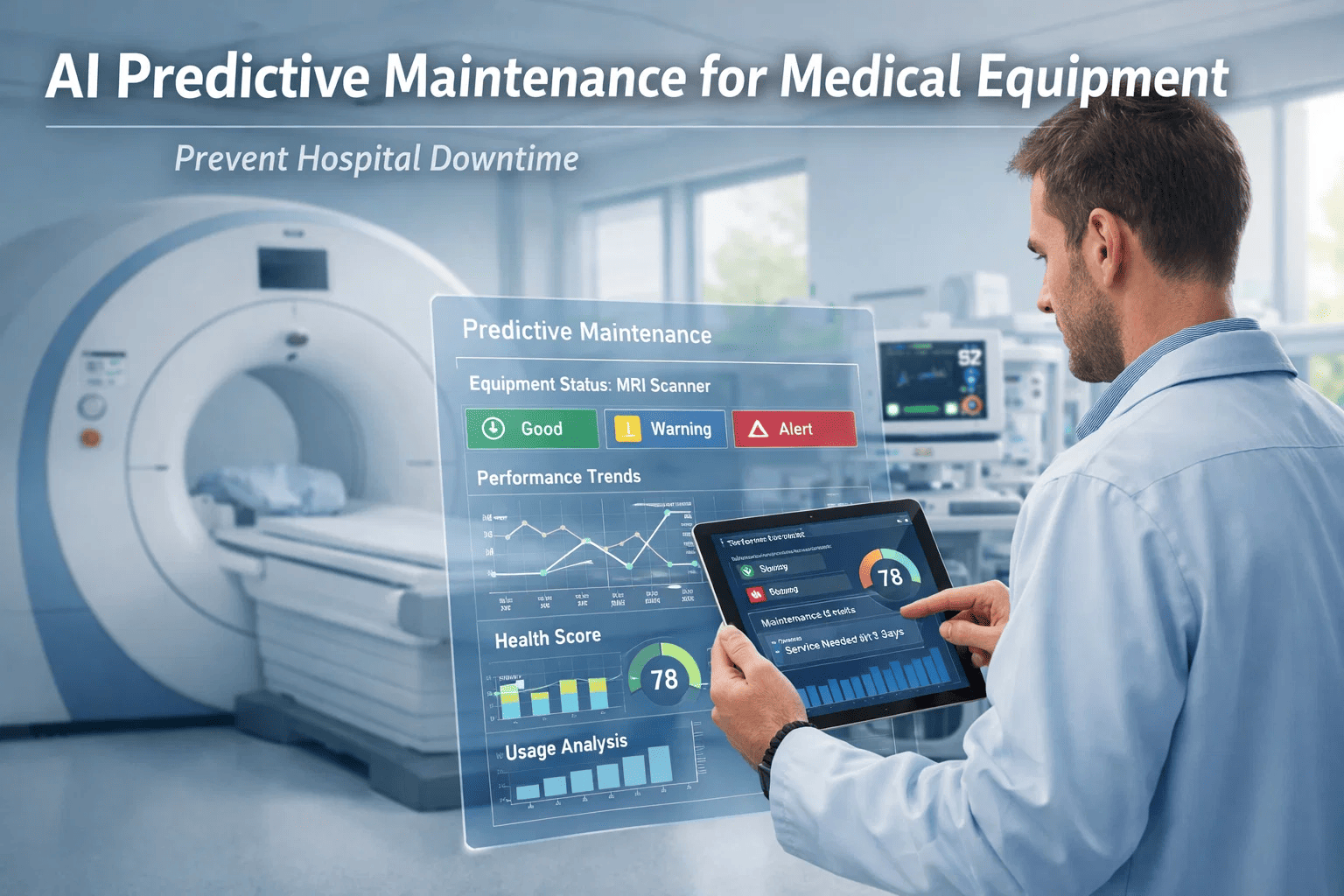
Imaging systems are among the highest-revenue and longest-lead-time-for-repair assets in any hospital. MRI cryogen systems, gradient amplifiers, RF coils, and cooling infrastructure all exhibit detectable degradation signatures before failure. AI monitoring of helium pressure, gradient coil temperature, and RF performance can predict magnet quench events and component failures weeks in advance — avoiding the catastrophic downtime that follows an uncontrolled quench or amplifier failure.
ICU Life Support Equipment
Ventilators, infusion pumps, patient monitors, and defibrillators in intensive care settings demand the highest reliability standards. AI monitoring tracks alarm frequency trends, motor performance in ventilator drive mechanisms, pump calibration drift, and battery backup capacity degradation. Proactive identification of performance drift before device failure protects patients and reduces sentinel event risk.
HVAC and Environmental Systems
Operating room air handling units, pharmacy clean room HVAC, and sterile processing department environmental controls must maintain precise temperature, humidity, and pressure differentials at all times. AI monitoring of chiller performance, air handler motor vibration, filter differential pressure, and compressor cycle patterns predicts failures before they compromise the controlled environments that clinical operations depend on.
Sterilization and Autoclave Systems
Central sterile processing department autoclaves and washer-disinfectors are throughput bottlenecks for surgical instrument availability. AI monitoring of steam pressure curves, door seal integrity, cycle time deviations, and temperature uniformity patterns identifies mechanical degradation before it causes sterilization failures — which carry both patient safety consequences and regulatory reporting requirements.
Surgical Robots and Powered Equipment
Robotic surgical platforms represent capital investments exceeding $2 million and generate significant per-procedure revenue. AI monitoring of joint actuator torque signatures, encoder accuracy, end-effector force feedback calibration, and cable tension enables proactive maintenance scheduling that avoids mid-procedure system faults and preserves surgical scheduling throughput.
Laboratory Analyzers and Refrigeration
Clinical laboratory analyzers, blood bank refrigeration, and specimen storage systems require continuous performance monitoring. AI models tracking reagent consumption rates, sample processing cycle times, calibration curve drift, and refrigeration temperature stability detect impending failures in systems whose downtime cascades across patient care workflows dependent on timely lab results.
AI Predictive Maintenance vs. Traditional Preventive Maintenance
Hospital maintenance programs have historically relied on two approaches: reactive maintenance (fix it when it breaks) and calendar-based preventive maintenance (service it on a fixed schedule regardless of condition). AI predictive maintenance represents a fundamentally different operating model. Understanding the differences clarifies the value proposition for hospital leadership evaluating the investment.
| Dimension | Reactive Maintenance | Calendar-Based PM | AI Predictive Maintenance |
|---|---|---|---|
| Trigger for Action | Equipment failure | Fixed time interval | Detected condition change |
| Failure Prevention | None | Partial — misses between-interval failures | High — detects degradation before failure |
| Maintenance Timing | Emergency response | Scheduled regardless of need | Optimized to actual condition |
| Parts Procurement | Emergency, premium cost | Planned but often over-stocked | Targeted, lead-time optimized |
| Downtime Pattern | Unpredictable, extended | Planned downtime windows | Minimal — interventions before failure |
| Compliance Documentation | Retroactive, incomplete | Scheduled records | Automated, continuous, audit-ready |
| Equipment Lifespan Impact | Shortened by failure damage | Moderate improvement | Maximized — condition-based care |
Implementation Roadmap: Deploying AI Predictive Maintenance in Your Hospital
Successful AI predictive maintenance deployment in healthcare settings follows a structured implementation pathway. Rushing deployment without adequate asset data foundations or CMMS integration leads to alert fatigue, low adoption, and failed programs. The following roadmap reflects best practices from successful hospital implementations.
Asset Inventory and Risk Stratification
Begin with a complete, accurate asset registry. Every piece of equipment the AI system will monitor needs a defined record: make, model, serial number, age, service history, failure history, and criticality classification. Stratify assets by failure impact — patient safety risk, revenue dependency, and lead time for replacement — to prioritize which equipment enters AI monitoring first. This foundation determines the quality of every prediction the system will make.
Sensor Infrastructure and Data Integration
Audit which high-priority assets already output operational data through APIs, OEM software, or BMS integrations. For assets without native data outputs, identify IoT sensor retrofit options. Establish data pipelines from equipment to your analytics platform. Data quality at this stage directly determines model accuracy — noisy, incomplete, or irregularly sampled data trains unreliable models. Invest in data validation protocols before moving to model training.
Baseline Establishment and Model Training
AI models require historical data to establish normal operating baselines and identify deviation patterns. For equipment with existing sensor data, this phase begins immediately. For newly instrumented assets, a baseline collection period of 60–90 days of normal operation provides sufficient data to begin anomaly detection. Work with your AI platform vendor to validate initial model performance against known failure events in historical maintenance records.
CMMS Integration and Workflow Design
Connect the AI alerting engine to your CMMS so that predictive alerts automatically generate structured work orders. Define escalation protocols: which alert severity levels trigger immediate response versus scheduled maintenance versus monitoring continuation. Train biomedical engineering and facilities maintenance staff on the new workflow. Book a demo with OxMaint to see how AI alert-to-work-order automation is configured for hospital environments.
Performance Monitoring and Program Expansion
Track program KPIs from day one: mean time between failures (MTBF) by equipment category, alert-to-intervention lead time, false positive rates, unplanned downtime incidents, and maintenance cost per asset. Use performance data to refine alert thresholds, expand monitoring to additional asset categories, and demonstrate ROI to hospital leadership. Programs that document performance gains from initial deployment phases generate the organizational buy-in needed for enterprise-wide expansion.
Your Equipment Fleet. Fully Monitored. Failures Prevented.
OxMaint unifies AI predictive intelligence with CMMS workflow automation — purpose-built for hospital asset management teams.
Regulatory Compliance and Documentation Benefits
Joint Commission Environment of Care standards, CMS Conditions of Participation, and FDA medical device regulations all require documented maintenance programs for hospital equipment. AI predictive maintenance systems generate continuous, timestamped records of equipment condition, maintenance interventions, and performance trends — creating an audit-ready compliance archive that traditional paper-based or spreadsheet maintenance programs cannot match.
When surveyors request maintenance documentation, AI-integrated CMMS platforms produce complete service histories, alert response records, and PM completion rates on demand. When equipment failures require incident reporting, the AI system's pre-failure alert history demonstrates that the organization was monitoring equipment proactively — a critical distinction in regulatory reviews and liability assessments. Hospitals that adopt OxMaint as their CMMS platform benefit from built-in compliance documentation workflows designed for Joint Commission and CMS audit requirements.
Frequently Asked Questions
What types of hospitals benefit most from AI predictive maintenance?
Academic medical centers, large community hospitals, and multi-facility health systems with complex, high-value equipment fleets see the greatest immediate ROI from AI predictive maintenance. Facilities operating imaging departments, surgical robots, ICUs, and central sterile processing at high utilization rates have the most to gain from preventing unplanned downtime. Smaller critical access hospitals benefit particularly from the reduced emergency repair costs and extended equipment lifespan that predictive maintenance delivers.
How long does it take to see results from AI predictive maintenance deployment?
Hospitals typically see initial predictive alerts within 60–90 days of deployment on equipment with sufficient historical data. Measurable reductions in unplanned downtime incidents are typically documented within 6 months. Full ROI calculations that account for avoided emergency repair costs, extended asset lifespan, and labor efficiency gains are typically available at the 12-month mark.
Can AI predictive maintenance integrate with existing biomedical engineering systems?
Yes. Modern AI predictive maintenance platforms are designed to integrate with existing CMMS, BMS, and OEM equipment management software through APIs and standard data protocols. OxMaint supports integration with major hospital CMMS platforms and equipment management systems, enabling hospitals to add AI predictive capabilities without replacing existing infrastructure investments.
How does AI predictive maintenance handle medical devices with strict FDA regulatory requirements?
AI predictive maintenance systems operate as monitoring and alerting tools — they detect anomalies and generate maintenance recommendations, but all maintenance interventions are performed by qualified biomedical engineering staff following FDA-compliant procedures. The AI system generates documentation of monitoring activities that supplements, rather than replaces, required device maintenance records. Regulatory compliance for the maintenance intervention itself remains the responsibility of the qualified technical team.
What is the difference between AI predictive maintenance and condition-based monitoring?
Condition-based monitoring uses real-time sensor data to trigger alerts when a parameter exceeds a fixed threshold — for example, alerting when a motor temperature exceeds 85°C. AI predictive maintenance goes further by using machine learning to detect subtle multi-variable patterns that precede failure before any single threshold is breached. It can predict that a bearing will fail in 12 days based on a combination of vibration frequency shift, temperature trend, and power consumption change — none of which have yet crossed their individual thresholds.


-(1).jpg)

