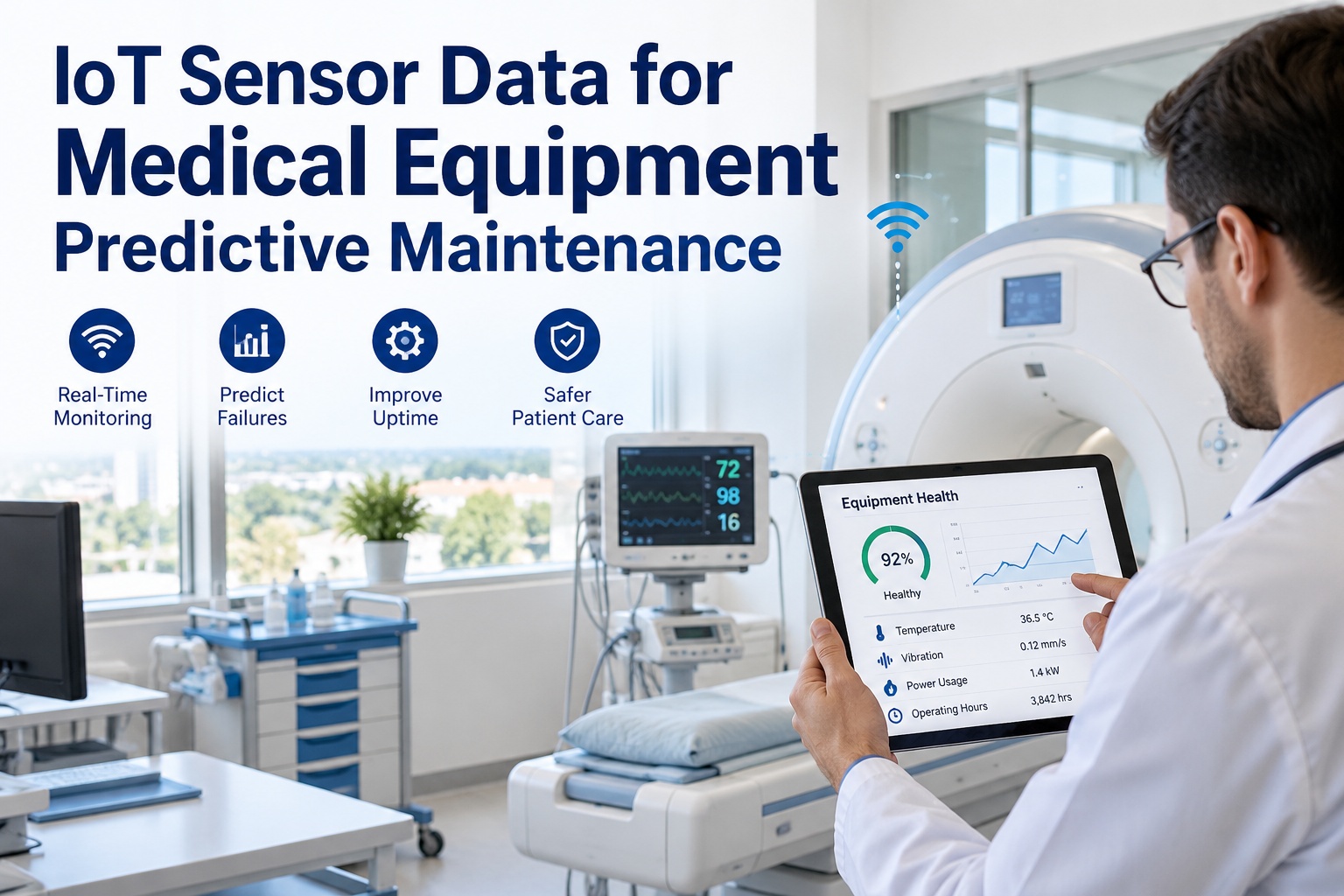
IoT Sensor Data for Medical Equipment Predictive Maintenance

By William Jerry on September 17, 2026

iot-sensor-data-for-medical-equipment-predictive-maintenance

A modern hospital collects more equipment sensor data in a single afternoon than a biomed team could read in a year — helium pressure from the MRI, valve cycles from every ventilator, motor current from every infusion pump, tube temperature from the CT. The problem was never gathering data; the problem is turning it into the right work order at the right time. Studies show 80% of medical equipment failures are preventable when the failure signature is caught early, and IoT + AI predictive systems typically catch that signature 2–4 weeks before breakdown. This guide walks through exactly which sensors matter on which devices, what a healthy signal looks like versus a degrading one, and how to build the sensor-to-work-order pipeline your team can actually run. Every workflow below runs inside OXMAINT AI, the AI-powered CMMS/maintenance management software that ingests IoT streams, grades anomalies into defects, and issues predictive work orders on a single platform.

Healthcare · IoT + Predictive Maintenance · Medical Device Sensors · 2026

IoT Sensor Data for Medical Equipment Predictive Maintenance

Vibration, temperature, pressure, current, cycle counts — every clinical device broadcasts its own health. OXMAINT AI is the AI-powered CMMS/maintenance management software that captures those signals, learns each asset's normal, and turns a drifting reading into a graded defect and a scheduled work order — before the device stops mid-scan or mid-infusion.

Joint Commission-ready records CMS 482.41 traceable Biomed + Facilities unified
80%
of medical equipment failures preventable with early signal (WHO)
2–4 wks
advance warning IoT + AI typically deliver on clinical assets
$8,662
cost per minute of surgical-equipment downtime
25–35%
maintenance-cost reduction with condition-based scheduling

The Six Sensor Signals That Do the Real Work

Every clinical device broadcasts dozens of readings — but only a handful actually predict failure. These six sensor families are the workhorses of medical predictive maintenance. OXMAINT AI captures each stream, compares it to the asset's learned baseline, and grades any drift into a defect record for biomed to action. Sign up free and start streaming your first six signals in OXMAINT AI.

Vibration
Bearing wear, imbalance, mechanical loosening in rotating equipment — MRI cooling systems, centrifuges, robotic drives.
Best for: Rotating mechanicals
Temperature
Motor windings, electrical panels, gradient coils, X-ray tubes. Abnormal heat is a precursor to insulation and component burnout.
Best for: Electrical & thermal
Current & Voltage
Motor amp draw and voltage stability in pumps, compressors, imaging. A motor pulling more than baseline is working harder than it should.
Best for: Motor-driven assets
Pressure
Medical gas, sterilizers, ventilator flow paths, pneumatic actuators. Drift outside threshold points to leaks, valve wear or compressor decay.
Best for: Gas & fluid systems
Cycle Counts
Valve actuations, exposures, infusion cycles, door openings. Manufacturer intervals become dynamic when the software tracks real usage per device.
Best for: Usage-based PM
Device-Native Logs
Alarm counts, error codes, calibration drift pulled straight from ventilator, pump and analyzer firmware over HL7/MQTT connectors.
Best for: Firmware-rich devices

Signal-to-Defect Matrix — Which Sensor Matters on Which Device

Not every sensor helps on every device. The matrix below shows the primary and secondary signals biomed teams actually rely on for the highest-cost failure modes on core clinical equipment. In OXMAINT AI, each cell corresponds to a device-class rule that turns the stream into a graded defect. Book a demo to walk the matrix on your equipment mix.

Device Primary signal Secondary signals Failure it catches Cost avoided
MRI scanner Helium pressure Gradient coil temp · vibration · chilled-water flow Quench risk, cold-head degradation $150k–$400k per quench event
CT scanner X-ray tube temp Anode current · exposure cycles · vibration Tube burnout, anode wear $80k–$150k tube replacement
Ventilator Pressure & flow sensor drift Valve cycle count · motor current · alarm rate Compressor decay, valve wear, calibration drift ICU downtime + patient risk
Infusion pump Motor current Cycle count · alarm history · battery cycles Actuator wear, delivery accuracy drift Ward-wide recall + rework
Sterilizer / autoclave Chamber pressure & temp Cycle count · steam quality · door-seal cycles Sterility failure, cycle abort Batch rejection, OR delay
Lab analyzer Calibration drift Pump vibration · reagent temp · error codes Assay drift, QC failure Result rerun, patient recall
Medical gas manifold Line pressure Alarm history · outlet flow · cylinder switch cycles Supply drop, leak, regulator wear NFPA 99 compliance risk

Healthy Signal vs Drifting Signal — What You're Actually Looking At

Predictive maintenance is not "watch a number." It's watching a shape. Below is what "normal" and "developing failure" look like on the two most-instrumented families of clinical equipment. OXMAINT AI learns each asset's own baseline over the first two to four weeks, then flags shape changes — not fixed thresholds. Sign up free — let OXMAINT AI learn your equipment's baseline.

MRI Helium Pressure HEALTHY
Steady oscillation inside band — cold head cycling normally. No action.
MRI Helium Pressure DRIFTING
Slow downward walk breaks the band — cold-head service or helium refill scheduled 14 days out.
Infusion Pump Motor Current HEALTHY
Uniform square-wave pulses per delivery cycle — motor healthy, actuator clean.
Infusion Pump Motor Current DRIFTING
Peaks climbing cycle-over-cycle — motor is pulling harder against a stiffening actuator. Defect logged.

A Sensor Reading Isn't Predictive Maintenance. A Graded Defect With a Named Owner Is.

Most hospitals already have the sensors. What's missing is the software that turns a stream of numbers into a work order — with the right technician, the right part, the right date. OXMAINT AI is that platform, and it was built for medical devices.

The Packet-to-Work-Order Pipeline

A sensor packet only helps a patient if it becomes an action. OXMAINT AI runs the five stages below on one platform — no exports, no CSV bridges, no biomed inbox scramble. Each stage is a step your team can trust to happen automatically. Book a demo to see the pipeline on live device data.

01
Ingest
Sensors, gateways, BMS and device firmware push readings to OXMAINT AI over MQTT, REST or HL7. Every packet is tagged to the asset record.
02
Baseline
The software learns each asset's normal over 2–4 weeks — no manual thresholds. Baselines refresh as devices age.
03
Grade
Drift becomes a Watch, Warn or Act-Now defect — with a predicted failure window and the recommended technician skill attached.
04
Schedule
A work order is drafted with parts, history and last service notes pre-attached — routed to the right biomed at the right campus.
05
Close & Learn
Technician closes the WO with photo evidence and signature. Outcome feeds back to sharpen the baseline for that asset and its siblings.

The False-Alarm Problem — And How OXMAINT AI Handles It

Every IoT-in-healthcare project starts strong and dies in a river of false alerts. A pump beeps because someone changed a syringe; the ventilator "vibration" is a nurse leaning on the cart. If every ping becomes a work order, biomed stops trusting the software inside a month. OXMAINT AI addresses this with layered filtering, not louder alarms. Sign up free and see how OXMAINT AI grades alerts in your environment.

Learned Baselines
Baselines are per-asset, not per-model — so an older MRI's normal is different from a newer one. Fixed thresholds go away.
Multi-Signal Confirmation
A defect fires only when two or more signals drift together — vibration + current, or pressure + cycle rate — filtering handling noise.
Context Suppression
Software knows a device is mid-scan or on-battery; readings during those windows carry lower weight than steady-state samples.
Biomed Feedback Loop
Every "not a real defect" close-out feeds the model. Repeat false triggers on a checkpoint get automatically down-weighted.

Live Asset Health Snapshot

Here's what a biomed lead sees on a Tuesday morning — a rolling health view across the most-instrumented devices in a hospital. Every asset carries a health score computed from its live signals, and the score is what routes attention. Book a demo to see your own live snapshot in OXMAINT AI.

Live Asset Health Monitor · General Hospital · Tue 09:14
MRI Scanner · Suite B
Helium pressure · gradient coil temp · vibration
HEALTHY
98.2%
CT Scanner · Radiology 2
X-ray tube temp anomaly · 18 days to threshold
WATCH
74.1%
Ventilator V-047 · ICU
Pressure sensor drift · WO auto-generated
ACT NOW
41.7%
Lab Analyzer · Pathology
All parameters within normal range
HEALTHY
96.5%
Infusion Pump Bank · Ward 4
Motor cycle count approaching threshold
WATCH
68.3%
Autoclave · CSSD
Chamber pressure, temp, door-seal cycles nominal
HEALTHY
94.7%
One "Act Now" and two "Watch" — each already tied to a graded defect and a routed work order inside OXMAINT AI.

Regulatory Records — Built From the Sensor Stream

The bonus of predictive maintenance for medical devices is that the same sensor stream that triggers a work order also produces the record every regulator wants to see. OXMAINT AI stitches the sensor reading, the graded defect, the work order, the technician signature and the photo evidence into one immutable trail per asset. Sign up free — turn every sensor packet into an audit-ready record.

TJC EC.02.04.03
Medical Equipment Maintenance
Every PM interval, condition alert and corrective task logged against the device's asset record — surveyable in seconds.
CMS CoP 482.41
Physical Environment
Timestamped inspection & work-order evidence for utility systems and clinical equipment retained per system policy.
NFPA 99
Medical Gas Testing
Line-pressure and alarm-history evidence continuously captured — inspection intervals scheduled from actual usage.
ISO 13485
Device Traceability
Full life-cycle record — commissioning, calibration, defects, PM, decommissioning — supporting quality-management audits.

What OXMAINT AI Gives a Biomed & Facilities Team

OXMAINT AI is the AI-powered CMMS/maintenance management software that connects medical-device IoT signals to the maintenance workflow biomed and facilities teams already run. Below are the platform capabilities that make it work. Sign up free and switch on the first signal in OXMAINT AI.

IoT Sensor & Firmware Ingest
MQTT, REST, HL7 and vendor SDK connectors — every reading tagged to an asset record automatically.
Per-Asset Learned Baselines
No manual thresholds. The software learns each device's own normal and flags drift, not absolute values.
Graded Defect Records
Watch / Warn / Act-Now grades with predicted failure window, recommended action and required part attached.
Auto-Routed Work Orders
Right technician, right skill, right campus — work orders drafted with device history and last service notes pre-loaded.
Compliance Evidence Chain
Every packet, defect, WO and signature stitched into one immutable record per device — surveyable on demand.
Fleet-Wide Learning
A failure signature caught on one asset raises the flag on identical models across the whole hospital or health system.
"

We were drowning in alerts before we tightened up baselines. The first month with OXMAINT AI, the software flagged a slow helium-pressure walk on our newer MRI that our quarterly PM had missed twice. Cold-head service was scheduled 12 days out, no quench, no cancelled scans, and the same fingerprint was already being watched on the sister-site machine. That was the moment biomed stopped treating this as an experiment.

Director of Clinical Engineering · Multi-Hospital Health System

Frequently Asked Questions

Do we need to buy new sensors, or can OXMAINT AI use what our devices already broadcast?
Both. Modern MRIs, ventilators, infusion pumps and analyzers already broadcast rich telemetry — OXMAINT AI ingests those streams over HL7, MQTT and vendor connectors. Where you need coverage on older equipment (rotary pumps, chillers, autoclaves), retrofit vibration and current sensors are inexpensive and typically install in under 5 minutes per asset. Start free — connect your first device today.
How long before the software actually predicts something useful?
OXMAINT AI needs 2–4 weeks per asset to learn its baseline, after which drift-based defects begin firing. Most biomed teams see their first meaningful "Watch" or "Warn" grade inside the first month, and their first prevented failure within 60–90 days. Book a demo to map a realistic timeline for your fleet.
Does this replace our biomed team's clinical judgement?
No — it protects it. OXMAINT AI drafts the work order, attaches history and predicted failure window, and routes it to the right technician. The clinical engineer still makes the call on the intervention. What the software removes is the manual data-chasing, not the expertise. Sign up free and put your biomed team on live device signals.
How does OXMAINT AI handle patient-data privacy on the same network?
OXMAINT AI's ingestion pipeline is scoped to operational telemetry — pressures, temperatures, currents, cycle counts, error codes — not patient data. Where devices carry both, the connector is configured to strip PHI before ingest, and the platform's records are held to the same access controls as any hospital IT system. Book a demo to walk through the security model.
What if we already have a biomed asset system — do we rip and replace?
Not necessarily. Many hospitals wire OXMAINT AI's predictive layer on top of an existing asset registry, then migrate progressively as biomed and facilities workflows converge. The 60–90 day rollout typically starts with one high-cost device class (imaging or ICU) rather than a full switch. Start free and pilot one device class in OXMAINT AI.

Turn Every Sensor Packet Into a Better Maintained Device.

Move medical-device predictive maintenance out of dashboards and into the workflow with OXMAINT AI — signal-to-defect-to-work-order on one platform, per-asset learned baselines, and an evidence chain your regulators can actually query.


Share This Story, Choose Your Platform!