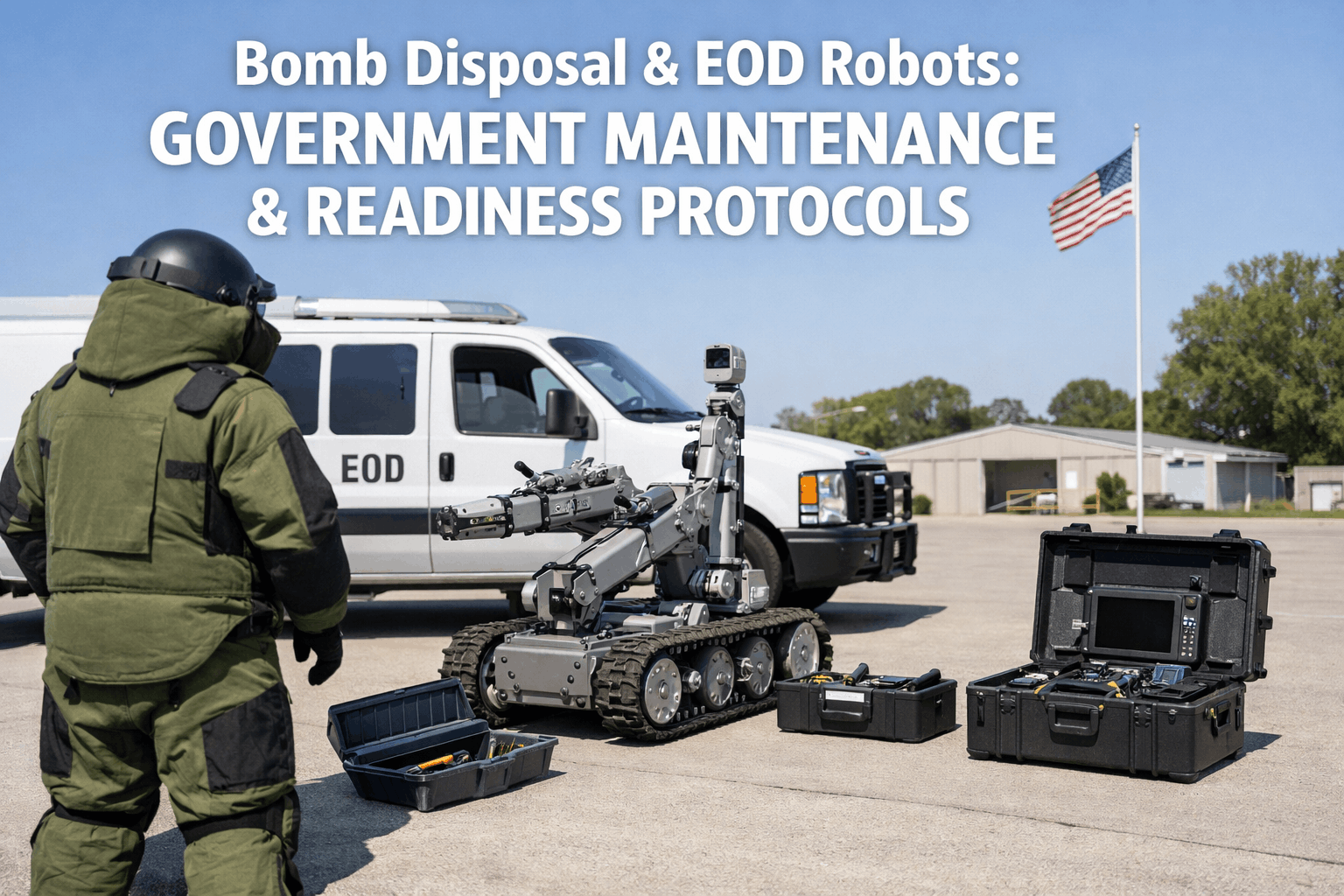
When a regional bomb squad deployed its primary EOD robot to a suspicious package call—only to have the manipulator arm seize at full extension 40 feet from a live device—the consequences went far beyond a failed mission. The $320,000 PackBot had to be abandoned in place while a secondary unit was trucked in from a neighboring jurisdiction 90 minutes away. The post-incident review revealed that the arm's actuator had shown intermittent torque faults in the previous two deployments, but the findings were logged in a technician's personal notebook instead of a centralized system. No follow-up work order was generated. No parts were ordered. This isn't an edge case—it's the predictable outcome when mission-critical EOD assets are maintained on institutional memory instead of documented protocols. Every bomb squad unit needs a maintenance system that tracks post-mission inspections automatically, triggers quarterly readiness checks without manual reminders, and ensures every manipulator arm, camera system, and communication link is verified before the next callout. Talk to our team about building EOD maintenance workflows that protect operators and ensure deployment readiness.
Mission-Critical Readiness Guide — 2026 Edition
Bomb Disposal & EOD Robots: Government Maintenance & Readiness Protocols
PackBot, TALON, and next-gen EOD platforms require rigorous maintenance of manipulator arms, camera systems, wireless links, and tracked mobility. Oxmaint CMMS delivers readiness dashboards, post-mission checklists, and classified-compatible tracking.
PackBot 510
Primary Disposal Platform
TALON V
Heavy-Duty EOD Platform
MTGR
Micro-Tactical Ground Robot
Caliber T5
Next-Gen Modular Platform
2,400+EOD callouts annually in the U.S.
98%Readiness rate required by NSTC
100%Post-mission inspections mandatory
$320KAvg. cost per EOD robot platform
The Stakes of Readiness Failure
EOD robots are not ordinary assets—they are life-saving tools that stand between bomb technicians and lethal devices. A manipulator arm that fails to grip, a camera feed that drops during a critical approach, or a track system that stalls on rubble can force human operators into the blast radius. Unlike commercial equipment where downtime means lost revenue, EOD downtime means lost lives. Every unresolved maintenance finding is a risk carried forward to the next callout, and callouts don't wait for convenient schedules. Book a Demo.
Critical Readiness Failure Modes
Manipulator Arm Failure
34%
Actuator seizure, gripper malfunction, or wrist joint failure during device approach. Most common cause: deferred torque calibration and worn gear trains.
Impact: Mission abort — human exposure
Video Feed Loss
27%
Camera failure, fiber optic tether damage, or wireless link dropout during operation. Operator loses situational awareness at critical moment.
Impact: Blind approach — operator at risk
Communication Link Drop
22%
RF interference, encrypted mesh failure, or antenna damage causes loss of command/control. Robot becomes unresponsive in the hazard zone.
Impact: Stranded asset — delayed response
Mobility Platform Failure
12%
Track separation, drive motor burnout, or flipper arm malfunction prevents traversal of stairs, rubble, or rough terrain to reach the device.
Impact: Cannot reach target — mission delay
Battery / Power System
5%
Premature battery depletion, charging contact corrosion, or power management fault causes mid-mission shutdown near a live device.
Impact: Dead robot in blast zone
Maintenance Protocol Tiers: A Readiness Matrix
EOD robot maintenance isn't a single checklist—it's a tiered system of inspections and servicing that mirrors the operational tempo. Each tier has specific triggers, scope, and documentation requirements. Your readiness strategy must cover every tier from post-mission rapid checks to annual depot-level overhauls.
EOD Robot Maintenance Tier Matrix
Immediate Post-Mission Inspection
Trigger: After every deployment or training exercise
✓ Visual inspection of manipulator arm joints and gripper
✓ Camera lens cleaning and video feed verification
✓ Track/flipper integrity and debris removal
Must be completed within 4 hours of return to base. All findings logged in CMMS before robot returns to "Ready" status. Decontamination protocol if CBRNE exposure.
Quarterly Readiness Verification
Trigger: Every 90 days regardless of deployment frequency
✓ Full manipulator arm torque calibration test
✓ Encrypted wireless link range and latency test
✓ Battery load test under full operational draw
Simulates full-mission profile including stair climb, arm manipulation, and sustained video feed. Failure of any subsystem triggers immediate corrective work order.
Semi-Annual Preventive Maintenance
Trigger: Every 180 days or 200 operating hours
✓ Manipulator gear train inspection and lubrication
✓ Fiber optic tether continuity and termination check
✓ Track tension adjustment and drive sprocket wear measurement
✓ Firmware/software update verification
Requires certified EOD robotics technician. All replaced components tracked by serial number with chain-of-custody documentation for classified units.
Annual Depot-Level Overhaul
Trigger: Annually or after major blast/impact event
✓ Complete disassembly, inspection, and rebuild of arm assembly
✓ Chassis structural integrity X-ray or NDT scan
✓ Full electronics bench test and recalibration
✓ OEM compliance certification and warranty verification
✓ Battery pack replacement and thermal testing
Typically performed by OEM or authorized depot facility. Robot offline for 2-4 weeks. Backup unit must be designated in CMMS during overhaul period.
Automate Your EOD Readiness Tracking
Oxmaint CMMS auto-triggers post-mission inspections, quarterly readiness checks, and annual overhaul schedules. Every manipulator test, camera verification, and battery load result is logged in a classified-compatible, audit-ready digital record.
Subsystem Maintenance Documentation
In EOD operations, the standard is absolute: "If it isn't documented, the robot isn't ready." Auditors, unit commanders, and accreditation bodies expect complete maintenance records for every subsystem. A digital system of record is the only way to manage the volume and sensitivity of data required for multi-platform EOD fleets. Book a Demo.
Critical Subsystem Maintenance Protocols
Manipulator Arms
Inspection Scope:
Gripper jaw alignment and force calibration
Wrist, elbow, and shoulder joint play measurement
Actuator current draw under load
Cable routing and strain relief verification
Common Failure Indicators:
Intermittent torque faults in telemetry logs
Gripper slippage under rated load
Audible gear noise during articulation
Excessive joint backlash beyond OEM spec
Arm failure is the #1 cause of EOD mission abort.
Camera & Sensor Systems
Inspection Scope:
PTZ camera function and auto-focus test
IR/thermal sensor calibration verification
Lens cleaning and anti-scratch coating check
Audio/microphone system clarity test
Common Failure Indicators:
Image blur or dead pixels in feed
PTZ motor lag or grinding noise
IR calibration drift beyond tolerance
Intermittent video freeze/artifacts
Vision loss during approach is an operator safety emergency.
Comms & Mobility
Inspection Scope:
Encrypted RF link — range and latency test
Fiber optic tether — continuity and bend radius
Track tension, sprocket wear, flipper articulation
Drive motor current draw under load
Common Failure Indicators:
Link dropout at less than rated range
Tether signal attenuation above threshold
Track slippage on incline test
Flipper arm hydraulic leak or slow response
Comms + mobility = mission survivability. Test both together.
Readiness Lifecycle Management
EOD robot readiness is a continuous cycle that spans from initial fielding through operational deployment to eventual decommissioning. Missing a step at any phase degrades the entire unit's response capability and can invalidate accreditation status.
Robot Readiness Lifecycle
Key milestones for bomb squad fleet managers
01
Fielding & Acceptance
OEM delivery inspection completed. Serial numbers, firmware versions, and accessories cataloged in CMMS. Operator acceptance test (OAT) performed. Baseline readiness status established.
Onboarding
02
Operational Readiness
Post-mission inspections executed after every deployment. Quarterly readiness tests passed. Readiness status dashboard shows "Green." Robot cleared for immediate callout deployment.
Active
03
Preventive Maintenance Cycle
Semi-annual PM completed by certified technician. Firmware updates applied. Worn components replaced with OEM parts tracked by serial number. Updated readiness certification signed off.
Recurring
04
Depot Overhaul / Blast Recovery
Annual depot-level service or post-blast damage assessment. Full teardown, NDT inspection, and rebuild. Backup unit activated. Chain-of-custody documentation maintained for classified components.
Critical
05
End-of-Life & Decommission
Robot reaches service life limit or becomes economically irreparable. CMMS generates disposition report. Classified components sanitized. Asset removed from readiness roster. Replacement procurement triggered.
Final
Never Miss a Readiness Deadline
Oxmaint auto-schedules quarterly readiness tests, semi-annual PMs, and annual overhauls for every robot in your fleet. Readiness dashboards give commanders instant visibility into which assets are green, amber, or red.
Expert Perspective: The Readiness Imperative
"
In 22 years of bomb squad operations, I've learned that robot readiness is not a maintenance problem—it's a leadership problem. The units that maintain 98%+ readiness rates aren't the ones with the biggest budgets; they're the ones with systems that make it impossible to skip a step. When a post-mission inspection automatically generates the work orders, when a quarterly readiness check can't be "pencil-whipped" because the CMMS requires photo verification and measured values, when the commander can pull up a dashboard showing every robot's status in 10 seconds—that's when readiness becomes culture instead of paperwork. The robot doesn't care about your excuses. It either works when you need it, or someone has to walk down range in a bomb suit.
— Retired Bomb Squad Commander, 22 years federal/municipal EOD service
98%
Target readiness rate for accredited bomb squads
4 hrs
Max time to complete post-mission inspection
$0
Acceptable cost of a readiness failure in lives
24/7
Deployment readiness requirement
Investing in EOD robot maintenance infrastructure is investing in the safety of bomb technicians and the communities they protect. By digitizing your readiness program with Oxmaint, you ensure that every manipulator arm is calibrated, every camera feed is verified, every communication link is tested, and your unit maintains the accreditation status required for federal interoperability. Start your free trial today.
Mission-Ready Robots, Every Callout
Oxmaint provides the digital backbone for EOD fleet readiness—tracking subsystem health, automating post-mission inspections, and delivering readiness dashboards that give commanders instant confidence. Be deployment-ready, every day.
Frequently Asked Questions
What is a post-mission inspection for an EOD robot?
A post-mission inspection is a standardized checklist completed after every deployment or training exercise. It covers all critical subsystems: manipulator arm function and gripper integrity, camera and sensor operation, wireless and tethered communication links, tracked mobility platform condition, battery charge state, and any visible damage or contamination. Oxmaint CMMS auto-generates this checklist when a deployment is logged, requires photo verification of key components, and prevents the robot from returning to "Ready" status until all items are signed off by a qualified technician.
How often should EOD robots undergo readiness testing?
National standards and most accreditation bodies (including NBSCAB) require quarterly readiness verification at minimum—every 90 days regardless of whether the robot has been deployed. This includes a full-mission simulation: stair climb, manipulator dexterity test, sustained video feed, communication range test, and battery endurance under load. Additionally, post-mission inspections are mandatory after every deployment, and semi-annual preventive maintenance and annual depot overhauls round out the maintenance calendar.
Can Oxmaint handle classified or sensitive maintenance data?
Oxmaint provides classified-compatible maintenance tracking with role-based access controls, encrypted data storage, and audit trails that satisfy government security requirements. Serial numbers, firmware versions, and component configurations for sensitive platforms can be tracked without exposure to unauthorized personnel. The system supports both cloud-hosted and on-premise deployment options depending on the security classification level required by your agency.
What happens when a robot fails a readiness check?
When any subsystem fails a quarterly readiness test or post-mission inspection, Oxmaint automatically generates a corrective maintenance work order with the specific failure details, changes the robot's status to "Not Mission Ready" (NMR) on the readiness dashboard, and notifies the unit commander and maintenance supervisor. The robot cannot return to "Ready" status until the corrective work order is completed, verified, and signed off. If the primary robot is NMR, the CMMS automatically highlights the backup unit's readiness status.
How does Oxmaint track maintenance for multiple robot platforms?
Each robot platform (PackBot, TALON, MTGR, etc.) has unique maintenance requirements, part numbers, and service intervals. Oxmaint maintains separate asset profiles with platform-specific PM templates, part catalogs, and OEM service bulletins. The readiness dashboard provides a fleet-wide view showing every platform's status (Ready, NMR, In Maintenance, At Depot) with drill-down capability to individual subsystem health. Cross-platform spare parts inventory is tracked centrally so technicians know exactly what's in stock before starting a repair.