Sanitary equipment design is the foundation of every food safety program — and the area where most facilities discover compliance gaps only after an FDA inspector or a third-party auditor identifies them. Equipment that cannot be fully cleaned, fully inspected, and fully drained does not just create contamination risk — it creates documented findings that trigger 483 observations, audit non-conformances, and in the worst cases, product recalls averaging $10 million in direct costs alone. The 3-A Sanitary Standards define measurable design criteria — surface finish requirements, crevice-free construction, self-draining geometry, and material specifications — that separate compliant equipment from equipment that harbours bacteria between cleaning cycles. Facilities managing dozens or hundreds of sanitary assets need a system that tracks every verification inspection, documents every design non-conformance, and ensures corrective actions close before the next production run. OxMaint gives maintenance and quality teams that system — managing sanitary design verification schedules, inspection records, and corrective action tracking in one platform accessible from the production floor. Ready to build your sanitary design compliance program? Book a demo to walk through a verification workflow, or start a free trial and register your first sanitary assets today.
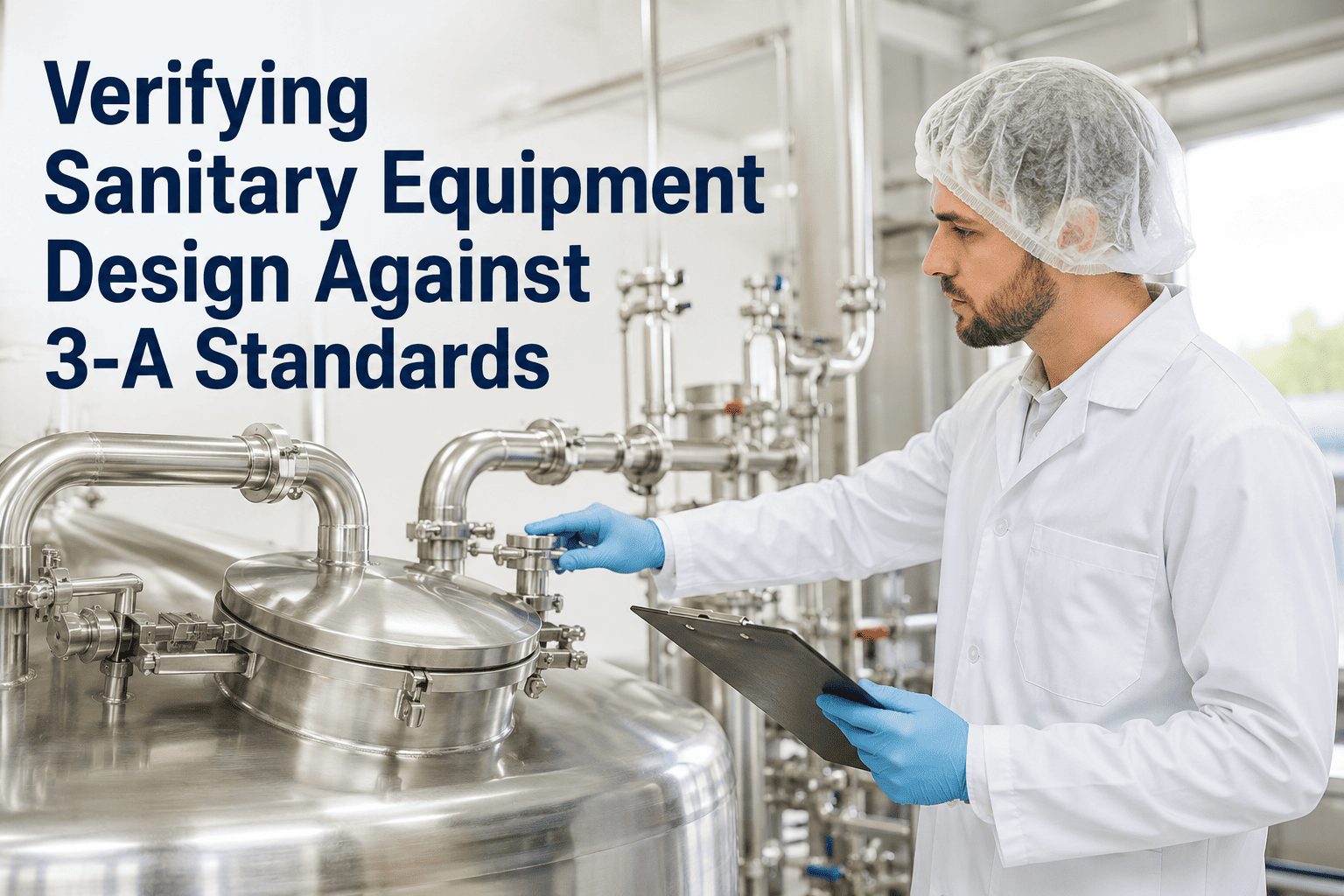
Verifying Sanitary Equipment Design Against 3-A Standards: CMMS-Based Compliance Tracking for Food and Beverage Plants
Track 3-A sanitary design verification inspections, crevice-free construction audits, surface finish measurements, and corrective action records with CMMS-managed schedules built for FDA and GFSI audit readiness.
$10M
Average direct cost per food recall — equipment design failures that create bacterial harborage points are a leading root cause of contamination events
19%
Of FDA-inspected food facilities cited for sanitary operations and plant maintenance deficiencies — the second most common category of 483 observations
32 Ra
Maximum surface roughness (microinch) required by 3-A Standards on all product-contact surfaces — rougher finishes trap residue and resist cleaning verification
48M
Americans affected by foodborne illness annually — contamination from poorly designed equipment that harbours pathogens between cleaning cycles is a persistent cause
Why Sanitary Design Verification Requires Structured CMMS Tracking
The 3-A Sanitary Standards are not regulations — they are industry-developed design criteria that define what makes food processing equipment cleanable, inspectable, and safe for production. But regulatory agencies including the FDA and USDA recognise 3-A compliance as evidence of acceptable sanitary design during inspections. Equipment that carries the 3-A symbol has passed third-party verification confirming that surfaces, joints, seals, and finishes meet specific hygienic criteria. The challenge for food plants is not obtaining 3-A certified equipment — it is maintaining compliance after installation, through years of production, cleaning cycles, repairs, and component replacements that can compromise the original design integrity.
A pump that was 3-A compliant at installation can lose that compliance the first time a gasket is replaced with a non-certified material. A tank that passed surface finish verification can develop micro-crevices from abrasive cleaning compounds. A valve assembly that was crevice-free at commissioning can harbour bacteria after a maintenance repair introduces a gap between mating surfaces. Without a CMMS tracking design verification inspections on defined schedules, these degradation events accumulate silently — discovered only when a swab test returns a positive result or an auditor identifies the non-conformance. Start a free trial and begin building your sanitary design verification program today.
3-A Sanitary Design Verification Checklist — What CMMS Must Track
01
Surface Finish Measurement
Product-contact surfaces verified at 32 Ra microinch or better. Profilometer readings recorded per asset with timestamp, location, and pass/fail disposition linked to the equipment maintenance record.
02
Crevice-Free Joint Inspection
Every weld, gasket seat, and mechanical joint inspected for gaps, pitting, or metal-to-metal contact loss. Non-conformances generate immediate corrective action work orders with photographic documentation.
03
Seal and Gasket Material Verification
Every replacement seal and gasket verified against 3-A approved material specifications before installation. Material certificates linked to the asset record confirming food-grade compliance and chemical resistance.
04
Self-Draining Geometry Confirmation
Equipment verified for complete drainage capability — no pooling zones, no dead legs, no trapped liquid after CIP or COP cycles. Drainage test records document residual volume measurements per verification event.
05
Cleanability and Accessibility Audit
Every food-contact and food-zone surface confirmed accessible for cleaning and visual inspection without tools. Disassembly procedures documented for components requiring clean-out-of-place verification.
06
Material Toxicity and Corrosion Check
All product-contact materials confirmed as 300-series stainless steel (304 or 316) or 3-A approved alternatives. Corrosion inspection on defined intervals with documentation of any surface degradation requiring remediation.
Track Every Surface, Every Seal, Every Inspection — All in One Compliance Platform
OxMaint manages your complete sanitary design verification program with scheduled inspections, automated corrective actions, and audit-ready documentation your team runs from mobile devices on the plant floor.
Where Sanitary Design Compliance Fails — And How Equipment Becomes a Contamination Source
Gasket Replacement with Non-Certified Material
Maintenance teams replace a worn gasket with the closest available material — not the 3-A certified specification. The non-compliant gasket absorbs cleaning chemicals, develops micro-cracks within weeks, and creates a bacterial harborage point invisible to visual inspection.
Surface Finish Degradation from Abrasive Cleaning
Abrasive pads or non-approved cleaning compounds roughen product-contact surfaces beyond the 32 Ra threshold over repeated cleaning cycles. The degraded surface finish traps residue that standard CIP cycles cannot fully remove — turning a compliant surface into a contamination source.
Weld Repairs That Introduce Crevices
Field weld repairs on tanks, piping, or valve bodies create rough weld beads, undercuts, or gaps between base metal and weld material. Without post-repair sanitary design re-verification, these crevices become permanent bacterial harbourage sites that resist standard sanitation procedures.
Dead Legs Created During Equipment Modifications
Piping modifications, line extensions, or equipment repositioning create dead legs — sections of pipe where product or cleaning solution stagnates. These undrained zones accumulate biofilm that contaminates downstream product and resists detection until environmental monitoring swabs return positive results.
Every contamination event traced to equipment design has the same root cause — a design verification that should have been scheduled, completed, and documented never happened.
How OxMaint Manages Sanitary Design Verification Programs
Verification Scheduling
Every sanitary asset runs on a defined verification schedule — surface finish measurements, crevice inspections, seal material audits, and drainage tests triggered by calendar interval, production hours, or CIP cycle count. OxMaint generates the inspection work order automatically and escalates overdue verifications before they become audit findings.
Non-Conformance Tracking
When a verification inspection identifies a design non-conformance — a surface finish reading above 32 Ra, a crevice at a weld joint, a non-certified gasket material — OxMaint creates a corrective action work order linked to the original finding. The non-conformance record stays open until the corrective action is completed, verified, and signed off.
Material Certificate Management
Every replacement seal, gasket, and component links to its material test report and 3-A certification in OxMaint. Maintenance teams verify material compliance before installation — not after an auditor identifies non-certified components during a facility inspection.
Audit-Ready Documentation
FDA inspectors and GFSI auditors request sanitary design verification records by equipment, by date range, or by product line. OxMaint compiles the complete verification history — inspection results, corrective actions, material certificates, and sign-offs — in minutes rather than the days required to assemble paper-based records.
Reactive vs. Structured: Sanitary Design Management Compared
The difference between facilities that pass sanitary design audits consistently and facilities that generate findings on every inspection is not equipment quality — it is whether design verification runs on a documented schedule with recorded outcomes. Every row below represents a verification activity that either exists as a traceable CMMS record or exists as an uncontrolled gap waiting to be discovered. Book a demo to see how OxMaint closes these gaps for your operation.
Regulatory and Standards Framework — What Your Program Must Cover
3-A SSI
3-A Sanitary Standards
Voluntary industry standards defining hygienic design criteria — surface finish, material specifications, cleanability, inspectability, and self-draining construction. The 3-A symbol confirms third-party verified compliance. The General Requirements Standard (00-02) updated in 2026 covers seal requirements, CIP gasket joints, and mandatory leak detection.
FDA
21 CFR Part 117 — FSMA Preventive Controls
Requires food facilities to implement preventive controls including sanitation controls for food-contact surfaces. Equipment must be designed to allow adequate cleaning and maintenance. FDA now uses AI-driven risk targeting to prioritise facility inspections — making documentation gaps more likely to trigger enforcement.
USDA
USDA Equipment Approval
USDA relies on the 3-A symbol to verify compliance with sanitary design criteria for equipment used in federally inspected meat, poultry, and dairy facilities. Equipment without 3-A certification requires individual USDA evaluation — a longer and more costly approval path.
GFSI
SQF, BRC, FSSC 22000
All major GFSI benchmarked schemes require documented evidence of equipment sanitary design verification as part of prerequisite programs. Audit non-conformances for missing or incomplete design verification records are among the most common findings during certification and surveillance audits.
Frequently Asked Questions
Does OxMaint track 3-A sanitary design verification records for individual equipment assets
Yes — every sanitary asset in OxMaint maintains a complete verification history including surface finish measurements, crevice inspections, seal material certificates, and drainage test results. Each record links to the asset, the inspection date, the technician, and the pass/fail disposition.
Start a free trial to configure your first sanitary asset verification schedule.
How does OxMaint handle non-conformances found during sanitary design inspections
When a verification inspection identifies a non-conformance, OxMaint auto-generates a corrective action work order linked to the original finding. The non-conformance stays open and visible in compliance dashboards until the corrective action is completed, verified, and signed off — ensuring nothing falls through the cracks before your next audit.
Book a demo to see the corrective action workflow.
Can OxMaint manage sanitary design verification across multiple production lines and facilities
Yes — OxMaint supports multi-line and multi-facility sanitary design programs. Each asset maintains its own verification schedule and compliance status. Portfolio-level dashboards show verification compliance rates, open non-conformances, and overdue inspections across every line and every facility in a single view.
How quickly can a food plant implement a sanitary design verification program in OxMaint
Most food plants complete their sanitary asset registry and configure initial verification schedules within 2-3 weeks. Pre-built templates for surface finish inspections, crevice audits, and gasket verification accelerate setup. Your first compliance records begin accumulating from day one — building the verification history that auditors require.
Start a free trial to begin today.
Does OxMaint support FDA and GFSI audit preparation for sanitary equipment compliance
OxMaint compiles complete sanitary design verification records — inspection results, corrective actions, material certificates — filtered by equipment, date range, or production area in under 10 minutes. Whether responding to an FDA Form 483 request or preparing for a BRC or SQF surveillance audit, your documentation is always audit-ready.
Book a demo to walk through audit report generation.
Sanitary Design CMMS — OxMaint
Stop Discovering Sanitary Design Failures During Audits. OxMaint Puts Every Surface Finish, Every Seal Verification, and Every Crevice Inspection on a Documented Schedule.
3-A design verification tracking. Crevice-free construction audits. Gasket material compliance. Non-conformance corrective actions. FDA and GFSI audit-ready in one platform your plant team runs from the production floor.