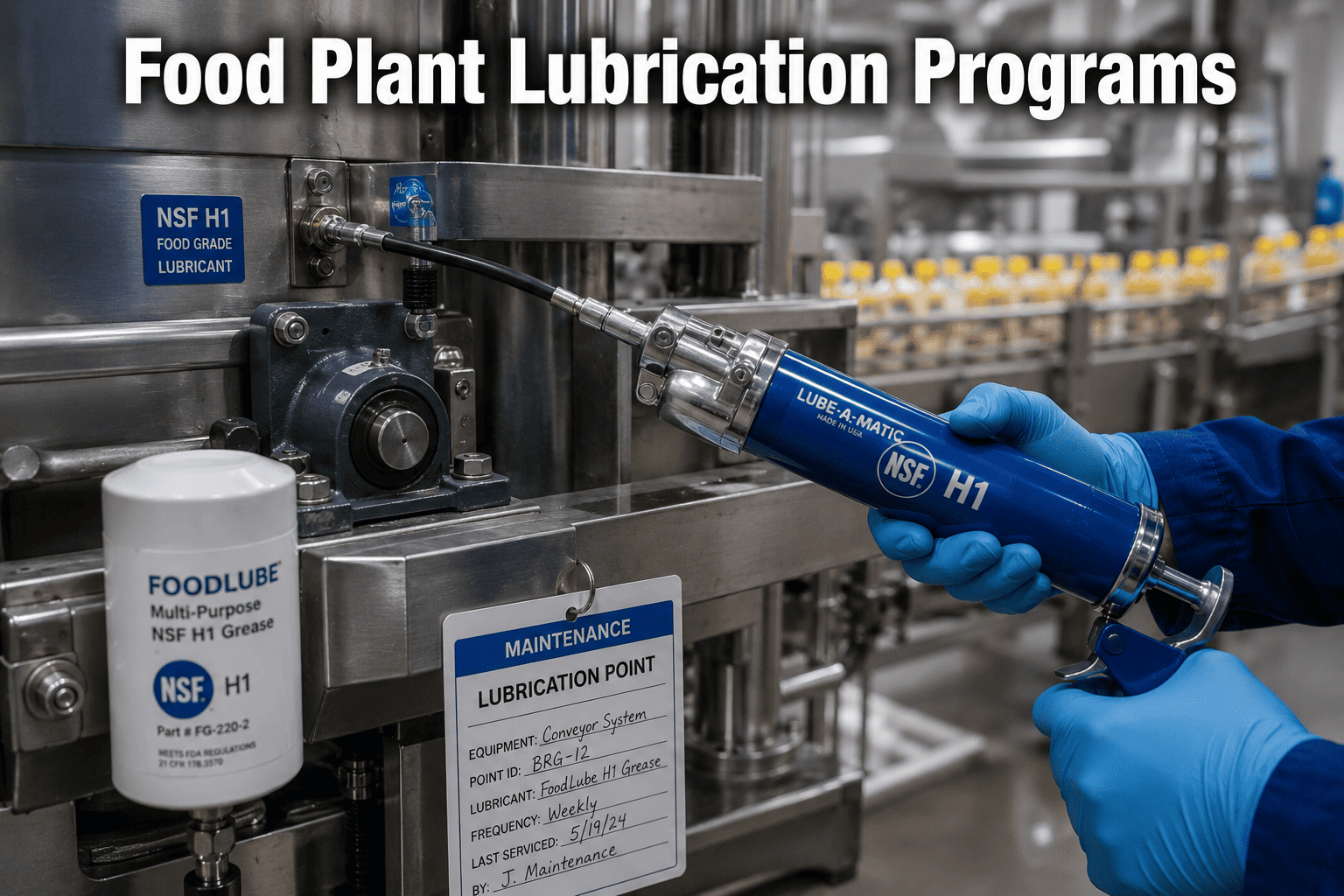
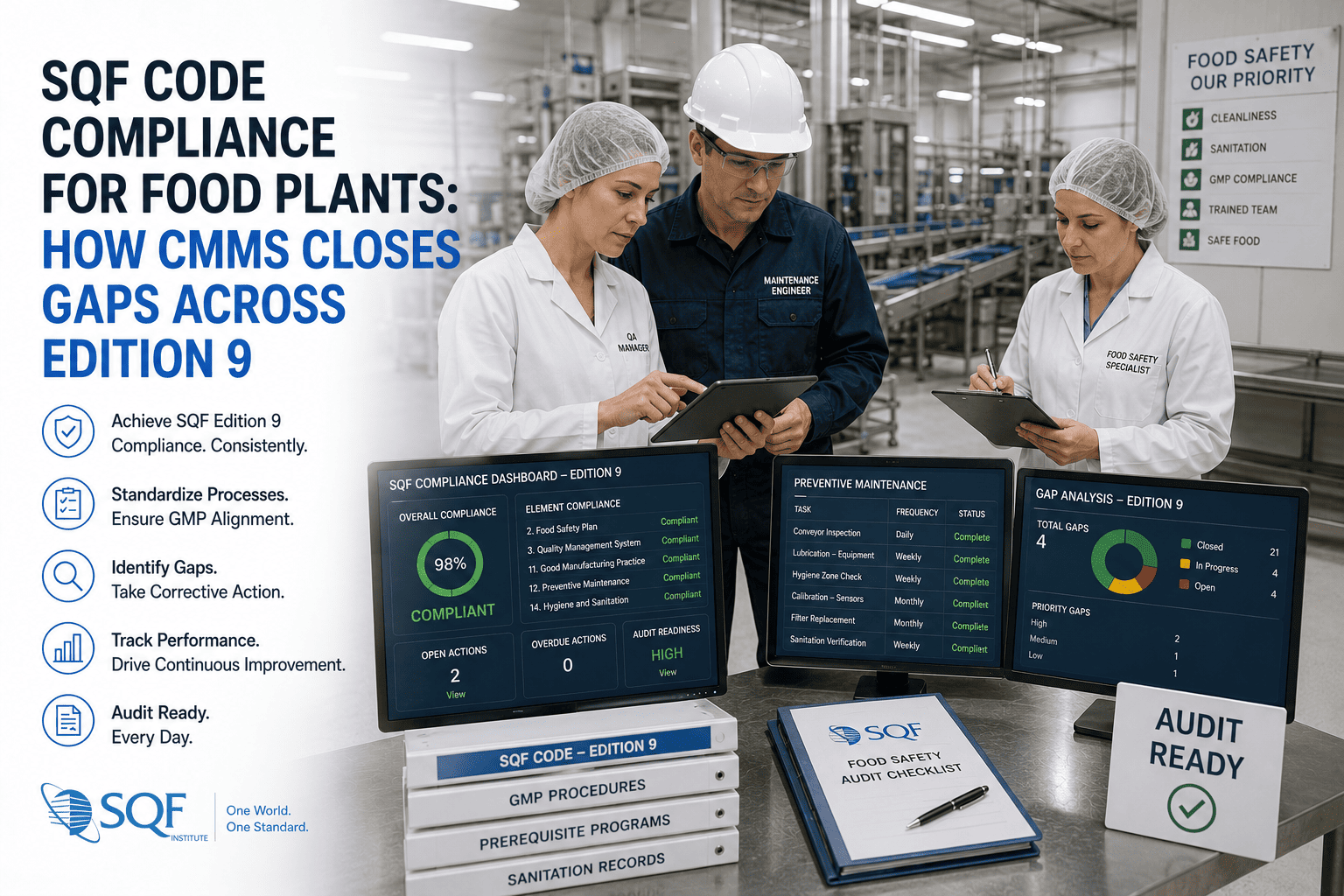
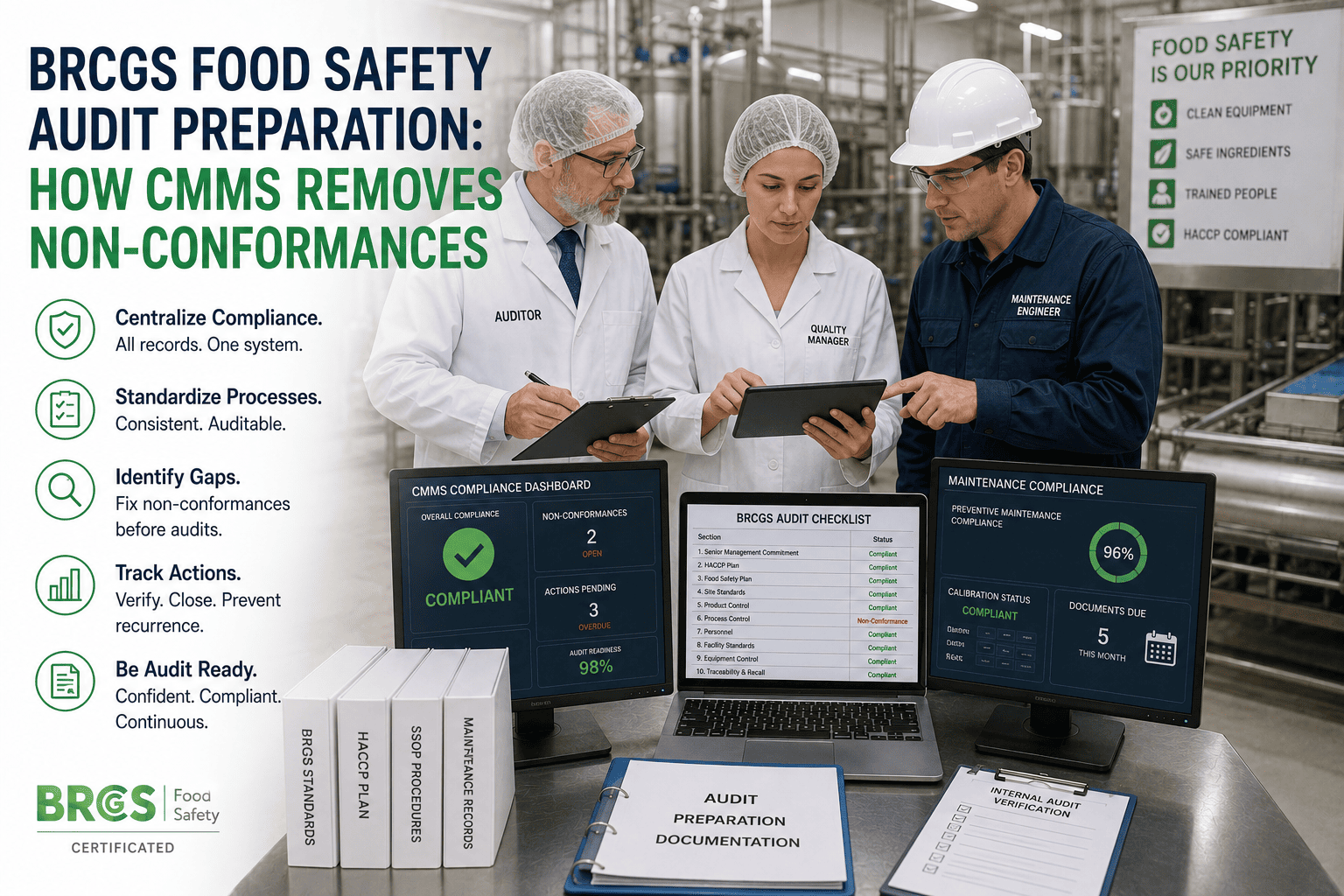
Food manufacturing facilities face a silent compliance risk that most CMMS programs overlook: lubricant management. A single unlabeled grease gun, a misapplied H2 lubricant near a processing line, or a missing NSF H1 certification on a bearing grease can trigger a GFSI non-conformance, a product recall, or a facility shutdown. The difference between a world-class lubrication program and a regulatory liability is documentation, traceability, and scheduled PM — which is exactly why operations teams that build structured lubricant programs into their CMMS see up to 60% fewer food-safety audit findings. If your facility is still managing lubrication with paper logs and verbal handoffs, start a free trial to see how Oxmaint builds a fully traceable lubricant program into your workflow, or book a demo and we will walk through your specific production line asset structure.
Food Safety · NSF H1 · GFSI Compliance · Allergen Control
Food Plant Lubrication Programs: NSF H1 Standards and Allergen Control
From lubricant registry to allergen cross-contact prevention — a practical, CMMS-ready guide for food plant maintenance teams operating under BRCGS, SQF, and FSSC 22000.
$10B+
Annual cost of food recalls in the US (FDA, 2023)
NSF H1
Required for incidental food contact lubricants globally
68%
Of GFSI audits flag lubricant documentation gaps (industry avg)
3 Types
NSF H1, H2, H3 — each with distinct food-zone placement rules
What This Covers
01 · What Is NSF H1
02 · Key Concepts
03 · Pain Points
04 · Oxmaint Solution
05 · Before vs After
06 · ROI Stats
07 · FAQs
Section 01
What Is a Food Plant Lubrication Program?
A food plant lubrication program is a formally documented, CMMS-tracked system that governs the selection, application, storage, labeling, and traceability of every lubricant used in a food or beverage manufacturing facility. Unlike industrial lubrication in non-food sectors, food plant lubrication operates under strict regulatory and certification frameworks — primarily NSF International's H1, H2, and H3 classifications — that define whether a lubricant may be used in zones where incidental food contact is possible.
The program encompasses far more than choosing the right grease: it includes building a lubricant registry tied to each asset, color-coding application tools to prevent cross-zone contamination, scheduling PM intervals in your CMMS, documenting every application with technician ID and batch number, and producing complete audit-ready records for BRCGS Clause 4.11, SQF Element 11.3, and FSSC 22000 PRP requirements. Allergen control adds another layer — certain lubricant base stocks and additives contain allergen-derived compounds that must be tracked in the same allergen management system as food ingredients.
A well-run lubrication program eliminates lubricant-related non-conformances at audit, reduces bearing and gear failures through correct application intervals, and gives auditors the documentary evidence they need in under 60 seconds. Teams that embed lubrication PM into a structured CMMS consistently outperform paper-based programs on both reliability and food-safety metrics — start a free trial to build your lubricant registry in Oxmaint today, or book a demo to see the full allergen-control workflow.
Section 02
8 Core Concepts Every Food Plant Lubrication Program Must Cover
Miss any one of these and your GFSI audit will find it. These are the building blocks of a compliant, reliable lubricant management system.
01
NSF H1 — Incidental Food Contact
Lubricants approved for use in locations where there is a possibility of incidental contact with food. Required for all food-zone equipment bearings, chains, gears, and conveyors. Maximum allowable incidental food contact is 10 ppm per FDA 21 CFR 178.3570.
02
NSF H2 — Non-Food Contact Zones
Lubricants acceptable for equipment in locations where there is no possibility of food contact. Used for motors, compressors, and utility systems in non-food areas. H2 lubricants must never migrate into food-contact zones — physical separation and color coding are required controls.
03
NSF H3 — Soluble / Release Agents
Water-soluble or edible oils used to prevent food adhesion to equipment surfaces — pans, molds, baking sheets, and release conveyors. H3 products are typically food-grade oils (mineral oil, vegetable oil) and must be listed in the facility's approved ingredient system, not just the lubricant registry.
04
Lubricant Registry
A master list of every approved lubricant in the facility: product name, NSF classification, manufacturer, SDS, allergen status, approved zones, application points, and re-order information. GFSI schemes require this list to be current, accessible, and linked to individual asset PM records.
05
Color-Coding System
Grease guns, oil cans, funnels, and application tools are color-coded by lubricant type and zone to prevent cross-contamination. A universally adopted scheme: red for H2/non-food-contact, blue or green for H1 food-zone, yellow for H3 release agents. Deviation from the color system is a Critical finding at BRCGS audit.
06
Application Records and Technician Sign-Off
Every lubrication event must be recorded: asset ID, lubricant product and batch number, quantity applied, date and time, technician name and ID, and any observations. Records must be retrievable by asset and by date range — paper logs fail this requirement in 80% of unannounced audits.
07
Allergen Risk Assessment for Lubricants
Some NSF H1 lubricants use base oils derived from soy, fish, or other allergenic sources. These must be formally risk-assessed, included in the facility allergen management plan, and flagged in the lubricant registry. Failure to assess lubricant allergen risk is a growing audit finding category under FSSC 22000 v6 and BRCGS Issue 9.
08
PM Scheduling and Interval Tracking
Lubrication intervals for each asset must be defined (hours of operation, calendar days, or production cycles), scheduled in a CMMS, and tracked for compliance. Over-lubrication is as dangerous as under-lubrication in food facilities — excess grease migration into product is a direct contamination risk and a GFSI critical non-conformance.
Most food plant lubricant-related recalls are not caused by wrong products — they are caused by correct products applied without traceability, at the wrong interval, by a technician with no documented training.
Section 03
6 Pain Points That Trigger Lubrication Non-Conformances
These are the exact failure patterns that GFSI auditors identify most frequently in food plant lubrication programs — and every one of them is a documentation or process failure, not a product failure. If your facility struggles with reactive maintenance driven by missed PM intervals, start a free trial on Oxmaint to close these gaps before your next audit.
01
No Centralized Lubricant Registry
Lubricants are stored in multiple locations, selected by individual technicians, and not cross-referenced against NSF classification. Auditors ask for the approved lubricant list and find a collection of SDS sheets with no connection to specific equipment assets.
02
H2 Lubricants in Food-Contact Zones
Without color-coding and zone maps, technicians use available lubricants rather than approved ones. H2 lubricants applied to food-zone conveyor bearings is a Critical non-conformance at BRCGS and SQF — one that can trigger a production hold and product testing requirement before lines resume.
03
No Allergen Assessment for Lubricants
Facilities with robust allergen programs for ingredients routinely omit lubricants from their allergen management plan. Under FSSC 22000 v6 and BRCGS Issue 9, lubricants with allergenic base stocks must be formally assessed and included in the allergen risk register — omission is a Major non-conformance.
04
Application Records Are Paper or Non-Existent
Lubrication events logged on paper sheets that are filed by month and not searchable by asset. When an auditor requests the last six lubrication records for a specific filler machine bearing, a 20-minute search through folders is not an acceptable response — it signals systemic traceability failure.
05
Over-Lubrication and Contamination Events
Without defined application quantities in PM work orders, technicians apply lubricant by judgment. Excess grease expelled from a bearing housing above a conveyor line is a direct product contamination event. Over-lubrication also accelerates bearing failure — creating the reactive maintenance cycle the facility was trying to prevent.
06
Lapsed NSF Certifications Not Caught
NSF H1 certification must be re-verified annually. Lubricant manufacturers occasionally change formulations or let certifications lapse. Without a CMMS-linked lubricant registry with certification expiry tracking, a facility may apply an uncertified lubricant for months before an auditor or recall investigation surfaces the gap.
Section 04
How Oxmaint Builds a Complete NSF H1 Lubrication Program
Oxmaint is designed for multi-site food and beverage operations where lubrication compliance is a non-negotiable audit requirement. Every feature below directly maps to a GFSI scheme requirement. Teams managing 500+ lubrication points across a single plant consistently close their lubrication audit gaps within 30 days of implementation.
01
Asset-Linked Lubricant Registry
Every approved lubricant is stored in a central registry with NSF classification, allergen status, expiry date, and approved zones. Each asset record links directly to its required lubricant — technicians see the approved product when they open a PM work order, eliminating selection errors at the point of application.
02
Scheduled PM with Defined Quantities
Lubrication intervals (hours, days, cycles) and application quantities (grams, ml, pump strokes) are built into each PM template. Work orders fire automatically, assign to the correct technician, and require sign-off with lubricant batch number — producing a complete, timestamped application record every time.
03
Allergen Flag Integration
Lubricants with allergenic base stocks are flagged in the registry and linked to the facility allergen management plan. Oxmaint's reporting module can generate an allergen-inclusive lubricant risk summary for FSSC 22000 v6 and BRCGS Issue 9 audits in minutes, not hours.
04
Mobile-First Application Records
Technicians complete lubrication work orders on a mobile device at the asset location — capturing lubricant product, batch number, quantity, date, time, and any visual observations with photos. Records are instantly searchable by asset, date range, technician, or lubricant product for same-day audit response.
05
NSF Certification Expiry Alerts
Certification expiry dates are stored in the lubricant registry and trigger automated alerts 60 and 30 days before expiry. If a certification lapses before renewal, the lubricant is automatically flagged as unapproved in all linked PM work orders — preventing compliant-looking records on an expired product.
06
Audit-Ready Reporting
One-click reports produce the complete lubrication compliance record: approved lubricant list, zone assignments, PM completion rates, open exceptions, and allergen assessment status — formatted to match BRCGS Clause 4.11, SQF Element 11.3, and FSSC 22000 PRP documentation requirements.
Used by operations teams managing 10,000+ assets. Live in days, not months. No heavy implementation required.
Section 05
Before vs After: Reactive Lubrication vs Structured Program
This comparison reflects the operational and compliance reality in facilities that have moved from ad-hoc lubrication to a CMMS-managed program. The gap in audit findings and bearing life is not subtle — it is measurable within one audit cycle.
| Area |
Before — Reactive / Ad-Hoc |
After — Structured CMMS Program |
| Lubricant Selection |
Technicians select from what is available in the storeroom — no zone-based controls, no cross-check against approved list |
PM work order shows approved lubricant product and classification — technician cannot proceed without confirming correct product |
| Application Records |
Paper log or nothing — not searchable by asset, not tied to batch numbers, frequently missing date or technician ID |
Digital record per application: asset ID, lubricant, batch number, quantity, date/time, technician — searchable instantly |
| Allergen Management |
Lubricants excluded from allergen assessment — soy-based H1 greases in service with no allergen declaration or risk assessment |
All lubricants allergen-assessed, flagged in registry, included in allergen management plan — FSSC 22000 v6 compliant |
| NSF Certification Tracking |
SDS file maintained manually — no expiry tracking, expired certifications in use for months before discovery |
Expiry dates in CMMS registry — automated alerts at 60 and 30 days, expired products flagged in all linked work orders |
| PM Interval Compliance |
Lubrication done when equipment fails or during annual shutdowns — no scheduled intervals, no compliance tracking |
PM intervals defined per asset, scheduled automatically, compliance rate tracked — target 95%+ completion rate |
| Audit Response Time |
20–40 minutes to locate last lubrication records for a specific asset — folders, paper, or multiple systems |
Under 60 seconds to pull full lubrication history for any asset, any date range — from a phone or laptop |
| GFSI Non-Conformances |
Lubrication typically generates 2–4 findings per audit cycle — documentation, zone control, allergen omission |
Zero lubrication-related non-conformances in first audit cycle after CMMS implementation — documented by multiple Oxmaint clients |
| Bearing and Gear Life |
Mean time between bearing failures: 8–14 months due to under- and over-lubrication from inconsistent intervals |
Mean time between bearing failures improves to 24–36 months with correct interval and quantity tracking — direct reduction in unplanned downtime |
Section 06
ROI and Results: What a Structured Lubrication Program Delivers
The financial and compliance returns from building a proper lubrication program are measurable within one production quarter. These numbers are drawn from industry benchmarks, GFSI audit data, and reliability engineering research — not projections. Teams that switch to structured CMMS-based lubrication management see measurable results in the first 30 days — start a free trial and build your lubricant registry this week, or book a demo to see your ROI on your specific asset count.
3x
Bearing Life Extension
Correct lubrication intervals and quantities extend bearing service life from 12 to 36 months on average (SKF Bearing Maintenance Handbook)
40%
Reduction in Unplanned Downtime
Lubrication-related failures account for 40–50% of all premature bearing failures — structured PM eliminates this category (Noria Corporation, 2022)
Zero
Lubrication Non-Conformances at Audit
Facilities using CMMS-tracked lubrication programs consistently achieve zero lubrication findings across BRCGS, SQF, and FSSC 22000 audits
60s
Audit Response Time Per Asset
Full lubrication history for any asset retrievable in under 60 seconds versus 20–40 minutes with paper logs — surveyor confidence increases immediately
30%
MRO Spend Reduction on Bearings
Correct lubrication reduces premature bearing replacement — a 200-employee food plant typically saves $80K–$150K annually in bearing and seal MRO costs
100%
Lubricant Registry Coverage Required
GFSI schemes require every lubricant in the facility to be registered, classified, and zone-assigned — partial registries generate automatic Major findings during audit
Real-Time Asset Visibility · Predictive Failure Alerts · 5–10 Year CapEx Forecasting
See how much your facility is losing to untracked lubrication events and lapsed certifications.
- Real-time lubricant registry linked to every asset PM
- Automated NSF certification expiry alerts
- Allergen-flagged lubricant records for FSSC 22000 v6 compliance
No heavy implementation required · Works across multi-site portfolios · Live in days, not months
Section 07
Frequently Asked Questions
What is the difference between NSF H1, H2, and H3 lubricants and which zones require which classification?
NSF H1 lubricants are formulated for use in locations where there is a possibility of incidental contact with food — this covers all food-zone equipment including conveyors, fillers, slicers, mixers, and packaging machines. The FDA permits up to 10 ppm of incidental H1 lubricant contact with food under 21 CFR 178.3570. NSF H2 lubricants are for non-food-contact locations — motors, utility compressors, and structural equipment away from food zones. H2 lubricants must never be used in food zones and must be physically prevented from migrating into food contact areas. NSF H3 lubricants are water-soluble or edible oils used as release agents directly on food-contact surfaces — baking pans, molds, and release conveyors. The critical compliance rule: when in doubt about whether a zone could have incidental food contact, default to H1. Using H2 where H1 is required is a Critical non-conformance at every GFSI scheme. Oxmaint's lubricant registry enforces zone classification at the point of PM work order creation so technicians cannot apply an H2 product to an H1-designated asset location.
Do lubricants need to be included in a food plant allergen management plan under BRCGS Issue 9 and FSSC 22000 v6?
Yes — and this is a growing audit finding category that many facilities are unprepared for. BRCGS Issue 9 Clause 5.3 and FSSC 22000 v6 require allergen hazard analysis to cover all inputs that could introduce allergens into the facility, including maintenance materials. Several NSF H1 lubricants use base stocks derived from soy (soybean oil), fish (fish oil), or other allergenic sources. These lubricants must be identified in a lubricant allergen review, formally risk-assessed in the allergen management plan, and controlled to prevent cross-contact with allergen-free production. The risk assessment must address application method, proximity to open food, and cleaning controls between lubricant application and production start. Lubricants found in the facility that are not included in the allergen management plan are a Major non-conformance. Building lubricant allergen flags into your CMMS registry ensures the connection between maintenance records and food safety documentation is maintained without manual cross-referencing.
How frequently should food plant bearing and chain lubrication PMs be scheduled, and what records must be kept?
Lubrication frequency depends on operating conditions — speed, load, temperature, and moisture exposure. As a baseline, food plant conveyor chain lubrication typically runs daily to weekly, open gear lubrication monthly, and enclosed bearing re-greasing every 1,000–3,000 operating hours or every 3–6 months. The lubricant manufacturer's technical data sheet and the equipment OEM recommendation should be the starting point, then adjusted based on operating environment. For GFSI compliance, the required records for each lubrication event are: asset ID and location, lubricant product name and NSF classification, batch or lot number, quantity applied (in defined units), date and time, technician name and ID, and any visual observations. Records must be retained for a minimum of 12 months and be searchable by asset for audit response. CMMS-based records meet this requirement automatically — paper logs frequently fail on the searchability and completeness criteria during unannounced audits.
What happens if an NSF H1 lubricant's certification lapses and the facility continues to use it?
NSF H1 certification is issued to a specific formulation and must be maintained by the lubricant manufacturer through annual re-registration. If a manufacturer changes the formulation or fails to renew the certification, the product loses its H1 status — even if the physical product on the shelf looks and performs identically. A food facility that continues to apply a lapsed-certification lubricant in food zones is technically applying an unapproved material. If discovered during a GFSI audit, this is a Critical non-conformance that can result in immediate suspension of the certification. If discovered during a regulatory investigation following a contamination event, it becomes a significant liability issue. The controls required are: a lubricant registry with certification expiry dates, a process for annual re-verification of NSF status (NSF's White Book is searchable online), and an alert system that flags expiring certifications before they lapse. Oxmaint's lubricant registry stores expiry dates and generates alerts at 60 and 30 days before expiry, and automatically flags expired products in any linked PM work order to prevent application after the certification window closes.
NSF H1 · GFSI Compliance · Allergen Control · CMMS-Tracked
Stop Losing Audit Points to Lubricant Documentation Gaps
Turn every lubrication event into a traceable, audit-ready record with Oxmaint. Build your lubricant registry, schedule H1-compliant PMs, and produce BRCGS and SQF evidence in under 60 seconds.
- Real-time asset visibility across all lubrication points
- Automated NSF certification expiry and allergen alerts
- 5–10 year CapEx forecasting for lubrication and MRO spend
Used by operations teams managing 10,000+ assets · See measurable results in the first 30 days
No heavy implementation · Works across multi-site portfolios · Live in days, not months