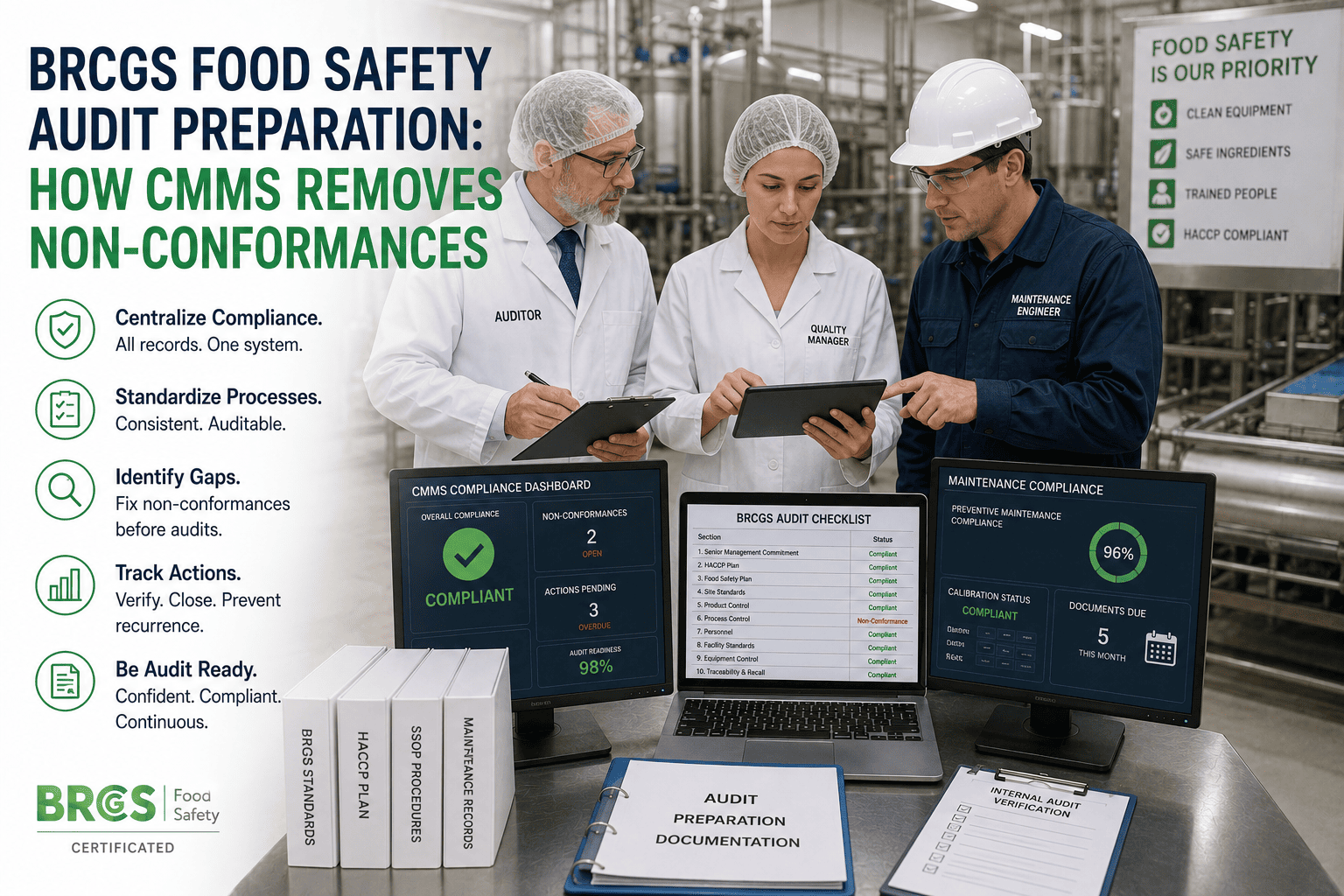
A retail customer second-party audit from Costco, Walmart, or Kroger can make or break a multi-million-dollar supply contract, yet most food plants scramble for documentation in the final 72 hours. This customer audit preparation guide breaks down exactly how to build a defensible, CMMS-driven compliance package so your food plant passes retail customer audits without reactive firefighting. By centralizing work orders, preventive maintenance schedules, and asset histories, maintenance and reliability teams can prove continuous compliance on demand. You can Start Free Trial to see how OxMaint transforms audit preparation from a manual scramble into an automated, export-ready process.
CUSTOMER AUDIT GUIDE 2026
Can your food plant prove compliance in 60 minutes — or will you lose the retail contract?
Retail second-party audits from Costco, Walmart, and Kroger have real teeth. A single missing preventive maintenance record or untraceable spare part can trigger a major non-conformance, halting shipments and freezing revenue. OxMaint turns your CMMS into an always-on, export-ready audit evidence engine.
PREPARATION STRATEGY
How to prepare for a retail customer's second-party audit
A food plant customer audit evaluates whether your maintenance operations meet the specific supplier quality requirements (SQRs) of major retailers. Unlike third-party certifications, second-party audits are buyer-driven and focus heavily on proof of execution — not just written procedures. Retailers want verifiable evidence that preventive maintenance was completed on time, corrective actions were documented, and spare parts used in food-contact zones are traceable. A CMMS food customer audit preparation strategy shifts your team from reactive evidence-gathering to continuous, system-level compliance.
Gap Assessment & SQR Mapping
Download the retailer's Supplier Quality Requirements and map every maintenance-related clause to a specific CMMS data field. Identify gaps where paper logs still exist and migrate them. Plants that conduct a formal gap assessment 60 days before the audit reduce major non-conformances by an average of 40%.
Documentation Packaging
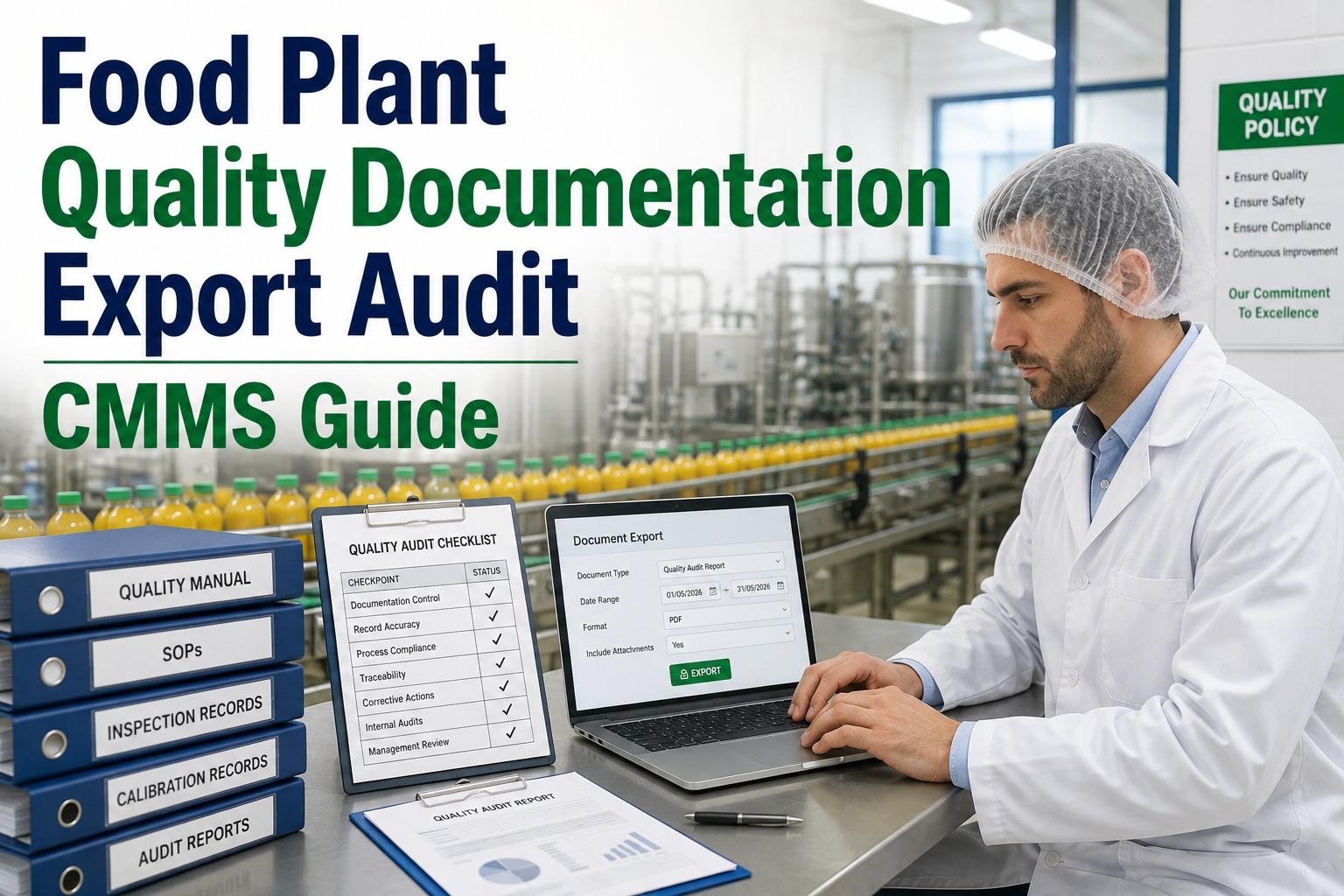
Build a customer-specific compliance package: PM schedules for critical assets, completed work order logs, calibration certificates, and MRO inventory transaction histories. OxMaint automatically filters this data by date range and asset class, generating an audit-ready export in under five minutes.
Internal Mock Audit
Run a simulated second-party audit using a cross-functional team. Pull 90 days of random work orders and verify signatures, completion times, and parts consumption. Mock audits uncover documentation blind spots — like missing technician sign-offs — that retail auditors will inevitably find.
Live Audit Execution
During the audit, use OxMaint's real-time dashboards to pull evidence on demand. When an auditor asks for the maintenance history of a specific filler or HVAC unit, generate the complete asset dossier — PMs, repairs, downtime, and parts — in seconds rather than hours.
DOCUMENTATION CHECKLIST
Customer audit documentation checklist for food plants
Retail auditors expect to see a closed-loop maintenance system. Use this checklist to verify your CMMS contains the exact records required for a customer audit 2026. Every item below should be retrievable in under two minutes from your system.
- PM schedules for all food-contact and critical assets
- Completed PM work orders with technician sign-offs
- Overdue PM reports with documented justifications
- Meter-based PM triggers (cycles, runtime, volume)
- Corrective work orders linked to root-cause analysis
- Downtime logs with failure codes (MTTR/MTBF data)
- Food safety holds and equipment release records
- Corrective action verification and closure dates
- Parts issued against work orders with lot traceability
- Food-grade lubricant compatibility documentation
- Critical spare parts min/max stock levels and alerts
- Supplier certificates of conformity for replacement parts
- Calibration certificates for scales, thermometers, sensors
- Asset hierarchy mapping equipment to production lines
- Equipment criticality ratings and risk assessments
- Master asset register with installation and warranty data
| Audit Requirement | Retailer Focus | CMMS Data Source | Evidence Format |
|---|---|---|---|
| Preventive Maintenance Compliance | On-time completion rate > 95% | PM Schedule Module | Date-stamped work order PDF |
| Corrective Action Traceability | Closed-loop root cause documentation | Work Order History | Linked WO + RCA attachment |
| Food-Contact Equipment Logs | Sanitation and maintenance separation | Asset Hierarchy & WO Types | Filtered asset dossier export |
| Spare Part Lot Traceability | Recall readiness for MRO components | Inventory Module | Issued parts transaction log |
| Calibration & Verification | Current, in-tolerance instruments | Predictive/Calibration Scheduler | Certificate + next-due date report |
REAL-WORLD SCENARIO
The cost of failing a retail second-party audit
Consider a mid-sized protein processing plant supplying private-label products to Kroger. The plant operates 180 critical assets across two packaging lines, generating roughly $42K per year in maintenance labor and MRO spend. When Kroger's quality team arrived for an unannounced second-party audit, the maintenance manager needed three full days to manually compile paper logs, reconcile spreadsheet PM schedules, and trace lot numbers for a replaced conveyor bearing.
Revenue frozen during a 5-day shipment hold triggered by an unresolved major non-conformance for missing PM records on a metal detector.
Time to generate a complete asset dossier — PM history, corrective actions, parts traceability, and calibration logs — directly from the dashboard during the audit.
Return on investment from avoided audit failures, reduced downtime, and eliminated manual documentation labor over 12 months.
The auditor found a 14-day gap in the metal detector's preventive maintenance log because the paper record had been misfiled. The result: a critical non-conformance, an immediate shipment hold, and a corrective action plan required within 30 days. The total cost of the documentation failure — including lost sales, expedited remediation labor, and a mandated third-party re-audit — exceeded $285,000. A CMMS retail second party food audit platform would have surfaced the gap automatically, flagged the overdue PM, and maintained a tamper-proof digital record.
PRODUCT FIT
How OxMaint CMMS keeps food plants audit-ready
OxMaint is an AI-powered CMMS and EAM platform built to make customer audit preparation effortless. Instead of treating compliance as an event, OxMaint embeds audit-readiness into every work order, every PM trigger, and every spare part transaction. Here is how OxMaint maps directly to your retail customer audit requirements:
Automated Work Order Documentation
Every corrective and preventive work order is digitally signed, time-stamped, and permanently archived. OxMaint eliminates paper logs entirely, ensuring 100% of maintenance records are retrievable in seconds — cutting audit prep time by up to 85%.
Predictive & Preventive Scheduling
AI-driven PM triggers ensure maintenance is always performed on time and on spec. OxMaint flags overdue PMs automatically and maintains a 95%+ on-time completion rate, directly satisfying the most scrutinized clause in any retail audit checklist.
Spare Parts Lot Traceability
OxMaint links every issued spare part back to a supplier lot number and a specific work order. When an auditor asks for bearing traceability on a filler motor, you pull the full transaction chain in one click — no spreadsheet cross-referencing required.
One-Click Audit Exports
Generate a customer-specific compliance package filtered by asset, date range, or retailer requirement. OxMaint compiles PM logs, calibration records, and parts histories into a single formatted PDF — turning a 72-hour manual task into a 5-minute export.
See OxMaint on your assets — book a 30-minute demo
Discover how OxMaint builds your retail customer audit compliance package automatically, so you walk into every second-party audit with total confidence.
FREQUENTLY ASKED QUESTIONS
Customer audit preparation: your top questions answered
What is a retail customer second-party audit in a food plant?
A second-party audit is a supplier verification audit conducted by a retail buyer (such as Costco, Walmart, or Kroger) to ensure your food plant meets their specific quality and safety requirements. Unlike third-party certifications, the retailer's own auditors assess your maintenance records, sanitation logs, and traceability systems, and non-conformances can directly suspend your supply contract.
How does a CMMS help with food customer audit preparation?
A CMMS centralizes all maintenance data — work orders, PM schedules, spare parts inventory, and asset histories — into a single, searchable system. Instead of manually compiling paper records, you can export a complete, date-stamped compliance package in minutes. You can Start Free Trial to test OxMaint's audit export features on your own asset data.
What documents do I need for a Costco or Walmart supplier audit?
Retailers typically require preventive maintenance schedules, completed corrective work orders with root-cause analysis, equipment calibration records, spare part lot traceability, and downtime logs. A CMMS food retail contract compliance package should also include master asset registers and proof of food-grade lubricant separation for food-contact equipment.
How far in advance should I start preparing for a customer audit in 2026?
You should begin a formal gap assessment at least 60 days before the scheduled audit date. This allows time to migrate any remaining paper records into your CMMS, run an internal mock audit, and resolve documentation gaps. With an AI-powered CMMS like OxMaint, continuous compliance means your preparation time drops to near zero because records are always audit-ready.
What happens if a food plant fails a retail second-party audit?
Failing a second-party audit can trigger an immediate shipment hold, freezing revenue and potentially costing hundreds of thousands of dollars per week. The retailer will require a documented corrective action plan within 30 days and may mandate a costly re-audit. To see how OxMaint prevents these failures, Book a Demo and we will show you a live audit-readiness dashboard.
Make your next retail audit the easiest one yet
Join the food plants using OxMaint to automate maintenance compliance, eliminate paper work orders, and pass second-party audits without the scramble.
Free 14-day trial · No credit card