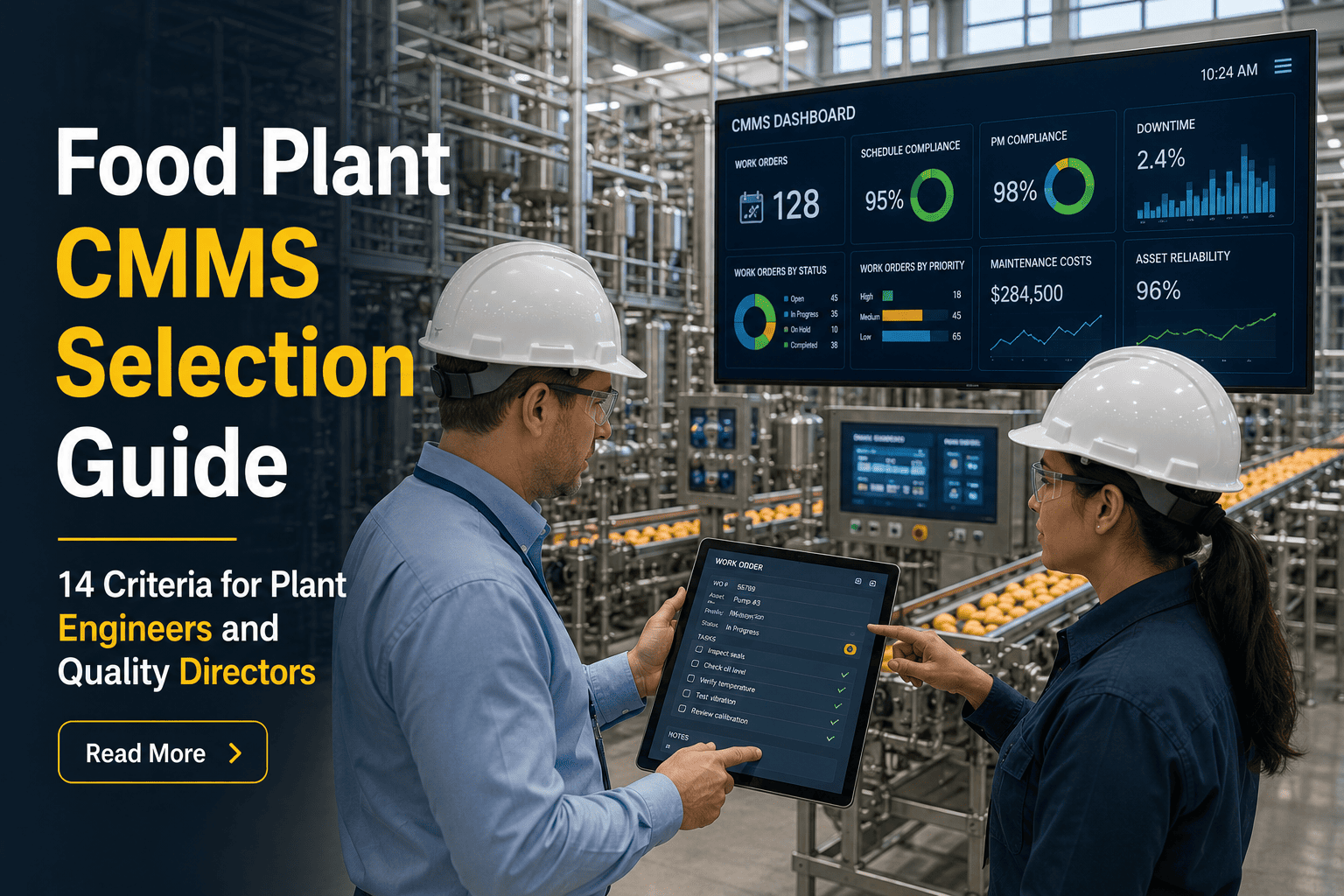
Selecting a CMMS for a food manufacturing facility is not the same as selecting maintenance software for a warehouse or a commercial building. Food plant CMMS decisions carry regulatory weight: the wrong system creates audit gaps, the wrong workflows fail GFSI scheme requirements, and a CMMS that lacks allergen logic can turn a changeover procedure into an uncontrolled cross-contact risk. Plant engineers need a system that manages asset hierarchy, PM scheduling, and work order execution efficiently. Quality directors need FSMA-compliant inspection records, GMP-aligned workflows, and audit export formats that do not require manual reformatting before every SQF or BRC visit. Getting the selection criteria wrong costs more than the annual subscription — it costs the re-implementation, the data migration, and the 18 months of incomplete records that accumulate while the team adapts to a system that was never designed for food manufacturing — start a free trial to evaluate Oxmaint against these 14 criteria with your own data, or book a demo and we will walk through your specific plant requirements.
FOOD MANUFACTURING · CMMS SELECTION · PLANT ENGINEERS AND QUALITY
Evaluate Your CMMS Against the 14 Criteria That Actually Matter in Food Plants
See how Oxmaint scores on FSMA workflows, allergen logic, GFSI exports, mobile parity, and ERP integration — the criteria that separate food-grade CMMS from generic maintenance software.
FSMA-ready inspection workflows
Allergen changeover logic built in
GFSI-formatted audit exports
No heavy implementation required · Live in days, not months · Works across multi-site portfolios
71%
of food plant CMMS implementations fail to meet quality director requirements within the first year
Source: Gartner EAM Survey
18mo
average time lost to re-implementation when the wrong CMMS is selected for a food facility
Source: ARC Advisory Group
$240K
average cost of CMMS re-selection and re-implementation in mid-size food manufacturing facilities
Source: Verdantix Maintenance Study
3 of 4
GFSI scheme auditors now check CMMS record quality as a proxy for maintenance program maturity
Source: GFSI Benchmarking Study
WHAT IS
Why Food Plant CMMS Selection Requires a Dedicated Evaluation Framework
A Computerized Maintenance Management System (CMMS) for food manufacturing must satisfy two sets of requirements simultaneously: the operational requirements of plant engineers (asset management, PM scheduling, work order execution, spare parts management) and the regulatory and food safety requirements of quality directors (FSMA compliance workflows, GMP inspection records, allergen changeover documentation, GFSI audit export capability).
Generic CMMS platforms — designed for facilities management, manufacturing, or utilities — typically cover the operational requirements adequately but lack the food-specific regulatory logic. This creates a hidden cost: the quality team builds parallel paper or spreadsheet systems to compensate for CMMS gaps, audit records are incomplete, and HACCP verification activities are not supported by the system that theoretically manages them.
The 14 criteria in this guide are drawn from food plant CMMS evaluation experience across FDA-regulated, USDA-inspected, GFSI-certified, and export-market facilities. They are sequenced from foundational (without which no other criteria matter) to differentiating (where the best platforms separate from average ones) — start a free trial to see how Oxmaint performs against your specific requirements.
14 SELECTION CRITERIA
The Complete Food Plant CMMS Evaluation Framework
Foundational
01
FSMA-Aligned Inspection Workflows
The CMMS must support structured inspection forms with mandatory fields, digital sign-off, photo evidence, and date/time stamps that satisfy FSMA preventive controls verification requirements — not just generic work order completion.
Foundational
02
GMP-Compliant Work Order Records
Work order completion records must be tamper-evident, timestamped, and retain the original entry without overwriting — GMP Part 11 principles require that records show what was done, when, by whom, and that corrections are traceable.
Foundational
03
Asset Hierarchy Matching Food Plant Structure
The CMMS must support a hierarchy that maps to food plant reality: Site, Building or Zone, System (e.g. pasteurization line), Asset (e.g. HTST), and Component (e.g. flow diversion valve). Flat asset lists or two-level hierarchies create navigation problems in complex facilities.
Foundational
04
Mobile Parity — Not Just Mobile Viewing
Technicians and sanitation teams must be able to create, progress, complete, and sign off work orders from mobile devices on the production floor — without needing desktop access for any step. Systems where mobile is view-only create adoption failure and paper fallback.
Regulatory
05
Allergen Changeover Workflow Logic
Allergen changeover procedures require sequential sign-off steps that cannot be bypassed — line clearance, allergen cleaning verification, first-piece inspection, and production release. The CMMS must enforce this sequence, not just record that it was completed.
Regulatory
06
Calibration Management with NIST Traceability
Calibration intervals, due-date alerts, NIST-traceable certificate storage, and out-of-tolerance impact assessment workflows must be native CMMS functions — not managed in a separate quality system that creates record silos.
Regulatory
07
GFSI Scheme Audit Export Capability
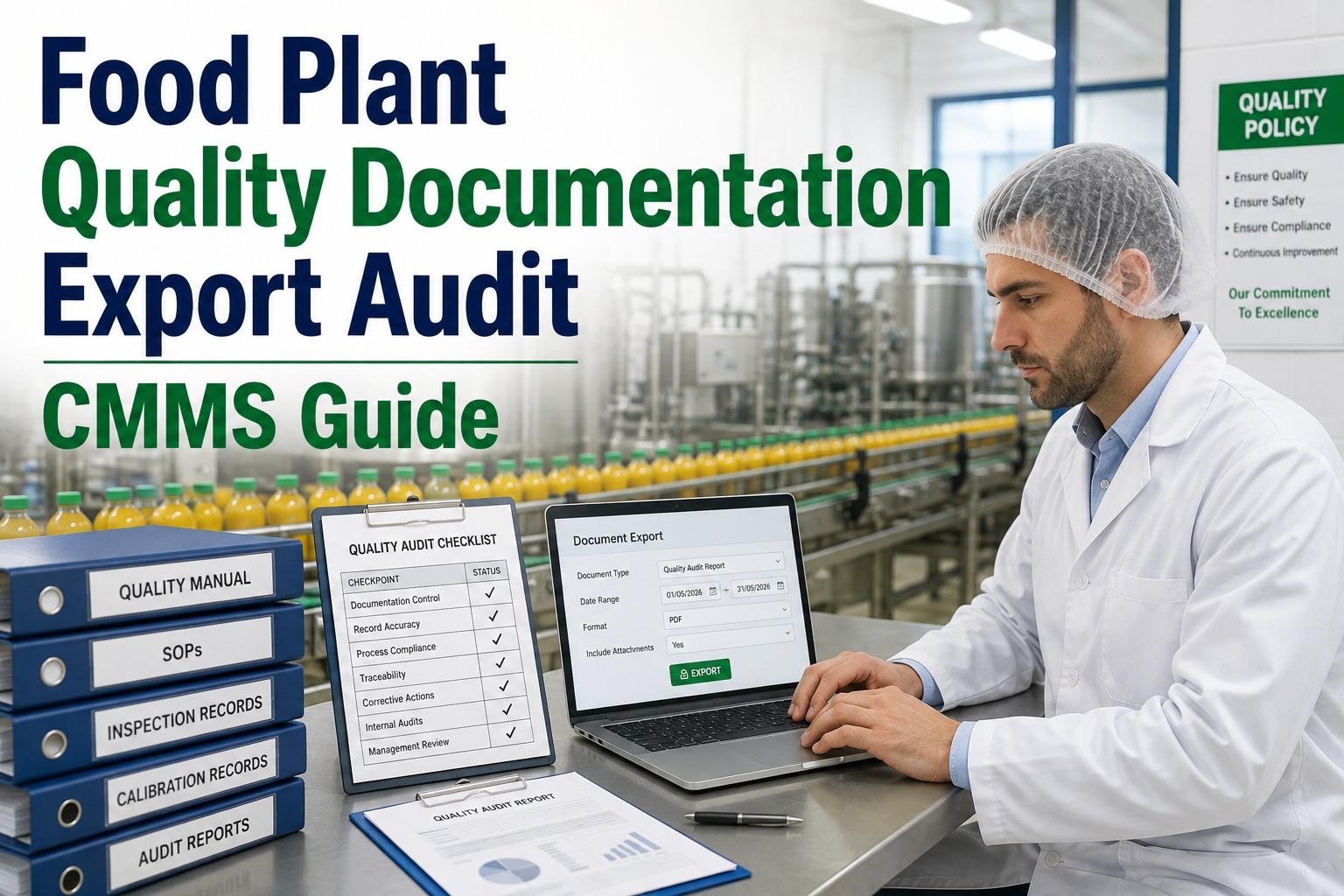
The CMMS must be able to export PM completion records, work order histories, calibration schedules, and inspection records in formats directly usable for SQF, BRC, FSSC 22000, and IFS audits — without manual reformatting that creates error risk and preparation burden.
Regulatory
08
Sanitation Work Order Integration
Sanitation master schedules (daily CIP, weekly deep clean, monthly environmental monitoring zone cleaning) must be manageable within the CMMS alongside maintenance PMs — so operations managers see one integrated schedule, not two parallel systems.
Operational
09
Spare Parts and MRO Inventory Integration
Parts consumption linked to work orders, minimum stock alerts, vendor lead times, and multi-site spare parts visibility are essential for food plant maintenance where unplanned parts shortages cause production downtime that exceeds the cost of the part by orders of magnitude.
Operational
10
OEE and Downtime Tracking
Work order completion data should feed OEE dashboards showing planned vs unplanned downtime by asset, line, and site. This connection transforms maintenance records from cost center data into production performance intelligence for plant managers and operations directors.
Operational
11
Contractor and Vendor Management
External contractors performing maintenance, calibration, and inspection in food plants require work permits, GMP induction records, and controlled access to work order information. The CMMS must support contractor portal access with appropriate record scope limits.
Differentiating
12
Multi-Site Portfolio Visibility
Food manufacturers operating multiple plants need portfolio-level maintenance KPI visibility — PM compliance rates, unplanned downtime, calibration overdue counts, and open corrective actions — across all sites simultaneously from a single dashboard without site-switching.
Differentiating
13
CapEx Forecasting from Asset Condition Data
Asset condition scores derived from maintenance history, inspection findings, and age data should feed rolling 5–10 year CapEx models — giving operations directors and finance teams the asset-based evidence needed for capital budget justification.
Differentiating
14
ERP Integration for Procurement and Finance
Work order parts consumption, purchase requisition generation, and maintenance cost allocation should integrate with SAP, Oracle, or other ERP systems — eliminating dual-entry, ensuring accurate maintenance cost tracking, and connecting maintenance decisions to financial reporting.
71% of food plant CMMS implementations fail to meet quality director requirements in year one — because selection criteria focused on maintenance features while ignoring regulatory workflows.
INDUSTRY PAIN POINTS
The Hidden Costs of the Wrong CMMS in a Food Plant
Food plants that select a CMMS based on price, IT department preference, or vendor demonstrations that focus on dashboards rather than compliance workflows consistently encounter the same set of operational and regulatory failures within 12 months of go-live — start a free trial to evaluate Oxmaint against your current system's gaps.
01
Quality Team Builds Parallel Paper Systems
When the CMMS lacks inspection workflows that satisfy GFSI or FSMA requirements, the quality team maintains separate paper records alongside the CMMS. This dual-system burden consumes QA time and creates record inconsistencies that are flagged immediately in external audits.
02
Mobile App Is View-Only for Technicians
Systems that restrict mobile functionality to viewing work orders force technicians to return to the office or use paper to record completion data, then transcribe it later. Transcription errors, delays, and incomplete records are the direct consequence — along with technician frustration that drives adoption failure.
03
Allergen Changeover Not Enforced by System
Generic CMMS systems record that allergen cleaning was done — they do not enforce the sequential sign-off steps that prevent production restart until all verification steps are complete. The difference matters enormously when an allergen incident investigation asks for evidence that the procedure was followed, not just recorded.
04
ERP Integration Requires Custom Development
Many CMMS vendors promise ERP integration but deliver it as a custom development project that costs $50,000–$200,000 and takes 6–12 months post-implementation. This is a selection failure — mature food manufacturing CMMS platforms have pre-built ERP connectors that integrate without custom code.
HOW OXMAINT SOLVES IT
How Oxmaint Scores on All 14 Criteria
Built-In FSMA and GFSI Workflow Templates
Oxmaint includes pre-configured inspection and work order templates aligned to FSMA preventive controls verification, SQF, BRC, and FSSC 22000 requirements. No custom development needed — food-specific regulatory workflows are ready on day one.
Full Mobile Parity on iOS and Android
Every CMMS function available on desktop is available on mobile — including work order creation, completion, sign-off, photo attachment, and checklist execution. Technicians and sanitation teams work entirely from mobile devices on the production floor, with offline capability for areas with poor connectivity.
Allergen Changeover Sequential Sign-Off Enforcement
Oxmaint's configurable workflow gates enforce allergen changeover procedure sequence — each step must be completed and signed off before the next step is accessible. Production release cannot be triggered until all verification steps are complete, creating an unbypassable evidence trail.
Five-Level Asset Hierarchy for Food Plant Complexity
Oxmaint's Portfolio, Property, System, Asset, Component hierarchy maps precisely to food plant organizational reality — from corporate portfolio level to individual instrument components. Asset records carry the full lineage for every work order, inspection, and calibration event.
Native Calibration Management with NIST Traceability
Calibration scheduling, certificate storage, NIST traceability chain management, and out-of-tolerance impact assessment are native Oxmaint features — in the same system as maintenance work orders. No separate quality system required for calibration management.
ERP Integration Without Custom Development
Oxmaint provides API-based integration with major ERP platforms for parts inventory, purchase requisitions, and cost allocation. Pre-built connectors for common platforms are available without custom development — integration is a configuration exercise, not a development project.
BEFORE VS AFTER
Generic CMMS vs Food-Grade CMMS: What the Difference Costs
| Selection Criterion |
Generic CMMS |
Oxmaint Food-Grade CMMS |
| FSMA Inspection Workflows |
Generic work order forms requiring custom configuration by IT |
Pre-built FSMA preventive controls verification templates, ready day one |
| Allergen Changeover |
Records that it was done; does not enforce sequence or block production restart |
Sequential sign-off gates that block production release until all steps verified |
| Mobile Capability |
View-only or limited mobile app; completion requires desktop access |
Full mobile parity — create, complete, sign off any work order from the production floor |
| Calibration Management |
Separate quality system required; calibration and maintenance records siloed |
Native calibration module with NIST traceability in the same CMMS |
| GFSI Audit Export |
Manual report compilation taking 2–3 days before every audit |
One-click audit export in GFSI-ready format with configurable date range and scope |
| ERP Integration |
Custom development required: $50K–$200K, 6–12 months |
API-based pre-built connectors; configuration only, no custom development |
The average food plant loses $240,000 and 18 months of productivity to a failed CMMS implementation. The right selection criteria eliminate that risk entirely.
ROI AND RESULTS
The ROI of Getting CMMS Selection Right
The financial case for a structured CMMS selection process is built on three avoidable costs: re-implementation after the wrong selection, compliance failures from inadequate food safety workflows, and productivity losses from systems that require parallel paper records — start a free trial to see how Oxmaint performs against your current system.
$240K
Average re-implementation cost avoided
When selection criteria match food plant requirements and system delivers without re-implementation
2–3 days
Audit preparation time saved per audit cycle
GFSI-ready export vs manual report compilation across SQF, BRC, and FSSC 22000 audits
40%
Reduction in QA time spent on parallel records
When CMMS replaces parallel paper systems for inspection, calibration, and allergen changeover records
18mo
Productivity recovery avoided
Average time lost to re-implementation when wrong CMMS is selected; avoided entirely with structured 14-criteria evaluation
FAQ
CMMS Selection Questions from Plant Engineers and Quality Directors
How long does a food plant CMMS RFP and selection process typically take?
A structured CMMS selection process for a mid-size food manufacturing facility typically takes 8–12 weeks from initial scoping to final vendor selection. The process should include: a cross-functional requirements workshop (plant engineering, quality, operations, IT, finance) to define weighted criteria; a long-list vendor review against the 14 criteria in this guide; a shortlist of 3–4 vendors for demonstration; a pilot or proof-of-concept with real plant data; and a reference check with existing food manufacturing customers. Compressing this timeline by skipping the cross-functional requirements step is the most common cause of misaligned selections.
Should the CMMS selection process be led by plant engineering or quality?
The selection process should have a co-lead structure: plant engineering leads the operational criteria evaluation (asset hierarchy, PM scheduling, work order management, mobile functionality, spare parts, ERP integration), and quality leads the regulatory criteria evaluation (FSMA workflows, GFSI exports, allergen logic, calibration management, GMP record requirements). A single-department selection process consistently under-weights the other department's requirements and produces the implementation failures that drive re-selection costs. The final decision should require sign-off from both functions.
How do you evaluate a CMMS vendor's food manufacturing credentials during the selection process?
Request food manufacturing customer references specifically — not just manufacturing references, as pharmaceutical, automotive, and food requirements differ significantly. Ask reference customers about GFSI audit experiences using the CMMS, FDA or USDA inspection outcomes, allergen changeover workflow performance, and calibration management. Request a live demonstration using food plant scenarios — allergen changeover with sequential sign-off, calibration overdue alert, FSMA inspection record export. Vendor experience with your specific GFSI scheme (SQF, BRC, FSSC 22000) is a material differentiator.
Book a demo to see Oxmaint's food manufacturing workflows in action.
What is the most common CMMS selection mistake food plants make?
The most consistent selection failure is evaluating CMMS platforms on feature lists rather than workflow demonstrations. A vendor's feature list will claim FSMA compliance, allergen management, and GFSI export capability — the question is whether those features work as food manufacturing workflows or as generic functions that require significant configuration to approach food plant requirements. Always require a live demonstration using a food plant scenario, not a scripted product tour, and always involve the quality director in the evaluation of regulatory workflow demonstrations — plant engineers evaluating food safety workflow adequacy consistently over-score systems that maintenance professionals find adequate but quality professionals find insufficient.
CMMS SELECTION GUIDE · OXMAINT FOOD MANUFACTURING
Stop Evaluating CMMS on the Wrong Criteria
Oxmaint is built for food manufacturing from the ground up — FSMA workflows, allergen changeover enforcement, GFSI exports, calibration management, and full mobile parity. Evaluate it against all 14 criteria with your own plant data.
Real-time asset and compliance visibility
Allergen and FSMA workflows built in
5–10 year CapEx forecasting from asset condition
Used by operations teams managing 10,000+ assets · See measurable results in the first 30 days · Limited onboarding slots available this quarter
No heavy implementation required · Live in days, not months · Works across multi-site portfolios