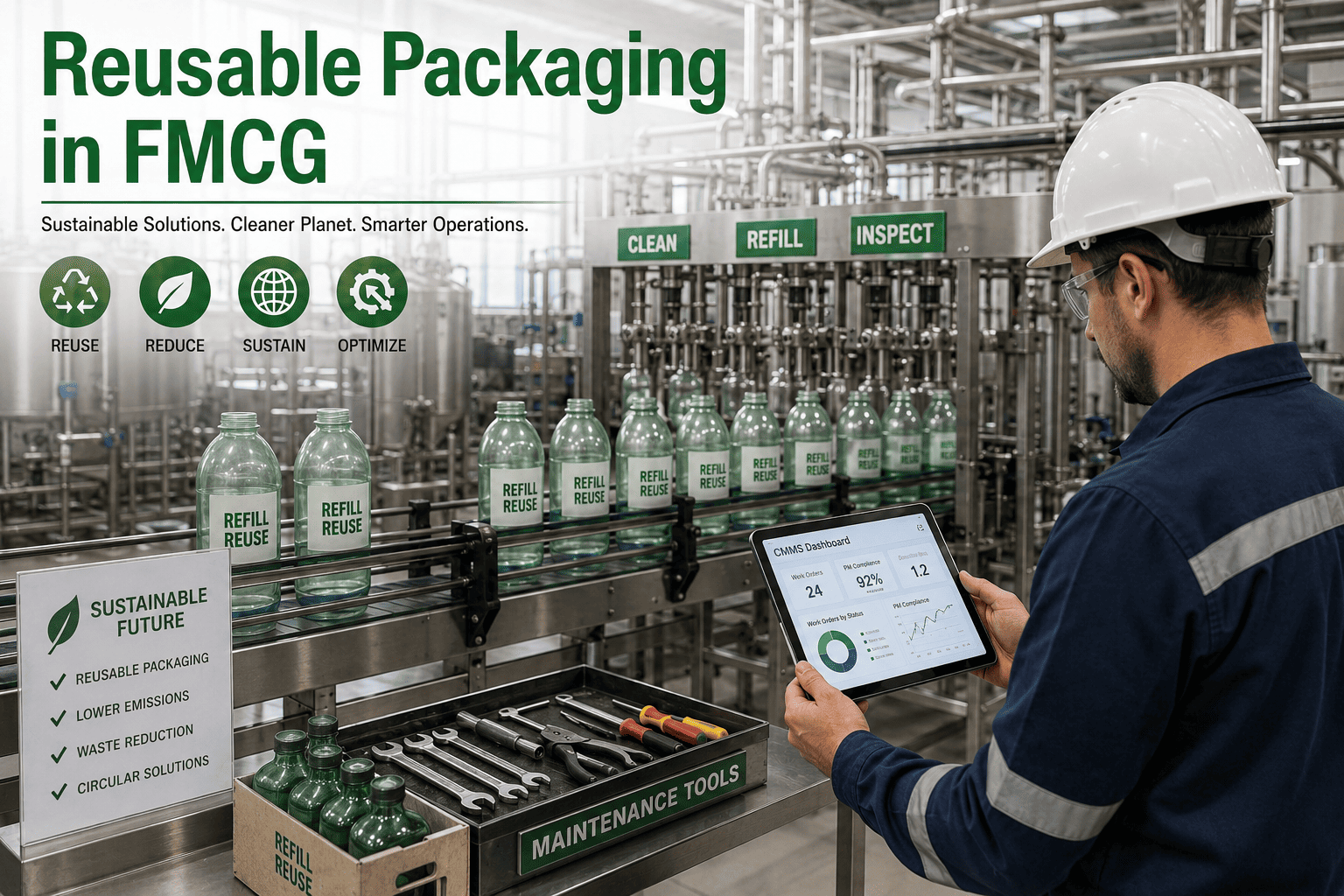
The EU Packaging and Packaging Waste Regulation (PPWR 2025/40) takes legal effect on 12 August 2026 — and every FMCG manufacturer placing products on the EU market must comply. By 2030, 40% of transport packaging must be reusable, 10% of grouped packaging must be in reuse systems, and beverage distributors must transition 10% of products to reusable formats. Compliance is not optional. But the operational challenge is just as large as the regulatory one: reusable and closed-loop packaging requires rigorous asset tracking, reconditioning maintenance, and documented hygiene compliance that most CMMS platforms were never designed to handle. This page explains exactly what FMCG maintenance teams must do — and how OxMaint makes it audit-ready.
Start Free Trial Book 30-Min Demo- PPWR 2025/40 applies from 12 August 2026 — non-compliant packaging cannot be placed on the EU market
- Reusable packaging documentation must be retained for 10 years — double the standard 5-year requirement
- PFAS-containing food-contact packaging is banned from market from 12 August 2026 — immediate reformulation required
What Is Reusable Packaging Under PPWR 2025/40?
The EU Packaging and Packaging Waste Regulation (PPWR), Regulation EU 2025/40, defines reusable packaging as packaging designed to complete multiple use cycles within a formalised reuse system — either a closed-loop system (where packaging circulates within a defined network of participants and remains under the operator's brand and tracking) or an open-loop system (where packaging circulates among an unspecified number of participants across the supply chain).
For FMCG manufacturers, this creates two parallel obligations. First, a product compliance obligation: ensuring that reusable packaging meets PPWR recyclability and substance restrictions (including the PFAS ban effective 12 August 2026 for food-contact materials). Second, a maintenance and operational obligation: packaging that re-enters the production cycle must be reconditioned — inspected, cleaned, and verified — before every reuse cycle. That reconditioning process must be traceable, timestamped, and retained in compliance records for up to 10 years.
6 Key PPWR Reusable Packaging Obligations FMCG Teams Must Know
Transport Packaging Reuse Targets
By 2030, 40% of packaging used for transporting products within the EU must be reusable — rising to 70% by 2040. FMCG manufacturers moving goods across EU distribution networks must redesign pallet systems, secondary packaging, and transit containers to meet these thresholds within formalised reuse systems.
Grouped Packaging Reuse Mandates
From 2030, 10% of grouped packaging (multi-packs, shelf-ready packaging, bundling formats) must be in reuse systems, increasing to 25% by 2040. For FMCG brands in personal care, household products, and food, this means redesigning secondary packaging lines and establishing collection and reconditioning infrastructure.
PFAS Food-Contact Ban (August 2026)
From 12 August 2026, food-contact packaging containing PFAS (per- and polyfluoroalkyl substances) above specified concentration limits cannot be placed on the EU market. FMCG manufacturers using fluorinated coatings in grease-resistant food packaging, beverage containers, or wrapping materials must complete reformulation and supplier requalification immediately.
10-Year Documentation Obligation
Reusable packaging documentation — conformity assessments, technical specifications, reconditioning records, and EU declarations of conformity — must be maintained for 10 years, double the standard 5-year period. This creates a long-term traceability obligation that spreadsheets and paper systems cannot reliably fulfil across thousands of packaging cycles.
Reconditioning Before Every Reuse
PPWR Article 11 mandates that operators using reusable packaging must participate in formal reuse systems and ensure packaging is reconditioned before every further use cycle. Reconditioning includes cleaning verification, structural integrity inspection, hygiene compliance checks, and fitness-for-purpose sign-off — all traceable to the specific packaging unit and cycle number.
Beverage Distributor Reuse Quotas
Beverage distributors must ensure 10% of products are offered in reusable packaging by 2030, rising to 40% by 2040. For FMCG beverage manufacturers — bottled water, soft drinks, dairy, juices — this drives adoption of returnable container systems, deposit-return programmes, and refill-station integration, each with its own maintenance and tracking requirements.
6 Pain Points FMCG Plants Face Managing Reusable Packaging
No Visibility Into Packaging Asset Lifecycle
Reusable containers, pallets, and refillable vessels are production assets — but most CMMS platforms don't track them as assets. Manufacturers lose count of how many cycles each unit has completed, when it was last reconditioned, and whether it is still fit for food contact. Without lifecycle visibility, compliance evidence simply doesn't exist at audit time.
Reconditioning Records Scattered Across Systems
Cleaning verification, structural inspection, and hygiene sign-off records may sit in three different systems — or on paper. When a national authority requests 10 years of reconditioning records for a specific reusable container batch, assembling that evidence from fragmented sources consumes weeks of labour and still carries risk of incomplete documentation.
PFAS Supplier Requalification Chaos
The August 2026 PFAS ban in food-contact packaging requires manufacturers to requalify packaging suppliers against new concentration limits, update approved-supplier registers, and retain conformity documentation. Without a centralised compliance management workflow, requalification timelines slip and non-compliant packaging enters the production supply chain undetected.
Closed-Loop Tracking Without Barcode/RFID Integration
Closed-loop reuse systems require each packaging unit to be individually identified and tracked from dispatch through reconditioning back to refill. Plants without barcode scanning or RFID integration lose track of units in the field, cannot confirm reconditioning completion before reuse, and have no audit trail linking a specific container to its food-contact history.
PM Scheduling Conflicts at Reconditioning Lines
Reconditioning lines — washers, sterilisers, inspection cameras, filling heads — require their own preventive maintenance schedules. When these schedules are managed separately from production PMs, clashes create line stoppages that interrupt reuse cycles, create gaps in continuity of compliance, and expose the plant to non-conformance findings at audit.
Greenwashing Risk Without Documented Sustainability Claims
PPWR restricts environmental claims to packaging properties that demonstrably exceed minimum regulatory requirements. FMCG brands making "sustainable packaging" or "circular economy" claims must back them with evidence — cycle counts, material composition data, reconditioning verification records. Without a CMMS-level evidence trail, marketing claims expose the brand to Unfair Commercial Practices enforcement under EU 2024/825.
How OxMaint Manages Reusable Packaging Compliance
Packaging Asset Register with Cycle Tracking
Register every reusable container, tray, pallet, and refillable vessel as a tracked asset in OxMaint. Assign serial numbers or RFID tags, log every reconditioning cycle, and monitor total cycle count and age against design-life thresholds. When a unit reaches end-of-reuse-life, OxMaint flags it automatically for retirement or return to supplier.
Reconditioning Workflow with Digital Sign-Off
Build standardised reconditioning checklists in OxMaint — cleaning verification, structural inspection, hygiene compliance, fitness-for-reuse sign-off — and capture digital completion records with timestamps, technician IDs, and photo evidence. Every completed reconditioning cycle is automatically logged against the packaging asset record and retained for the full 10-year PPWR period.
Production-Integrated Reconditioning PM Scheduling
OxMaint reads production and refill schedules to align reconditioning-line PM tasks — washer calibration, steriliser validation, inspection camera checks — with demand gaps. PM deferrals that interrupt closed-loop continuity are eliminated. Reconditioning capacity is always available when incoming reusable packaging arrives from distribution.
Supplier Qualification Document Vault
Store PFAS compliance declarations, material safety data sheets, EU declarations of conformity, and supplier requalification records directly against each packaging asset or supplier profile in OxMaint. Expiry date alerts flag approaching requalification deadlines. When an authority requests documentary evidence, the full compliance pack is retrieved in minutes — not weeks.
Closed-Loop Dispatch and Return Tracking
Track every packaging unit from dispatch to customer, through return, through reconditioning, and back to the refill line — with a complete chain-of-custody log. Barcode scan and RFID integrations capture physical movements. You always know how many reusable units are in circulation, in reconditioning, or awaiting retirement — giving accurate input for PPWR reuse-ratio reporting.
PPWR Audit-Ready Compliance Reports
Generate ready-to-submit PPWR compliance reports from OxMaint: reuse-ratio calculations by packaging category, reconditioning cycle counts by asset, PFAS-compliance status by supplier and material, and environmental claims substantiation evidence. Demonstrate to national authorities — and internal ESG teams — that reusable packaging claims are backed by verifiable operational data.
Reactive Packaging Management vs PPWR-Ready Closed-Loop CMMS
| Dimension | Reactive / Untracked Approach | OxMaint Closed-Loop Management |
|---|---|---|
| Packaging Asset Visibility | No cycle count, no location tracking; units lost in distribution | Every unit tracked from dispatch to return with serial/RFID; real-time cycle count and location |
| Reconditioning Evidence | Paper checklists, incomplete records, high audit risk | Digital reconditioning log per asset per cycle; auto-retained for 10 years |
| PFAS Compliance | Supplier declarations filed manually; expiry not tracked | Declarations stored against supplier/asset; expiry alerts prevent gaps |
| Reconditioning Line PMs | PMs scheduled separately, clash with reuse-cycle demand | Production-synced PM scheduling; reconditioning capacity always maintained |
| Reuse Ratio Reporting | Manual count of dispatched vs returned units; high error rate | Automated reuse-ratio calculation by packaging category; PPWR-ready reports |
| Environmental Claims Evidence | Marketing claims not backed by traceable operational data | Cycle counts, material data, reconditioning records — full substantiation for PPWR-compliant claims |
| Audit Response Time | Weeks assembling reconditioning and supplier records | Complete 10-year compliance pack retrieved in minutes from CMMS |
Frequently Asked Questions
Does PPWR apply to non-EU FMCG manufacturers?
Yes — PPWR 2025/40 applies to all packaging placed on the EU market, regardless of where the manufacturer is based. Importers and distributors placing packaged products on the EU market are included in the regulation's definition of "producers" and share compliance obligations. Any FMCG manufacturer exporting to EU markets must ensure its packaging meets PPWR recyclability, substance restriction, and reuse system requirements from 12 August 2026.
What does "reconditioning" require under PPWR for FMCG reusable packaging?
PPWR requires that reusable packaging is reconditioned before every further use cycle. For food-contact FMCG packaging, reconditioning typically includes a validated cleaning or sterilisation process, a structural integrity inspection (checking for cracks, contamination, damage), a hygiene compliance verification, and a fit-for-reuse sign-off. Each of these steps must be documented and traceable to the specific packaging unit, with records retained for the full 10-year PPWR documentation period.
What is the difference between closed-loop and open-loop reuse systems under PPWR?
A closed-loop system is one where reusable packaging circulates within a defined, controlled network — for example, a dairy manufacturer's own returnable bottles collected from its own retail partners and reconditioned in its own facility. An open-loop system involves packaging circulating among an unspecified number of participants, with ownership potentially changing at different stages. PPWR Annex VI defines both models. Closed-loop systems are generally easier to audit because the operator controls the full reconditioning and tracking chain.
Can a CMMS like OxMaint generate PPWR reuse-ratio reports automatically?
Yes. OxMaint tracks every packaging unit's dispatch, return, and reconditioning cycle in a structured asset register. Reuse ratios by packaging category — transport, grouped, sales — are calculated automatically from dispatch and reconditioning log data. Reports can be generated for any date range and exported in formats suitable for regulatory submission, internal ESG reporting, or third-party assurance review. No manual spreadsheet count is required.
PPWR Compliance Starts With a Traceable Packaging Asset Register
OxMaint gives FMCG teams the closed-loop tracking, reconditioning workflow management, and 10-year documentation retention needed to meet PPWR 2025/40 from day one — without spreadsheets or manual record assembly.
Start Free Trial Book 30-Min Demo