EPR (Extended Producer Responsibility) for FMCG Packaging: 2026 Compliance Roadmap
By Jack Edwards on May 13, 2026
Extended Producer Responsibility is no longer a future compliance concern for FMCG manufacturers — it is a 2026 operational reality. EPR fees tied to packaging weight, recyclability, and material composition are already live in France, Germany, Spain, and across EU member states. The EU Packaging and Packaging Waste Regulation (PPWR), advancing toward enforcement, will require FMCG producers to prove recyclability percentages, track packaging material volumes by SKU, and pay eco-modulated fees based on how recoverable their packaging actually is. The manufacturers who cannot produce granular packaging data will face the highest fee brackets by default. Your maintenance team holds a critical piece of this puzzle — packaging line asset records, material changeover logs, and equipment inspection histories that document which packaging formats run on which lines and at what volumes. A CMMS that captures this operational data transforms your compliance posture from reactive to audit-ready. Start a free trial on Oxmaint and begin linking your packaging asset records to EPR compliance workflows, or book a demo to see how FMCG plants are preparing for PPWR enforcement today.
FMCG Compliance · EPR and PPWR 2026
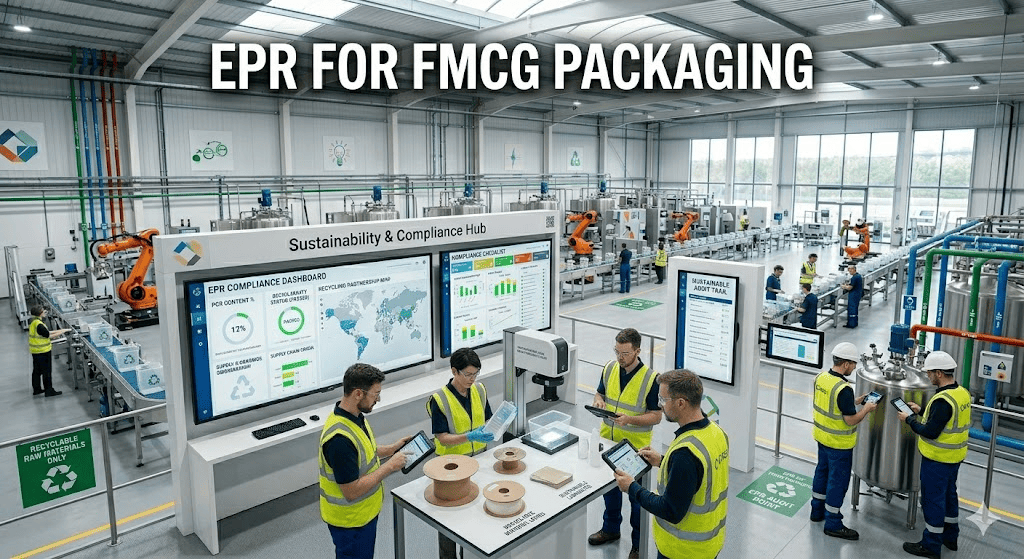
EPR for FMCG Packaging: 2026 Compliance Roadmap
EPR fees are rising and PPWR enforcement is approaching. Discover how FMCG manufacturers capture packaging compliance data using CMMS systems before audits and penalty brackets increase.
of all packaging placed on EU markets must be reusable or recyclable at scale under PPWR by 2030
€800M+
in EPR fees collected annually in France alone — FMCG sector bears the largest share by volume
4x
higher eco-modulation fees for packaging formats that cannot demonstrate recyclability certification
2026
PPWR enforcement milestone — FMCG manufacturers must report packaging volumes by material type and format
What Is EPR and How Does PPWR Affect FMCG Manufacturers
Extended Producer Responsibility (EPR) is a regulatory framework that holds manufacturers financially responsible for the end-of-life management of their packaging. In the FMCG sector, this means paying fees to national producer responsibility organizations based on the volume, weight, and recyclability of every packaging format placed on market. The EU Packaging and Packaging Waste Regulation (PPWR) significantly strengthens EPR by introducing eco-modulation — fee structures that vary based on how recyclable, reusable, or recycled-content-containing your packaging actually is. Manufacturers with unverified or poorly documented packaging data face the highest default fee brackets.
For FMCG operations, EPR compliance requires three capabilities: tracking packaging volumes by SKU and material type, maintaining asset-level records of which packaging formats run on which production lines, and documenting packaging changeovers to support material composition audits. This is where maintenance data becomes commercially valuable. Packaging line records, material specification logs from PM tasks, and equipment inspection histories held inside a CMMS provide the audit trail that reduces eco-modulation fees and satisfies producer responsibility organization reporting requirements. Start a free trial and connect your packaging line assets to EPR data collection, or book a demo to see the full compliance workflow.
6 Core EPR and PPWR Concepts FMCG Manufacturers Must Understand
01
Eco-Modulation
EPR fees are scaled by recyclability score. Packaging that cannot demonstrate design-for-recycling certification or recycled content percentage incurs the highest fee bracket — often 3–4x the minimum rate.
02
Producer Responsibility Organizations
FMCG manufacturers must register with national PROs (such as CITEO in France or dual System in Germany) and report packaging volumes by material type annually. Underreporting triggers penalty audits.
03
Packaging Material Reporting
Volume reporting requires granular data: plastic by polymer type, paper and cardboard by grade, glass by color, and metal by material. Asset-level production records are the primary source for this data.
04
Reusability Targets Under PPWR
PPWR mandates that specific packaging categories meet reusability targets by 2030. For FMCG manufacturers, this means introducing refill and reuse formats — which create new maintenance and inspection requirements.
05
Recycled Content Obligations
PPWR sets minimum recycled content thresholds for plastic packaging — 10% by 2030 rising to 35–65% by 2040 depending on format. Recycled content percentages require supply chain documentation to substantiate.
06
Plastic Packaging Tax
The UK Plastic Packaging Tax (£210.82/tonne in 2024/25) applies to plastic packaging with less than 30% recycled content. FMCG exporters to the UK face liability for every SKU that does not meet the recycled content threshold.
Where EPR Compliance Breaks Down for FMCG Manufacturers
No SKU-Level Packaging Volume Tracking
EPR fee calculations require packaging volumes by material type, weight, and SKU. FMCG plants without asset-linked production records report at the site level and pay blended maximum fees rather than actual lower rates.
Recyclability Claims Without Documentation
Eco-modulation fee reductions require documented recyclability certification per packaging format. Manufacturers that claim recyclability without audit-ready evidence face both higher fees and PRO audit exposure.
Changeover Records Not Linked to Compliance
Packaging line changeovers introduce new material formats with different EPR fee implications. Without CMMS-linked changeover logs, compliance teams cannot reconcile production schedules with material volume declarations.
Multi-Country Fee Calculation Errors
FMCG groups placing products in multiple EU markets face different EPR fee schedules per country. Without granular asset-level production data, allocating packaging volumes to the correct national PRO is impossible to audit.
FMCG manufacturers paying default EPR fee brackets may be overpaying by 200–400% compared to peers with documented recyclability and material composition data.
How Oxmaint Supports EPR Packaging Compliance for FMCG Operations
Oxmaint creates the maintenance data infrastructure that EPR compliance requires at the asset and production line level. Packaging equipment is registered in the asset hierarchy — filler, capper, labeller, wrapper — with material specifications recorded against each asset's PM profile. Changeover work orders capture which packaging format was installed and when, creating a timestamped record of every material type that ran on every line throughout the reporting year. This operational data, already generated by your maintenance team, becomes the evidence base for granular PRO reporting and eco-modulation fee optimization. Book a demo and see how Oxmaint links packaging line maintenance records to EPR material volume reporting in a live FMCG environment.
Packaging Asset Registry with Material Profiles
Register every packaging line asset with material specifications, format capabilities, and compliance certifications. Oxmaint maintains a traceable record of which materials each asset processes at every production run.
Changeover Work Order Logging
Every packaging changeover is recorded as a work order with format details, material type, and timestamps. This creates the audit trail that links production volumes to specific packaging materials for annual PRO reporting.
PM Schedule for Recyclability Maintenance
Reusable and high-recyclability packaging formats require specific maintenance protocols to retain their certification status. Oxmaint PM schedules enforce these protocols and log completion records required for eco-modulation fee claims.
Multi-Site Volume Consolidation
For FMCG groups with multiple packaging facilities, Oxmaint consolidates production asset records across sites — enabling accurate national market volume declarations per PRO without manual spreadsheet reconciliation.
Inspection Records for Compliance Audits
PRO audits and PPWR enforcement checks require documented evidence of packaging compliance maintenance. Oxmaint GMP-compliant inspection records provide timestamped, user-attributed evidence for every audit request.
CapEx Forecasting for Packaging Line Transitions
PPWR reusability targets require packaging line capital investment. Oxmaint rolling 5–10 year CapEx models forecast the equipment investment required to meet format transition timelines before fee penalties apply.
Manual EPR Reporting vs. CMMS-Linked Packaging Compliance
EPR Compliance Task
Manual / Disconnected Approach
Oxmaint CMMS Approach
Material Volume Reporting
Estimated from purchasing records; format mismatches common; PRO audits flag discrepancies
Asset-linked changeover logs provide timestamped material volume records by format and line
Eco-Modulation Fee Claims
Default fee bracket applied; no documentation to claim lower recyclability rate
Recyclability maintenance records and PM completion logs support lowest fee bracket claims
Changeover Traceability
Production schedule only; no timestamp trail for material format transitions
Work order records with format, material, timestamp, and technician ID for every changeover
Multi-Country Allocation
Manual spreadsheet allocation by market; high error rate in annual declarations
Portfolio dashboard consolidates site production records for accurate per-country PRO reporting
CapEx Planning for Compliance
Ad-hoc capex requests when penalties arrive; reactive line modifications
Rolling CapEx models forecast packaging line investment required ahead of PPWR target milestones
Immutable maintenance records ready for PRO audit requests within hours of submission
EPR Compliance ROI for FMCG Manufacturers
40%
average EPR fee reduction achievable through documented eco-modulation claims versus default fee brackets
€800M+
annual EPR collections in France — FMCG manufacturers contribute the largest share without granular data
4x
higher fee rates for non-recyclable packaging under eco-modulation versus documented recyclable formats
2030
PPWR reusability target year — CapEx planning for packaging line transitions must start no later than 2026
FMCG plants without CMMS-linked packaging asset records will pay maximum default EPR fees every year — while competitors with documented recyclability evidence claim minimum rates.
Frequently Asked Questions
What is eco-modulation and how does it affect FMCG EPR fees?
Eco-modulation is a fee-scaling mechanism used by producer responsibility organizations to reward packaging that is more recyclable, contains higher recycled content, or is designed for reuse. FMCG manufacturers with packaging that scores well on recyclability assessments pay significantly lower EPR fees than those using non-recyclable formats. The fee differential can be 3–4 times the base rate. To claim eco-modulation reductions, manufacturers must provide documented evidence of packaging design compliance — which requires material specifications, maintenance records, and certified recyclability assessments linked to each format running on production lines.
How does CMMS maintenance data support EPR volume reporting?
Annual EPR reporting requires FMCG manufacturers to declare packaging volumes placed on market by material type (plastic, paper, glass, metal) and packaging category. The most accurate source for this data is asset-level production records — specifically, changeover work orders that log which packaging format ran on which line and for how many production cycles. A CMMS that links work orders to asset profiles and production volumes creates a timestamped, auditable record that PROs and compliance auditors accept as primary evidence for volume declarations.
What does PPWR require from FMCG manufacturers by 2030?
The EU Packaging and Packaging Waste Regulation (PPWR) requires FMCG manufacturers to meet reusability targets for certain packaging categories, achieve minimum recycled content thresholds in plastic packaging, ensure all packaging is recyclable at scale by 2030, and reduce unnecessary packaging formats. For operations teams, the most significant implication is capital investment in packaging line modifications to handle reusable formats — which requires CMMS-supported CapEx forecasting and PM scheduling for new refill and return equipment. Starting this planning in 2026 is essential to meet 2030 targets without emergency capital spend.
Can Oxmaint help FMCG manufacturers manage EPR compliance across multiple EU markets?
Yes. FMCG groups placing products in multiple EU markets must register with and report to multiple national PROs under different fee schedules and reporting formats. Oxmaint's multi-site portfolio structure enables manufacturing sites in different countries to maintain their own asset and production records while a central portfolio dashboard consolidates volume data for group-level reporting. This eliminates the manual spreadsheet reconciliation that leads to declaration errors and PRO penalty audits, and provides the timestamped audit trail that each national PRO requires for compliance verification.
Stop Paying Maximum EPR Fee Brackets by Default.
FMCG manufacturers with documented packaging asset records claim eco-modulation reductions, pass PRO audits faster, and plan PPWR transitions before penalty deadlines. Oxmaint builds that operational data foundation from your existing maintenance activity.
Packaging line asset registry with material specificationsChangeover work order logs for PRO volume declarationsRolling CapEx forecasts for PPWR packaging transitions
No heavy implementation. Live in days. Used by FMCG manufacturers managing multi-format packaging lines across multiple markets.
.png)