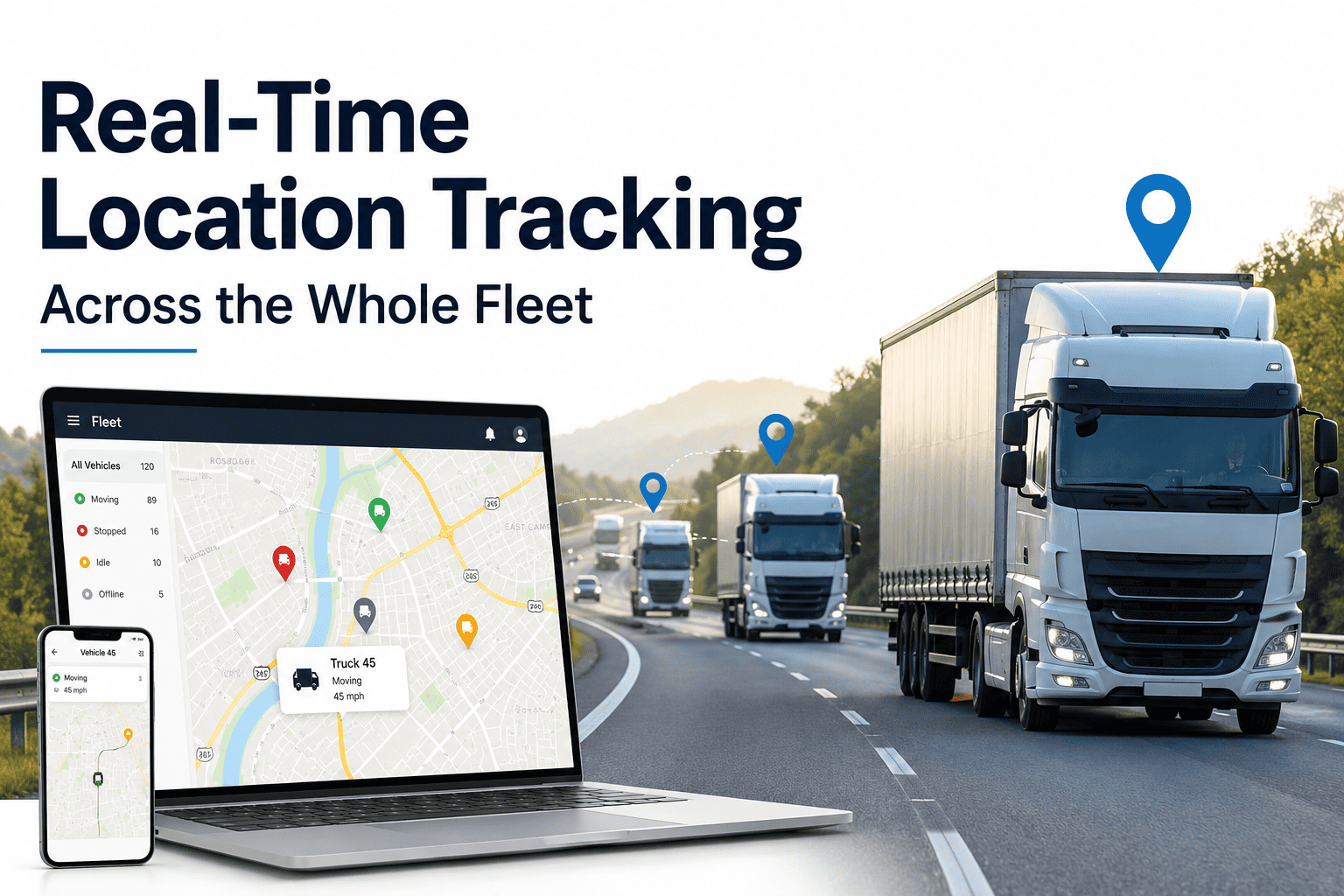
Real-time GPS tracking is the single most underused maintenance signal in a modern fleet — most teams treat it as a dispatch toy, then wonder why preventive maintenance slips and breakdown response takes two hours instead of twenty minutes. When position updates land every 30 to 120 seconds and feed geofence events for shops, terminals, fuel islands, and customer locations, the maintenance team gains three answers instantly: is the truck near a company shop or does it need a mobile unit, where does it actually end each day, and did the driver complete the route or divert. Oxmaint layers that live position directly over the maintenance dashboard so a fleet manager can watch which trucks are drifting from their scheduled PM shop while the work order is still open. You can explore the full system with a Start Free Trial or read on for the operational playbook, the privacy framework, and the geofence configuration that turns raw position pings into maintenance decisions.
REAL-TIME GPS TRACKING GUIDE · 2026
What if every breakdown, every PM, and every rescue started with the right location answer?
A live position feed answering three questions — near the shop or on the shoulder, where it actually sleeps, and did the driver divert — is the difference between a 22-minute fix and a four-hour tow. This guide maps the operational uses, the privacy framework, and the geofence configuration that converts 30-second pings into maintenance decisions.
FROM A STANDARD TELEMATICS FEED
THE MAINTENANCE LENS
Three questions a live map answers that dispatch never asks
Dispatch uses GPS to assign the next load. Maintenance uses it to decide where the truck gets serviced, how it gets rescued, and whether the work it logged actually happened. Those three answers drive PM completion rates, breakdown MTTR, and fleet utilization — and none of them appear on a standard dispatch screen.
Near a shop, or on the shoulder?
When a fault code fires at 14:32 on I-85, the live ping tells you whether the driver is six minutes from the Charlotte terminal or forty miles past it. That single data point decides whether you route a mobile technician, send a rescue vehicle, or call for a tow — and it cuts average breakdown MTTR by 30 to 45 minutes in fleets that actually use it.
Where does it actually sleep?
Home-yard assignment based on where each truck spends its downtime — not where the registration says it lives — is the single biggest lever on PM completion. A truck registered to the Atlanta yard that nightly parks in Greenville will miss Atlanta PMs for months. Reassign it to the Greenville shop and completion rates jump from the low 60s to over 90 percent inside one quarter.
Did the route actually get driven?
Breadcrumb trails against the planned route reveal diversions, unauthorized fuel stops, and skipped customer locations. For maintenance, that same trail confirms whether the hours logged on the inspection report match the miles actually driven — a number that matters when warranty claims and FMCSR inspection cycles are tied to true operating hours.
GEOFENCE CONFIGURATION
Turning position pings into maintenance triggers
A geofence is a virtual perimeter drawn around a physical location. When a truck crosses it, the telematics platform fires an enter or exit event — and in a maintenance-aware setup, that event can open a work order, pause a PM clock, or alert the shop foreman. The table below maps the six geofence types that produce the highest-value maintenance signal for a multi-shop fleet.
| Geofence type | Drawn around | Enter event | Exit event | Maintenance action |
|---|---|---|---|---|
| Company shop | Each maintenance bay entrance | Flag truck on-site for open PM | Close service window, log hours | Auto-open work order if PM due in 7 days |
| Terminal / yard | Home-base perimeter | Reset daily downtime clock | Start duty cycle timer | Assign home-yard PM slot |
| Customer location | Load and unload docks | Log arrival for ETA audit | Confirm route segment complete | Corroborate driver inspection log |
| Fuel island | Company and network fuel stops | Validate fueling against card swipe | Release driver to next segment | Flag fuel-card fraud anomalies |
| Vendor / mobile repair | Approved third-party shops | Start external labor clock | Close vendor work order | Auto-attach invoice to asset record |
| Out-of-route corridor | Planned route buffer (typ. 1–3 mi) | Deviation alert to safety | Return-to-route confirmation | Audit inspection hours vs. true miles |
WORKED EXAMPLE
A 220-truck regional carrier, three shops, one quiet fix
Consider a regional dry-van operator running 220 power units out of terminals in Charlotte, Greenville, and Atlanta. PM completion was stuck at 63 percent. The root cause was not technician capacity — it was home-yard assignment. Twenty-eight trucks registered to Atlanta were actually parking nightly in Greenville. Their PMs were being scheduled at a shop they never visited. The fix took one afternoon of geofence analysis.
BEFORE
63%
PM COMPLETION RATE
- Home-yard set by registration, not by actual downtime location
- 28 of 220 trucks never reached their assigned shop
- Average breakdown MTTR: 2 h 40 min — tow dispatched by default
- Three roadside rescues per week went to the wrong closest shop
AFTER
94%
PM COMPLETION RATE (ONE QUARTER LATER)
- Home-yard reassigned using 30-day breadcrumb analysis
- Breakdown MTTR fell to 58 min — mobile unit beats the tow
- Geofence at each shop auto-opens PM work order on entry
- Annual maintenance savings estimated at $186K across the fleet
The trucks were never late for service. We were scheduling service at the wrong building. Once home-yard followed the truck instead of the paperwork, completion fixed itself.
— Fleet maintenance director, 220-unit regional carrier
PRIVACY & ACCESS CONTROL
Who sees the dot — and when the dot should disappear
Live tracking is powerful, and live tracking without rules erodes driver trust. The fleets that roll it out successfully restrict access by role, pause tracking during off-duty hours for assigned vehicles, and document the policy in writing. The matrix below reflects the access pattern that balances maintenance and dispatch utility with driver acceptance.
Full live map · all assets · route deviation alerts · ETA recalculation
Primary consumer of the 30–120 second ping stream. Sees everything, in real time, during duty hours.
Live position · geofence events · home-yard assignment · PM proximity view
Sees which trucks are near their scheduled shop and which are drifting. Does not need driver identity layer.
Harsh-event replay · breadcrumb trails · out-of-route corridors · speed overlays
Uses historical trail for incident reconstruction, not continuous monitoring.
Own route and ETA only · no fleet-wide visibility · off-duty pause for personal-use vehicles
Personal-use conveyance pauses the live feed. The policy is documented and signed at onboarding.
The off-duty rule that keeps trust intact
For personal-conveyance vehicles, the live feed should pause the moment the driver clocks out and resume at the next duty status change. Fleets that skip this step see driver acceptance scores drop 20 to 30 points in the first quarter — and the maintenance gains disappear when drivers find workarounds. The technology supports the pause; the policy has to mandate it.
UTILIZATION & HIDDEN IDLE
The trucks sitting in a yard that management assumed were rolling
Position history is the cheapest utilization audit a fleet will ever run. When you pull a 30-day breadcrumb report and cross-reference it against dispatch assignments, the gap between assumed service and actual service is almost always wider than anyone expects. The numbers below come from a typical mid-size fleet review — your mileage will vary, but the pattern holds.
14%
POWER UNITS THAT LOGGED ZERO MOVEMENT IN A 7-DAY WINDOW
$1,200
MONTHLY CARRYING COST PER IDLE ASSET (INSURANCE, DEPRECIATION, REGISTRATION)
3.2 days
AVERAGE TIME BETWEEN LAST KNOWN MOVE AND UTILIZATION REVIEW FLAG
9%
FLEETS THAT REVIEW POSITION-BASED UTILIZATION MONTHLY OR MORE OFTEN
The fix is not more trucks. It is reading the data you already have. A 220-asset carrier that recovers even 14 percent of hidden-idle units — roughly 31 trucks — avoids a $37,000 monthly bleed and defers roughly $4.6 million in new-equipment capital that would otherwise be approved to solve a capacity problem that does not exist.
See which trucks are drifting from their PM shop — right now
Oxmaint layers live GPS position over your maintenance dashboard so the proximity call, the rescue decision, and the home-yard reassignment all happen on one screen.
FREQUENTLY ASKED
Real-time fleet tracking, answered straight
How often does the GPS position actually update?
Standard telematics hardware reports every 30 to 120 seconds while the ignition is on, and most platforms also support a motion-triggered ping for fast events. For maintenance decisions — PM proximity, geofence triggers, breakdown routing — that cadence is more than enough. The latency that hurts is not the ping interval; it is how long the data sits before someone acts on it. Oxmaint surfaces the relevant event in the maintenance dashboard within seconds. You can see it yourself with a Start Free Trial.
Will live tracking hurt driver acceptance?
Only if it is rolled out without rules. The fleets that succeed restrict live-map access to dispatch, safety, and maintenance roles — not the whole company — and they pause tracking for personal-conveyance vehicles during off-duty hours. Driver acceptance scores stay high when the policy is documented, signed at onboarding, and applied consistently. The technology supports every one of those controls natively.
How do I figure out the correct home-yard for each truck?
Pull a 30-day breadcrumb trail for every asset and count nights spent inside each terminal geofence. The yard where a truck parks most often is its true home yard — regardless of what the registration says. Reassigning the 20 to 15 percent of trucks that are registered to the wrong yard is typically the single fastest PM completion improvement a multi-shop fleet can make, and it costs nothing but an afternoon of analysis.
What happens when a truck breaks down — how does position help?
The live ping tells you immediately whether the truck is close enough to a company shop to limp in, whether a mobile technician can reach it faster than a tow, and which rescue vehicle to dispatch. In the fleets we work with, that decision tree cuts average breakdown MTTR by 30 to 45 minutes and reduces unnecessary tows by more than half. The same ping feeds the customer ETA update so dispatch is not guessing either.
Can I see a live demo with my own fleet's data?
Yes. Book a 30-minute session and we will walk through the GPS-over-maintenance dashboard, configure a sample geofence, and show the home-yard reassignment report on a representative dataset. Schedule it at calendly.com/oxmaintapp/30min — bring your terminal addresses and we will draw the first geofences live.
START IN MINUTES
Your next PM should be scheduled where the truck actually sleeps
Connect your telematics feed, draw the first geofence, and watch the maintenance dashboard light up with trucks near their shop — and trucks drifting away from it. The setup takes one afternoon. The payback starts the first Monday morning after.
Free 14-day trial · No credit card