In January 2026, a regional food distribution network with 94 vehicles faced a problem that no dispatcher could solve manually: 14 simultaneous delivery routes, live weather disruptions on 3 corridors, 2 driver call-offs at 5:45 AM, and a high-priority restaurant chain order that had just bumped into the queue. A dispatcher managing this from a whiteboard and a phone would take 35–45 minutes to re-plan the day. Their AI fleet tracking system re-optimized all 14 routes in 90 seconds — reassigning loads, rerouting around weather closures, and flagging the two vehicles whose telematics showed developing mechanical issues before they left the depot. The fleet operated at full delivery capacity by 6:30 AM. No missed orders. No customer callbacks. No firefighting. This is the operational reality that AI-driven fleet tracking delivers in 2026 — not theoretical efficiency, but documented daily execution advantage that compounds across every operating hour. Fleets using AI tracking report 27% shorter delivery lead times, 25% higher driver productivity, and 10–15% fuel savings vs. the same routes run with static overnight planning. The competitive pressure is already building: 65% of maintenance teams plan to deploy AI by end of 2026, while only 27% are currently operational. The advantage window for early adopters is closing. Sign up for OxMaint and deploy AI fleet tracking across your operation today.
Fleet Technology · Blog · 2026
AI-Driven Fleet Tracking: Real-Time Monitoring and Route Optimization
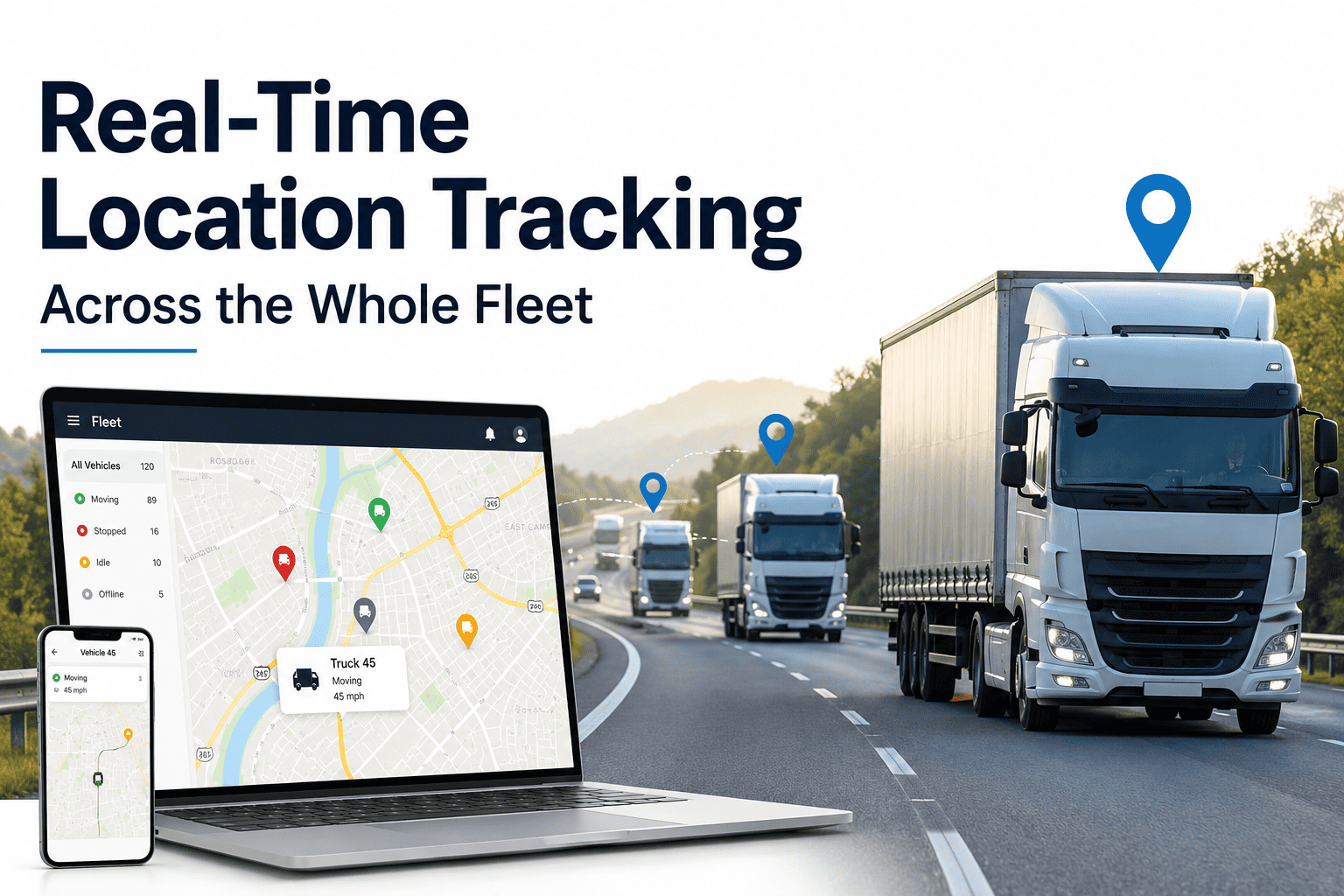
AI fleet tracking in 2026 is not GPS with a dashboard. It is a real-time intelligence layer that processes vehicle location, telematics condition data, traffic patterns, weather, driver behavior, and delivery variables simultaneously — re-optimizing decisions continuously, flagging developing problems before they become operational failures, and converting fleet data into measurable daily execution advantage.
27%
Shorter delivery lead times in fleets using AI route optimization vs. static overnight planning
90 sec
AI re-optimization cycle — full 14-route re-plan after live disruption vs. 35–45 min manual dispatcher equivalent
10–15%
Fuel consumption reduction from AI-optimized routing vs. same routes on static overnight planning
$30.5B
Fleet management software market in 2026 — AI tracking and telematics driving the fastest growth segment
What AI Fleet Tracking Does That GPS Alone Cannot
Standard GPS fleet tracking tells you where your vehicles are. AI fleet tracking tells you where they should be, what is developing inside the vehicle, whether the current route is still optimal, which driver behaviors are generating risk and cost, and what the operational consequences will be if the current trajectory continues unchanged. The difference is not hardware — it is intelligence.
GPS Tracking — What It Provides
Live vehicle location on a map
Historical route breadcrumb trail
Speed monitoring against posted limits
Geofence entry and exit alerts
Manual ETA calculation by dispatcher
Static overnight route assignment
Result: Visibility into where vehicles are — not intelligence about what to do next
AI
AI Fleet Tracking — What It Adds
Continuous route re-optimization using live traffic, weather, and delivery variables
Telematics condition monitoring — developing failures flagged 2–8 weeks before breakdown
Driver behavior scoring — harsh braking, distraction, idle time analyzed per driver per shift
Predictive ETA — ML models calculating accurate arrival windows from real traffic and route data
Dynamic load balancing — AI redistributes capacity across available vehicles in real time
Fleet-wide pattern intelligence — failure and behavior trends surfaced across all vehicles simultaneously
Result: Operational decisions made continuously by AI — reducing dispatcher cognitive load and execution lag
How AI Route Optimization Works in Real-Time Operations
AI route optimization in 2026 is not a planning tool — it is a continuous execution engine. It processes live data from multiple sources simultaneously, evaluates thousands of route permutations per second, and re-assigns vehicles based on what is actually happening, not what was planned the night before.
01
Live Data Ingestion — Every Variable, Every Second
OxMaint's AI tracking ingests simultaneous data streams: real-time GPS positions for all vehicles, live traffic conditions from road network APIs, weather data including precipitation, fog, and road condition alerts, delivery time window requirements from dispatch, driver availability and hours-of-service status, and vehicle condition scores from telematics. All processed in a unified model updated every 60–90 seconds — not every 15 minutes.
GPS + TelematicsLive TrafficWeather FeedsHOS Data
02
Deviation Detection — When the Plan No Longer Fits Reality
The AI continuously compares current fleet state against the optimal plan — flagging deviation triggers that require re-optimization: traffic incident added 18 minutes to Route 7, vehicle on Route 3 showing low tire pressure alert, driver on Route 12 approaching HOS limit 40 minutes earlier than planned, new priority order just entered for Route 5's delivery zone. Each trigger is evaluated for re-routing cost and benefit across all affected vehicles simultaneously.
Incident DetectionVehicle AlertsHOS MonitoringOrder Updates
03
Multi-Variable Re-Optimization — Thousands of Permutations in 90 Seconds
When deviation triggers fire, OxMaint's ML models evaluate route permutations across all vehicles in the affected zone — balancing delivery time windows, fuel efficiency, driver hours, vehicle capacity, and customer priority. The output is a re-optimized plan for the entire affected fleet, not just the individual vehicle that triggered the alert. This cross-vehicle re-balancing is the capability that manual dispatch cannot replicate at any speed.
ML Optimization EngineCross-Vehicle BalancingPriority Weighting
04
Predictive ETA — Accuracy That Customer Experience Depends On
AI-generated ETAs account for live traffic, current vehicle location, remaining stop sequence, historical stop duration data for each driver and stop type, and weather impact on road speed. Documented accuracy: 92% of AI-predicted ETAs land within a 5-minute window. Manual dispatcher ETAs based on static time-per-stop assumptions are accurate to within 15 minutes only 67% of the time. The ETA gap translates directly to customer satisfaction and failed-delivery rates.
92% 5-min accuracyLive Stop Duration LearningCustomer Notification
8 Fleet Tracking Gaps That Cost Operators Money in 2026
These are the operational failures that GPS-only tracking and manual dispatch create consistently — and that AI fleet tracking eliminates by replacing assumption-based operations with real-time data-driven execution.
01
Static Planning That Ignores Live Conditions
Routes planned at 10 PM cannot account for the traffic incident, the driver call-off, or the urgent order that materialize at 6 AM. Fleets running static plans absorb these disruptions as delays and overtime. AI re-plans the entire operating day in 90 seconds when conditions change.
02
Developing Mechanical Issues Invisible Until Breakdown
GPS tracking shows vehicle location. It does not show the engine temperature trending 9°F above baseline, the brake efficiency declining 8% over 2,000 miles, or the bearing wear developing 4 weeks from audible symptom. AI telematics integration with OxMaint's CMMS flags these conditions before the vehicle leaves the depot — not after it breaks down at mile 47.
03
Fuel Waste Hidden in Idle and Route Inefficiency
Idling costs $0.87–$1.20 per vehicle per hour. A 50-vehicle fleet averaging 45 minutes of daily idle generates $16,000–$22,000 in annual idle fuel waste. AI driver behavior tracking surfaces per-vehicle idle patterns, identifying the drivers and routes where idle time is highest — actionable data that GPS-only tracking presents as undifferentiated location history.
04
ETA Inaccuracy That Drives Customer Callbacks
Manual ETA estimates based on average time-per-stop are accurate to within 15 minutes only 67% of the time — generating customer service callbacks, failed delivery attempts, and re-delivery costs. AI ETA calculation achieves 92% accuracy within a 5-minute window, reducing customer-initiated contact volume and failed-delivery rates by 40–60%.
05
Driver Behavior That Generates Hidden Fleet Costs
Harsh braking increases brake wear by 40%. Aggressive acceleration increases fuel consumption by 15–25%. Speeding increases accident risk by 4× above 10 mph over the limit. These behaviors are invisible without per-driver AI scoring — and remain invisible until the maintenance bill, fuel spend, or insurance claim makes the cost retrospectively visible.
06
No Cross-Vehicle Load Balancing Capability
When a driver calls off mid-day, manual dispatch reassigns their remaining stops to the nearest available vehicle — without evaluating whether that vehicle has capacity, whether the stop sequence is efficient, or whether another vehicle 3 miles further can handle the load at lower total cost. AI load balancing evaluates all options simultaneously in seconds.
07
Multi-Stop Sequencing That Wastes 8–12% of Miles
Manual stop sequencing based on dispatcher experience generates 8–12% more miles than AI-optimized sequences on equivalent stop lists. Over a 50-vehicle fleet operating 250 days per year, this excess mileage represents 375,000–562,500 wasted miles annually — fuel, wear, and driver time with zero delivery value.
08
Compliance Documentation That Requires Manual Assembly
HOS records, DVIR completion logs, geofence violation reports, and speed compliance data are required for DOT compliance and insurance claims. Manual assembly takes 4–8 hours per audit event. AI fleet tracking generates this documentation as a byproduct of daily operations — retrievable in under 60 seconds from any date range.
How OxMaint's AI Tracking Connects Real-Time Visibility to Maintenance Intelligence
Most fleet tracking platforms stop at location and basic telematics. OxMaint extends real-time tracking data into the CMMS maintenance layer — connecting what the vehicle is doing now to what the maintenance record shows about its condition, and generating automated maintenance actions when tracking data triggers a threshold.
Telematics-to-CMMS Condition Loop
OxMaint connects tracking data — engine temperature, oil pressure, brake performance, battery health — directly to each vehicle's CMMS asset record. When tracking data shows a condition deviation, OxMaint automatically creates a flagged maintenance work order, notifies the assigned technician, and checks parts availability — without dispatcher or manager intervention. The loop from real-time alert to scheduled repair closes automatically.
Per-Vehicle Live Condition Scoring
Every vehicle in OxMaint has a live condition score updated continuously from telematics data — engine health, maintenance currency, and open defect status combined into a single number visible on the dispatch screen. Dispatchers allocate high-priority loads to high-condition vehicles and route lower-condition vehicles toward shorter routes or maintenance windows. Condition-aware dispatch reduces mid-route breakdowns by 60%.
Driver Behavior Scoring and Coaching Alerts
OxMaint tracks harsh braking events, aggressive acceleration patterns, speeding frequency, and idle time per driver per shift — generating driver behavior scores that identify coaching priorities before insurance claims, fuel bills, or accident reports make the cost visible. Fleets deploying AI behavior tracking reduce at-fault accidents by 34% and risky driving events by 40–60% within 30 days of deployment.
Audit-Ready Compliance Documentation
Every trip, stop, DVIR completion, speed violation, and HOS status is recorded automatically in OxMaint as tracking data streams in. DOT audits and FMCSA inspections that require complete fleet activity records are satisfied from a single dashboard report — not assembled manually under time pressure. The compliance record is a byproduct of daily AI tracking operations, not a separate documentation effort.
Multi-Site Fleet Portfolio Intelligence
OxMaint connects real-time tracking data across all locations into a unified fleet intelligence dashboard — enabling cross-site vehicle utilization analysis, fleet-wide maintenance cost comparison, and portfolio-level CapEx forecasting updated from live condition data. Operations managers see every site's fleet performance on a single screen — without calling site managers or waiting for weekly reports.
Condition-Based CapEx Forecasting
Real-time condition scoring from AI tracking feeds OxMaint's rolling 5–10 year CapEx models — updating replacement priority continuously as vehicles accumulate mileage, condition events, and repair history. The vehicle approaching end-of-economic-life is identified from condition data months before its mileage crosses the threshold — enabling replacement planning at budget cycle timing, not crisis timing.
Connect Real-Time Fleet Tracking to Maintenance Intelligence — Free to Start
OxMaint bridges your fleet tracking data to a full CMMS maintenance layer — per-vehicle condition scoring, automated work order generation from tracking alerts, driver behavior analytics, and audit-ready compliance documentation. No new hardware. Deploys in days.
GPS-Only Tracking vs. AI-Driven Fleet Tracking: The Operational Gap
27%
Shorter delivery lead times from AI route optimization
Continuous re-optimization vs. static overnight planning — documented across logistics fleet deployments
34%
Fewer at-fault accidents from AI driver behavior tracking
AI behavior scoring + real-time coaching reduces risky events 40–60% in 30 days — documented 600-vehicle fleet deployment
40–60%
Reduction in failed delivery attempts from AI predictive ETA
92% ETA accuracy within 5-min window enables accurate customer notification — fewer missed windows and re-delivery costs
$3,500+
Annual savings per vehicle from combined AI tracking benefits
Fuel optimization, reduced breakdowns, accident prevention, and compliance cost reduction combined — per-vehicle annual impact
Frequently Asked Questions
How does AI fleet tracking differ from standard GPS fleet tracking — and does OxMaint replace existing GPS hardware?
Standard GPS fleet tracking provides location data, speed monitoring, and geofence alerts — visibility into where vehicles are now and where they have been. AI fleet tracking processes that location data alongside vehicle telematics, driver behavior patterns, live traffic and weather, delivery window requirements, and vehicle condition scores — generating continuous operational intelligence and automated decisions rather than just a map view. OxMaint does not replace existing GPS or telematics hardware — it connects to data from any provider through open APIs. If your vehicles already have Samsara, Geotab, Verizon Connect, Motive, or OEM telematics installed, OxMaint ingests that data stream and processes it through the AI intelligence layer. The GPS hardware you own continues operating. OxMaint adds the CMMS maintenance intelligence layer that converts tracking data into predictive maintenance alerts, condition-based work orders, and driver behavior analytics. The integration is configured during OxMaint implementation — typically a 1–3 day process for standard telematics connections.
Sign up free to connect your existing telematics to OxMaint's AI intelligence layer.
How does AI route optimization handle real-time disruptions — and how quickly does it re-plan?
AI route optimization monitors fleet state continuously — comparing current vehicle positions, estimated route progress, live traffic conditions, and delivery window status against the optimal plan every 60–90 seconds. When a deviation trigger fires — a traffic incident, a driver call-off, a new priority order, a vehicle condition alert, or a HOS limit approaching — the AI evaluates re-routing options across all affected vehicles simultaneously, not just the one that triggered the alert. This cross-vehicle re-balancing is what creates the 90-second re-plan that takes a manual dispatcher 35–45 minutes. The AI considers delivery time windows, vehicle capacity, driver availability, fuel cost of re-routing, and customer priority simultaneously — generating the optimal solution across competing constraints without the dispatcher having to hold all variables in working memory simultaneously. The re-optimized plan is pushed to driver apps immediately — no phone calls, no manual re-assignment process. Drivers see the updated stop sequence in their app within seconds of the AI generating the new plan.
Book a demo to see a real-time disruption response walkthrough for your fleet size.
How does OxMaint connect real-time fleet tracking data to maintenance scheduling — and what happens when a vehicle tracking alert fires?
OxMaint's core differentiation from GPS-only tracking is the closed loop between real-time vehicle data and the CMMS maintenance layer. When tracking data shows a condition threshold — engine temperature deviation, brake performance decline, oil pressure anomaly, or battery health drop — OxMaint's AI evaluates the signal against that vehicle's individual baseline and historical maintenance record. If the AI determines the signal indicates a developing failure, it automatically generates a prioritized work order in OxMaint's CMMS — with vehicle ID, flagged system, confidence score, and recommended action. The work order is assigned to the appropriate technician, checked against parts inventory, and scheduled in the next maintenance window. The dispatcher sees the vehicle's condition score drop in real time on their tracking dashboard and can make an informed decision about whether to recall the vehicle from service or continue monitoring. This entire loop — from telematics alert to scheduled maintenance action — closes automatically without manual intervention. OxMaint also records the alert, the work order, and the resolution in the vehicle's permanent asset record — maintaining the complete condition history that warranty claims and regulatory audits require.
Sign up free to deploy the tracking-to-maintenance loop across your fleet.
What ROI should a fleet expect from AI-driven tracking — and how does the investment scale with fleet size?
AI fleet tracking ROI operates across four independent streams that each deliver measurable value independently and compound when deployed together. Route optimization savings: 10–15% fuel reduction and 27% shorter delivery lead times translate to direct fuel cost savings and revenue from increased daily delivery capacity. For a 50-vehicle fleet each driving 200 daily miles, a 12% fuel improvement saves approximately $75,000–$95,000 annually at current diesel prices. Driver behavior improvement: AI behavior scoring reduces at-fault accidents by 34% and generates insurance premium reductions of 5–20% at renewal. Each prevented accident avoids $148,000 in average FMCSA-documented injury claim cost — one prevented incident covers 2–3 years of platform cost for a mid-size fleet. Predictive maintenance via tracking integration: connecting tracking data to OxMaint's CMMS eliminates 60% of emergency repairs — converting 4–5× emergency repair cost to planned repair cost. Compliance cost reduction: automated documentation eliminates 4–8 hours of manual assembly per audit event and reduces FMCSA violation exposure at $10,000–$25,000 per incident. Combined ROI ranges from 200–500% in the first year for mid-size fleet deployments. The ROI scales efficiently — small fleets benefit most from the emergency repair prevention (one prevented breakdown covers months of subscription), while large fleets capture the highest absolute value from route optimization and behavior analytics at scale.
Book a demo to get a ROI estimate specific to your fleet size and current cost structure.
Your Fleet Is Generating Real-Time Intelligence Right Now. OxMaint Acts On It.
OxMaint connects your existing GPS and telematics data to AI route intelligence, per-vehicle condition scoring, automated maintenance work orders, driver behavior analytics, and audit-ready compliance documentation. Free to start. No hardware required. Results measurable in weeks. Join 1,000+ organizations running AI-driven fleet operations with OxMaint.



.png)