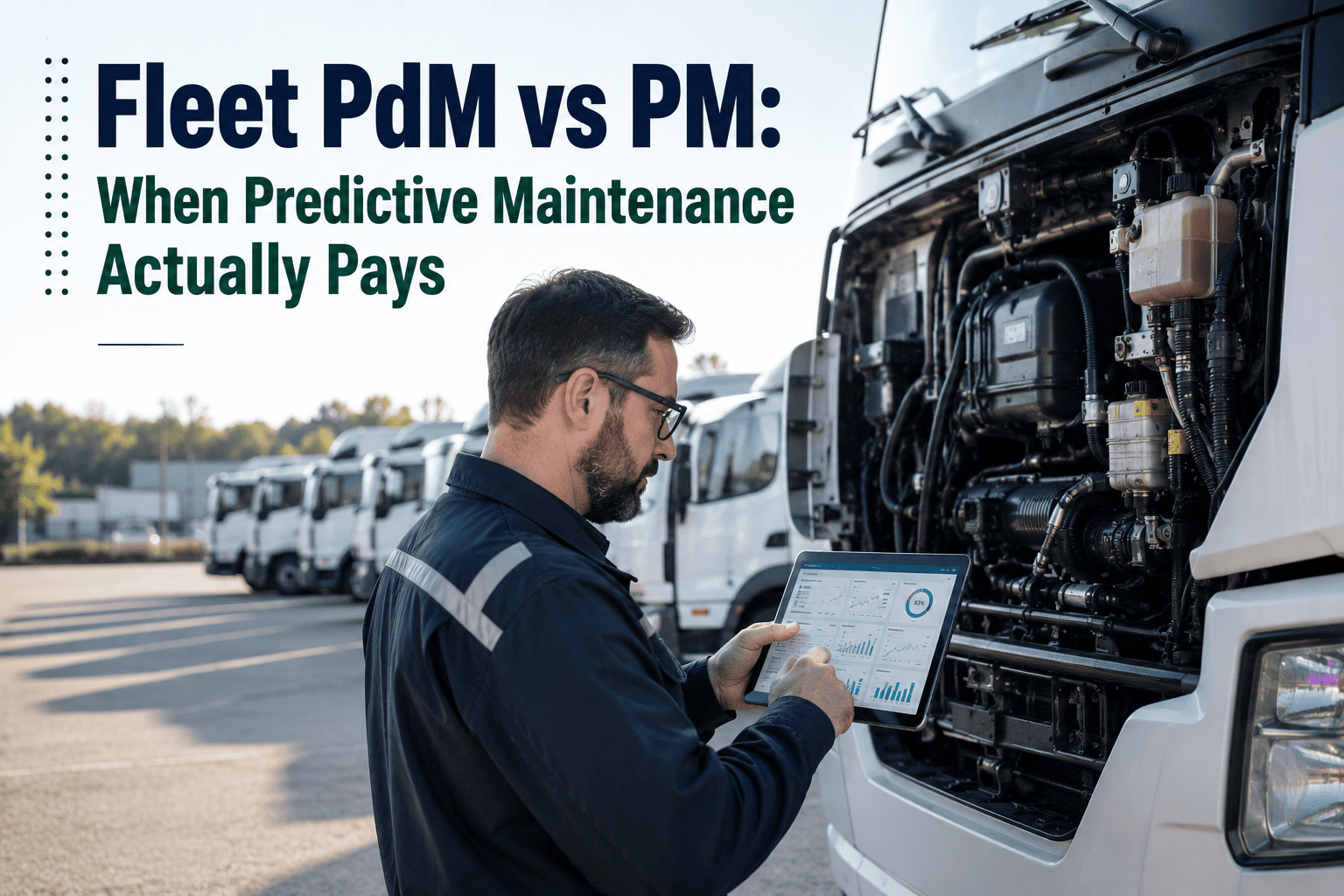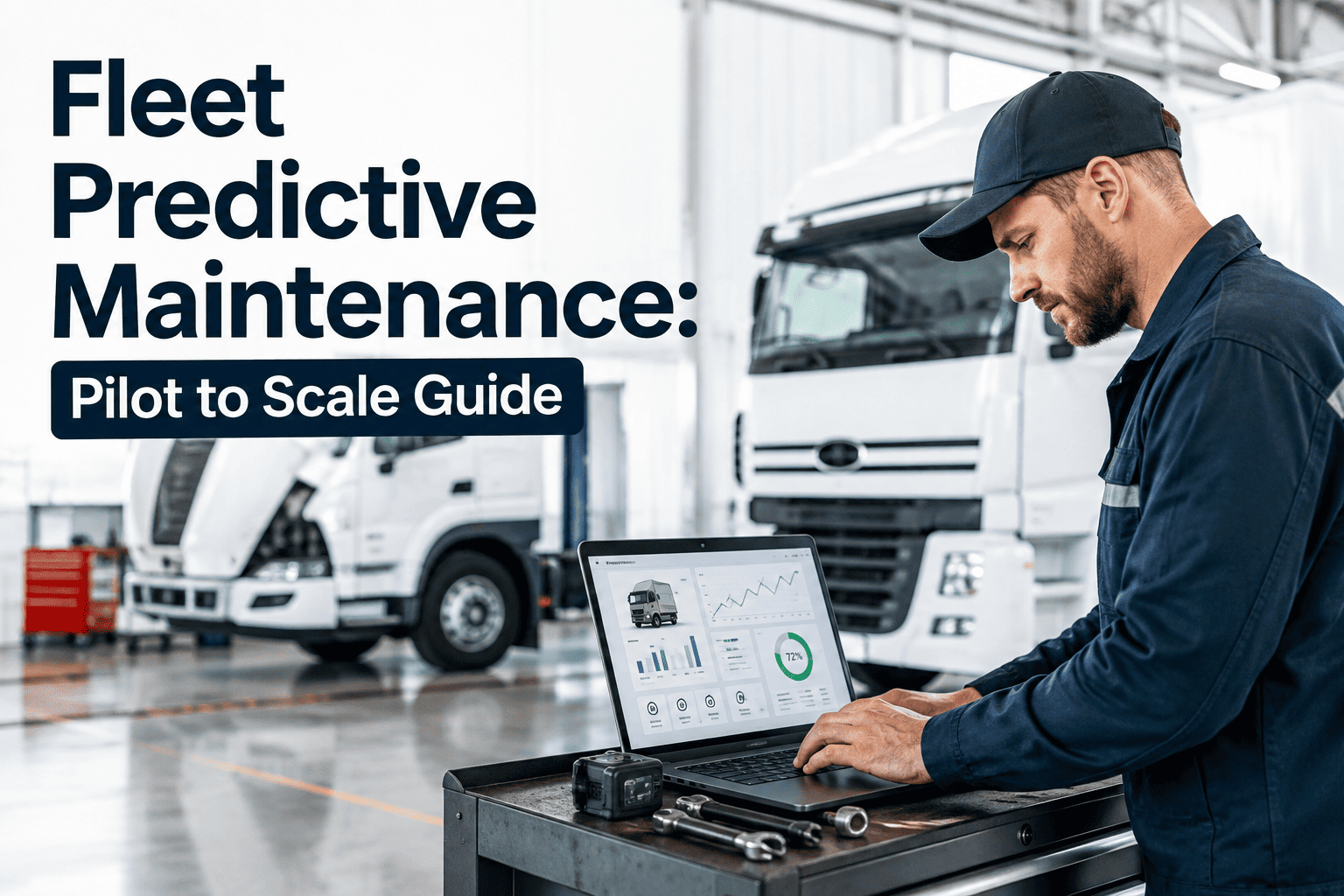
Fleet predictive maintenance pilots succeed in proving value on a handful of vehicles but fail to scale across the whole fleet — industry data suggests 70–80% of PdM pilots never reach enterprise production. The pilot-to-scale transition is where most fleet predictive maintenance programs stall: the technology works, but the operational framework to expand it doesn't exist. This guide covers the exact methodology successful fleet operators use to move from pilot to production — pilot design, scaling phases, change management, and the CMMS foundation that supports PdM at enterprise scale. Whether you're running 50 vehicles or 5,000, the path from predictive maintenance pilot to fleet-wide deployment follows a repeatable pattern. Start Free Trial to see how OxMaint supports fleet PdM programs from day one.
Why do 70–80% of fleet predictive maintenance pilots never scale past the proof-of-concept phase?
The technology validates. The ROI case is clear. But the operational bridge from a 10-vehicle pilot to a 500-vehicle production deployment is missing. This guide shows you how to build it — pilot design, scaling methodology, change management, and the CMMS infrastructure that makes enterprise fleet PdM actually work.
Why fleet PdM pilots stall at the transition point
A 2023 Deloitte study found that 68% of predictive maintenance pilots in asset-intensive industries never progress beyond the initial deployment. In fleet operations, the failure rate is often higher because vehicle heterogeneity, distributed operations, and driver workflows add complexity that stationary-plant PdM doesn't face.
Pilot designed for proof, not scale
Most pilots hand-pick the 10 "best" vehicles — newest models, cleanest data, most cooperative drivers. The pilot succeeds, but the methodology doesn't transfer to the 490 older, messier vehicles in the rest of the fleet.
No CMMS integration from day one
PdM alerts live in a standalone dashboard or email inbox. When the pilot scales, there's no automated work order generation, no parts reservation, no technician assignment — the alert-to-action workflow collapses under volume.
Change management treated as an afterthought
Technicians and dispatchers weren't involved in pilot design. At scale, they ignore alerts, override recommendations, or revert to calendar-based PM because "that's how we've always done it." Adoption fails before the technology does.
A regional logistics fleet running 320 Class 8 tractors spent $180K on a predictive maintenance pilot covering 12 vehicles. The pilot reduced unplanned breakdowns by 41% and saved $94K in avoided roadside repairs. But when they tried to scale to the full fleet, the program stalled for 14 months because alerts weren't connected to their work order system, and technicians didn't trust the recommendations. They eventually succeeded — but only after rebuilding the program on a CMMS-integrated foundation.
How to design a fleet predictive maintenance pilot that actually scales
The difference between a pilot that scales and one that stalls is decided in the first 30 days — before a single sensor is installed. Successful fleet PdM pilots are designed backward from enterprise production, not forward from a technology demo.
Choose a representative pilot cohort, not the "best" vehicles
Select 10–20 vehicles that mirror the full fleet's diversity: different makes/models, age ranges, duty cycles, and routes. If your fleet is 60% highway linehaul and 40% urban delivery, your pilot should be too. A pilot that only works on new Freightliners won't scale to a mixed fleet.
Define success metrics tied to business outcomes, not model accuracy
Don't measure "prediction precision." Measure unplanned downtime reduction, cost per mile, mean time between failures (MTBF), and maintenance cost as % of revenue. Set a target: "reduce unplanned roadside events by 30% and save $1,200 per vehicle per year." That's a metric a CFO can scale.
Integrate alerts into your CMMS from day one
Every PdM alert should auto-generate a work order in your CMMS with asset ID, failure mode, recommended action, and parts list. If alerts live in a separate dashboard during the pilot, you'll have to rebuild the entire workflow at scale — and that's where most programs die.
Involve technicians and dispatchers in pilot design
Run a workshop before launch: show them the alert format, ask what information they need to act on it, and let them define the escalation workflow. Technicians who help design the system trust it. Technicians who have it imposed on them ignore it.
Document the playbook as you go
Every decision — sensor placement, alert thresholds, work order templates, escalation paths — should be documented in a scaling playbook. When you expand from 20 vehicles to 200, you shouldn't be redesigning the program; you should be executing a checklist.
The 4-phase fleet PdM scaling roadmap (pilot to production in 6–18 months)
Fleets that successfully scale predictive maintenance follow a phased rollout — not a "big bang" deployment. Each phase has a specific goal, a defined vehicle count, and a go/no-go decision gate before moving to the next phase.
Pilot: 10–20 vehicles
Prove value on a representative cohort. Target: 25–40% reduction in unplanned downtime, documented ROI, validated alert-to-work-order workflow. Gate: CFO approves business case for Phase 2.
Regional rollout: 50–150 vehicles
Expand to one region or terminal. Stress-test the workflow at 5–10x volume. Train a second cohort of technicians. Refine alert thresholds based on false-positive rate. Gate: alert-to-action time under 48 hours, technician adoption above 80%.
Fleet-wide deployment: 200–1,000+ vehicles
Roll out to the full fleet in waves (50–100 vehicles per month). Automate parts forecasting based on predicted failures. Integrate PdM alerts with route planning and dispatch. Gate: unplanned downtime down 30–50% fleet-wide, maintenance cost per mile down 15–25%.
Continuous optimization
Shift from reactive scaling to proactive optimization. Use fleet-wide failure data to refine PM schedules, renegotiate OEM warranty terms, and optimize vehicle replacement cycles. PdM becomes a strategic asset, not just a maintenance tool.
The CMMS foundation that scales fleet predictive maintenance from pilot to production
Predictive maintenance generates alerts. A CMMS turns alerts into completed work orders, parts reservations, and documented cost savings. OxMaint is the operational layer that makes fleet PdM work at enterprise scale — from 10 vehicles to 10,000.
Automated work order generation from PdM alerts
Every predictive alert auto-creates a work order with asset ID, failure mode, recommended action, and required parts. Technicians see alerts in the same queue as PM tasks — no separate dashboard, no missed alerts. Outcome: alert-to-action time drops from days to hours, and no predicted failure slips through the cracks.
Spare-parts inventory linked to predicted failures
When PdM predicts a turbocharger failure in 3 weeks, OxMaint checks inventory, reserves the part, and triggers a reorder if stock is low. Parts arrive before the failure, not after. Outcome: eliminate expedited freight costs, reduce parts-related downtime by 40–60%, and cut inventory carrying costs by only stocking what you'll actually need.
Fleet-wide analytics that prove ROI at every phase
Track unplanned downtime, cost per mile, MTBF, and maintenance cost as % of revenue — by vehicle, by region, by failure mode. Show the CFO exactly what the pilot saved and project fleet-wide ROI with real data. Outcome: faster approval for scaling phases, defensible budget requests, and a clear payback timeline (typically 8–14 months).
Mobile-first workflows that technicians actually use
Technicians see PdM alerts, work orders, and asset history on their phone — no desktop login, no paper work orders. They can close a work order, log parts used, and upload photos from the field. Outcome: technician adoption above 85%, complete maintenance records for every vehicle, and no data entry backlog.
See how OxMaint scales fleet predictive maintenance from pilot to production
Book a 30-minute demo and we'll show you the exact CMMS workflows that support PdM at enterprise scale — automated work orders, parts integration, and fleet-wide analytics.
The change management framework that prevents technician resistance at scale
Technology scales easily. People don't. The fleets that successfully scale predictive maintenance treat change management as a parallel workstream — not an afterthought. Here's the framework that works.
1. Involve technicians in pilot design (Month 0)
Run a pre-launch workshop: show 3–5 senior technicians the alert format, ask what information they need to act on it, and let them define the escalation workflow. Technicians who co-design the system become internal champions. Technicians who have it imposed become skeptics.
2. Prove value with quick wins (Months 1–3)
In the first 90 days, publicly celebrate every predicted failure that was fixed before it became a roadside breakdown. Share the cost savings. Make the technicians who acted on alerts look like heroes. Early wins build trust faster than any training deck.
3. Train in waves, not all at once (Months 4–12)
Don't train 200 technicians in a single webinar. Train 10–15 at a time as each region goes live. Hands-on training with real vehicles and real alerts. Each cohort should include a mix of early adopters and skeptics — peer influence is more powerful than management mandates.
4. Measure adoption, not just uptime (Ongoing)
Track what % of PdM alerts result in a completed work order within 48 hours. If adoption is below 70%, don't scale to the next phase — fix the workflow first. Low adoption at 50 vehicles becomes zero adoption at 500 vehicles.
A 450-vehicle refuse fleet scaled predictive maintenance across 8 terminals in 14 months. Their secret: they appointed a "PdM champion" at each terminal — a senior technician who helped design the alert workflow and trained their peers. Adoption stayed above 85% throughout the rollout, and unplanned downtime dropped 43% fleet-wide.
5 mistakes that kill fleet PdM programs at the scaling stage
These are the failure modes that show up again and again when fleets try to move from pilot to production. Avoid them and your odds of successful scaling increase dramatically.
| Mistake | Why it kills scaling | How to avoid it |
|---|---|---|
| Scaling too fast after a successful pilot | Going from 10 vehicles to 500 in 60 days overwhelms technicians, parts inventory, and the alert workflow. False positives spike, trust collapses, and the program gets shut down. | Scale in waves: 10 → 50 → 150 → 500. Each wave should take 3–6 months. Prove the workflow at each volume before expanding. |
| Keeping PdM alerts in a separate system | Technicians have to check two systems. Alerts get missed. Work orders don't get created. At scale, the alert-to-action workflow collapses. | Integrate PdM alerts into your CMMS from day one. Every alert should auto-generate a work order in the same queue as PM tasks. |
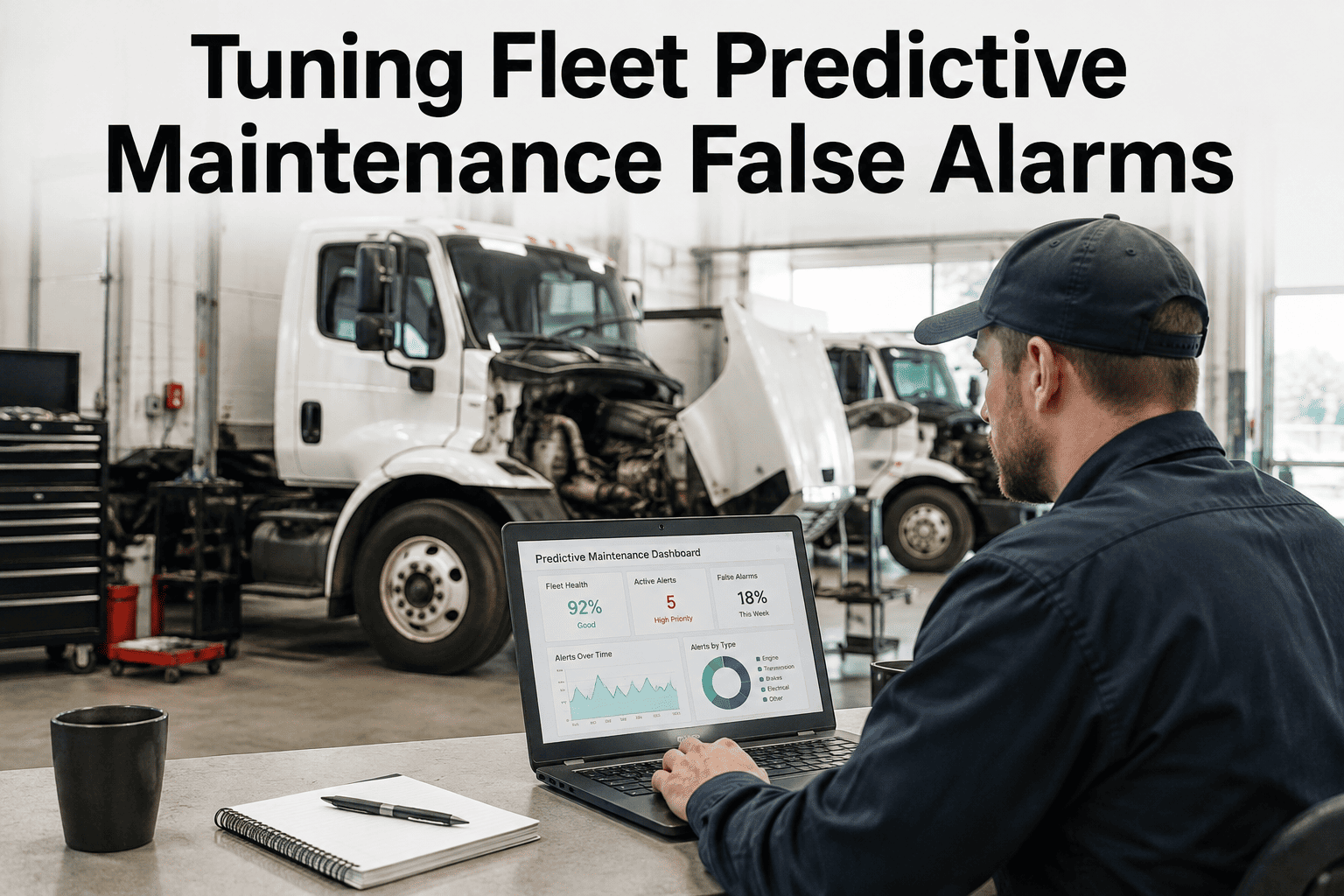
| Ignoring false positives during the pilot | A 20% false-positive rate on 10 vehicles is 2 bad alerts per month. On 500 vehicles, it's 100 bad alerts per month — technicians stop trusting the system. | Track false-positive rate as a core KPI during the pilot. Refine alert thresholds before scaling. Target: below 10% false positives. |
| No parts inventory integration | PdM predicts a failure 3 weeks out, but the part isn't in stock. The vehicle breaks down anyway. Technicians conclude "PdM doesn't work." | Link PdM alerts to spare-parts inventory in your CMMS. Reserve parts when an alert fires. Reorder automatically if stock is low. |
| Treating change management as optional | Technicians ignore alerts, override recommendations, or revert to calendar-based PM. Adoption drops below 50%. The program dies. | Involve technicians in pilot design. Celebrate early wins. Train in waves. Measure adoption as a core KPI. Make PdM champions out of senior techs. |
Fleet predictive maintenance pilot-to-scale: your questions answered
How long should a fleet predictive maintenance pilot run before scaling?
A fleet PdM pilot should run 3–6 months and cover at least one full maintenance cycle (e.g., 10,000–20,000 miles per vehicle). You need enough time to capture real failure predictions, validate the alert-to-work-order workflow, and document ROI. Scaling before 3 months means you're scaling on incomplete data. Waiting longer than 6 months usually means the pilot wasn't designed for scale from day one.
What's a realistic ROI timeline for fleet predictive maintenance at scale?
Most fleets see positive ROI within 8–14 months of fleet-wide deployment. The payback comes from three sources: reduced unplanned downtime (30–50% reduction), lower maintenance cost per mile (15–25% reduction), and avoided roadside repairs ($800–$2,500 per event). A 200-vehicle fleet spending $1.2M/year on maintenance can expect $180K–$360K in annual savings once PdM is fully scaled. Book a Demo to see ROI projections for your fleet size.
Do I need a CMMS to scale fleet predictive maintenance?
Yes — a CMMS is the operational foundation that makes PdM work at scale. Predictive maintenance generates alerts. A CMMS turns those alerts into work orders, parts reservations, technician assignments, and documented cost savings. Without a CMMS, alerts live in a separate dashboard, work orders don't get created, and the alert-to-action workflow collapses under volume. Fleets that try to scale PdM without a CMMS almost always stall at the 50–100 vehicle mark.
How do I get technicians to trust predictive maintenance alerts?
Involve technicians in pilot design, prove value with early wins, and keep false positives below 10%. Run a pre-launch workshop where senior techs help define the alert format and escalation workflow. In the first 90 days, publicly celebrate every predicted failure that was fixed before it became a breakdown. Track false-positive rate as a core KPI — if it's above 10%, refine alert thresholds before scaling. Technician trust is earned through accuracy and involvement, not mandated through management directives.
What's the biggest mistake fleets make when scaling predictive maintenance?
Scaling too fast after a successful pilot. Going from 10 vehicles to 500 in 60 days overwhelms technicians, parts inventory, and the alert workflow. False positives spike, trust collapses, and the program gets shut down. The fix: scale in waves (10 → 50 → 150 → 500), with 3–6 months between each wave. Prove the workflow at each volume before expanding. Start Free Trial to see how OxMaint supports phased PdM rollouts.
Ready to scale fleet predictive maintenance from pilot to production?
See how OxMaint's CMMS platform supports PdM at enterprise scale — automated work orders, parts integration, and fleet-wide analytics. Start your free trial or book a 30-minute demo.
Free 14-day trial · No credit card required