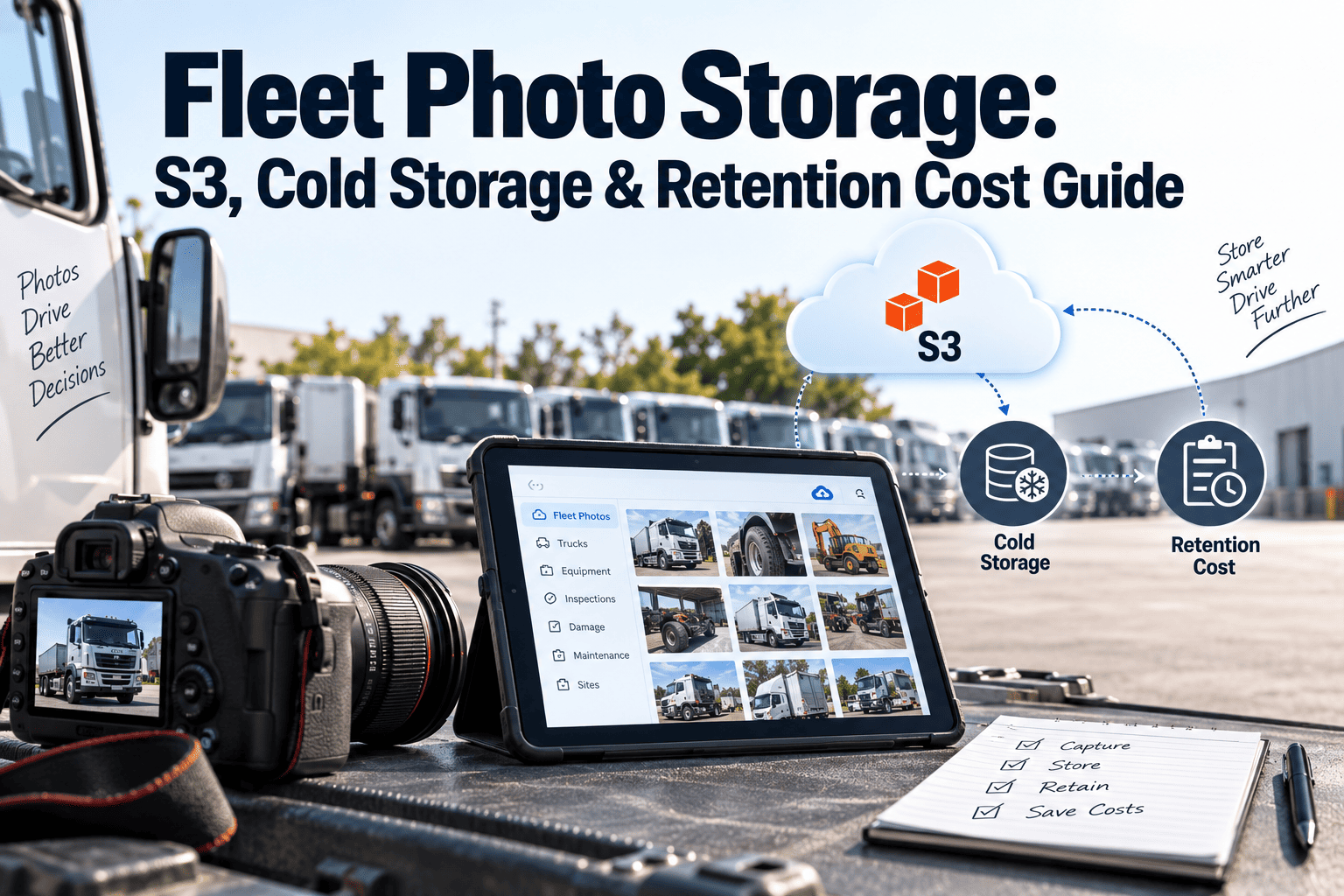
Fleet Photo Storage: S3, Cold Storage & Retention Cost Guide

By Corin Hale on September 11, 2026

fleet-photo-storage-s3-cold-retention

Every DVIR defect, every accident scene, every proof-of-delivery signature now comes with two or three photos attached, and a fleet running a few hundred trucks can generate millions of images a year without anyone in the office noticing the storage bill climbing behind the scenes. Most fleets default to keeping everything in the same hot storage tier because nobody wants to be the person who deleted evidence a lawyer needed eighteen months later, and that instinct is understandable but expensive — hot object storage can cost more than twenty times the price of an archive tier for photos nobody has opened in a year. The fix is not less retention, it is smarter tiering, and the difference between those two approaches is the entire subject of this guide, which you can put into practice directly at https://app.oxmaint.ai or by booking a walkthrough at https://calendly.com/oxmaintapp/30min.

Fleet Photo Storage · Cost & Retention Architecture

Fleet Photo Storage: The S3 Tiering Guide Nobody Reads Until the Bill Arrives

Millions of DVIR and inspection photos need a retention strategy, not a single storage bucket. OxMaint automatically tiers every photo by age and compliance category, so hot storage stays fast and cheap, and cold storage stays cheap without ever losing a record an audit or a lawsuit might need.

Why Fleet Photo Volume Gets Out of Control

A single DVIR defect entry now typically captures two to four photos. A cargo claim adds another six to ten. An accident file can run past fifty images once scene, damage, and document photos are combined. Multiply that across a fleet running daily inspections on every unit, and the storage curve stops looking like a rounding error within the first year.

3-4
photos captured per DVIR defect entry on average across mobile inspection workflows
23x
the per-GB price gap between always-hot S3 Standard storage and Glacier Deep Archive
90 days
the federal minimum retention window for DVIR-linked records under 49 CFR 396.11
7 yrs
the retention window many carriers hold for accident and litigation-linked photo evidence

The Cost Stack: What Every Storage Tier Actually Costs

The sticker price on cloud storage is never the whole story, but the per-GB baseline is still the number that determines whether your fleet's photo archive costs hundreds or thousands a month. Here is the tier stack, ordered from the most expensive tier your recent photos should live in, down to the cheapest tier your seven-year-old accident files belong in.

S3 Standard
$0.023/GB
Standard-IA
$0.0125/GB
One Zone-IA
$0.010/GB
Glacier Instant
$0.004/GB
Glacier Flexible
$0.0036/GB
Deep Archive
$0.00099/GB

Matching Photo Age to the Right Tier

Hot · 0-30 days
Active DVIRs, in-progress claims, and anything a dispatcher or safety manager might reopen this week belong in Standard, where retrieval is instant and free.
Warm · 30-180 days
Closed inspections still inside their compliance window move to Standard-IA or One Zone-IA, cutting storage cost by roughly half with millisecond access if needed.
Cold · 180 days-2 years
Photos past their active compliance window but still within a typical claims cycle sit in Glacier Instant or Flexible Retrieval, priced under half a cent per GB.
Archive · 2-7+ years
Accident and litigation-hold records that must survive but are almost never opened belong in Deep Archive, at roughly 4% the cost of Standard.

Retention Reference by Photo Category

Photo CategoryTypical RetentionRecommended Tier After 90 Days
DVIR defect photo 90 days minimum, federal Standard-IA
No-defect inspection photo 90 days, company policy One Zone-IA
Cargo claim documentation 2-3 years typical Glacier Instant Retrieval
Accident scene photo 3-7 years, insurer dependent Glacier Flexible Retrieval
Litigation-hold evidence Indefinite, case dependent Deep Archive, hold flagged
Proof-of-delivery signature 1-2 years typical One Zone-IA
Annual DOT inspection record 1 year past the vehicle's service life Glacier Instant Retrieval
Driver onboarding document photo Duration of employment plus 3 years Standard-IA

Stop Paying Hot-Tier Prices for Cold-Tier Photos

OxMaint applies lifecycle rules automatically the moment a photo's compliance category and age cross a threshold, moving it to the correct tier without a single manual export or migration project on your side.

Three Signs Your Storage Strategy Is Costing You

1
Every photo you have ever captured still lives in the hot tier
If nobody can tell you which tier a seven-year-old accident photo sits in, it is almost certainly still in Standard storage, quietly costing 23 times what it should.
2
Nobody can produce a photo fast enough during a live claim
Over-aggressive archiving into Deep Archive without exceptions for active claims means a 12-hour retrieval delay right when an adjuster or attorney needs the image today.
3
Retention rules live in someone's memory, not in policy
If retention length depends on which safety manager set it up, a legal hold can be missed entirely and evidence can be deleted before a case is even filed.

Fleet Photo Storage: Frequently Asked Questions

How much cheaper is cold storage than hot storage, really?
S3 Standard runs about $0.023 per GB per month while Glacier Deep Archive runs about $0.00099 per GB — roughly a 23-times difference for photos that are rarely, if ever, reopened.
Will moving photos to cold storage slow down an active claim?
Only if the tiering rule ignores claim status. See how OxMaint flags active-claim photos to stay in a fast-retrieval tier at https://app.oxmaint.ai regardless of age.
What is a litigation hold and how does it affect storage tiering?
A litigation hold suspends normal retention and deletion rules for specific records tied to a legal case, and it should override any age-based lifecycle rule automatically.
Do smaller fleets need a formal tiering strategy at all?
Yes — even a 20-truck fleet accumulates tens of thousands of photos a year, and the cost gap between tiers scales the same way regardless of fleet size. Book a demo at https://calendly.com/oxmaintapp/30min.
What is the minimum storage duration for Glacier tiers?
Glacier Instant and Flexible Retrieval both carry a 90-day minimum, and Deep Archive carries a 180-day minimum — deleting earlier still bills as if the object had stayed the full term.

How OxMaint Automates Fleet Photo Lifecycle

From the moment a photo is captured to the day an auditor pulls it years later, OxMaint moves each image through the right tier automatically. The flow below shows how a single photo travels from capture to long-term archive without anyone on your team touching a storage console.

1
Capture & Tag
A photo is taken in the field and auto-tagged by category — DVIR, claim, accident, or POD — at the moment of capture.
2
Hot Tier
For its first 30 days it stays in Standard storage, instantly retrievable while the inspection or claim is still active.
3
Age-Based Tiering
As it ages past its compliance window, the category-aware rule steps it down through Warm and Cold tiers automatically.
4
Deep Archive
Accident and litigation records land in Deep Archive, preserved for years at a fraction of hot-tier cost, hold flags respected.
5
Retrieve On Demand
Any photo pulls back directly inside its record for an audit or claim — no support ticket, no engineering request.
Category-Aware Lifecycle Rules
Every photo is tagged by category at capture, so DVIR, claim, and accident images each follow their own age-based tiering schedule automatically.
Litigation Hold Flags
Flagging a record for legal hold suspends its lifecycle rule and pins it to fast-retrieval storage regardless of age until the flag is cleared.
Cost Dashboard by Fleet and Tier
A running view of storage spend broken out by tier and vehicle group makes it obvious where the biggest savings opportunity is sitting today.
Retrieval Without a Ticket
Pulling an archived photo for an audit or a claim does not require a support ticket or an engineering request — it happens directly in the record.

Case Study: Cutting a Storage Bill Without Losing a Single Record

We had four years of DVIR and claim photos sitting in the same storage tier because nobody wanted to be the one who set up deletion rules and got it wrong. Our monthly storage bill had crept past what we were paying for two of our smaller depots combined, and we still could not find a photo quickly when a claim needed one. After we moved to category-based lifecycle rules, our storage spend dropped by more than 60 percent in the first billing cycle, and every active claim still pulls its photos instantly. Nothing was deleted — it just moved to the tier where it actually belonged.

— Fleet Operations Manager, Multi-Terminal LTL Carrier

Give Every Photo the Storage Tier It Actually Deserves

Retention is not optional and neither is cost control. OxMaint tiers every DVIR, claim, and accident photo automatically by category and age, so your archive stays complete, retrievable, and a fraction of the cost of a single hot-tier bucket.
Share This Story, Choose Your Platform!