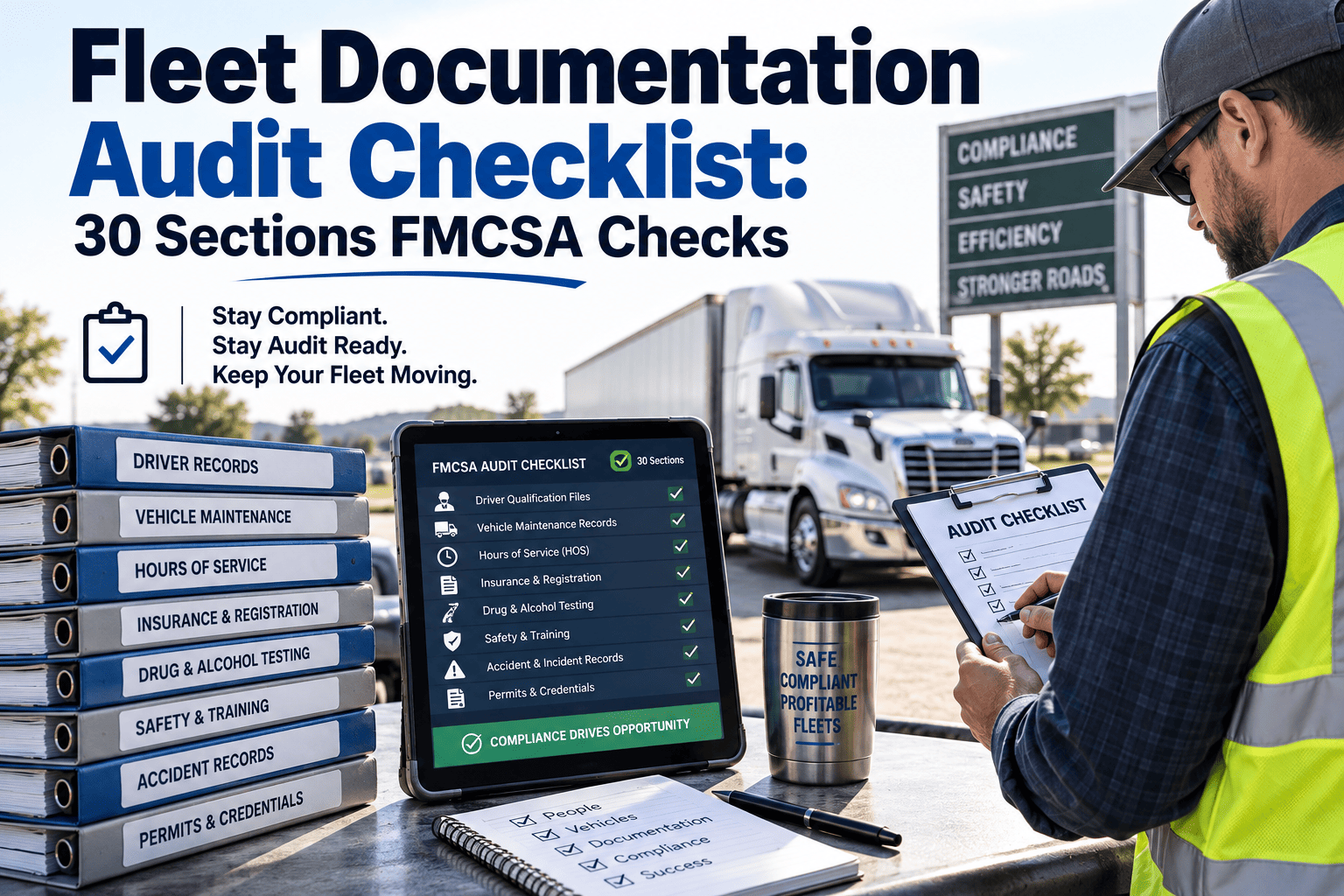
Every year, FMCSA investigators open compliance reviews and new entrant audits by pulling carrier files, and the pattern repeats: fleets get flagged because a required document was missing, expired, or unverifiable when the auditor asked for it, not because a truck crashed. Each review moves through the same categories in the same order — driver qualification files, hours of service, drug and alcohol testing, vehicle maintenance, accident register, and operating authority — and one missing item in any category becomes its own violation. This checklist breaks an FMCSA audit into the 30 sections regulators actually check, grouped the way an investigator reviews them. Sign up on OxMaint to run this exact checklist against every driver and vehicle file automatically.
Fleet Documentation Audit Checklist
30 Sections FMCSA Checks. One Fleet Rarely Passes All of Them Clean.
A compliance review does not sample your fleet at random. It works through six document categories in a fixed sequence, and every missing, expired, or unsigned record inside them becomes a separate finding on your safety record. This is the full 30-section checklist, organized the way an investigator actually opens your files.
22.6%
of inspected vehicles were placed out of service during the 2025 CVSA International Roadcheck, brakes being the top reason
30-40%
of driver qualification files show at least one gap the first time a fleet reviews them digitally
12%
of all FMCSA violations nationwide trace back to missing or incomplete driver qualification documents alone
7%
Roughly seven in a hundred carriers come through a full FMCSA compliance review with no findings at all, while close to one in five are rated conditional or unsatisfactory and required to file a corrective action plan before operations continue normally. The carriers in the clean seven percent are not lucky — they sample their own files against the same 30 sections an investigator uses, on a schedule, before the audit notice ever arrives.
The Six Categories an FMCSA Audit Works Through, in Order
Sections 1–5
Driver Qualification Files
The first file an investigator opens. Every CDL driver needs a complete DQF under 49 CFR Part 391, and each missing piece is counted as its own separate violation.
1Employment application — complete 3-year work history and violation disclosures required under 391.21, no blank fields left for the driver to fill in later.
2Motor Vehicle Record — an initial MVR pulled before hire, plus one fresh annual MVR review documented every 12 months without a gap.
3Road test certificate — a signed certificate of driver's road test or an accepted CDL-based waiver kept on file for every driver.
4Medical examiner's certificate — current, matched against the National Registry, with the next expiration date tracked before it lapses mid-route.
5Previous employer history — documented good-faith contact attempts to prior employers for the required look-back period, even when nobody responds.
Sections 6–10
Hours of Service & ELD Records
Investigators check the device itself before they check a single log — an ELD pulled from FMCSA's revoked list invalidates every record it produced.
6ELD device registration — confirmed against FMCSA's current registered device list, with no delisted or decertified model still in a truck.
7Supporting documents — fuel receipts, bills of lading, and toll records retained alongside logs to corroborate hours of service entries.
8Unassigned driving segments — reviewed and either claimed or annotated on a weekly basis rather than left unresolved in the ELD.
9Edited record of duty status — every driver-certified edit exportable with the original entry preserved alongside the correction.
10Malfunction and diagnostic events — logged and resolved within the required window, with paper logs kept during any device outage.
Sections 11–15
Drug & Alcohol / Clearinghouse
A missing Clearinghouse query is one of the fastest ways to turn a routine review into an unsatisfactory rating, since it applies to every driver individually.
11Pre-employment full query — completed and the result documented before a new driver is dispatched for the first time, no exceptions.
12Annual query — run for every currently employed CDL driver at least once every 12 months and filed with the DQF.
13Random testing pool — selections drawn and completed at or above the FMCSA minimum annual percentage for drugs and alcohol.
14Post-accident and reasonable-suspicion tests — chain-of-custody paperwork intact and the triggering event documented alongside the result.
15Return-to-duty plans — a documented follow-up testing schedule on file for any driver with a prior violation.
Sections 16–20
Vehicle Maintenance & Inspection
Maintenance is the largest single violation category by volume, and roadside brake findings are almost always defects that a proper PM record would have caught first.
16Daily vehicle inspection reports — archived for every vehicle, with every reported defect annotated as corrected before the next dispatch.
17Annual periodic inspection certificate — current for every CMV in the fleet, dated, and signed by a qualified inspector.
18Preventive maintenance records — service history matched against the interval schedule the carrier itself set, not just when something breaks.
19Repair work orders — linked to the DVIR defect that triggered them and closed with a technician sign-off before dispatch.
20Brake system measurements — pad thickness and pushrod travel recorded per axle position, compared against the FMCSA out-of-service threshold.
Sections 21–25
Accident Register & Insurance
This is the file an investigator reads most carefully after a crash, because a gap here is treated as evidence the maintenance and driver programmes were not working.
21DOT-recordable accident register — maintained for three years with date, location, injuries, fatalities, and citation detail for each entry.
22Certificate of insurance — current MCS-90 endorsement matched to the cargo classifications the fleet actually hauls.
23Liability coverage minimums — verified against the operating classification, since general freight, hazmat, and passenger minimums all differ.
24Post-accident testing triggers — documented within the required time window after any DOT-recordable event.
25Cross-referenced records — the accident file linked back to the driver's DQF and the vehicle's maintenance history for the same event.
Sections 26–30
Operating Authority & Registration
The last category checked, but the fastest one to stop operations entirely if a filing has lapsed without anyone noticing.
26USDOT and MC number status — verified as active through FMCSA's licensing system, not assumed from the original approval letter.
27IFTA and IRP registration — current for every vehicle that crosses state lines, renewed before the filing deadline each cycle.
28Process agent (BOC-3) filing — current and matched to every state the carrier is registered to operate in.
29Unified Carrier Registration — renewed annually at the correct fleet-size bracket for total vehicle count.
30Safety rating status — monitored continuously, with a corrective action plan already on file if the fleet carries a conditional rating.
30 Sections Is a Lot to Track by Hand. OxMaint Tracks Every One, per Driver and per Vehicle.
OxMaint runs this exact checklist continuously in the background — flagging an expiring medical certificate, a missing Clearinghouse query, or an unclosed DVIR defect the moment it happens, not the week an audit notice arrives.
Where a Single Missing Record Carries the Most Consequence
Critical
Missing Clearinghouse Query
A missing pre-employment or annual query is treated as if the driver was never checked at all, regardless of the driver's actual record.
Critical
Expired Medical Certificate
A driver operating past certificate expiration is disqualified from that moment, and every mile driven after is a separate exposure.
Critical
Brake Adjustment Beyond Limit
Pushrod travel past the FMCSA limit is an immediate out-of-service order, one of the most common roadside findings by volume.
Elevated
Unresolved ELD Malfunction
A device fault left open past the resolution window can invalidate the hours of service records it produced during the fault.
Elevated
Incomplete Employer History
A DQF without documented good-faith contact attempts to prior employers is one of the most frequently cited findings in a DQF audit.
Elevated
Lapsed Insurance Filing
A gap between an old policy expiring and a new certificate being filed can freeze operating authority entirely, even briefly.
Retention Requirements by Document Category
| Document Category |
Retention Period |
Regulation |
Typical Production Window |
| Driver qualification file |
Employment plus 3 years |
49 CFR 391.51 |
Within 48 hours of request |
| Hours of service / ELD records |
6 months |
49 CFR 395.8 |
Within 48 hours of request |
| DVIR archive |
3 months minimum |
49 CFR 396.11 |
Same day at roadside |
| Annual inspection certificate |
14 months |
49 CFR 396.17 |
Same day at roadside |
| Drug and alcohol / Clearinghouse |
5 years (queries), 3 years (tests) |
49 CFR Part 382 |
Within 48 hours of request |
| Accident register |
3 years |
49 CFR 390.15 |
Within 48 hours of request |
A 30-Day Runway Before Any Audit Notice
30 days out
Run the full 30-section checklist against every active driver and every vehicle in the fleet, not just the ones due for renewal this month. This is the pass that finds the quiet gaps — a Clearinghouse query that was never logged, a road test certificate that was never scanned in, a repair order that was closed without a technician's signature.
15 days out
Close every gap found in the first pass and re-verify. Chase down the previous-employer contact attempts that still show no response, request any missing medical certificate before it becomes an expired one, and confirm the accident register lines up with the maintenance and driver files it references.
5 days out
Confirm every file can be produced within the required window. Export a sample driver qualification file and a sample vehicle maintenance history as a test run, and time how long it actually takes — this is the step most fleets skip, and the one that turns a 48-hour deadline into a scramble.
Audit day
Hand over exactly what is requested, in the format requested, with nothing missing and nothing left to explain away. A fleet that has already run this checklist on a schedule spends audit day answering questions, not searching for paperwork.
How OxMaint Keeps All 30 Sections Audit-Ready
Continuous Monitoring
Every Document Tracked Against Its Own Expiration
Medical certificates, MVRs, Clearinghouse queries, inspection certificates, and insurance filings are watched on a rolling basis, with alerts sent well before the deadline rather than discovered during a file pull.
Cross-Linked Records
Driver, Vehicle, and Accident Files Connected Automatically
A DVIR defect, its repair order, and the driver who reported it stay linked in one record, so an investigator's cross-reference check has nothing left to catch.
Instant Production
Any File Exported in Minutes, Not Days
A complete driver qualification file or vehicle maintenance history is generated as an audit-formatted export well inside the 48-hour production window most reviews require.
We used to run a manual file review twice a year and still got cited for two missing MVR annual reviews and an expired medical card nobody caught. After we moved every document deadline onto OxMaint, the same 30-point checklist runs every single day instead of twice a year. Our last compliance review closed with zero driver qualification findings for the first time in company history.
— Safety Director, Regional Truckload Carrier · 140 Power Units
96%
fewer missing-document findings across fleets that moved their driver and vehicle files onto OxMaint's continuous checklist
Zero
annual MVR or Clearinghouse query gaps reported at fleets using OxMaint's rolling deadline tracking
Under 2 min
to export a complete, audit-formatted driver or vehicle file once a request comes in
Run the Same 30 Sections an Investigator Uses, Before the Investigator Does
Sampling your own files on a schedule is the difference between a clean review and a corrective action plan. OxMaint turns this checklist into a live dashboard for every driver and every vehicle in the fleet.
Frequently Asked Questions
How many driver files does FMCSA actually review during a compliance review?
Investigators typically pull a sample rather than every file, but they can request any file at any time during the review.
Sign in to OxMaint to see which of your files would be flagged first.
What is the fastest way to find gaps across all 30 sections before an audit notice arrives?
A document-by-document review against this checklist, repeated on a schedule rather than once a year, surfaces gaps while there is still time to correct them.
Book a demo to see a live gap review for your fleet.
Does a missing document count as one violation or one per driver?
Each driver's file is reviewed independently, so the same missing document type across multiple drivers generates a separate violation for each one, not a single combined finding.
Can vehicle maintenance findings affect a driver's file review, or are the two separate?
They are reviewed as separate categories, but an investigator will often cross-reference a DVIR defect against the driver who reported it and the repair record that followed.
Sign up on OxMaint to keep both linked automatically.
How quickly do we need to produce a requested file once an auditor asks for it?
Most categories carry a 48-hour production expectation, though roadside inspections require certain records like DVIRs and inspection certificates on the spot.
Book a demo to see instant file export in action.
78 Percent of What Auditors Find Was Sitting in a File the Whole Time. The Other 22 Percent Was Never Filed at All.
Driver qualification tracking. Hours of service and ELD monitoring. Clearinghouse queries. Maintenance and DVIR records. Accident register and insurance. Operating authority status. OxMaint keeps all 30 sections current for every driver and every vehicle, so the next audit notice is routine instead of a scramble.