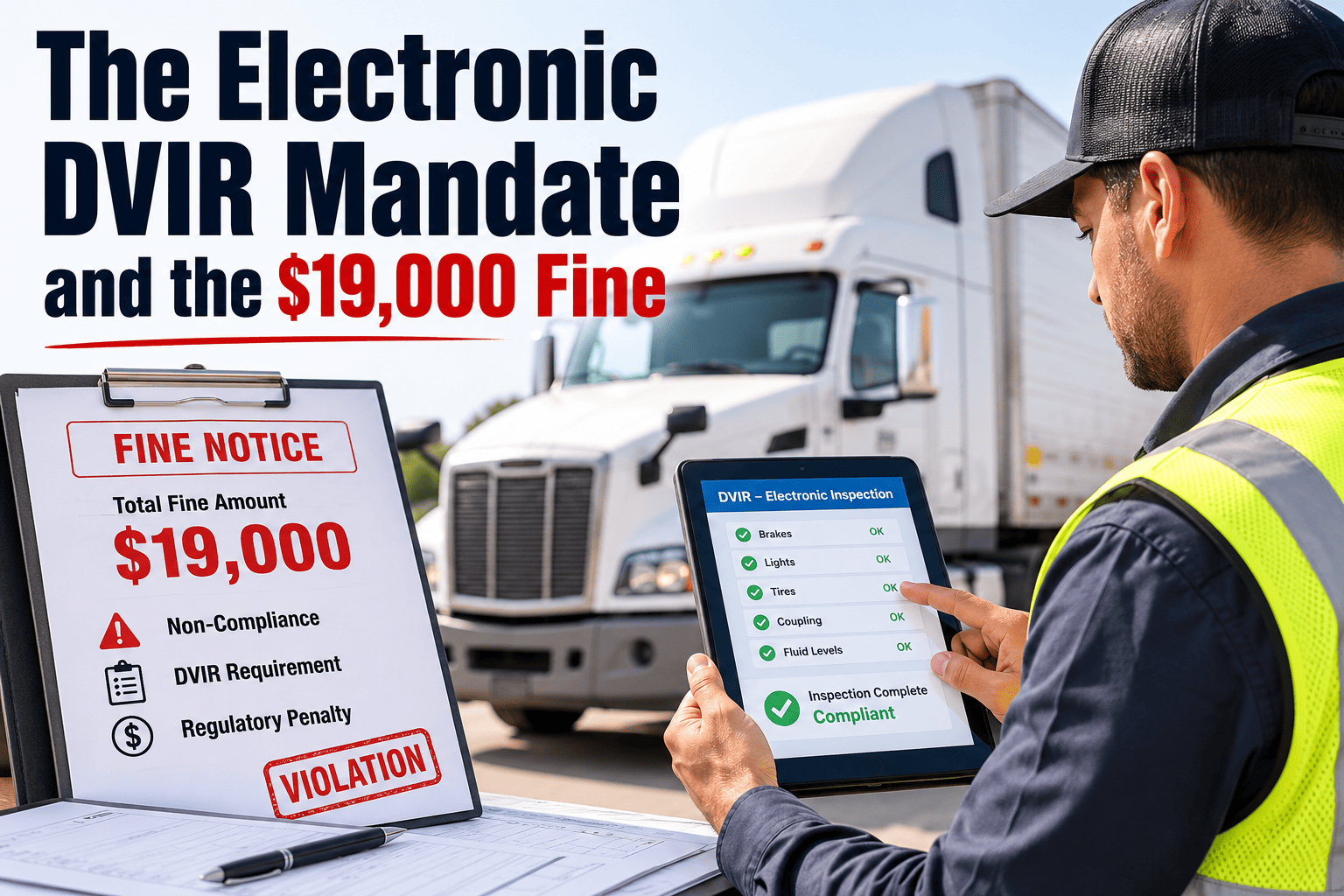
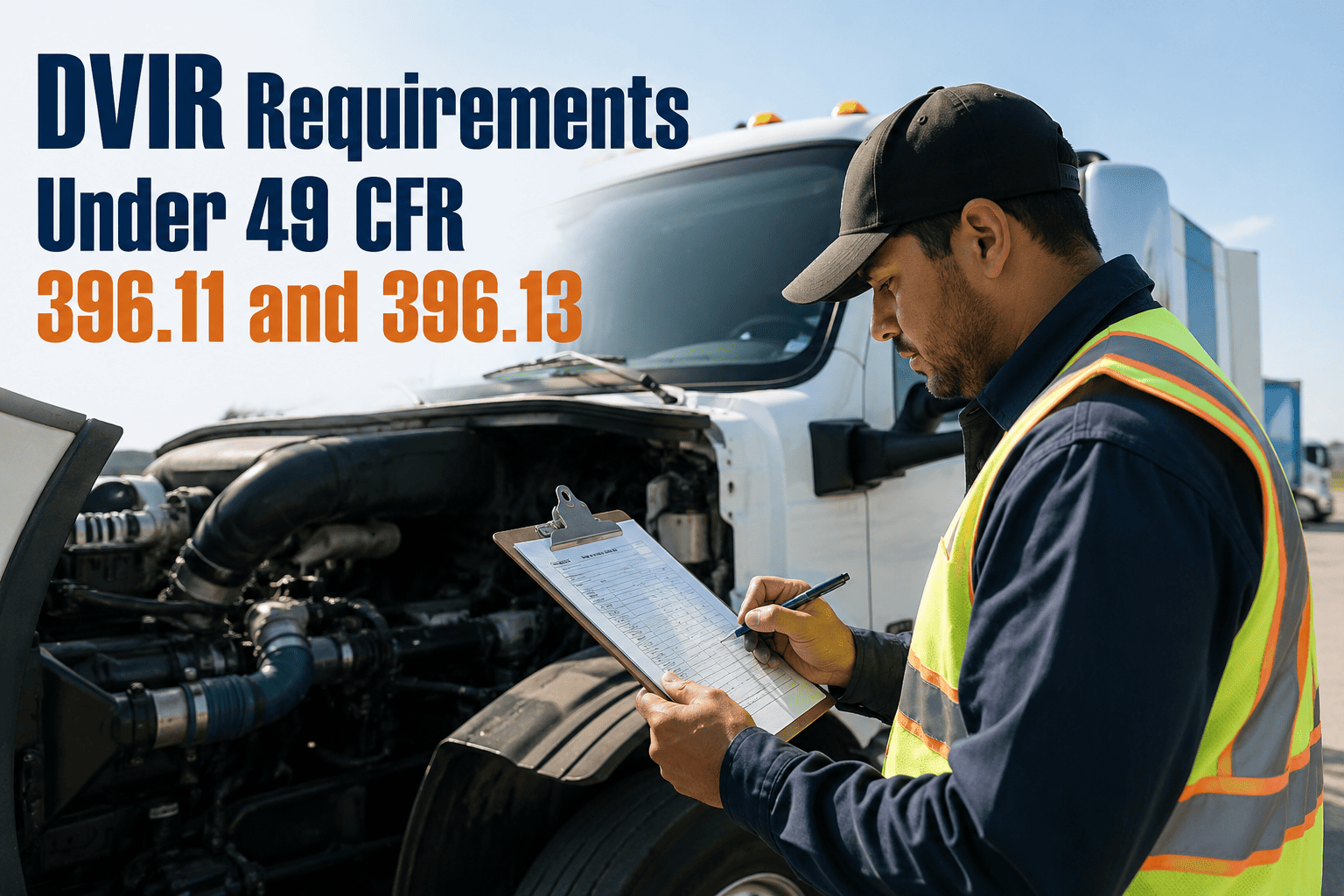
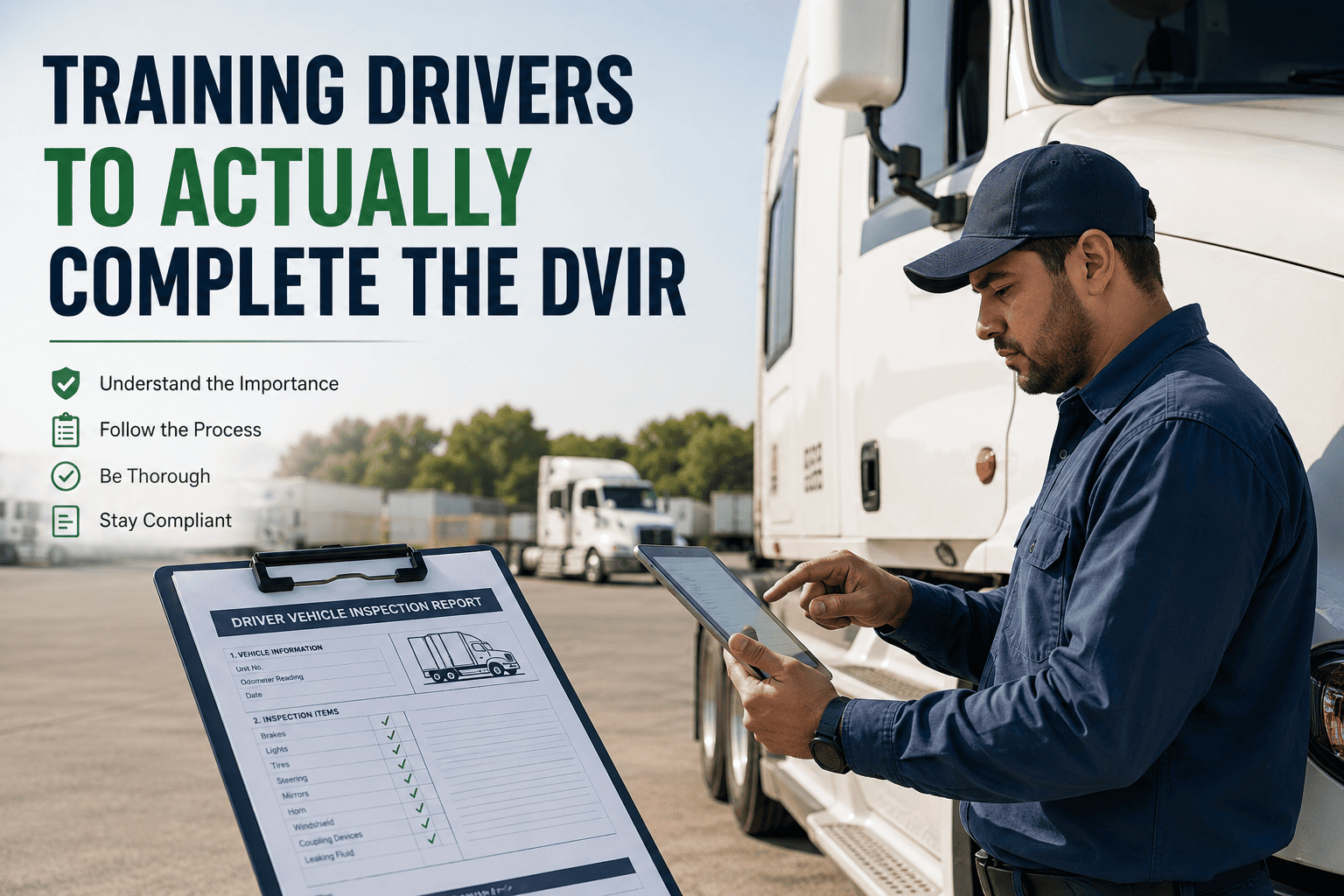
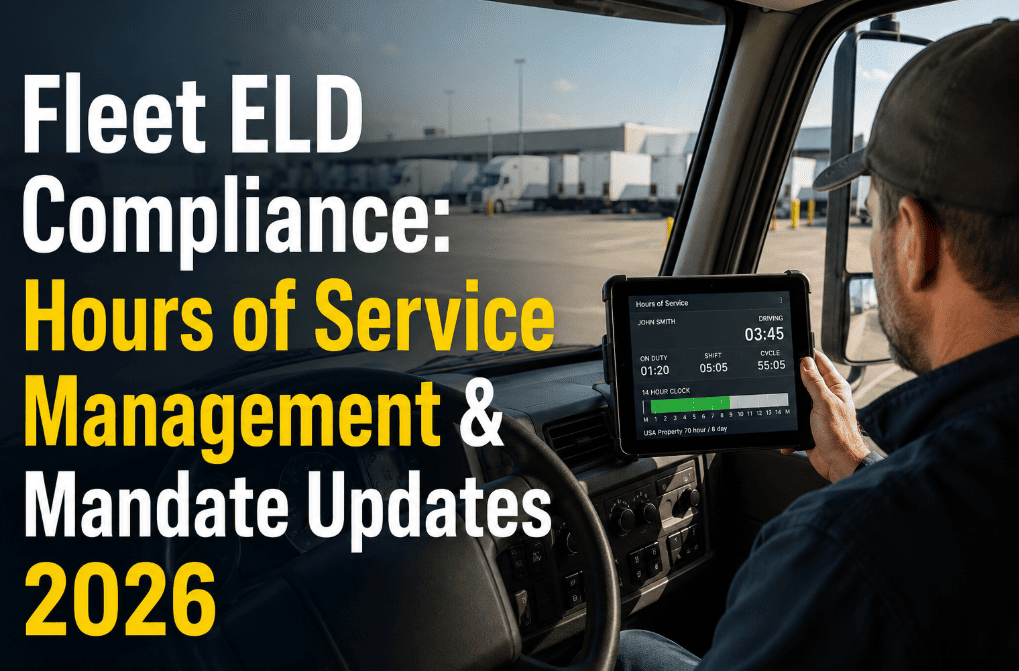
On February 19, 2026, FMCSA published Docket FMCSA-2025-0115 — a final rule that added a single clarifying sentence to 49 CFR 396.11 and 396.13, and quietly changed the economics of every paper DVIR still in operation. The rule did not outlaw paper. It did something more consequential — it made electronic the unambiguous compliance standard, so an illegible, missing, or timestamp-mismatched paper DVIR is now treated as an audit failure rather than an inconvenience. The 2026 civil penalty schedule caps willful DVIR falsification at $19,000 per violation, and enforcement has visibly intensified since the rule took effect on March 23. Move your fleet's paper DVIR workflow to a defensible digital chain with OxMaint's eDVIR module, or book a walkthrough to see the 2–4 week migration path.
2026 FMCSA CIVIL PENALTY SCHEDULE
$19,000
maximum civil penalty per occurrence for willful DVIR falsification under the Federal Civil Penalties Inflation Adjustment Act — applied when a driver marks "safe to operate" on a vehicle with a known out-of-service condition
Feb 19, 2026
Final rule published — Docket FMCSA-2025-0115 explicitly authorizes eDVIR under 396.11 & 396.13
Mar 23, 2026
Effective date — interpretive grey area gone, illegible paper now treated as missing document
400%
Rise in offsite audits with 48-hour digital-record demands — paper fleets cannot realistically respond
The 2026 eDVIR Rule in One Sentence — and Everything It Actually Means
The Federal Register text of Docket FMCSA-2025-0115 is short. Its operational consequences are not. FMCSA added a clarifying sentence stating that DVIRs may be created and maintained electronically per 49 CFR 390.32 — resolving nearly a decade of interpretive ambiguity that let cautious fleets stay on paper and gave defence attorneys leverage in litigation. Here is what the rule does, what it deliberately does not do, and what it clarifies. Book a walkthrough to see how OxMaint delivers every element in the "does" column.
Adds explicit electronic-authorization language to 49 CFR 396.11 and 396.13
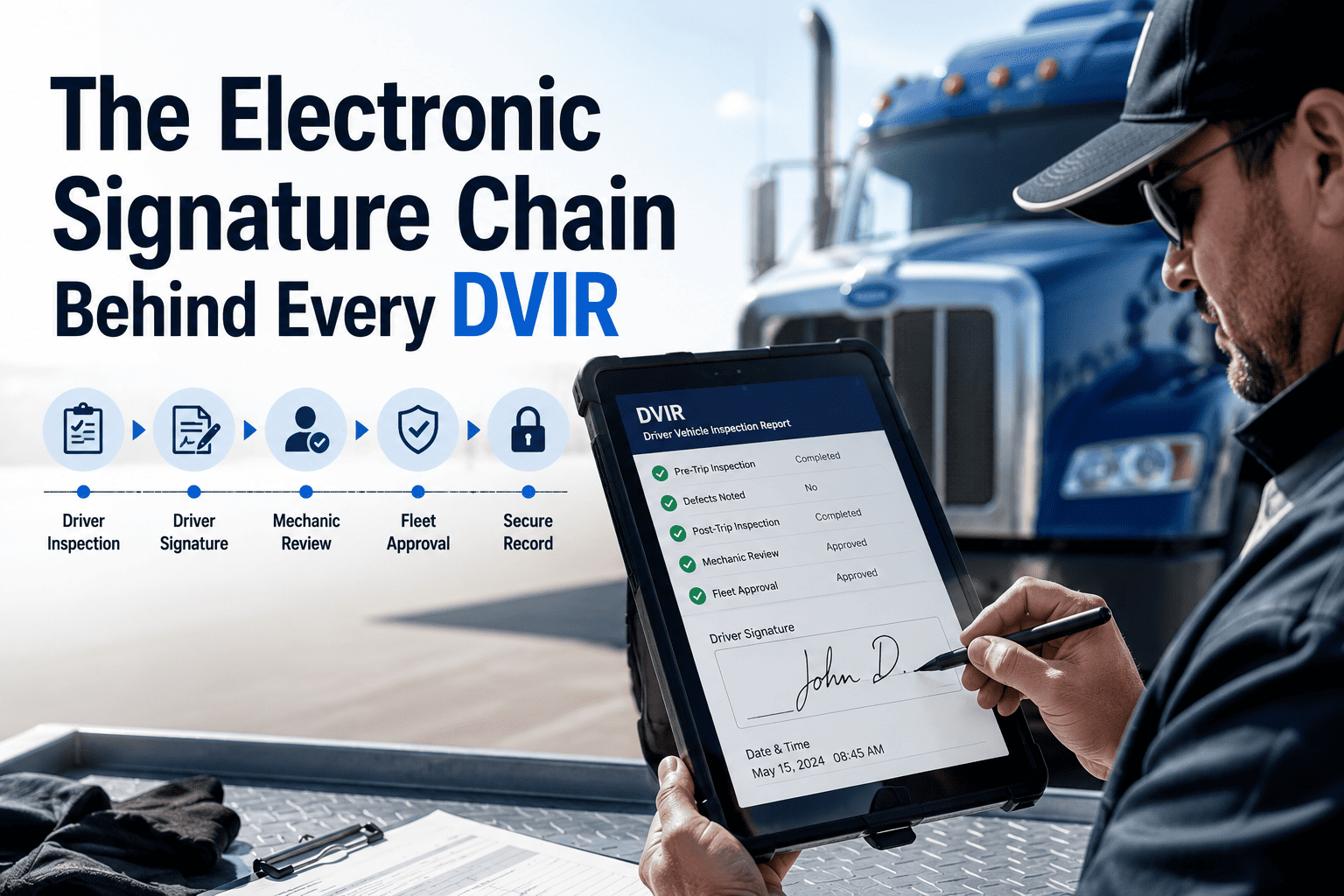
Confirms all three chain-of-custody signatures may be captured digitally with timestamp
Establishes E-SIGN Act compliant digital signatures as equal to wet ink in enforceability
Recognises cloud storage as satisfying the 90-day retention requirement under 390.32
Encourages carriers to switch to electronic, cost-saving inspection methods
02
What the Rule DOES NOT
Does not outlaw paper DVIRs — paper remains technically legal
Does not reinstate no-defect DVIR filing for property-carrying CMVs
Does not change the 11-component minimum inspection list under 396.11(a)(1)
Does not modify the 90-day record retention requirement
Does not exempt drivers from the three-signature chain of accountability
03
What the Rule CLARIFIES
Illegible, grease-stained, or rain-damaged paper is now treated as a missing document
Paper DVIR timestamps must synchronize with ELD data — mismatches auto-flagged at audit
All three signatures (driver, mechanic, next driver) can be captured on one device
Digital audit trail with signer identity, GPS, and device ID is legally superior to wet ink
FMCSA offsite audits will demand digital record production in 48 hours or less
Every Element in the "Does" Column — Built Into OxMaint's DVIR Module
E-SIGN Act compliant signatures. Three-signature chain enforced. 90-day cloud retention (we store indefinitely). 15-minute audit exports. Migration in 2 to 4 weeks.
How a $2,500 Base Fine Becomes a $19,000 Occurrence — The Escalation Math
The $19,000 figure is not arbitrary. It is a ceiling reached when a base civil penalty for falsification stacks with aggravating factors — a driver signing "safe to operate" on a vehicle with a known out-of-service condition, a supervisor who dispatched knowing the defect existed, or a pattern of falsification across multiple inspections. The 2026 penalty schedule is where FMCSA now sends its clearest signal: paper systems that allow this kind of falsification are the operational risk regulators intend to price out of the market.
BASE
$2,500
Base falsification penalty
Driver marks pass on an item not actually inspected — pencil-whipping. Applied per occurrence.
+
AGG 1
+$3,500
Known OOS condition
Driver signs "safe to operate" knowing the vehicle has a defect that would trigger out-of-service.
+
AGG 2
+$4,500
Willful dispatch
Carrier official knowingly dispatches the vehicle after the false certification — carrier liability attaches.
+
AGG 3
+$8,500
Pattern & safety impact
Auditor identifies a pattern of falsification, or the vehicle was involved in a safety event downstream.
=
MAXIMUM
$19,000
Per violation ceiling under the 2026 Federal Civil Penalties Inflation Adjustment Act — before criminal referral
The 3-minute inspection that costs $12,000
An investigator opens an ELD log and sees a driver logged on-duty at 6:00 AM. The truck registered movement at 6:03 AM. The paper DVIR shows a complete 11-component pre-trip inspection completed in that same window. FMCSA's position: it is physically impossible to inspect an 80,000-pound combination vehicle in three minutes. That timestamp mismatch is now automatically flagged during audit — and produced a real fleet a downgraded safety rating plus $12,000+ in fines. Electronic DVIRs with locked device timestamps make the mismatch impossible in the first place.
Six Paper-DVIR Failure Modes That the 2026 Rule Now Punishes as Missing Documents
Under the pre-2026 language, an auditor could give a fleet the benefit of the doubt on a grease-stained page or a signature that trailed off the form. That interpretive latitude is gone. The rule's explicit endorsement of electronic records changed the reference standard — and paper DVIRs that cannot meet a legibility, timestamp, or completeness bar are now cited exactly like missing records. These are the six failure modes that produce citations in nearly every offsite audit.
MODE 01
Illegible ink — grease, rain, coffee
A DVIR that a DOT officer cannot clearly read from three weeks ago is now treated as a "missing document" rather than a "poorly maintained document." One damaged page equals one citable violation per vehicle per day.
MODE 02
Timestamp mismatch with ELD
Driver logs 6:00 AM on-duty on the ELD. Paper DVIR claims a full pre-trip completed by 6:03 AM. FMCSA auto-flags any DVIR that finishes in under 10 minutes on a tractor-trailer — the physics do not support it.
MODE 03
Missing next-driver signature
Driver A logs the defect. Mechanic certifies the repair. Driver B is handed keys — but never signs acknowledgment. Paper breaks this chain silently every day. Digital dispatch is blocked until the acknowledgment lands.
MODE 04
Unverified mechanic sign-off
A scrawl in the shop by "some guy" no longer counts. Under the revised guidance, the repair signature must be linked to a verified maintenance provider identity — a digital signature with signer credentials is now the compliance floor.
MODE 05
Pencil-whipped checklist
Every one of the 11 items marked pass without evidence of inspection. Guided digital checklists with photo capture and per-item timestamps make fabricated inspections technologically impossible rather than merely discouraged by policy.
MODE 06
The 48-hour paper retrieval
FMCSA offsite audits arrive with a 48-hour demand to produce 90 days of DVIRs, repair certifications, and next-driver signatures for a random vehicle sample. Filing-cabinet paper cannot respond in the window. Missing records are automatic violations.
eDVIR Migration — OxMaint
Every Failure Mode Above Is a Design Feature of Paper. OxMaint's Digital Chain Eliminates All Six.
Guided 11-component checklists with photo capture, GPS-tagged timestamps, verified mechanic sign-off, three-signature enforcement, and cloud-stored records producible in under 15 minutes for a 90-day sample. Migration in 2 to 4 weeks; drivers use existing smartphones.
What DVIR Fine Exposure Actually Looks Like at Fleet Scale
A single DVIR violation is one number. A fleet's real exposure is a multiplication problem — every truck, every operating day, every category of failure. The table below models realistic exposure at four fleet sizes, assuming a moderate paper-DVIR failure rate seen in offsite audits (roughly 8% of records with a citable defect). Digital eDVIR fleets reduce exposure by more than 90% in every category.
10 vehicles
$12,700 – $19,000
Under $1,270
Over 92%
14-day setup
25 vehicles
$31,750 – $47,500
$1,270 – $2,540
Over 94%
2-week rollout
50 vehicles
$63,500 – $95,000
$2,540 – $5,080
Over 95%
3-week rollout
100 vehicles
$127,000 – $190,000
$5,080 – $10,160
Over 95%
4-week rollout
250 vehicles
$317,500 – $475,000
$12,700 – $25,400
Over 95%
4-week rollout
The 4-Week Paper-to-eDVIR Migration Path
Most fleets complete the paper-to-digital transition in 2 to 4 weeks — no hardware required, drivers use their existing smartphones, and audit-export testing is built into the final week. Below is the exact migration roadmap OxMaint uses for fleets moving to the 2026 eDVIR standard.
WEEK 01
Audit & Configure
Review the current paper workflow, map defects and repair categories, and configure OxMaint checklists to cover all 11 FMCSA components plus fleet-specific items. Import 90 days of historical DVIR data where available.
Output: Configured OxMaint tenant with fleet-specific inspection templates
WEEK 02
Defect Routing & Shop Integration
Set up defect-to-work-order routing rules, connect the maintenance shop workflow so mechanic sign-offs flow into the same DVIR record, and configure verified-identity credentials for repair certifiers.
Output: End-to-end defect-to-repair chain running in test mode
WEEK 03
Driver Rollout
Onboard drivers in 25-minute guided sessions on their existing smartphones. First DVIRs complete in under 5 minutes with photo capture, GPS tagging, and three-signature enforcement running live.
Output: Full fleet operating on eDVIR — paper decommissioned
WEEK 04
Audit-Export Testing & CSA Activation
Simulate a 48-hour FMCSA offsite audit — export 30 days of DVIRs with all three signatures for a random vehicle sample. Activate CSA "Driver Observed" dashboard so DVIR quality directly protects the safety score.
Output: Verified audit-ready fleet — every requirement of FMCSA-2025-0115 delivered
Frequently Asked Questions
Does the 2026 rule actually mandate electronic DVIRs, or is paper still legal?
Paper is technically still legal — the rule authorizes electronic explicitly rather than banning paper. Operationally, however, paper fleets face a measurable disadvantage: illegible or missing paper is cited as a missing document, and 48-hour offsite audit demands are difficult to meet from filing cabinets.
See OxMaint's eDVIR module.
When does the maximum $19,000 penalty actually apply?
The $19,000 ceiling applies to willful falsification of a DVIR — most commonly when a driver signs "safe to operate" on a vehicle with a known out-of-service condition, particularly when the carrier dispatches knowing about the defect. Aggravating factors include pattern falsification and downstream safety events.
Are electronic signatures legally binding for all three positions in the DVIR chain?
Yes. Under both FMCSA's 2026 rule and the federal E-SIGN Act of 2000, electronic signatures carry the same legal weight as handwritten ones. Digital signatures also typically provide stronger legal defensibility because they capture signer identity, GPS location, device ID, and a tamper-evident audit trail.
Book a demo to see the chain live.
How fast can a fleet realistically migrate from paper to electronic DVIRs?
Most fleets complete the paper-to-digital transition in 2 to 4 weeks. Week 1 audits the current workflow and configures templates. Week 2 sets up defect routing and shop integration. Weeks 3 and 4 roll out to drivers and test audit exports. Drivers use existing smartphones — no hardware purchase required.
Does the 2026 rule change the 11-component checklist or the 90-day retention?
No. The rule does not modify the 11-component minimum under 396.11(a)(1), the 90-day retention requirement, or the three-signature chain of accountability. It only clarifies that all of these can be satisfied digitally under 49 CFR 390.32 — including all three signatures and cloud storage.
FMCSA-2025-0115 Compliance — OxMaint
Stop Paying the $19,000 Ceiling. Start Running the Chain Digital.
OxMaint delivers every requirement of the 2026 eDVIR rule — E-SIGN Act signatures, three-signature enforcement, 90-day cloud retention (we store indefinitely), 15-minute audit exports, and full 396.11 and 396.13 compliance. Migration in 2–4 weeks with your existing smartphones.
96%
audit pass rate on digital
15 min
90-day audit export