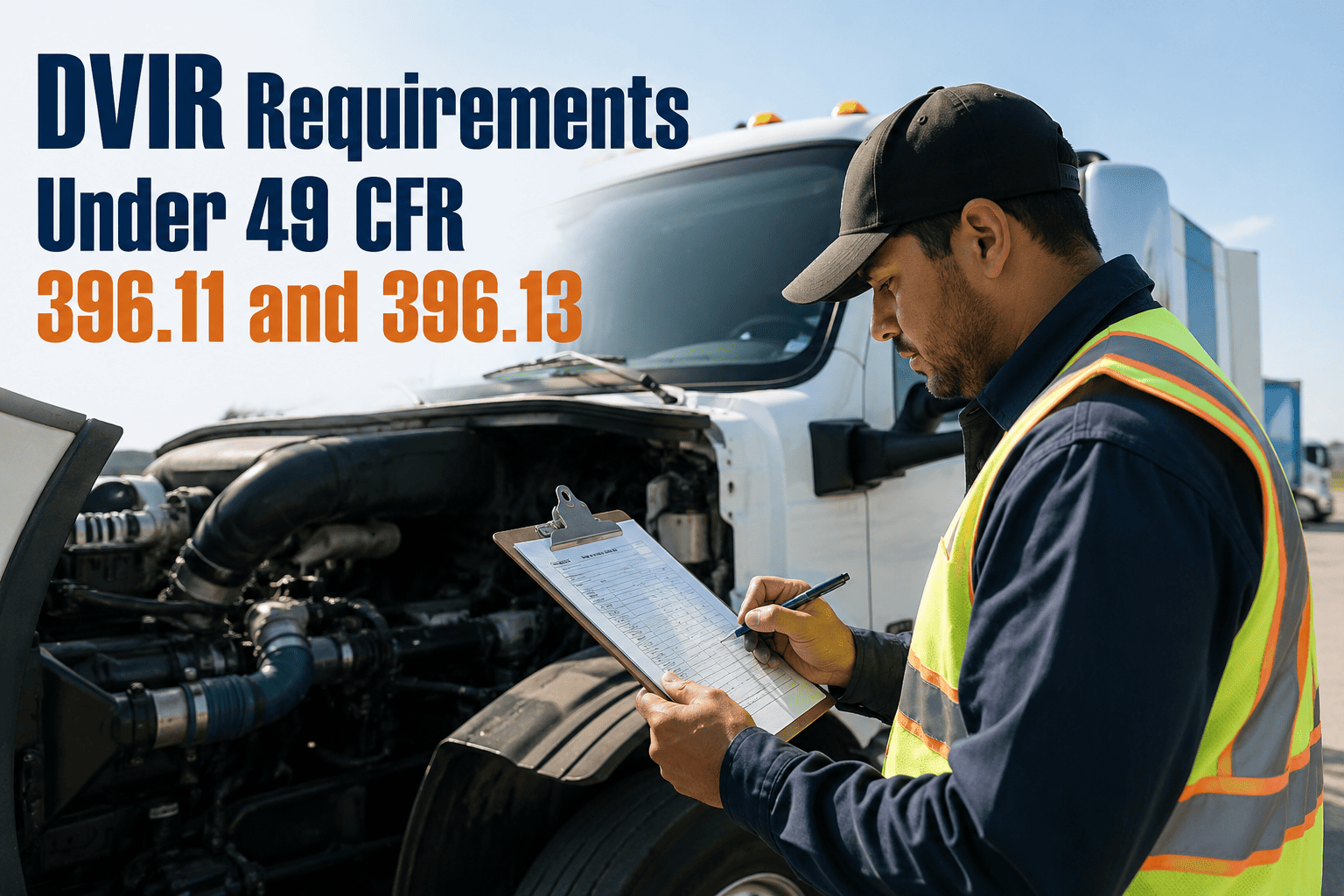
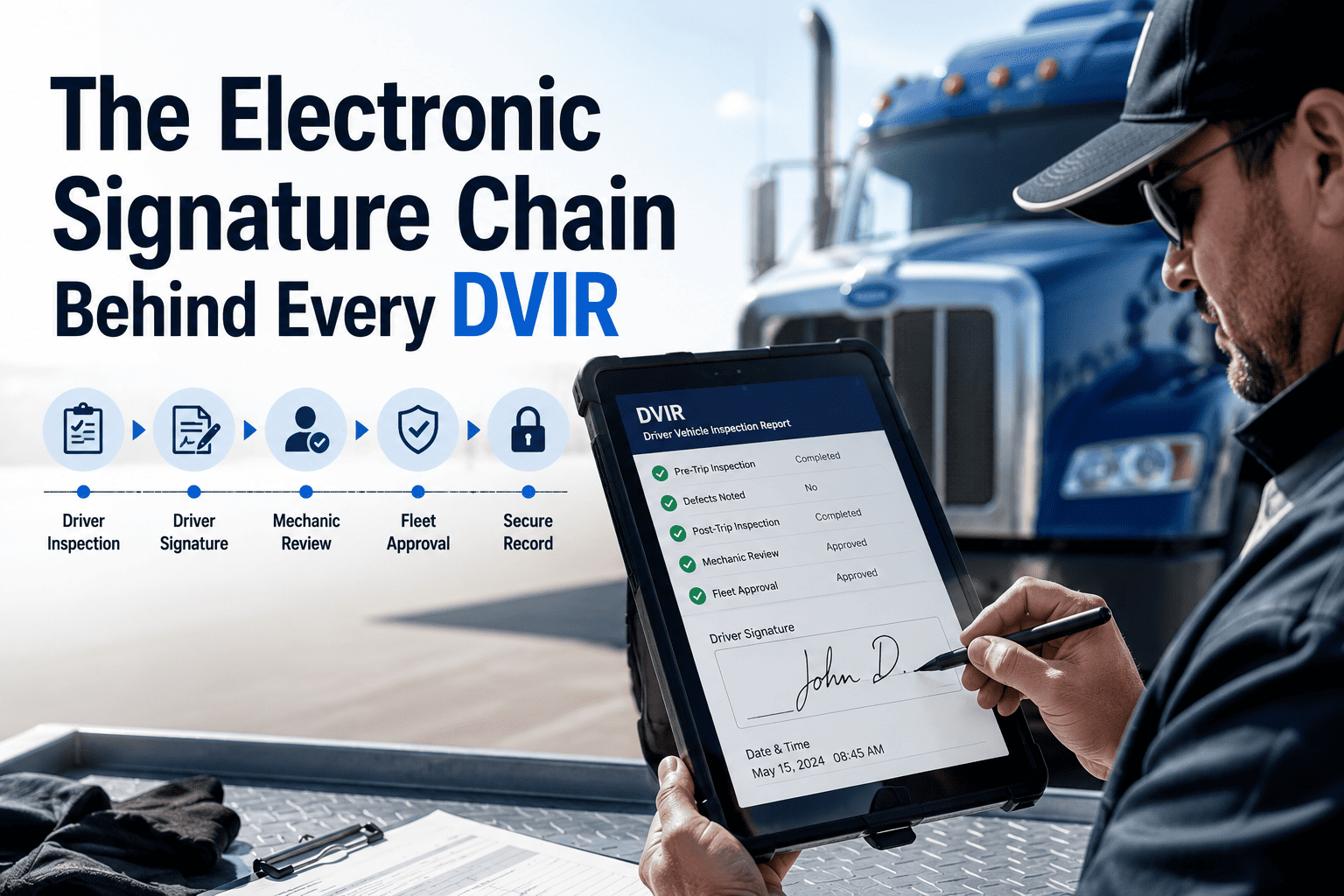
On an FMCSA compliance review, an auditor pulls three months of Driver Vehicle Inspection Reports for a random sample of vehicles and traces the three-signature chain on every DVIR that documented a defect. One missing signature — one driver who did not acknowledge the previous repair — is a citable violation under 49 CFR 396.11 or 396.13. DVIR findings appear in 89% of compliance reviews, and only 7% of carriers pass cleanly. After the FMCSA final rule effective March 23, 2026, the electronic DVIR that closes the chain automatically has become the operational baseline for every fleet under a DOT number. Run the complete three-signature chain digitally with OxMaint's DVIR module, or book a walkthrough to see audit-export live.
89%
of FMCSA compliance reviews audit DVIR records — the single most-cited document category in DOT reviews
$15,420
per-occurrence civil penalty for dispatching a vehicle with an unrepaired safety defect under 396.11
7%
of carriers pass focused compliance reviews without a single DVIR-related citation
The Three-Signature Chain of Custody — What 396.11 and 396.13 Actually Require
A DVIR is not one signature — it is three, arranged in a legally binding sequence that begins when a driver documents a defect and closes only when the next driver acknowledges the repair. Breaking any link is a separate citable violation under 49 CFR 396.11 or 396.13, and missing signatures are the number-one finding in DVIR audits. OxMaint's DVIR module enforces the three-signature chain digitally — dispatch is blocked until every signature is captured, so no link can be skipped.
01
Driver A — Reporting
End of day's work
Driver completes post-trip inspection across all 11 FMCSA component categories, documents any defect that affects safe operation or could cause a breakdown, and signs the DVIR with name, date, and timestamp.
49 CFR 396.11(a)
02
Mechanic / Carrier Official
Before next dispatch
Repairs the defect or certifies that repair is unnecessary for safe operation, and signs the original DVIR certifying the work. Without this signature the vehicle cannot lawfully be returned to service.
49 CFR 396.11(a)(3)
03
Driver B — Next Driver
Before operating vehicle
Reviews the most recent DVIR and the repair certification, then signs acknowledging the defect was addressed. This is the most commonly missed signature and the most common audit finding — because three people handle one document at three different times.
49 CFR 396.13
The audit trap that costs fleets a Conditional rating
An FMCSA investigator selects Truck #27 from a sample. Driver A logged "loud grinding when applying service brakes" on Feb 3. The mechanic certified new brake pads on Feb 4. Truck #27 dispatched to Driver C on Feb 5 — but Driver C's acknowledgment signature is blank. The loop was never closed. That is a 396.13 violation, filed the moment paper leaves a driver's hand and lands in a folder no one revisits.
Enforce the Three-Signature Chain Automatically — No Skipped Links
OxMaint blocks vehicle dispatch until every DVIR signature is captured. Driver → Mechanic → Next Driver, timestamped and audit-ready.
The 11 Components Every DVIR Must Cover Under 396.11(a)(1)
49 CFR 396.11(a)(1) specifies the minimum vehicle components that every DVIR must address — the same 11 categories that appear in the pre-trip inspection under 392.7, so drivers inspect the same items at both ends of a shift. A defect in any one that affects safe operation or could cause mechanical breakdown must be documented in writing. Your DVIR template must cover all 11 categories regardless of vehicle type or route.
01
Service Brakes — including trailer brake connections
04
Lighting Devices and Reflectors
Beyond the minimum 11
Many carriers add company-specific items on top — fluid levels, body damage, load securement, cargo-area condition, DEF level, and air conditioning. These additions are permitted as long as they never replace or dilute the federal 11.
What DVIR Violations Actually Cost — The 2026 Penalty Ladder
FMCSA updated its civil penalty schedule in late 2024 and enforcement has intensified since. A fleet of 50 trucks with systematic DVIR failures can face $63,500 or more in fines from a single audit — and each occurrence is a separate violation. The ladder below shows the real financial exposure for each failure category, from missing paperwork at the bottom to out-of-service orders at the top.
TIER 5
Operating Under Out-of-Service Order
The nuclear penalty — grounds an entire operation and triggers escalated audit frequency for 24 months
TIER 4
Dispatching a Vehicle With Unrepaired Safety Defect
Per occurrence — applies when Driver B is dispatched before the mechanic certification is on file
TIER 3
Falsified Inspection Report
Pencil-whipping — marking items pass without actually inspecting — carries criminal exposure in addition to civil fines
TIER 2
General DVIR Non-Compliance
Per-day civil penalty for continued non-compliance — including record incompleteness and template deficiencies
TIER 1
Missing DVIR / Failure to File
Per-day base penalty — the most common finding, applied per-vehicle-per-day the record cannot be produced
Paper DVIR vs Electronic DVIR — What Actually Changes at Audit
The February 19, 2026 FMCSA final rule (Docket FMCSA-2025-0115) explicitly authorized electronic DVIRs under 396.11 and 396.13, effective March 23, 2026. Paper remains legal — but the audit pass rate difference tells the operational story. 73% of paper DVIRs never reach the office intact; 96% of digital fleets pass a focused compliance review.
PAPER DVIR
73%
audit pass rate
Report time to office
2–5 days average
Signature enforcement
Manual — often skipped
Record retrieval speed
1–3 days per DVIR
48-hour audit response
Frequently impossible
Defect-to-work-order time
Days — or never
Storage cost per year
Filing, retrieval, loss
ELECTRONIC DVIR
96%
audit pass rate
Report time to office
Instant — on submit
Signature enforcement
Blocks dispatch until captured
Record retrieval speed
Under 15 minutes for 90 days
48-hour audit response
One-click export
Defect-to-work-order time
Auto-generated on submit
Storage cost per year
Cloud — indefinite
DVIR Module — OxMaint
Every Signature. Every Defect. Every Record. Audit-Ready in 15 Minutes.
OxMaint's DVIR module runs the full 49 CFR 396.11 and 396.13 chain digitally — guided 11-component checklists, photo-verified defects, timestamped three-signature enforcement, auto-routed work orders, and 90-day audit export in under a quarter of an hour.
The 2026 eDVIR Rule — How We Got Here, and What Changed on March 23
The regulatory path to explicit eDVIR authorization took nearly a decade. Electronic records were technically permitted under 49 CFR 390.32 since 2018 — but interpretive ambiguity in the paper-centric language of 396.11 and 396.13 meant different auditors treated digital DVIRs differently. The 2026 final rule resolved that in a single clarifying sentence added to both sections.
2018
Electronic records permitted under 390.32
FMCSA authorizes electronic creation and storage of required records. Digital DVIRs technically compliant — but some auditors continue to require wet-ink originals, creating interpretive risk.
Feb 19, 2026
Final rule published — Docket FMCSA-2025-0115
FMCSA publishes explicit eDVIR authorization language for both 396.11 and 396.13. Supported by ATA, OOIDA, and NTTC. FMCSA confirms it will NOT reinstate the no-defect DVIR requirement for property-carrying CMVs.
Mar 23, 2026
Rule effective — interpretive grey area gone
Electronic creation, maintenance, and signature of DVIRs is unambiguously compliant across all three positions in the signature chain. E-SIGN Act–compliant digital signatures carry the same legal weight as wet ink.
Now
Offsite audits up 400% with 48-hour notice
FMCSA compliance reviews now routinely arrive with a 48-hour demand to produce 90 days of DVIR records digitally. Paper-based fleets cannot realistically respond — creating a systemic audit gap the 2026 rule expects fleets to close.
The Three Failures That Break Fleets at Audit
Reviewing DOT compliance outcomes across property-carrying and passenger-carrying fleets, three failure patterns account for the overwhelming majority of DVIR violations. None of them involve drivers deliberately skipping the inspection — they are all system failures, not individual ones, and each one is addressable with structured process.
FAILURE 01
The broken chain — missing Driver B acknowledgment
#1 audit finding
Driver A reports the defect. Mechanic certifies the repair. But the DVIR sits in a folder and Driver B is handed keys without reviewing it — a separate citable violation under 396.13 for both the driver and the carrier. On paper, three people handle the same document at three different times, and the chain breaks silently every day. Digital enforcement blocks dispatch until Driver B's acknowledgment signature is captured.
FAILURE 02
Pencil-whipping — inspections that never happened
$12,700 per occurrence
95% of DVIRs report no defects — a rate that raises real questions about how carefully each post-trip is actually done. Marking every item "pass" without inspecting is falsification, carrying civil fines and criminal exposure. Guided digital checklists with photo requirements, GPS tagging, and per-item timestamping make fabricated inspections technologically impossible rather than merely discouraged by policy.
FAILURE 03
The 48-hour audit response fleets cannot make
400% rise in offsite audits
FMCSA offsite audits now arrive with a 48-hour demand to produce 90 days of DVIRs, repair certifications, and next-driver acknowledgments — for every vehicle in a sample. Paper fleets simply cannot respond in the window. Missing records are automatic violations. Digital DVIRs stored in cloud produce a full 90-day export in under 15 minutes with all three signatures documented per record.
Frequently Asked Questions
Are electronic DVIRs fully legal under 49 CFR 396.11 in 2026?
Yes — unambiguously. FMCSA Docket FMCSA-2025-0115, effective March 23, 2026, added explicit eDVIR authorization to both 396.11 and 396.13. Digital signatures, mobile submission, and cloud storage are fully compliant.
See OxMaint's eDVIR module.
How long must DVIR records be retained?
Minimum 90 days (three months) from the date the report was prepared, under 396.11(a)(4). This covers the original DVIR, the repair certification, and the next-driver acknowledgment — all three documents. Most safety-conscious fleets retain 12 months or more for litigation defense.
Do property-carrying fleets need to file a DVIR when no defects are found?
No — since the 2014 rescission, property-carrying CMVs are not required to file a DVIR on days with zero defects. However, most compliance experts recommend filing daily "no-defect" DVIRs as company policy for stronger audit and litigation defense. Passenger-carrying CMVs must file daily regardless.
Which components does 396.11(a)(1) require every DVIR to cover?
Eleven categories: service brakes (including trailer brake connections), parking brake, steering mechanism, lighting devices and reflectors, tires, horn, windshield wipers, rear vision mirrors, coupling devices, wheels and rims, and emergency equipment.
Book a walkthrough to see a compliant template.
What is the three-signature chain and why do so many fleets break it?
Driver A reports a defect, mechanic certifies the repair, next driver acknowledges before operating. All three signatures must be captured under 396.11 and 396.13. Paper breaks the chain because three people handle one document at three different times — missing signatures are the number-one DVIR audit finding.
DVIR Compliance Made Structural — OxMaint
Close the Chain. Pass the Audit. Move On With Your Day.
OxMaint enforces 49 CFR 396.11 and 396.13 digitally — guided 11-component checklists, photo defect capture, three-signature enforcement, auto-generated work orders, and audit-ready records exportable in under 15 minutes. Migration typically completes in 2–4 weeks; drivers use existing smartphones.
96%
digital audit pass rate
15 min
90-day audit export
2–4 wk
paper-to-digital migration